
Yes, several federal whistleblower retaliation laws protect employees who report wrongdoing, but the filing windows are short. OSHA administers more than 20 of these statutes, federal civil service employees have separate channels through the Office of Special Counsel (OSC) and the Merit Systems Protection Board (MSPB), and deadlines can run from 30 to 180 days. If you suspect retaliation, file now.
TL;DR:
- OSHA complaints under the OSH Act have a 30 day deadline, while many other statutes allow 180 days; equitable tolling is rare.
- Private sector claims usually start with OSHA; federal civil service employees use OSC and may reach MSPB after 120 days without relief.
- Good faith reports to supervisors, agency complaints, investigation cooperation, and some refusals of unlawful orders may be protected, even if the suspected violation is unproven.
- Retaliation can include exclusion from projects, sudden negative reviews, or a stripped down role, so log dates and decision makers alongside stated reasons.
- Save emails, messages, reviews, and witness details somewhere your employer cannot access, but do not copy classified or legally restricted material.
Table of Contents
- Which federal laws protect whistleblowers?
- OSHA statutes and the filing deadlines that matter
- What counts as protected activity and retaliation?
- How to file with OSHA, OSC, MSPB or the EEOC
- Remedies if a retaliation claim succeeds
- Why timing is the first thing to protect
- Practical steps: documenting, preserving and preparing for a lawyer
- State whistleblower laws beyond the federal statutes
- Public sector versus private sector protections
- Common barriers in retaliation claims
- Court decisions that shape whistleblower retaliation law
- How workplace policies and prevention programs affect retaliation
- Why we explain whistleblower rights plainly
- How we can help you prepare
- FAQ
- Sources
Which federal laws protect whistleblowers?
No single statute covers every disclosure. OSHA enforces more than 20 whistleblower laws that bar employers from taking adverse actions against people who report violations. Other laws sit with other agencies, so the first job is matching your disclosure to the right statute.
- OSHA-enforced statutes cover workplace safety, environmental protection, transportation, securities fraud, consumer products and more, including the Sarbanes–Oxley whistleblower statute for publicly traded companies.
- The Whistleblower Protection Act (WPA) covers many federal civil service employees, and the Congressional Research Service overview explains how OSC and MSPB handle those cases.
- The Taxpayer First Act addresses tax-related reports under 26 U.S.C. § 7623(d).
- Industry-specific laws, such as 15 U.S.C. § 2087 for consumer product safety, carry their own procedures.
Ask what your disclosure was about, then look for the statute that governs that subject.
OSHA statutes and the filing deadlines that matter
OSHA’s whistleblower program is where most private-sector employees start. Each law has its own clock, and the clocks differ sharply. Retaliation complaints under section 11© of the OSH Act must be filed within 30 days, while many other statutes allow 180 days.
- OSHA’s complaint portal is free to use and covers many claims.
- If you work in a State Plan state, OSHA may refer your case to the state agency. A dually filed complaint with state and federal OSHA may preserve federal review rights, though state windows and procedures can differ.
- Keep the date of the adverse action in front of you. The clock generally starts when the retaliatory action occurs, though the applicable rules depend on the statute.
Filing deadlines are strictly enforced and range from 30 days to 180 days or longer depending on the statute. Equitable tolling is a narrow exception, not a safety net, and missing a deadline often ends the claim.
What counts as protected activity and retaliation?
Protected activity is broader than most people expect. It includes reporting concerns to a supervisor, filing a complaint with an agency, cooperating with an investigation, and in some situations refusing an unlawful order. You do not have to be right about the underlying violation. A reasonable, good-faith belief is enough.
For federal employees, 5 U.S.C. § 2302(b)(8) protects disclosures of suspected law violations, gross mismanagement, waste, abuse of authority or dangers to public health. The EEOC applies a similar logic to retaliation under equal employment laws: any materially adverse action that could discourage reporting can qualify.
Retaliation includes:
- Firing, demotion, suspension or a pay cut
- Denial of a promotion or training
- Reassignment to a worse role or shift
- Exclusion from meetings or key projects
- Harassment or threats
The quiet forms count too. A string of sudden negative reviews after years of strong ones, a stripped-down job description, or being left off email threads you used to receive can all form the pattern a claim rests on.
How to file with OSHA, OSC, MSPB or the EEOC
Choosing the wrong route can cost you protections, so identify your category first. Most private-sector complaints go through OSHA’s portal. Federal civil service employees generally go to OSC, and some personnel actions can be appealed to MSPB. If OSC has not obtained relief within 120 days, you may be able to take the matter to MSPB directly in some cases. Retaliation tied to discrimination complaints may belong with the EEOC.
- Identify who employs you: private company, federal agency, state or local government.
- Match your disclosure to a statute and note its deadline.
- Gather your core facts: what you reported, to whom, when, and what happened afterward.
- File electronically through the agency’s portal, or by mail where the agency allows it.
- Where available, ask OSC to request a stay of a personnel action.
- Save confirmation numbers and keep a copy of everything you submit.
Pro Tip: If you are unsure which agency has jurisdiction, use OSHA’s complaint portal or contact OSC to determine where to file. Filing with the wrong agency can cost you protections, so seek guidance as soon as possible.
Remedies if a retaliation claim succeeds
Relief depends on the statute, but the goal is to put you back where you would have been without the retaliation. OSHA materials describe these common outcomes:
- Reinstatement to your job
- Back pay with interest
- Compensatory damages for harm such as lost earnings
- Other corrective actions ordered against the employer
Under many statutes OSHA can issue an administrative order, and either side may seek review before an administrative body or in the federal courts of appeals. Some laws also let you take the case to federal court if the agency does not resolve it in time. In federal employee cases, OSC can seek stays of personnel actions and pursue corrective or disciplinary action.
Why timing is the first thing to protect
Filing deadlines are important, and missing one can affect a claim. Deadlines commonly run between 30 and 180 days, and agencies enforce them. Equitable tolling means a deadline may be extended in exceptional circumstances, such as when an employer actively misled you. Nobody should plan around it.
Equitable tolling is a limited exception and not a guarantee, so treat the deadline as final.
- Time-stamp and save emails, texts and notes today.
- File a short complaint now if you are unsure about jurisdiction.
- Write down the date of each adverse action while the details are fresh.
- Raise tolling only if truly exceptional circumstances apply.
Practical steps: documenting, preserving and preparing for a lawyer
Evidence made at the time events happen carries the most weight. Agency FAQs stress that contemporaneous documentation, from before and after retaliation begins, is crucial. Our guide on documenting a hostile work environment walks through the same habits.
- Record your disclosure: who you told, when, how, and what you said.
- Preserve emails, messages, performance reviews and policies, and keep copies somewhere your employer cannot reach.
- List witnesses and what each saw or heard.
- Log each adverse action with its date, the decision-maker and the stated reason.
- Compare the timeline of your disclosure and the adverse actions.
- Prepare questions for an attorney: Which statute applies? What are my deadlines? Which agency should I file with? Where are the evidence gaps? What remedies are realistic?
Pro Tip: Never copy classified or legally restricted material to build your file. The OSC urges consulting an attorney experienced in whistleblower law before or immediately upon making a disclosure, and using secure channels such as an Inspector General or OSC for sensitive information.
State whistleblower laws beyond the federal statutes
Federal protections are not the full picture. State rules may also apply, and their coverage depends on the state and the circumstances. Check your state labor department’s website or consult an attorney about possible state-law claims.
State rules may differ on who is covered, which disclosures qualify, and how to file. Check your state labor department’s guidance or consult an attorney about the applicable procedures and deadlines. In State Plan states, OSHA retaliation complaints can involve both state and federal agencies, as noted above.
Because the details vary, check your state labor department’s website and our employee rights overview to see how state rules fit alongside federal ones. Whether a state claim can run alongside a federal claim depends on the applicable rules. Ask a lawyer which routes may be open to you.
Public sector versus private sector protections
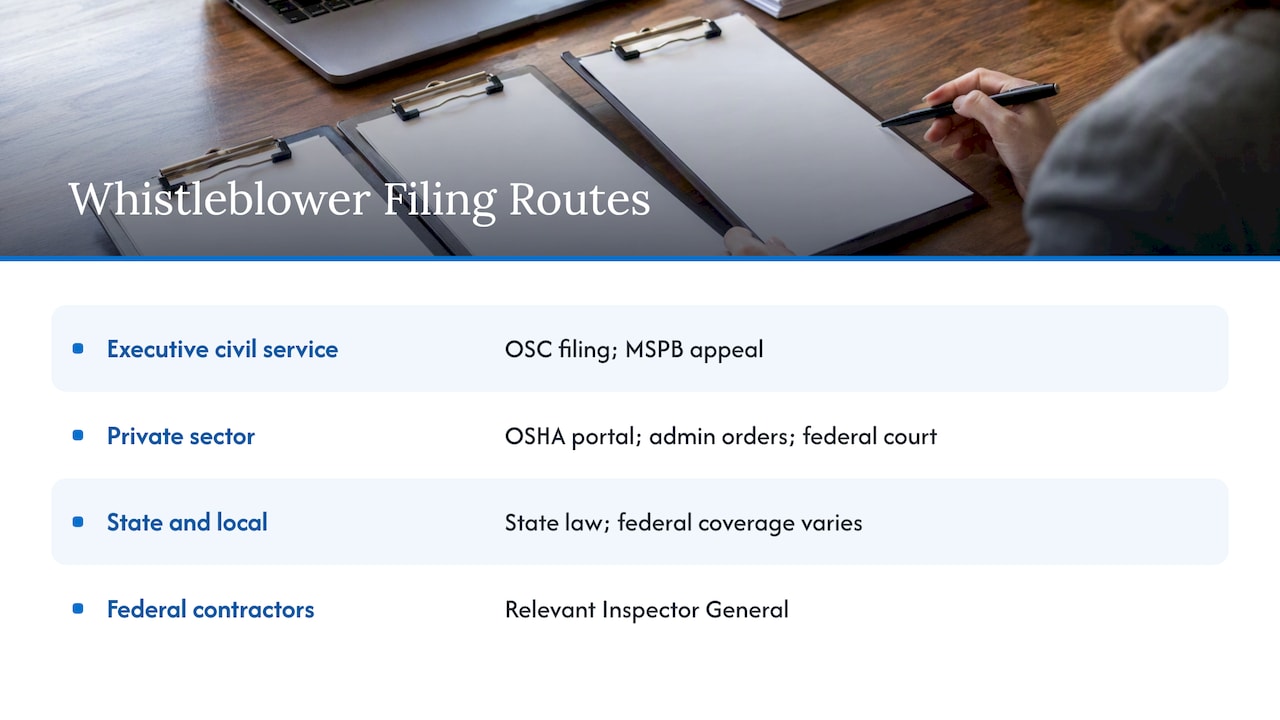
Who your employer is shapes everything: your statute, your agency and your appeal route. Most executive branch civil service employees fall under the WPA and its enhancement act. They file with OSC and can appeal to MSPB, and some personnel can ask OSC for stays. Certain groups are excluded, including some intelligence personnel, who use separate channels.
Private-sector employees rely on the patchwork of statutes OSHA administers, plus state law. Their first stop is usually OSHA’s portal, with administrative orders and federal court review as later steps.
State and local government employees may have protections under state law, and coverage under federal laws depends on the subject and the applicable statute. Federal contractors may also contact the relevant Inspector General, which offers a different path than OSC or OSHA.
The practical takeaway is simple. Identify your category before you file, because a complaint sent to the wrong place can burn time you do not have.
Common barriers in retaliation claims
Even strong claims run into obstacles, and knowing them early helps.
- Missed deadlines. Short windows and confusion about which statute applies are the top reasons claims fail.
- Proving the link. You must connect your protected activity to the adverse action. Employers often point to performance or restructuring as the real reason.
- Thin documentation. Without dates, messages and witnesses, your account stands alone.
- Wrong forum. Filing with the wrong agency can forfeit protections.
- Mishandled sensitive material. Taking restricted records or going public too soon can complicate your protections.
- Fear and isolation. Many employees delay filing because they worry about their reputation or their next job.
Subtle retaliation is hardest to prove because no single act looks dramatic. A pattern after your report, such as a sudden shift in treatment, is often what makes the case. Keeping a dated log, filing on time and getting legal advice early address most of these barriers.
Court decisions that shape whistleblower retaliation law
Courts keep refining what the statutes mean, so we point readers to primary sources and a lawyer rather than treating any one ruling as settled. We do not summarize specific case holdings here because outcomes turn on the statute, the circuit and the facts.
The questions that most often reach the courts are consistent. What does it mean to hold a reasonable belief that a law was violated? How closely must the protected activity be tied to the adverse action? Which employees and contractors count as covered? What remedies can a court award beyond what an agency can order?
OSHA’s own guidance explains that aggrieved parties may seek review of administrative orders in the federal courts of appeals, so appellate decisions steer how agencies handle later complaints. The Congressional Research Service overview of the WPA is a good place to see how statutory changes and case law interact.
An attorney can tell you which decisions currently control in your circuit and whether a recent ruling helps or hurts your claim. That check belongs on your attorney question list from the section above.
How workplace policies and prevention programs affect retaliation
A written policy does not decide your rights, but it can shape your case. If your employer has an internal reporting channel, using it may create a dated record of your disclosure. Some whistleblower protections cover internal reporting. Check which law applies to your situation.
Policies cannot take away protections the law grants. NDAs or employer rules that try to bar protected whistleblowing are often unenforceable for federal employees, as with the anti-gag provision at 5 U.S.C. § 2302(b)(13).
Strong prevention programs usually include several features:
- Multiple reporting channels, including options that bypass the manager involved
- Clear anti-retaliation language that supervisors are trained on
- Prompt, documented follow-up on every report
- Monitoring of the reporter’s treatment after a complaint
If your employer lacks these, it matters little to your legal rights, but it can make your documentation even more important. Our workplace surveillance rights and workplace privacy pages cover related issues when monitoring is part of the story.
Why we explain whistleblower rights plainly
The people who most need this information usually find it in the middle of a crisis, with a deadline already running. We think the right response is clear language, direct links to the agencies that actually accept complaints, and honest limits: we do not provide legal representation, but we can point you to resources and attorney directories. A guide that buries the 30-day window under legal jargon fails the reader. Deadlines, forum choice and evidence are the three things that decide most cases, and they are the ones most often missed. Plain explanation is not a shortcut. It is how workers keep rights they already have.
— Max
How we can help you prepare

If you are preparing to file or to talk with a lawyer, our free guides, attorney directory and checklists are a practical place to start. Our Membership, from $25 per year, gives you ongoing access to plain-language resources and links to agency portals. Start with the guide that matches your situation, collect your timeline, and file before your window closes.
This article is general information, not a substitute for advice from a qualified lawyer. Consult a qualified legal professional about your own circumstances before acting on anything here.
FAQ
Who enforces whistleblower retaliation laws in the U.S.?
It depends on who employs you. OSHA enforces more than 20 statutes covering most private-sector workers, while OSC and MSPB handle many federal civil service cases. The OSHA complaint portal is the usual starting point for private-sector claims.
What deadlines apply to whistleblower retaliation complaints?
Deadlines vary by statute and are strictly enforced. They range from 30 days to 180 days or longer, so file as soon as possible and do not count on an extension.
Do I have to be right about the wrongdoing to be protected?
No. A reasonable, good-faith belief that a violation occurred is generally enough. Agency guidance also stresses keeping records from before and after retaliation begins.
Can an NDA stop me from blowing the whistle?
Often not. Where federal law protects the disclosure, contractual gag attempts are frequently unenforceable. Check your situation with an attorney before relying on that.
What can I recover if my claim succeeds?
Remedies can include reinstatement, back pay with interest and compensation for damages. OSHA materials describe administrative orders and review in the federal courts of appeals.
Sources
- Osha
- Osha
- OSHA Online Whistleblower Complaint Form | Occupational Safety and Health Administration
- Retaliation Protection by Subject | Whistleblower Protection Program