
Straight time is what you earn for each hour at your regular rate. Overtime is what the law requires on top of that once you pass a threshold. Under federal law, covered nonexempt employees generally must receive at least 1.5 times their regular rate for hours worked over 40 in a fixed workweek, according to the U.S. Department of Labor. Paying you the same rate for hour 45 as for hour 5 is not overtime pay at all. We wrote this guide so you can read your own paycheck and know which one you received.
TL;DR
- Straight time is your regular hourly rate for hours worked, before any overtime premium is added.
- Federal overtime is 1.5 times your regular rate for hours over 40 in a workweek, if you are a covered, nonexempt employee.
- Federal law looks at the week, not the day. Some states, California among them, also require overtime for long days.
- A salary does not by itself cancel overtime. Your job duties and pay level decide whether you are exempt.
- Your regular rate can be higher than your base wage once bonuses and similar pay are counted.
Table of Contents
- What straight time means
- What overtime means
- Overtime vs. straight time at a glance
- How to calculate your overtime step by step
- Why your regular rate may be higher than your base wage
- Daily overtime vs. weekly overtime
- Does a salary mean no overtime?
- Is overtime taxed at a higher rate?
- Common ways overtime goes wrong
- If you think you were shorted
- Our perspective
- Keep this resource free for every worker
- FAQ
- Sources
What straight time means
Straight time is pay at your normal rate with no premium attached. The Department of Labor’s overtime calculator glossary describes it as your earnings before the overtime premium is calculated. If you earn $18 an hour and work 30 hours, you are paid 30 hours of straight time: $540.
Straight time is not a legal limit on how much you can work. The Department of Labor says the Fair Labor Standards Act (FLSA), the main federal wage law, places no cap on weekly hours for employees age 16 or older. The law cares about how those hours are paid.
People also use the phrase “straight time” in a second, less welcome way: “I get straight time for overtime.” That means an employer pays the ordinary rate for hours beyond 40. For a covered nonexempt employee, that is generally not enough. We come back to this below.
What overtime means
Overtime is the extra pay owed for hours past a legal threshold. The federal threshold is 40 hours in a workweek. The premium is at least one and a half times your regular rate, which is why people call it “time and a half.” The two terms describe the same federal requirement, and “time and a half” is the usual rate. Some state rules, as you will see, add double time.
Two details matter more than most workers expect.
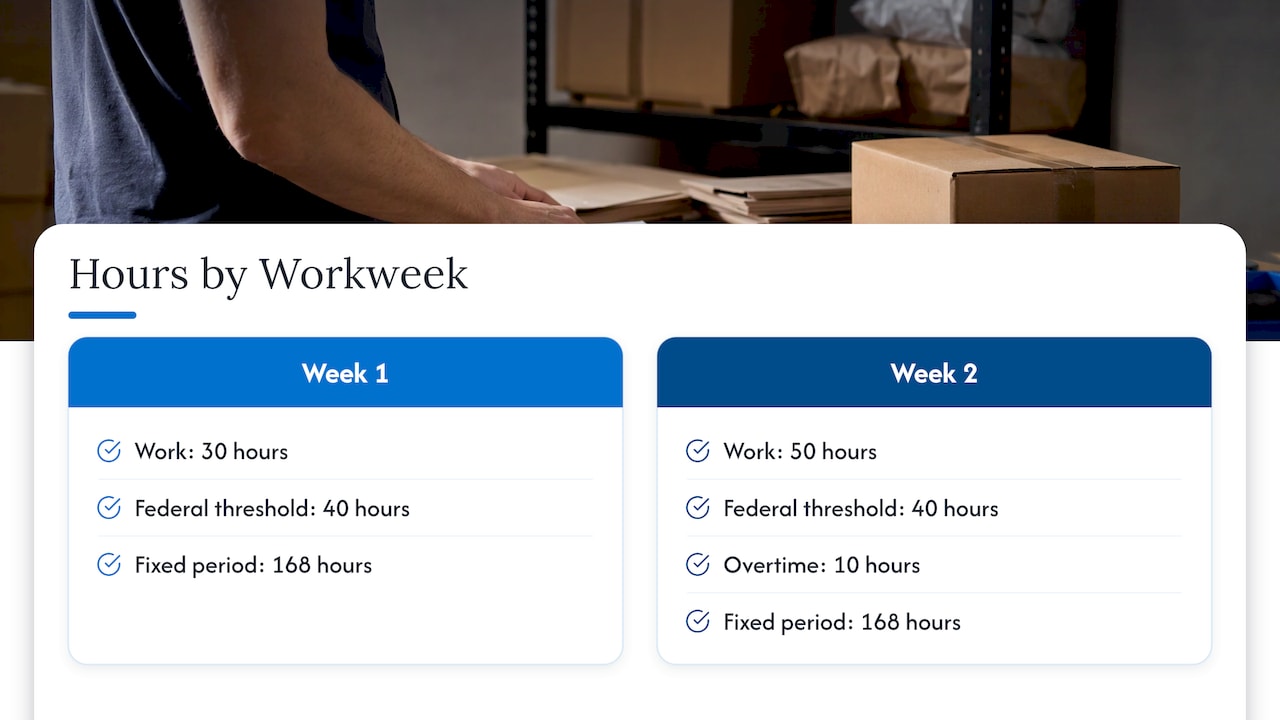
The workweek is fixed. The Department of Labor’s Fact Sheet #23 defines a workweek as a fixed, recurring period of 168 hours, which is seven consecutive 24-hour periods. It can start on any day and at any hour. Your employer picks it, and it need not be Monday through Sunday. Hours do not average out across two weeks: 30 hours in one week and 50 in the next still means 10 overtime hours in the second.
Weekends and holidays do not trigger overtime on their own. The same fact sheet says federal law does not require a premium just because you worked a Saturday, Sunday, holiday or regular day off. The premium is owed only when you exceed the overtime threshold. Your employer may offer premiums for those days by policy or contract, and some state laws add their own rules.
Overtime vs. straight time at a glance
| Straight time | Overtime | |
|---|---|---|
| Rate | Your regular rate | At least 1.5 times your regular rate (federal) |
| When it applies | Hours up to the threshold | Hours over 40 in a workweek (federal); over daily limits in some states |
| Source of the rule | Your agreed pay | FLSA and state law |
| Counts toward the 40 hours | Yes | Not applicable |
| Example at $18/hour | $18 | $27 |
How to calculate your overtime step by step
The math is simple once you know what goes in it.
- Add up hours worked in your fixed workweek. Count all hours you worked, including time you were required to be on duty. Off-the-clock work counts too, and proving it takes records.
- Find your regular rate. The Department of Labor’s Fact Sheet #56A says to divide the week’s total compensation, apart from certain statutory exclusions, by the total hours worked that week.
- Subtract 40 hours to find your overtime hours.
- Multiply overtime hours by 1.5 times your regular rate, and add straight-time pay for the first 40 hours.
Worked example, hourly worker. You earn $18 an hour and work 45 hours in one workweek.
- Straight time for 40 hours: 40 × $18 = $720
- Overtime for 5 hours: 5 × $27 = $135
- Total: $855
There is a second way to see the same result. Pay all 45 hours at straight time ($810), then add the extra half-rate premium for the 5 overtime hours (5 × $9 = $45). The total is again $855. This is the formula the U.S. Office of Personnel Management uses in its guidance for federal employees, which combines straight-time pay for all hours with an extra half of the regular rate for overtime hours. It also notes special rules for federal workers.
When the premium is only the “half”
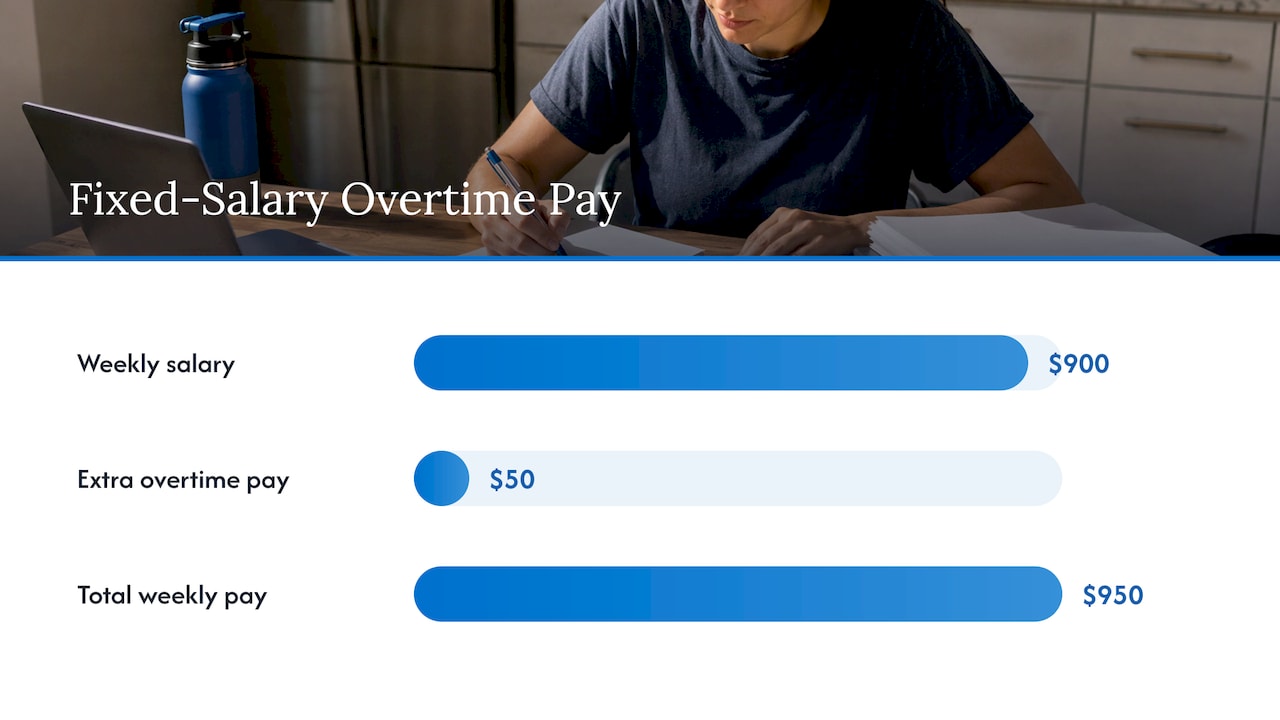
Some salaried nonexempt employees are paid a fixed salary meant to cover a fixed schedule longer than 40 hours. Fact Sheet #23 explains that in this case the extra overtime pay is one-half the regular rate for each overtime hour, because the salary already covers the straight-time portion of those hours.
Worked example, fixed salary. You are paid $900 a week for a set 45-hour schedule. Your regular rate is $900 ÷ 45 = $20. The salary already pays $20 for each of the 5 hours over 40, so the additional owed is 5 × $10 = $50, for a total of $950.
This is where “I get straight time for overtime” can be correct or incorrect. If your salary was truly meant to cover all your hours, and you still receive the extra half-rate for hours over 40, that is how the rule works. If you receive nothing beyond your normal pay and you are a nonexempt employee, you may be owed the difference.
Why your regular rate may be higher than your base wage
Your regular rate is not always the number on your offer letter. Under Fact Sheet #56A, compensation such as certain bonuses and commissions can be included in the regular rate, which raises the overtime rate even when your base wage is unchanged. Fact Sheet #23 adds that piece-rate, salary and commission earnings still require overtime calculated from the average hourly rate derived from that week’s earnings.
If you receive a production bonus, a shift differential or a commission, compare your overtime hourly figure with a calculation that includes them. An overtime rate that looks exactly like your base wage times 1.5 may be too low.
Another point: an agreement to count only 8 hours a day or 40 hours a week as working time does not satisfy the FLSA, according to the research summarized in Fact Sheet #23. Hours worked are hours worked, whatever a side agreement says.
Daily overtime vs. weekly overtime
Federal law uses a weekly test. If you work 12 hours on Monday and 28 hours the rest of the week, you have 40 hours total and no federal overtime, even though one day was long.
Some states layer on a daily test. California is the clearest example. The state’s Division of Labor Standards Enforcement says that, generally, covered nonexempt workers receive 1.5 times their regular rate for daily hours over eight up to 12, and for the first eight hours on a seventh consecutive workday. It also says daily overtime can be owed even when weekly hours do not exceed 40, because the daily and weekly thresholds are independent.
Worked example, California. You earn $20 an hour and work 10 hours on one day.
- First 8 hours: 8 × $20 = $160
- Next 2 hours at 1.5 times: 2 × $30 = $60
- Total for the day: $220
A handful of other states have their own daily or other special overtime rules, and many follow the federal weekly test only. Rules also differ by industry and occupation. Where the state and federal rules differ, you are generally entitled to the rule more favorable to you, so check your state labor department’s overtime page for the rules that apply to your job.
| Federal (FLSA) | California (generally) | |
|---|---|---|
| Weekly test | Over 40 hours in the workweek | Over 40 hours in the workweek |
| Daily test | None | Over 8 hours in a day |
| Seventh consecutive day | No special premium | First 8 hours at 1.5 times |
| Daily test applies without 40 weekly hours | No | Yes |
Does a salary mean no overtime?
No. Being paid a salary does not decide your status. What decides it is whether you are exempt or nonexempt: whether your duties and pay level meet the exemption tests. A salaried worker who does not meet them can be entitled to overtime like an hourly worker. Our guide to exempt vs. nonexempt classification explains the tests, and our pages on the federal salary threshold and the 2026 salary numbers cover the pay-level side, which has been revised and contested in recent years. Check them for the current figure rather than relying on an older number.
Is overtime taxed at a higher rate?
No special tax rate applies to overtime. It is part of your income, taxed at the same rates as the rest of your pay. What changes is withholding. A larger paycheck can cause your employer’s payroll system to withhold more tax from that one check, so your overtime can feel as though it was taxed harder. Your actual tax for the year is settled when you file your return, and any excess withholding is refunded. Your tax preparer or the IRS can answer questions about your own withholding.
Common ways overtime goes wrong
- Straight time for overtime hours. You are nonexempt and receive your normal rate for hours over 40.
- Comp time swaps. A private employer offers time off instead of overtime pay. Compensatory time for public agency employees is its own category with its own rules, and it does not generally apply in private jobs.
- Rounding. Minutes trimmed from each punch add up. See our explainer on time clock rounding.
- Off-the-clock work. Pre-shift setup, post-shift cleanup and answering messages at home. Our guide to unpaid overtime lists what to track.
- Misclassification. You are labeled exempt but your duties and pay do not fit.
If you think you were shorted
Start with records. Write down your workweek start day, your daily hours, your pay rate and every bonus. Keep pay stubs and schedules. Then compare what you were paid to the calculation above. Our step-by-step overtime claim guide walks through filing, and our labor worker rights and overtime guide gives the wider picture. If the amount is large or your employer retaliates, speak with an employment attorney, or contact the Department of Labor’s Wage and Hour Division or your state labor agency.
Our perspective
Overtime confusion usually starts with vocabulary. “Straight time,” “time and a half,” “regular rate,” “workweek”: each term has a precise meaning, and employers who use them loosely can leave workers underpaid without anyone noticing.
We founded this organization in 1994 to connect the knowledge of employment rights attorneys with the people who need it. That is why we write in plain language and show the arithmetic. A worker who can calculate 45 hours at $18 on a napkin is a worker who can recognize a short paycheck.
We believe equitable workplaces are built when every employee understands the rules that protect them. Learn the rule, keep your records, and use the process available to you.
Max
Keep this resource free for every worker
Our guides on overtime, classification and claims are free to read. Membership starts at $25 per year, and it supports the plain-language information that helps workers check their own pay. You can become a member here.

FAQ
Is straight time the same as overtime?
No. Straight time is your regular rate for ordinary hours. Overtime is the premium pay owed for hours past the threshold, at least 1.5 times your regular rate under federal law for covered nonexempt employees. Some salaried arrangements owe only the extra half-rate for overtime hours, because the salary already covers the straight-time part.
Is time and a half the same as overtime pay?
Usually, yes. Time and a half is the standard federal overtime rate. Some state rules require double time in certain situations, such as long days in California, so the rate can be higher than 1.5 times.
Does federal law require daily overtime?
No. The federal test is hours over 40 in a fixed workweek, not hours in a day. Some states, including California, add daily rules, so your state’s law may give you more than the federal minimum.
Do weekends or holidays count as overtime?
Not by themselves under federal law. Fact Sheet #23 says a premium is not required just for weekend, holiday or rest-day work unless you exceed the overtime threshold. Your contract, employer policy or state law may provide more.
Can my employer pay me straight time for overtime hours?
If you are a covered nonexempt employee paid hourly, generally not. You are owed the premium for hours over 40. If you are salaried, the answer depends on whether you are exempt and how your salary was set, so check your classification first.
Sources
- Overtime Pay, U.S. Department of Labor
- FLSA Overtime Calculator Advisor glossary, U.S. Department of Labor
- Fact Sheet #23: Overtime Pay Requirements of the FLSA
- Fact Sheet #56A: Overview of the Regular Rate of Pay
- Overtime FAQ, California Division of Labor Standards Enforcement
- How to Compute FLSA Overtime Pay, U.S. Office of Personnel Management