A non-disparagement clause stops one or both parties from making negative public statements about the other, and in the United States it cannot override certain protected rights. Federal law still lets you file a charge with the EEOC, engage in protected concerted activity under the NLRA, and, since the Speak Out Act of 2022, avoid being bound by a predispute clause in sexual harassment or assault disputes.
TL;DR:
- Federal law prohibits non-disparagement clauses from blocking reports to the EEOC, protected concerted activity, or allegations of sexual harassment or assault under the Speak Out Act.
- The enforceability of these clauses depends on precise wording, with narrow scope, clear carve-outs, and defined durations reducing legal risks.
- Overbroad clauses that lack carve-outs or cover social media, private conversations, or indefinite timeframes are more likely to be challenged or unenforceable.
- Employees should negotiate for explicit exceptions to report misconduct and discuss working conditions, especially when penalties are severe or clauses are lengthy.
- Assistance from legal professionals is recommended if a clause restricts protected rights, and ongoing access to employee rights resources helps in understanding evolving workplace protections.
Table of Contents
- What a non-disparagement clause is and where it appears
- Examples and short sample clause language
- U.S. enforceability: federal limits and agency positions
- Red flags, carve-outs, and what to ask for before signing
- If your employer tries to enforce a non-disparagement clause
- Workplace Fairness’ approach to employee rights education
- What employees get wrong about non-disparagement clauses
- How Workplace Fairness can support you after signing
- FAQ
- Sources
What a non-disparagement clause is and where it appears
A non-disparagement clause is a contract provision barring negative statements about the other party, and it shows up most often in employment agreements, severance packages, and settlement agreements that resolve a workplace dispute. According to Cornell’s Wex, these clauses commonly appear in all three contexts and vary widely in how they are written.
Some clauses are unilateral, binding only the employee, while others are mutual, restricting both the employee and the employer equally. Employers favor them because they protect brand reputation, reduce the risk of public disputes following a termination, and give both sides an incentive to part on calmer terms.
The catch is that “disparage” has no fixed legal definition, so the clause’s own wording does the real work. A few patterns to watch for:
- Vague terms like “any negative statement” invite broad interpretation.
- Clauses covering social media, interviews, and private conversations extend reach far beyond a formal reference check.
- Mutual clauses are generally fairer than one-sided versions, since they bind the employer too.
Examples and short sample clause language
Reading actual clause language helps you spot problems before you sign. Here are two short, representative examples, annotated for what to notice.
- Unilateral example: “Employee agrees not to make any statement, written or oral, that disparages the Company, its officers, or its products, except as required by law or in response to a lawful government inquiry.” The carve-out at the end is doing the real protective work here.
- Mutual example: “Neither party shall make disparaging remarks about the other, provided that nothing in this clause restricts truthful testimony in a legal proceeding or communications with a government agency.” This version binds the employer equally and names two specific exceptions.
- Overbroad red flag: “Employee shall never discuss the circumstances of their employment with any third party.” No carve-outs, no time limit, and no distinction between true and false statements. Language this broad often runs into the enforceability limits described below.
The difference between a clause you can live with and one that should worry you usually come down to precision: narrow scope, explicit carve-outs, and a defined duration.
U.S. enforceability: federal limits and agency positions
Non-disparagement clauses are not absolute, and several federal sources draw clear lines around what they can and cannot restrict. The Speak Out Act, signed into law in December 2022, makes predispute nondisclosure and non-disparagement clauses judicially unenforceable in disputes involving sexual assault or sexual harassment. That means a clause signed before a dispute arises cannot be used to silence someone once a sexual harassment or assault claim surfaces, though it leaves employers’ ability to protect trade secrets untouched.
The Speak Out Act applies specifically to predispute clauses tied to sexual assault and sexual harassment disputes, narrowing one of the most commonly abused uses of non-disparagement language in settlement agreements.
Two federal agencies add further constraints:
- The EEOC’s guidance states that no contract can lawfully bar someone from filing a charge or participating in an EEOC investigation; waivers that attempt this are invalid.
- The NLRB treats overbroad non-disparagement language as a potential violation of Section 7 of the NLRA when it chills employees’ right to discuss wages, conditions, or workplace concerns with coworkers.
- Enforcement history, including NLRB positions in cases like D.R. Horton and Murphy Oil, shows agencies will strike down contract terms that prevent employees from acting collectively.
State law adds another layer. Some states have passed their own restrictions on nondisclosure and non-disparagement provisions in harassment and discrimination settlements, so the federal floor described here is not the ceiling everywhere. An employee weighing a clause should check whether their state has gone further than the Speak Out Act or EEOC guidance already requires.
Red flags, carve-outs, and what to ask for before signing
Before signing anything with a non-disparagement clause, read it the way you would read fine print on a loan: slowly, and with an eye for what is missing. A few warning signs mean the clause deserves a second look:
- Vague scope with no definition of what counts as disparagement.
- No carve-out for government reporting, agency investigations, or truthful testimony.
- Indefinite duration with no end date.
- Harsh or undefined penalties for a violation.
If you have room to negotiate, ask for carve-outs that preserve your core rights: the ability to file an EEOC charge or report to a government agency, the ability to give truthful testimony under oath, permission to discuss your employment history with prospective employers, a defined time limit, and, where possible, a mutual clause rather than a one-sided one.
Pro Tip: Ask the other side to add “except as protected by law” to any non-disparagement clause. It is a short phrase that preserves a wide range of rights without renegotiating the whole agreement.
When the clause covers a severance or settlement tied to a harassment or discrimination claim, or when the sanctions for violation are financially significant, it is worth having an employment attorney review the language before you sign.
If your employer tries to enforce a non-disparagement clause
Enforcement attempts to happen, and how you respond in the first few days matters.
- Preserve every relevant communication, including e-mails, texts, and notes from conversations, along with the names of anyone who witnessed the dispute.
- Document the context of the statement you made and why you believe it falls under a protected activity or a carve-out.
- If the clause appears to block a report to a government agency, you can still file an EEOC charge; agencies generally treat such waivers as unenforceable against public policy.
- If the issue involves discussing wages or working conditions with coworkers, consider raising it with the NLRB as protected concerted activity.
- Consult an employment attorney before responding to a cease-and-desist letter or demand for damages.
Workplace Fairness’ approach to employee rights education
An organization providing free guides and an attorney directory was founded in 1994 to offer plain-language answers about employee rights, helping people understand situations like this before consulting a lawyer, though case-specific questions still require individual legal advice.
What employees get wrong about non-disparagement clauses
The biggest misreading of non-disparagement clauses is treating them as absolute. They are not. Federal protections already carve out space for EEOC charges, NLRB-protected activity, and, since the Speak Out Act, predispute sexual harassment and assault disputes, regardless of what the written clause says.
The conventional advice, “just don’t sign anything with a non-disparagement clause,” misses the point. Most employees cannot avoid these clauses entirely, and a well-drafted mutual clause with clear carve-outs protects both sides without costing you much; see this non-compete agreement template for Australian contracts for examples of careful drafting in employment clauses. The real work is in the wording: a narrow, time-limited clause with explicit exceptions is a reasonable trade in a severance negotiation, while an open-ended, undefined one is a sign that something else in the agreement may deserve scrutiny too.
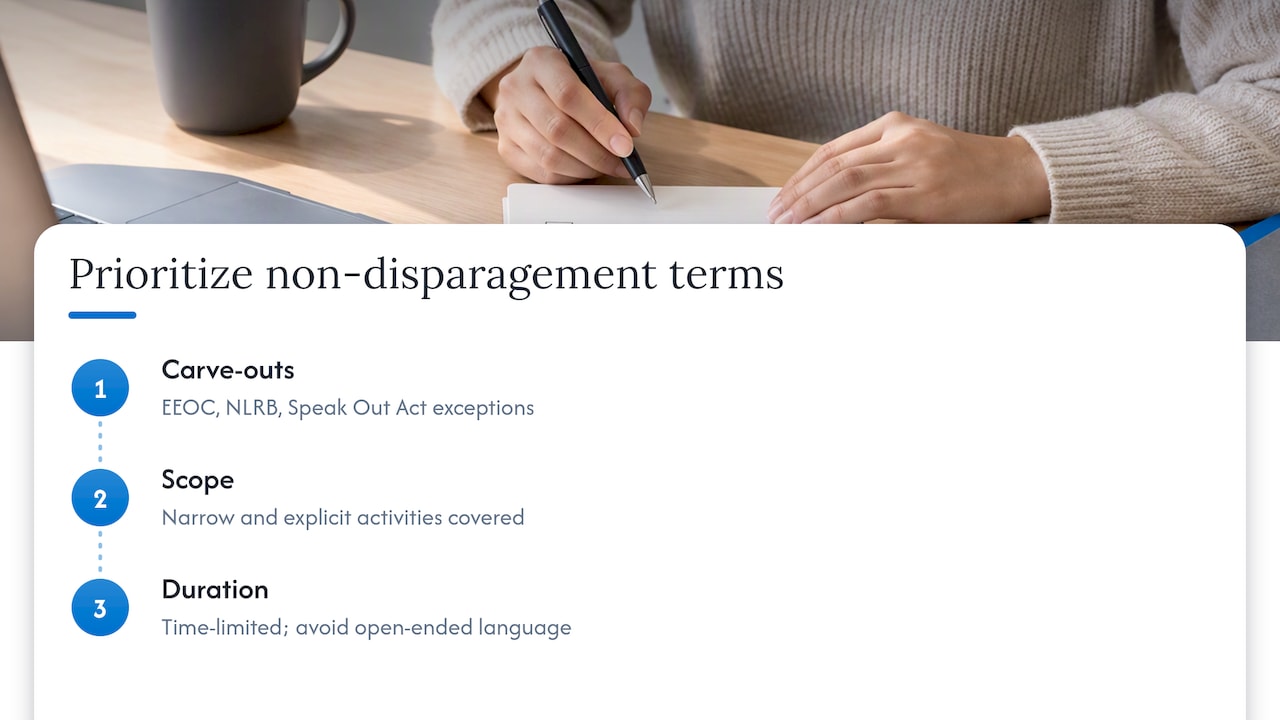
Readers should prioritize the carve-outs first, the scope second, and the duration third. Everything else in the clause tends to follow from how those three elements are written.
— Max
How Workplace Fairness can support you after signing
Understanding a clause is the first step, and ongoing access to current employee-rights information is the next one. Workplace Fairness offers a membership starting at $25 per year for readers who want continued access to guides and resources as workplace law evolves.
- Review our guide on filing an EEOC charge if you believe a clause is being used to block a legitimate complaint.
- Learn more about protected concerted activity if your dispute involves discussing pay or conditions with coworkers.
- Consider membership for ongoing access to plain-language employee rights resources.
This article is general information, not a substitute for advice from a qualified lawyer. Consult a qualified legal professional about your own circumstances before acting on anything here.
FAQ
How enforceable are non-disparagement clauses?
Non-disparagement clauses are generally enforceable, but federal law limits them in specific situations. They cannot be used to bar someone from filing an EEOC charge or engaging in NLRA-protected concerted activity, and predispute clauses tied to sexual harassment or assault disputes are not judicially enforceable under the Speak Out Act.
Is a non-disparagement clause a red flag?
Not on its own. A clause with clear, narrow language and carve-outs for government reporting and truthful testimony is a routine part of many severance and settlement agreements, but one with vague scope, no carve-outs, or indefinite duration deserves closer review before signing.
Is it disparagement if it is true?
Disparagement clauses typically target negative statements regardless of truth, which is different from defamation law, where truth is a defense. That said, carve-outs for truthful testimony in legal proceedings are common and often specifically protected, so the clause’s own wording determines whether truthful statements outside a legal proceeding are covered.
What is an example of a non-disparagement clause?
A typical clause reads something like “Employee agrees not to make disparaging statements about the Company, except as required by law or in a government investigation.” The exact language varies by agreement, and the carve-outs included matter as much as the restriction itself, as described in Cornell’s Wex entry on the topic.
Sources
- Law
- Public Law 117–224 (Speak Out Act)
- Enforcement guidance: Non-waivable employee rights under EEOC-enforced statutes – EEOC
- Protected concerted activity – NLRB