
A last chance agreement is a voluntary contract that gives an employee one final opportunity to correct conduct or performance in exchange for meeting set conditions. It can be lawful, but an employer cannot make you waive your right to file a discrimination charge or take part in an EEOC investigation, and any clause that tries is void. Do not sign before getting union or legal review.
TL;DR:
- An agreement should define measurable violations, monitoring, consequences, and a 6 to 12 month end date; open ended terms invite perpetual scrutiny.
- Any clause barring an EEOC charge or participation in an investigation is void, and demanding that waiver may constitute illegal retaliation.
- If an age discrimination waiver applies to an employee age 40 or older, it must allow 21 days for review and seven days to revoke.
- Keep copies of the agreement and document how the employer applies it; inconsistent enforcement or missing promised monitoring may help challenge termination.
Table of Contents
- What a last chance agreement is and how it works
- When employers typically offer last chance agreements
- Key elements every enforceable last chance agreement should include
- Legal limits: waivers, non-waivable rights, and EEOC rules
- How arbitrators and courts handle last chance agreements
- Unionized workplaces and collective bargaining
- If you are offered an LCA: a step-by-step checklist
- Practical sample clauses and red flags
- What happens if you fail to comply, beyond termination
- How LCAs differ from progressive discipline and other agreements
- How employers should document and implement LCAs fairly
- Employee rights and protections during negotiation or refusal
- Our perspective on last chance agreements
- Where we can help: guides, attorney directory, and membership
- FAQ
- Sources
What a last chance agreement is and how it works
An LCA is a formal, voluntary agreement between an employer and an employee, often with a union involved, that offers a final opportunity to fix misconduct or performance problems and keep the job. EEOC materials describe it as a contract, and they note that the ADA does not require an employer to offer one. Whether to offer an LCA is the employer’s choice.
Think of it as a negotiated alternative to firing. Instead of an automatic termination, the employer holds the termination in reserve and sets terms under which you can stay. If you meet the terms, you keep working. If you break them, the employer can act on the agreement, often without the usual just-cause inquiry. That is why it differs from severance, which pays you to leave, and from ordinary discipline, which follows the steps in a handbook or contract.
Most LCAs share the same building blocks:
- An offer: the employer proposes to keep you on instead of terminating.
- Consideration: you receive something of value, usually continued employment.
- Voluntariness: you sign freely, with a real chance to consult a representative or lawyer.
- Specific conditions: the conduct, attendance or performance standards you must meet.
- Monitoring: a defined way the employer checks your compliance, such as supervisor reviews or testing.
Because an LCA is a contract, its exact words control. A vague or one-sided agreement can cost you protections you would otherwise have, so the details matter more than the label.
When employers typically offer last chance agreements
Employers tend to reach for an LCA when termination is already on the table and they see a reason to try one more step. Practitioner coverage from labor arbitrators and the Job Accommodation Network points to a familiar set of triggers:
- Attendance problems, such as repeated unexcused absences or tardiness.
- Policy violations that would normally justify discharge.
- Substance-related incidents, including relapse after treatment.
- Safety breaches on the job.
- Repeated performance shortfalls after earlier warnings.
The employer’s motives are usually practical. It may want to keep an experienced worker, limit the cost and risk of a grievance or lawsuit, and create a documented final opportunity. Arbitrators often see an LCA as a pragmatic compromise that keeps a dispute from escalating.
That does not mean every offer is fair. Be cautious if any of these show up:
- The offer arrives suddenly, with no prior documentation of the problem.
- The allegations are vague or undated.
- You are pressured to sign on the spot.
- You are told you cannot talk to a union representative or a lawyer.
A genuine LCA grows out of a record. If the paper trail is thin, ask why. The answer can tell you whether the employer has a strong case or is using the agreement to avoid proving one.
Key elements every enforceable last chance agreement should include
Arbitrators look hard at what an LCA actually says. Labor arbitrators disapprove of agreements with no stated duration, and they favor clear terms that both sides understood. When you review or negotiate one, check for these:
- Specific, measurable conditions. The agreement should define what counts as a breach, such as repeated unexcused absences, not “any unacceptable behavior.”
- A finite timeframe. A defined end point, commonly 6 to 12 months, avoids perpetual heightened scrutiny and supports enforceability.
- Clear consequences tied to named violations. You should know exactly what triggers termination and what does not.
- Monitoring and support provisions. Look for testing schedules, counseling, supervisor check-ins or access to an employee assistance program where relevant.
- Consideration and voluntariness. The text should show what you receive in return and state that you signed freely and had the chance to consult counsel or a union representative.
- Written notice and a chance to respond. Ideally the employer must tell you in writing about an alleged breach before acting.
Pro Tip: Ask the employer to attach an example of conduct that would and would not count as a breach. A concrete illustration removes the ambiguity that later causes most disputes.
Legal limits: waivers, non-waivable rights, and EEOC rules
The firmest line in this area comes from the EEOC. Under its enforcement guidance on non-waivable employee rights, an agreement that requires you to give up the right to file a charge or take part in an EEOC investigation is null and void, and demanding it may amount to illegal retaliation. An LCA can set conduct standards, but it cannot strip these protections.
Any agreement that requires an employee to waive the right to file a charge or participate in an EEOC investigation is null and void and may amount to illegal retaliation.
This is not only theory. In 2013 an employer settled an EEOC retaliation lawsuit after requiring employees to sign agreements that barred them from filing discrimination charges.
BASF Corporation agreed to pay $500,000 to settle the EEOC suit over last chance agreements that barred discrimination charges, showing that overbroad waiver language carries real enforcement risk.
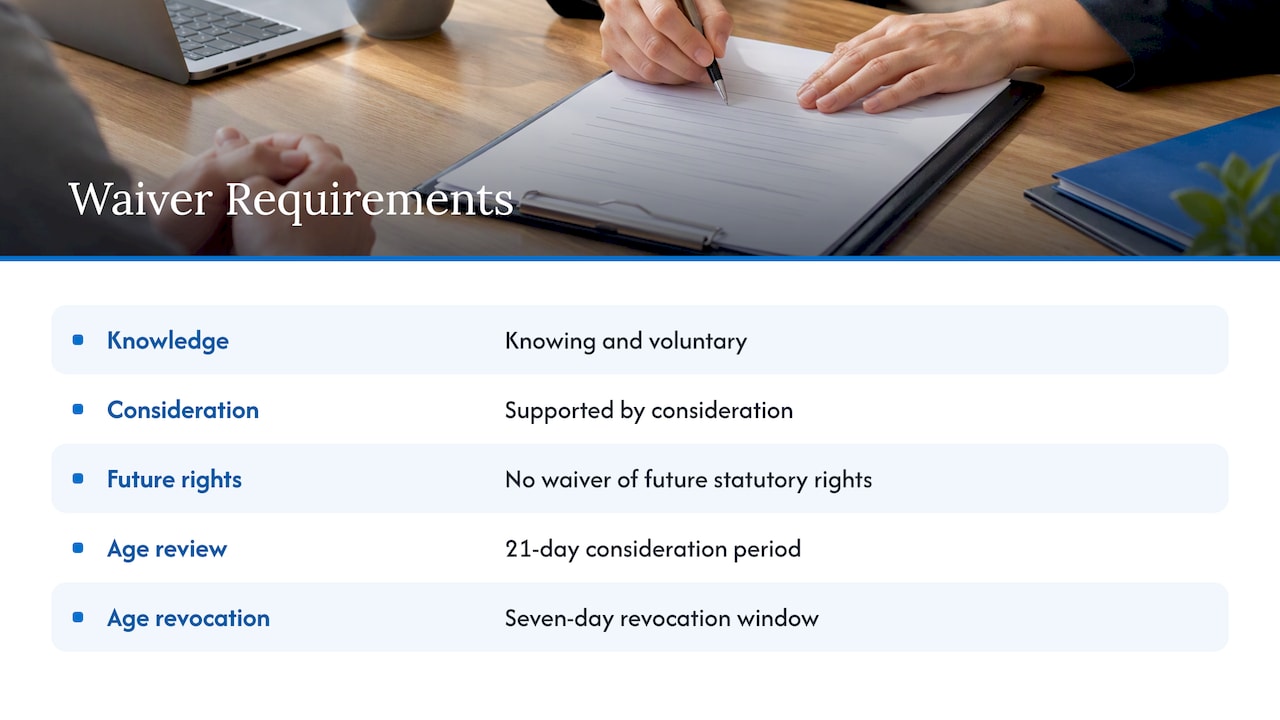
Some waivers are allowed. Under the EEOC’s guidance on waivers, a valid waiver of discrimination claims must be knowing and voluntary, supported by consideration, and must not require you to waive future statutory rights. For age claims under the Older Workers Benefit Protection Act, the waiver must also give you a 21-day consideration period and a seven-day revocation window.
If a clause appears to release future claims, bars you from contacting an agency, or is written so broadly that you cannot tell what you are giving up, challenge it. Ask for the language to be removed or narrowed before you sign anything. Our broader guide to employee rights gives more legal context.
How arbitrators and courts handle last chance agreements
When an LCA is challenged, the first question is whether it is a valid contract. Arbitrators often uphold voluntarily negotiated LCAs, and if one is valid, proving a violation can replace the usual just-cause analysis. The ADR perspective adds that parties should say explicitly whether a just-cause standard is being waived, so the point is not argued later.
A few themes come up again and again:
- What may be disputed. If the employer says you breached the LCA, keep records that support your account.
- Vague language weakens enforcement. Case materials show that some LCAs requiring broad, undefined waivers and flawless performance have been found illusory, meaning continued employment was promised in name only.
- Inconsistency undermines the agreement. If an employer lets violations slide for others, or for you, it may later be unable to enforce the termination provision strictly.
- Voluntariness can be contested. Practitioner materials from the Office of Personnel Management note that a challenge may still succeed where voluntariness is lacking or the agency itself breached the deal.
Keep your own records. Notes on how the agreement was presented, who attended, and whether monitoring actually happened can decide a later dispute.
Unionized workplaces and collective bargaining
In a union setting, an LCA may affect how discipline is applied to a member. The parties should make sure the deal is voluntary and specific. A union representative’s signature gives the agreement credibility, which is also why reps should read every line before adding it.
What unions should push for:
- Measurable terms and realistic timeframes instead of open-ended standards.
- A stated end date, so scrutiny does not continue indefinitely.
- Access to support such as an employee assistance program or treatment, where relevant.
- A clear statement of whether the just-cause standard is waived.
Employers must also deal with the union properly. If an employer bypasses the union and negotiates directly with a represented employee, that can raise unfair labor practice issues, and federal administrative records, including an ALJ decision, show disputes over bargaining and whether the union was sidestepped. A member who is approached directly should say they want their representative present and decline to sign until that happens.
If you are offered an LCA: a step-by-step checklist
Move through these steps in order, and write down each request and response.
- Pause and read. Ask for time to consider the agreement rather than signing on the spot, and note that you asked.
- Scan for illegal waiver language. Nothing should bar you from filing an EEOC charge or taking part in an investigation, per the EEOC’s guidance.
- Ask for specifics. Request concrete examples of the alleged misconduct, a defined timeframe, measurable success metrics, and any support the employer will provide.
- Check age-claim timing. If you are 40 or older and age may be involved, ask for the 21-day review and seven-day revocation periods described in the EEOC waiver Q&A.
- Get representation. Talk to your union representative or an employment lawyer, and negotiate specific fixes. Keep copies of prior discipline and any monitoring records.
- If you sign, keep records. Hold on to your copy and document how the employer enforces it, including any inconsistent treatment that could matter later.
Pro Tip: Send your request for more time by email, even if you also make it in person. A dated message proves you asked and shows you were pressured, if that is what happened.
If you want to understand the deadlines that may apply after an adverse action, our guide to wrongful termination laws covers them.
Practical sample clauses and red flags
Reading clause language side by side makes the difference clear. These are generic examples, not branded forms. Industry groups such as SHRM publish sample forms that show common structures.
- Safer language: a narrow definition of breach tied to named policies, a fixed duration of 6 or 12 months, specified monitoring steps, and an acknowledgment that you signed voluntarily with access to representation.
- Red-flag language: a broad general release of future discrimination claims, wording that bars you from filing charges, indefinite standards such as “any unacceptable behavior,” and releases with nothing given in return.
- Negotiable fixes: limit the scope to named policies, shorten the duration, add support commitments, require written notice of an alleged breach, and allow a chance to cure before termination.
Legal digests such as the AELE summaries show that courts sometimes uphold and sometimes reject overbroad LCAs, depending on voluntariness and specificity. The same agreement can survive in one case and fail in another, so push for plain, narrow wording from the start.
What happens if you fail to comply, beyond termination
Losing the job is the most obvious result of breaking an LCA, but it is rarely the only one. Because the agreement often replaces the normal just-cause review, you may have far less room to contest the firing, and any waiver of grievance rights you agreed to can limit your options afterward.
Other effects can follow. A termination for violating an agreement can appear in your personnel file and may be described to future employers, depending on the employer’s reference practices and your state’s rules. Unemployment benefits are decided under state law, and the stated reason for separation can influence a claim, so read your state agency’s rules and respond to any employer statement about why you left. Severance is generally not required at the federal level either, since the Department of Labor explains it is typically a matter of private agreement, so do not assume a payout will follow.
Our guide on severance versus unemployment explains how the two interact. If you believe the employer breached the LCA first, or applied it inconsistently, preserve that evidence right away. A breach claim may help you contest the termination.
How LCAs differ from progressive discipline and other agreements
Progressive discipline is a ladder: a verbal warning, a written warning, a suspension, then termination, with each rung set out in a policy or contract. You usually know where you stand, and the employer generally must still show just cause at the end.
An LCA works differently. It is a negotiated contract that can skip or compress those steps. You give up some procedural protections, often including the right to a full just-cause review, in exchange for keeping your job. As OPM practitioner materials describe, LCAs belong with other alternative approaches to misconduct, and they require a knowing, voluntary waiver of certain rights.
It also differs from a severance agreement, which ends the relationship, and from a settlement of a pending grievance, which resolves a past dispute. An LCA looks forward: it sets conditions for future conduct. Another distinction is that discipline ladders stay in force even after a warning, while an LCA has a defined end date. Once that date passes, you should be back under ordinary rules, which is why a missing duration is such a serious defect.
How employers should document and implement LCAs fairly
An LCA that is fair to the employee is also more likely to hold up. Employers who want an enforceable agreement should start with a documented record of the underlying problem: dates, policies violated, and prior warnings. Without it, the offer looks arbitrary.
From there, good practice looks like this:
- Put every term in writing, with measurable conditions and a stated end date.
- Give the employee time to review and the chance to consult a union representative or lawyer.
- Keep waiver language within legal limits. Never bar filing charges or participating in agency processes, as the EEOC guidance makes plain.
- Apply the agreement consistently and monitor as promised. Arbitrators note that inconsistent enforcement can erode the agreement’s credibility and block later strict enforcement.
- Give written notice of an alleged breach and a chance to respond before acting.
- Keep ADA obligations in mind. Where a disability or accommodation is involved, the EEOC’s conduct standards guidance applies.
Employers who follow these steps protect the employee and themselves.
Employee rights and protections during negotiation or refusal
You have more power than the pressure of the moment suggests. You can ask for time, ask questions, request that terms be changed, and involve a union representative or lawyer. None of that is misconduct.
Your core rights do not disappear because an LCA is on the table. You keep the right to file a discrimination charge and to take part in an EEOC investigation, and an employer who threatens you to get you to give that up risks a retaliation claim. Our guide to at-will employment explains the background rules that apply when no contract protects you.
If you refuse to sign, the employer may go ahead with the discipline it had planned, including termination. That risk is real, and it is the reason to weigh the offer with advice rather than refuse reflexively. Document everything: who proposed the agreement, what was said, and any deadline you were given. If you are fired after declining and suspect discrimination or retaliation, act quickly, because filing deadlines can be short. Whatever you decide, do it with the facts and a representative at your side, not under a stopwatch.
Our perspective on last chance agreements
At Workplace Fairness, we believe a last chance agreement can be a fair tool when it is written clearly and chosen freely. It can also become a trap when it is vague, rushed or used to strip rights the law says cannot be taken. Our priority is simple: voluntariness, clarity, measurable conditions, and real access to a union representative or lawyer before anyone signs. An LCA should narrow what an employee must do to keep a job. It should never narrow what the law protects.
We also think plain language is part of fairness. If the person signing cannot tell what counts as a breach, the agreement is not doing its job. We encourage you to use our guides when you weigh or negotiate one.
— Max
Where we can help: guides, attorney directory, and membership

If you are weighing a last chance agreement, we offer free, plain-language resources on employee rights and how to respond to workplace wrongdoing. We also maintain an attorney directory where you can find an employment lawyer for paid legal advice. We provide information and referral resources, not legal representation. For current details, see our membership page.
- Free guides on employee rights and workplace protections
- An attorney directory for finding employment lawyers
- Membership
This article is general information, not a substitute for advice from a qualified lawyer. Consult a qualified legal professional about your own circumstances before acting on anything here.
FAQ
Are last chance agreements legal?
Yes, they can be lawful when entered into voluntarily and written clearly. They cannot, however, make you give up the right to file an EEOC charge or take part in an investigation, and a clause that tries is null and void.
How do you challenge a last chance agreement?
Start by checking whether you signed voluntarily and whether the terms are specific. Arbitrators and courts have found some agreements illusory or coerced when they were vague or required broad waivers. Gather your records and speak with a union representative or employment lawyer.
How long does a last chance agreement last?
Most run 6 to 12 months, and arbitrators favor a clear end point. An agreement with no stated duration invites perpetual scrutiny and is harder to enforce.
Is severance legally required in the U.S.?
Generally no. The Department of Labor says severance is typically a matter of agreement, though state law or the WARN Act may require notice in some cases.
Sources
- Enforcement Guidance on non-waivable employee rights under EEOC enforced statutes | U.S. Equal Employment Opportunity Commission
- Eeoc
- Last Chance Agreements: Labor Arbitrators Share Insights
- Q&A-Understanding Waivers of Discrimination Claims in Employee Severance Agreements | U.S. Equal Employment Opportunity Commission