
If you are a nursing employee in the United States, federal law gives you the right to reasonable break time and a private space to pump at work, for up to one year after your child’s birth. Most private and public employers are covered. The time is usually unpaid, but there are important exceptions, and some states go further. This guide explains who is protected, how breaks and space work, where state law adds more, and what to do if your employer says no.
TL;DR
- The Fair Labor Standards Act (FLSA), as amended by the PUMP Act, requires most employers to give reasonable break time and a private space, other than a bathroom, to pump for up to one year after birth.
- Pumping time is unpaid unless you are not fully relieved from duty during the break, or you use a paid break you already have.
- The Pregnant Workers Fairness Act (PWFA) can add accommodations for employers with 15 or more employees, with no fixed end date after birth.
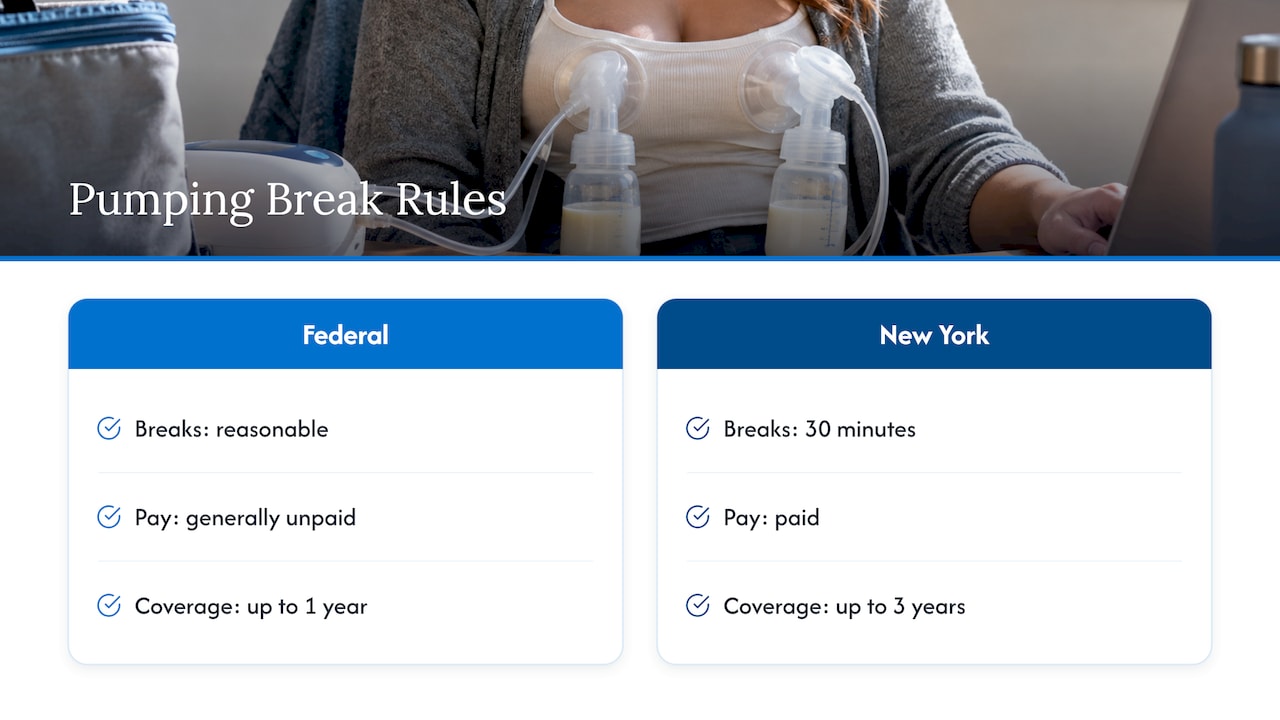
- State laws can be stronger. New York, for example, requires paid pumping breaks for up to three years.
- Retaliation is prohibited. You can file a complaint with the Department of Labor or the EEOC.
Table of Contents
- Which Federal Laws Protect You When You Pump at Work
- How Much Break Time You Get
- When Pumping Breaks Are Paid
- The Space Your Employer Must Provide
- How Long the Protections Last
- State Laws That Go Further
- Storing and Handling Your Milk
- What to Do If Your Employer Says No
- Our Perspective
- Support Free Employee Rights Information
- FAQ
- Sources
Which Federal Laws Protect You When You Pump at Work
Two federal laws matter most, and they work side by side.
The first is the FLSA. As amended by the PUMP Act, it requires most employers to provide reasonable break time and a private space for nursing employees to express breast milk for up to one year after the child’s birth. The PUMP Act was enacted on December 29, 2022, and it expanded these protections to millions of employees who were previously exempt from the pump-at-work requirements. Before that change, many salaried workers, including teachers and nurses, had no federal pumping right. Now the FLSA covers most private and public employment, with limited exceptions.
The second is the PWFA. It requires covered employers with at least 15 employees to provide reasonable accommodations, including pumping time and space, for employees with pregnancy-related limitations. Unlike the FLSA, the PWFA has no specific time limit after birth. The entitlement depends on your ongoing needs. If you need to ask for an accommodation in writing or in conversation, our guide to getting PWFA accommodations in two sentences walks through the request step by step.
For a broader view of how these laws fit together, see our overview of Pregnancy Discrimination Act, PWFA and PUMP Act rights.
Who is covered
In practical terms, you are likely covered by the FLSA pumping rules if you work for a private employer or a public agency, whether you are hourly or salaried, full time or part time. Some groups have specific rules:
- Rail and motorcoach workers. Beginning December 29, 2025, certain employees of rail carriers and motorcoach services operators are covered by the FLSA pump-at-work provisions, subject to limited exemptions for significant expense or unsafe conditions.
- Remote workers. Employees who telework are eligible to take pump breaks on the same basis as on-site employees.
- Employees of small employers. The PWFA threshold is 15 employees, but the FLSA pumping rules are not tied to that number in the same way. Check the Department of Labor’s pump-at-work pages for any exemption that might apply to your situation.
If you are unsure whether your job is covered, a call to a Wage and Hour Division office is free and confidential.
How Much Break Time You Get
The law does not set a number of minutes or a number of breaks. Employers must provide a reasonable amount of break time, as frequently as you need it. That standard exists because every body and every baby is different. How long you need depends on your pump, the distance to your pumping space, how many times you pump in a shift, and how your milk supply responds.
Some points that follow from that standard:
- No rigid schedule. Under the FLSA, employers cannot require you to stick to a fixed pumping schedule if it does not meet your need, because frequency and duration can change over time.
- Time includes more than pumping. Reasonable time generally includes getting to your space, setting up, pumping, cleaning parts, and returning to work. If walking to a distant room adds ten minutes, that is part of the picture.
- Your needs can change. As your baby grows, you may pump less often or for a shorter time. You can adjust without needing permission to change a fixed arrangement.
A simple example: a nurse working a 12-hour shift might need three pumping sessions. If the pumping room is two floors away, her total break time per session is longer than the pumping itself. That is still reasonable, because it reflects what she needs.
When Pumping Breaks Are Paid
The default rule is that this time is unpaid. But the Department of Labor explains that the time is unpaid unless you are not completely relieved from duty, or the employer provides paid breaks that you choose to use for pumping.
The “completely relieved from duty” test is where many disputes arise. Under the FLSA, employers must compensate you for a pumping break if you are not completely relieved from duty during the entire break. Examples of when that may apply: you are required to answer your phone or monitor a radio, you are expected to respond to customers or coworkers, or you work from your desk while pumping because your employer expects it.
If your employer gives everyone a paid 15-minute break, you may use it to pump and be paid for it. If you need more time than that, the extra time can be unpaid, unless a state law or your employer’s policy says otherwise. Keep a brief personal record of your pumping times and any times you were interrupted. It is useful if a dispute arises later.
The Space Your Employer Must Provide
The federal standard is a place to pump, not a bathroom, that is shielded from view and free from intrusion by coworkers and the public. The Department of Labor’s pump-at-work guidance describes this private space requirement, and its Fact Sheet #73A covers the details.
There is no requirement for a dedicated lactation room, but a space must be available whenever you need it. Here is what employers must and need not do, according to the Department of Labor’s fact sheet on space requirements:
| Item | What the employer must do |
|---|---|
| Refrigerator | Not required |
| Pump and cooler | Must allow you to bring a pump and an insulated container or personal cooler |
| Storage | Must provide a place to store those items |
| Vie privée | Must provide a space that is not a bathroom and is shielded from view |
When an employer has no spare room, a private office, a conference room with a door that locks or is clearly marked as occupied, or a screened-off area can work, provided it is truly private and available when you need it. If a space is shared with other uses, scheduling should never push you off your own pumping rhythm.
How Long the Protections Last
The two federal laws run on different clocks.
- FLSA: protections last for one year following the birth of your child.
- PWFA: there is no specific time limit. Your right to a reasonable accommodation depends on your ongoing needs, as long as the employer is covered and you meet the law’s requirements.
So if your baby is past the first birthday and you are still pumping, the FLSA may no longer apply. The PWFA, a state law, or your employer’s policy may still protect you. Ask for the accommodation in writing and describe the related need.
State Laws That Go Further
Federal law is a floor, not a ceiling. The FLSA does not preempt state or local laws that offer greater protections, such as paid breaks or accommodations extending beyond one year. Employers must follow all applicable laws, so the stronger rule controls.
New York is a clear example. State law requires 30 minutes of paid break time for pumping, available for up to three years after a child’s birth. In practice that means a New York employee can have a paid pumping break where a federal-only employee would not.
Other states and some cities have their own lactation laws, with differences in paid time, the length of coverage, notice requirements, and written policy duties. Because these rules change, check your state labor department’s website for the current version before you rely on a summary. When you search, use terms like “[your state] lactation accommodation labor department.”
Storing and Handling Your Milk
Because an employer need not provide a refrigerator, plan ahead for storage. A small insulated bag with ice packs is often enough for a shift. At home, many parents find a first-in, first-out routine helpful, and this guide to breast milk storage guidelines covers how to organize and rotate what you have pumped. If your employer lets you use a shared refrigerator, label your containers clearly.

What to Do If Your Employer Says No
First, know that retaliation is not allowed. Federal law prohibits retaliation against employees for exercising their right to pump at work, filing a complaint, or cooperating with an investigation.
A practical sequence:
- Ask in writing. Send a short email to your supervisor or HR describing the break time and space you need. Keep a copy.
- Cite the law. Mention the FLSA pump-at-work requirement and, where it applies, the PWFA.
- Document problems. Note dates, who said what, missed pumping sessions, and any discipline or schedule changes after you asked.
- Contact the right agency. Contact the Department of Labor’s Wage and Hour Division to file an FLSA complaint, or the EEOC to file a charge of discrimination under the PWFA. Both agencies prohibit retaliation.
- Ask about harassment. If harassment interferes with your ability to pump, you can contact or visit a Wage and Hour office to ask about the laws or file a complaint.
- Consider talking to an employment attorney. Deadlines apply to complaints and charges, so do not wait. A lawyer can explain which law fits your case and what remedies are available.
If you are also dealing with leave, our resources on FMLA eligibility and requesting a reasonable workplace accommodation can help you plan the return to work.
Our Perspective
We have heard from many working parents that the hardest part of pumping at work is not the law itself. It is the conversation. People worry that asking for a break will mark them as less committed, so they skip sessions, endure pain, or stop earlier than they planned. That is a systemic barrier, and it falls hardest on workers in hourly, front-line and shift-based jobs, where schedules are tight and supervisors have the most control.
The PUMP Act narrowed that gap by bringing millions of previously excluded employees under the law. But rights on paper only matter when workers know them. We believe every organization benefits from a clear, written lactation policy, a private space that is ready before the first request, and managers who are trained to respond with “yes, how can we help?” Equitable workplaces are built by routine, not exception.
For employees, our advice is to start early. Ask before your leave ends, put your request in writing, keep notes, and use the agencies built for this. You are not asking for a favor. You are using a right that people before you fought to win.
— Max
Support Free Employee Rights Information
Workplace Fairness provides free, plain-language information about employee rights, and our work depends on readers who value it. If these guides helped you understand your rights, you can support them with a Workplace Fairness membership, from $25 per year.
Membership helps us keep our guides current as laws and agency guidance change, so the next working parent can find clear answers when they need them.
FAQ
Do lactation break laws apply to salaried employees?
Yes, in most cases. The PUMP Act expanded FLSA pumping protections to cover millions of employees who had been exempt from them, including many salaried workers. Exceptions are limited, so check the Department of Labor’s pump-at-work pages or call a Wage and Hour office if you are unsure.
Does my employer have to pay me while I pump?
Not usually. The time is unpaid unless you are not completely relieved from duty during the break, or you use a paid break your employer already provides. Some states, such as New York, require paid pumping breaks, so check your state’s rules.
Does my employer have to provide a lactation room or a refrigerator?
Your employer must provide a private space that is not a bathroom, and a place to store your pump and cooler. It does not have to provide a refrigerator, but it must let you bring an insulated container or personal cooler.
How long can I pump at work under federal law?
The FLSA protects pumping at work for up to one year after your child’s birth. The PWFA has no set end date, because it depends on your continuing needs, and some state laws extend protection further.
What if I work from home?
You are eligible to take pump breaks under the FLSA on the same basis as on-site employees. If you are required to keep working during the break, the time may need to be paid.
Sources
- FLSA Protections to Pump at Work, U.S. Department of Labor
- Time and Place to Pump at Work: Your Rights, U.S. Equal Employment Opportunity Commission
- Employer Responsibilities, U.S. Department of Labor
- Field Assistance Bulletin No. 2022-4, U.S. Department of Labor
- Fact Sheet #73A: Space Requirements for Employees to Pump, U.S. Department of Labor
- Fact Sheet #73B: Transportation Industry Exemptions, U.S. Department of Labor
- Retail and Restaurants Pump at Work FAQs, U.S. Department of Labor
- Transportation Pump at Work FAQs, U.S. Department of Labor
- Breast Milk Expression in the Workplace, New York State Department of Labor
- Breast milk storage guidelines