
No federal law requires an employer to pay you a bonus. But once a bonus is promised with clear terms, it stops being a gift and starts behaving like pay: it can be owed to you, it can raise your overtime, and you have a way to pursue it if it never arrives. How much protection you have depends on one question: was the bonus discretionary or nondiscretionary? This guide explains the difference in plain terms, shows what it does to your paycheck, and lays out what to do when a promised bonus is not paid.
We wrote it for employees and hourly or salaried workers who want to know where they stand, not for payroll departments.
TL;DR
- Federal law does not make employers offer bonuses. The Department of Labor (DOL) says bonus arrangements of this kind are generally a matter of agreement between employer and employee.
- A bonus is discretionary only if the employer decides whether to pay it, and how much, at or near the end of the period. A bonus promised in advance, or triggered by set criteria, is nondiscretionary.
- Nondiscretionary bonuses generally count toward your regular rate of pay, so they can increase your overtime pay.
- If a promised bonus is not paid, gather the written terms, send a written demand, and file a wage claim with your state labor agency if needed. State law, not federal law, usually supplies the collection process.
Table of Contents
- Does the law require a bonus at all?
- Discretionary vs. nondiscretionary bonuses
- How a bonus affects your overtime pay
- Bonuses and the salary threshold for exempt employees
- When a promised bonus is not paid
- Common bonus situations
- Our perspective
- Keep learning your rights with Workplace Fairness
- FAQ
- Sources
Does the law require a bonus at all?
No. The Fair Labor Standards Act (FLSA), the federal law that sets minimum wage and overtime, does not address nonproduction cash bonuses. The DOL states that these payments are generally a matter of agreement between an employer and an employee. The FLSA only steps in to require that bonuses be included in your regular rate when overtime is calculated, with some exceptions.
The same DOL guidance explains that the FLSA also does not require vacation, holiday, severance or sick pay, pay raises, or fringe benefits, and that it does not set wage collection procedures for usual or promised wages beyond its own requirements. That second point matters later: when a promised bonus goes unpaid, you will usually look to your offer letter, your bonus plan and your state’s wage law.
So the practical question is rarely “does the law give me a bonus?” It is “what did my employer promise, and how does the law treat that promise?”
Discretionary vs. nondiscretionary bonuses
This is the distinction behind most bonus disputes. The DOL’s Fact Sheet #56C on bonuses sets out the test. A bonus is discretionary only when both of these are true:
- The employer keeps sole discretion over whether to pay the bonus and how much, until at or near the end of the period the bonus covers.
- The payment is not made under a prior contract, agreement or promise that leads employees to expect it regularly.
A nondiscretionary bonus is everything else. It is usually tied to something you can see in advance: a sales target, a production goal, perfect attendance, a retention date, or a sign-on promise.
The label does not decide it
Calling a payment a “discretionary bonus” in a handbook does not make it one. The DOL looks at how the bonus actually works. The federal regulation at 29 C.F.R. § 778.211 says that when an employer promises a bonus in advance, for example by announcing in January that a bonus will be paid in June, it has given up its discretion. That bonus is not excluded from the regular rate.
The same regulation says bonuses promised to employees when they are hired, or that result from collective bargaining, are not excluded. It also says most attendance bonuses, individual or group production bonuses, and bonuses for quality and accuracy of work must be included in the regular rate.
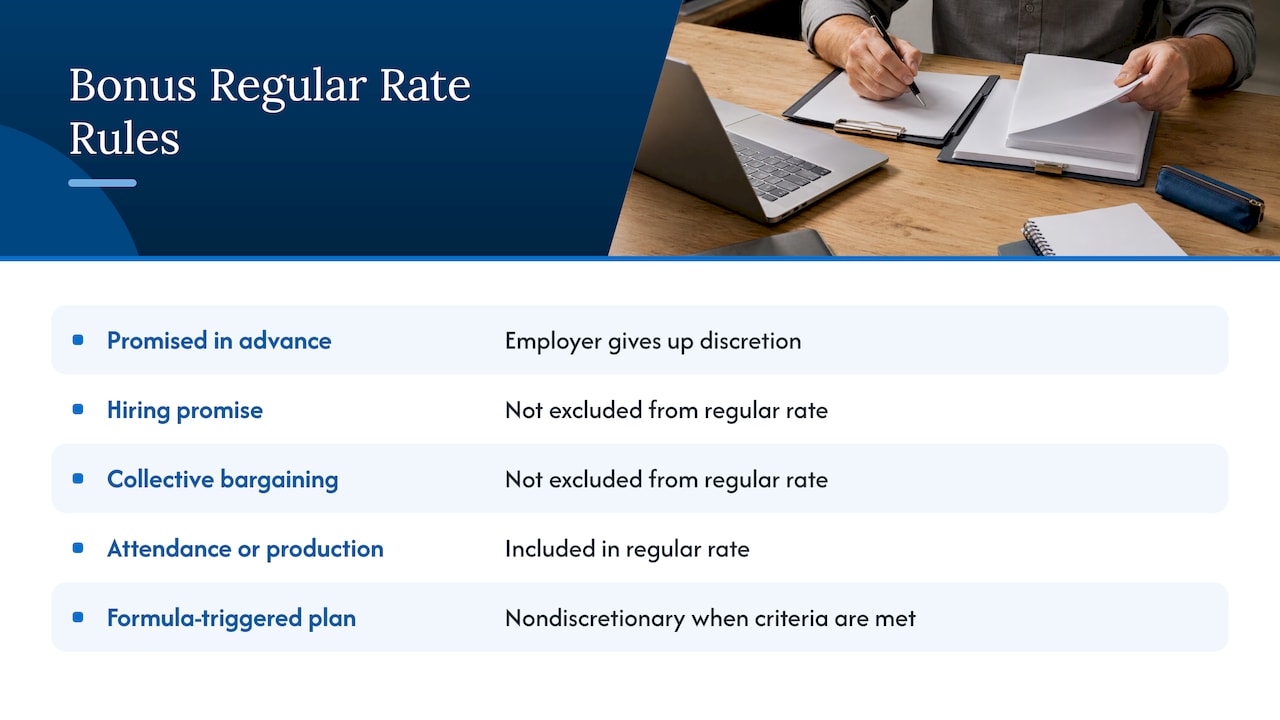
The DOL’s Wage and Hour Division applied this reasoning again in a January 5, 2026 opinion letter. It concluded that a plan which automatically triggers a quantifiable bonus once criteria are met is nondiscretionary. The employer’s discretion ended when it set up the formula, even if the decision to offer the plan was voluntary at first.
Examples of each
| Bonus | Usually treated as | Why |
|---|---|---|
| “Hit $200,000 in sales and earn 5%” | Nondiscretionary | Fixed criteria and amount set in advance |
| Sign-on bonus promised in your offer letter | Nondiscretionary | Promised on hiring |
| Quarterly attendance bonus | Nondiscretionary | Pre-set criteria that employees count on |
| Surprise bonus after a crisis, decided afterward | Potentially discretionary | Employer decided whether and how much at the end |
| Employee-of-the-month award | Potentially discretionary | The DOL lists it among examples that may be excludable |
| Severance bonus | Potentially discretionary | Also on the DOL’s list of examples |
The DOL’s list of potentially discretionary examples also includes bonuses for unique or extraordinary efforts that are not awarded under pre-established criteria, and referral bonuses paid to employees who are not primarily engaged in recruiting. These are “potentially” excludable because the facts decide each case.
How a bonus affects your overtime pay
If you are a nonexempt employee, meaning you are entitled to overtime, a nondiscretionary bonus changes your overtime rate. Overtime is not just your base hourly wage times 1.5. It is based on your regular rate, which includes most compensation you earn for working. If you are unsure which group you fall into, our guide to exempt vs. nonexempt classification explains it.
Fact Sheet #56C gives the calculation in three steps:
- Add your total weekly pay, minus any legally excludable amounts, and divide by the total hours you worked. That is your regular rate.
- Multiply the regular rate by 0.5. That is the half-time premium for each overtime hour.
- Multiply the premium by your overtime hours. That is the extra overtime pay owed.
The half-time premium appears because your straight-time pay for all hours, including the bonus, is already counted in step 1.
A worked example
Say you earn $20 an hour, work 50 hours in a week, and that week’s production bonus is $100 (a nondiscretionary bonus earned for that single week).
- Straight-time pay: 50 hours × $20 = $1,000, plus the $100 bonus = $1,100.
- Regular rate: $1,100 ÷ 50 = $22 an hour.
- Half-time premium: $22 × 0.5 = $11 per overtime hour.
- Overtime premium owed: 10 overtime hours × $11 = $110.
So you are owed $1,210 for the week. Without counting the bonus, an employer would calculate the premium at $10 an hour, or $100, and you would be short by $10. Small numbers, but they repeat every pay period.
Bonuses that cover more than one week
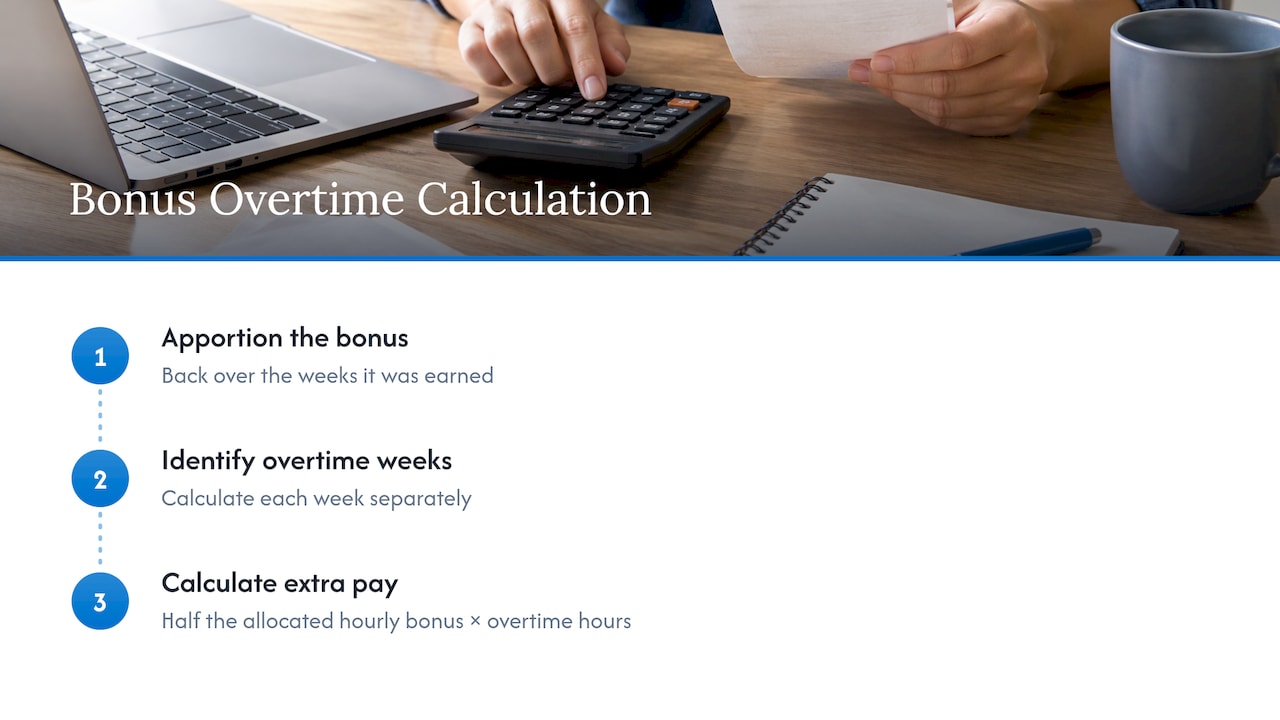
Quarterly or annual bonuses work differently. Under 29 C.F.R. § 778.209, a bonus that covers more than one workweek must be apportioned back over the weeks in which it was earned. For each week in which you worked overtime, you are owed additional pay equal to half of the hourly amount allocable to the bonus, multiplied by that week’s overtime hours. If your employer paid a large year-end bonus and never recalculated your overtime, ask for that back-calculation in writing.
Our labor worker rights and overtime guide walks through the wider overtime picture.
Bonuses and the salary threshold for exempt employees
Bonuses can also matter if you are paid a salary and classified as exempt. A rule effective May 15, 2026 republished the pre-2024 federal regulations after courts vacated the DOL’s 2024 salary-threshold rule. Under that text, the standard salary level is $684 per week. Up to 10 percent of that level can be met with nondiscretionary bonuses, incentives and commissions paid annually or more often.
The DOL’s compliance guide explains the catch-up rule. If salary plus those bonuses falls short of the required level at the end of a 52-week period, the employer may make a catch-up payment within one pay period. If it does not, the exemption is lost and overtime is owed for any week you worked more than 40 hours. For the numbers and how states differ, see our pages on the FLSA salary threshold and the 2026 overtime salary threshold.
When a promised bonus is not paid
This is the situation most workers searching this topic face. Can an employer simply refuse to pay a bonus it promised? There is no single federal answer, because the FLSA does not provide a collection process for promised pay beyond its own requirements. The outcome usually turns on three things.
- What exactly was promised. A written offer letter, bonus plan, commission agreement or email with clear criteria and an amount is the strongest footing. Vague talk of “we’ll take care of you” is much harder to enforce.
- Whether you met the conditions. If the plan required hitting a target, show that you did. If it required you to be employed on the payout date, that condition matters too.
- Your state’s wage law. States define wages differently. In some, earned bonuses count as wages and can be pursued through the state labor agency. California is one example: its Labor Commissioner accepts claims for wages including overtime, commissions and bonuses.
If you left the company or were let go, timing rules may apply to what you are owed. Our final paycheck laws guide covers when you must be paid by state.
Steps to take
- Collect the paper trail. Save the offer letter, plan documents, emails, pay stubs, and any performance or sales records showing you met the criteria. Keep copies outside work accounts.
- Read the plan’s conditions. Look for the payout date, eligibility requirements and who decides amounts.
- Ask in writing. Send HR or payroll a short, factual message: what was promised, when it was due, and that you are requesting payment by a specific date. Legal Aid at Work notes that a demand letter can help avoid filing a claim, document your request and support penalty claims where they exist.
- File a wage claim. Most states let you file with the state labor department. In New Jersey, for example, the Division of Wage and Hour Compliance accepts wage complaints online, by mail or by fax, and in California you can file a claim with the Labor Commissioner or sue in court. Search for your own state’s labor department to find its form and deadlines.
- Consider an employment attorney. If the amount is large or the plan is complicated, a lawyer who handles wage cases can review your documents. Filing deadlines apply, so do not wait.
If an unpaid bonus is one of several pay problems, our list of wage theft signs to document shows what records to keep.
Common bonus situations
Bonus announced, then cancelled
If the bonus was promised in advance with criteria, it was most likely nondiscretionary, and cancelling it after you did the work is the kind of dispute state wage agencies hear. If it was truly decided at the employer’s sole discretion at the end of the period, there is less to enforce. The terms the employer used are your best evidence.
“You must still work here on payout day”
Many plans include this condition. Whether it can be enforced depends on the plan language and your state’s law, so read the plan and check your state’s rules before assuming either way.
Sign-on bonus with repayment terms
Because a sign-on bonus is promised on hiring, it falls in the nondiscretionary group for regular-rate purposes. Read any repayment clause before you accept, and keep the signed copy.
Bonus paid late or short
Compare the amount to the plan formula line by line. Errors in sales credit, wrong period dates and missed overtime recalculations are common sources of shortfalls.
Our perspective
Bonus disputes are almost always disputes about what was said and what was written down. The law gives workers real protection once a bonus has been promised on clear terms, but it rarely protects an expectation that lives only in a conversation.
That is why we push employees to treat every incentive as something to document: the date it was announced, the criteria, the amount, and the proof that you met them. A worker with a paper trail can ask for what they are owed calmly and be taken seriously.
We built Workplace Fairness since 1994 as a free, plain-language place to learn these rules without legal jargon, and to connect with employment attorneys when a problem needs one. Understanding the difference between a discretionary and a nondiscretionary bonus is a first step toward fair pay, and every worker deserves access to that knowledge.
Max
Keep learning your rights with Workplace Fairness
Workplace Fairness is a free resource for employees, and it runs on community support. If these guides helped you understand your pay, you can support the work through a Workplace Fairness membership, from $25 per year. For more plain-language help on pay and other job issues, start from our employee rights overview or common work issues page.
FAQ
Can my employer refuse to pay my bonus?
It depends on what was promised. If the bonus was discretionary, meaning the employer decided at the end of the period whether to pay it, there is generally little to enforce. If it was promised with set criteria and you met them, it may be owed as wages under your state’s law, and you can pursue it through your state labor agency.
Is a bonus required by federal law?
No. The DOL says the FLSA does not address nonproduction cash bonuses and treats them as a matter of agreement between employer and employee. The FLSA’s role is making sure nondiscretionary bonuses are counted in the regular rate when overtime is calculated.
Does a bonus count toward my overtime?
A nondiscretionary bonus generally does. It is added to your pay for the period it covers, divided by hours worked to find your regular rate, and the half-time premium is then calculated on that rate. A truly discretionary bonus may be excluded, but the DOL says the label alone does not decide it.
What is the difference between a discretionary and a nondiscretionary bonus?
A discretionary bonus is one where the employer alone decides, near the end of the period, whether to pay and how much, with no earlier promise. A nondiscretionary bonus is announced or promised ahead of time, or paid automatically when set criteria are met.
Where do I file a complaint if a promised bonus is not paid?
Start with your state labor department’s wage claim process, since states usually handle collection of promised wages. Use the written terms of the bonus as your evidence. Deadlines vary by state, so file promptly.
Sources
- Other Compensation Benefits, U.S. Department of Labor
- FLSA Advisor, U.S. Department of Labor
- Fact Sheet #56C: Bonuses under the FLSA
- 29 C.F.R. § 778.211, Discretionary bonuses
- DOL opinion letter FLSA2026-2
- 29 C.F.R. Part 778, Overtime compensation
- Federal Register: Defining and Delimiting the Exemptions, May 15, 2026
- DOL small-entity compliance guide on exemptions
- Legal Aid at Work: Recovering unpaid wages
- California DIR: Overtime FAQ
- New Jersey Department of Labor: File a wage complaint