If an employment background check contains a mistake, you can dispute it in writing with the screening company that produced the report. You should also tell the employer. Federal law gives you the right to see the report and to have wrong information investigated. It also gives you time to act before a final hiring decision. This guide explains each step, what to put in your dispute, and what to do if the error stays.
TL;DR
- Send a written dispute to the background screening company, not only the employer. Describe each error and attach copies of your proof.
- Tell the employer about the error as well, and ask that the corrected report go to them.
- The company generally has 30 days to investigate, sometimes 45, and must notify you within five business days after it finishes.
- Before an employer acts against you, it must give you the report and a summary of your FCRA rights. After the decision, you can request a free additional report within 60 days.
- Recording a meeting about your dispute depends on state law and workplace rules, so confirm the rule first or keep everything in writing.
Table of Contents
- What counts as a background check error
- How to get and read your report
- How to dispute a background check error, step by step
- How long the screening company has to respond
- Consent and notice: what employers must do before and after
- If the error is not fixed or the employer still relies on it
- Can you record the meeting about your dispute?
- Our perspective
- Support free information on workers’ rights
- FAQ
- Sources
What counts as a background check error
A background report can be wrong in small ways or in ways that cost you the job. The Consumer Financial Protection Bureau (CFPB) lists common problems to look for:
- Incorrect name, Social Security information, or address
- Wrong case or docket numbers
- Sealed or expunged records that still appear
- Incomplete records
- Duplicate charges for the same incident
- Information that should not be reportable, including old non-conviction information
- A misdemeanor listed as a felony, or the reverse
- Records that belong to another person
A guide from the Justice and Opportunity project describes the same patterns. These include mixed-file identity errors, missing case dispositions, sealed records, duplicated incidents, misleading presentation, and offense misclassification.
Check identity first, then the details
The CFPB’s examples point to two separate questions. First, is this record really yours? Mixed files happen when someone with a similar name or birth date is matched to you. Second, if the record is yours, is it accurate? A report can omit that charges were dismissed, repeat one arrest as two entries, or label an offense at the wrong level. Read every line with both questions in mind.
How to get and read your report
You may not have seen the report before the employer did. The rules give you several chances to get it.
According to the Federal Trade Commission (FTC), an employer must give you the report it relied on and the FCRA rights summary before taking adverse action. After the decision, the employer’s notice gives you the screening company’s contact information. You may then request a free additional report within 60 days.
Our guide to the adverse action notice and your 60-day rights walks through what each notice should contain.
If your concern is a credit report used in hiring, the Equal Employment Opportunity Commission (EEOC) says you can get a free copy through AnnualCreditReport.com or 1-877-322-8228. You do not need to buy a product or pay anyone to correct errors.
When the report arrives, mark every item that is wrong, missing, or confusing. Keep the envelope or email, the notice, and the date you received them. Those dates matter later.
How to dispute a background check error, step by step
The FTC advises that you review the report carefully and contact the reporting company about each mistake. Ask for a correction and give supporting documentation. Check the revised report. Ask that the corrected report go to your employer, and tell the employer about the error yourself. That advice appears in its consumer guidance on employer background checks. The EEOC gives the same basic instruction.
- Identify the company. The name and contact details are on the report and in the post-decision notice. The employer is not the one to fix the report. The screening company is.
- Write, do not just call. The CFPB says to send a written dispute with supporting documents. A phone call can supplement it, but the letter is your record.
- List each error separately. Quote the entry as it appears, then say what is wrong and what is correct.
- Attach proof. Send copies, never originals.
- Use traceable delivery. The CFPB suggests certified mail with return receipt.
- Notify the employer. Send a short note saying you found an error, you have disputed it, and you have asked for the corrected report to be sent.
- Follow up. Check the revised report when it arrives and confirm that the employer received it.
What to put in the letter
Keep the letter factual and brief. Include your full name, current address, and the report date or reference number if one is shown. Then add one short paragraph per error.
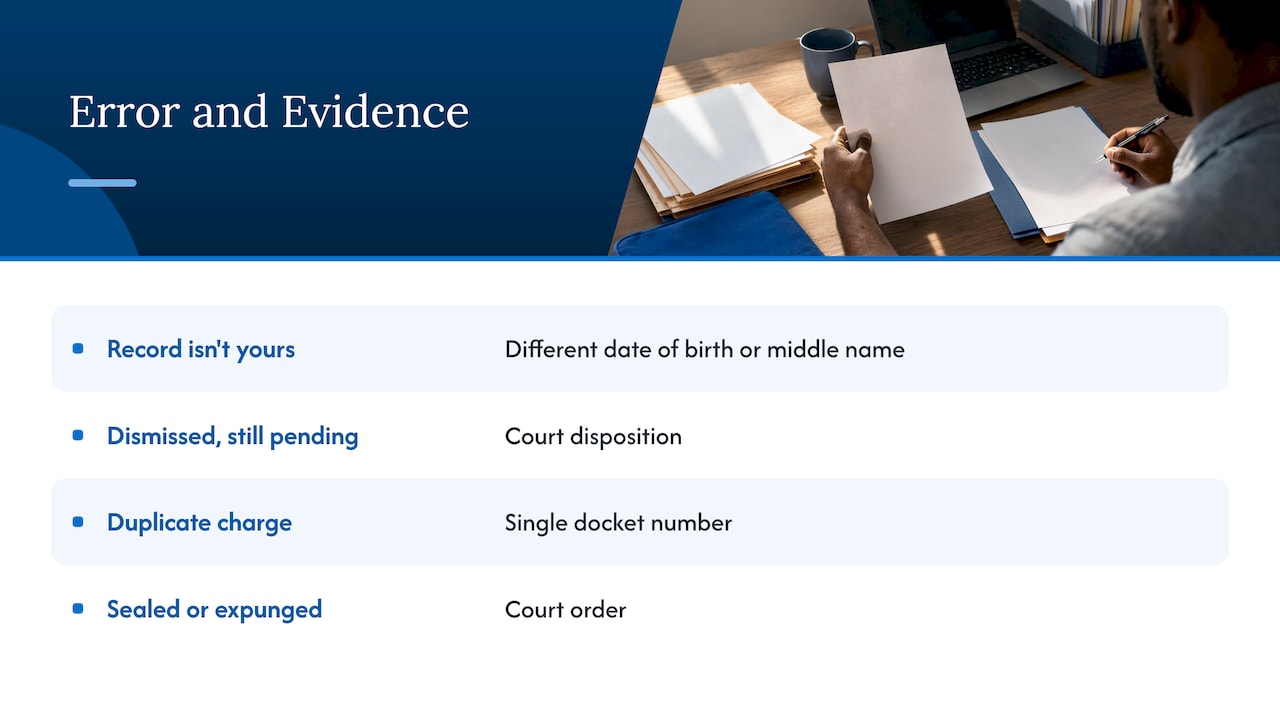
For a record that is not yours, state that you were not the person charged, and include something that distinguishes you, such as a different date of birth or middle name on the court record. For a dismissed case still shown as pending, attach the court’s disposition. For a duplicated charge, point to the single docket number. For a sealed or expunged record, attach the order.
Court clerks can usually provide certified copies of dispositions. Those are strong supporting documents because they come from the source of the record.
How long the screening company has to respond
The CFPB states that a reporting company generally has 30 days to investigate, with an additional 15 days in some circumstances. It must notify you within five business days after it completes the investigation.
That timeline can collide with a hiring process. Two things help:
- Tell the employer right away that a dispute is underway, so the decision is not finalized on the disputed report.
- Keep a calendar of the date you mailed the dispute, the delivery confirmation, day 30, and day 45.
If the screening company corrects the record, ask for the revised report in writing and confirm it was sent to the employer. If it does not change the record, ask for the reason in writing. That answer shapes your next step.
Consent and notice: what employers must do before and after
Many readers searching for a dispute are also asking whether the employer followed the rules at the start. The FTC explains that when an employer uses a third-party report, it must give a clear written disclosure and get your written authorization. The disclosure must be a stand-alone document, and the employer must certify compliance to the reporting company.
The disclosure form and your authorization
The FCRA disclosure form should tell you, in a document that stands on its own, that a report may be obtained for employment purposes. It should not be buried in an application packet or mixed with unrelated terms. The FTC adds that an authorization may cover reports throughout your employment only if that continuing authorization is stated clearly and conspicuously. If you signed something vague, ask what exactly you authorized.
If the report is based on personal interviews with people such as former coworkers or neighbors, it is an investigative consumer report. The EEOC explains that this requires additional notice of your right to request the nature and scope of the investigation.
Before and after an adverse decision
Before adverse action, you should receive the report and the summary of your rights. After the decision, the notice should name the reporting company, explain that the company did not make the decision, and describe your rights to dispute and to a free report within 60 days. If any of these pieces are missing, write down what you received and when. Your state’s personnel file rules may also affect what records you can request from a current or past employer.
If the check involves what a former employer said about you, see our page on references and what a former employer is saying.
If the error is not fixed or the employer still relies on it
If the screening company will not correct a real error, the first move is the same as before: ask in writing, add stronger proof, and tell the employer. Court records are often the strongest evidence, so request a fresh certified copy if the first one was not enough.
The EEOC says to contact it if you think the employer discriminated against you based on background information. Its guidance explains that a criminal-record exclusion may be discriminatory if it disadvantages a protected group and is not job-related and consistent with business necessity. That is a separate question from whether the report is accurate. A report can be entirely correct and still be used unlawfully.
To understand how discrimination claims are framed, read our overview of the types of workplace discrimination. Because most jobs are at will, an employer can end a hiring process for many reasons, so it helps to know where at-will limits apply.
If the dispute has cost you a job, a lawyer who handles employment and FCRA matters can review your notices and timeline. Our guide on employment lawyer costs explains what to expect before you call, and our attorney directory can help you find one.
Can you record the meeting about your dispute?
Workers often want a recording of a conversation with HR about a disputed report. The FCRA does not answer that question. It depends on state interception law, where each participant is located, and your employer’s policies.
A professional surveillance law compendium describes Rhode Island and Oklahoma as generally one-party-consent states, where a participant may record. It describes Pennsylvania as generally requiring all-party consent for covered communications. Even where recording is legal, a workplace no-recording policy may still be enforced against you.
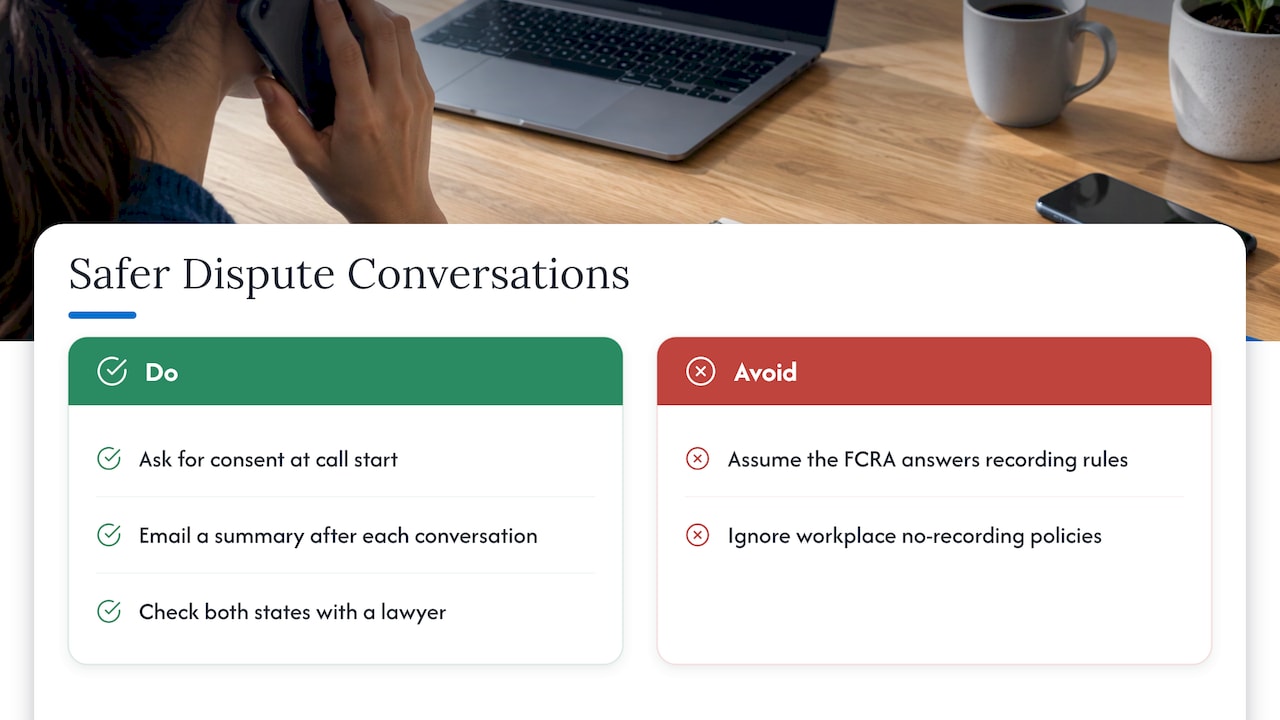
The safe approach is to ask for consent at the start of the call, or to follow up every conversation with an email summarizing what was said and asking the employer to correct anything wrong. If you want to record without that, confirm the rule for your state and the other person’s state with a lawyer first. For related questions, our guide to workplace privacy rights is a good next read.
Our perspective
A background check can shape a person’s livelihood in a few lines of text, and the people most affected are often those already facing systemic barriers to steady work. Mistaken identity, an outdated record, or a duplicated charge should not decide whether someone is hired.
We believe the law’s protections only work when workers know about them. That is why we publish free, plain-language information on employee rights, on filing claims, and on finding an employment attorney. The dispute process is not complicated, but it is unforgiving about timing and paperwork, so we encourage every worker to keep copies, write things down, and act early.
Equitable workplaces are built when employees and the professionals who serve them share what they know. Our work, which began in 1994, has always rested on that idea.
Max
Support free information on workers’ rights
Workplace Fairness is a free resource funded by people who believe workers should understand their rights without paying for the answers. If this guide helped you, consider supporting our work with a Membership, from $25 per year.
Members help us keep guides current and accessible. You can also explore our wider employee rights guide at no cost.
FAQ
Who do I send a background check dispute to?
Send it to the background screening company that prepared the report. Its contact details are on the report and in the employer’s post-decision notice. Also tell the employer about the error and ask that the corrected report be sent to them.
How long does a background check dispute take?
The CFPB says the reporting company generally has 30 days to investigate, sometimes 45. It must notify you within five business days after finishing. Tell the employer about the dispute early so a decision is not made on the disputed report.
Can I get a free copy of my background report?
Yes, in the situations the FTC describes. After an employer’s adverse action, you may request a free additional report within 60 days. For credit reports, the EEOC points to AnnualCreditReport.com or 1-877-322-8228. You do not have to pay anyone to fix errors.
Does an employer need my consent for a background check?
For a report from a third-party screening company, yes. The FTC says the employer must give a clear, stand-alone written disclosure and get your written authorization. Interview-based investigative reports require extra notice about your right to request the investigation’s nature and scope.
What if the report is accurate but I was still rejected?
Accuracy and fairness are separate issues. The EEOC says a criminal-record exclusion may be discriminatory if it disadvantages a protected group and is not job-related and consistent with business necessity. If you suspect that, contact the EEOC or an employment lawyer.
Sources
- Using Consumer Reports: What Employers Need to Know (FTC)
- Employer Background Checks and Your Rights (FTC)
- Background Checks: What Job Applicants and Employees Should Know (EEOC)
- Background Checks: What Employers Need to Know (EEOC)
- Background screening report checklist (CFPB)
- Focus on Reentry: Criminal Justice handout (CFPB)
- Getting the Record Straight (Justice and Opportunity)
- United States and Canada Surveillance Compendium