As an essential-services worker in the U.S., you retain the same core workplace rights under federal law — pay, safety, nondiscrimination, accommodations, and collective action — and the “essential” label does not change that baseline. The U.S. Department of Labor confirms that essential workers keep the same protections under the FLSA, OSHA, ADA, NLRA, and other federal statutes. If your rights are being violated, start here:
- Document the incident immediately: date, time, witnesses, and any written records.
- Report internally in writing to your supervisor or HR, and keep a copy.
- File with the appropriate agency (DOL, OSHA, EEOC, or NLRB) or contact your union representative.
Your immediate federal protections include FLSA overtime pay, OSHA workplace safety and whistleblower coverage, ADA reasonable accommodations, NLRA collective action rights, and Title VII nondiscrimination protections.
Table of Contents
- What “essential services” actually means for your legal rights
- Core federal protections that apply to essential-services workers
- What differs by sector: healthcare, public safety, and transportation
- How to document, file, and what timelines to expect
- How anti-retaliation and whistleblower protections work
- Collective bargaining and strike rights for essential-services workers
- When to involve a lawyer, union rep, or outside organization
- Key Takeaways
- What Workplacefairness has seen in essential-services cases
- Workplacefairness guides for essential-services workers
- Useful sources and agency contacts
What “essential services” actually means for your legal rights
“Essential services” is a policy and statutory designation used by federal, state, and local governments to prioritize continuity of critical functions during emergencies or normal operations. It is not a legal category that overrides your employment rights.
Sectors commonly designated essential include:
- Healthcare (hospitals, nursing homes, home health, pharmacies)
- Public safety (police, fire, emergency medical services)
- Utilities (water, electricity, gas)
- Transit and transportation (public transit, freight, postal)
- Education and childcare (in many state emergency orders)
Definitions vary by jurisdiction. A worker classified as essential under a state emergency order may face slightly different rules than one covered by a federal designation. Some state laws include narrow emergency clauses that temporarily modify specific rules, such as mandatory rest periods in certain industries. These exceptions are limited. Federal protections like the FLSA generally remain in force even during declared emergencies, and employers cannot lawfully suspend overtime or minimum wage obligations simply because you have been designated essential.
Check your state labor department’s website to confirm whether any emergency modifications apply to your sector.
Core federal protections that apply to essential-services workers
Understanding which federal law covers your specific issue is the fastest way to act. Here is a plain-language summary of the statutes that matter most for workers’ rights in essential services:
| Federal Law | What It Covers | Key Rule |
|---|---|---|
| FLSA | Minimum wage and overtime | Overtime; state minimums override federal where higher |
| OSHA | Workplace safety and whistleblower rights | Employers must provide safe conditions; retaliation for safety complaints is prohibited |
| ADA (EEOC) | Disability accommodations | Reasonable accommodations required unless undue hardship applies |
| NLRA (NLRB) | Collective bargaining and concerted activity | Private-sector workers may organize, bargain, and act collectively |
| Title VII (EEOC) | Nondiscrimination | Prohibits discrimination based on race, sex, religion, national origin, and color |
DOL guidance for healthcare workers addresses overtime calculations, what counts as hours worked, and specific exceptions in some care settings, such as nursing homes where overtime rules may apply across different pay period structures. State minimum wage laws override the federal baseline when they are higher, so always check your state’s current rate.
The ADA requires employers to provide reasonable accommodations to qualified workers with disabilities unless doing so would impose an undue hardship. You do not need to use specific legal language to request an accommodation; you only need to communicate that you need an adjustment related to a medical condition.
Pro Tip: To calculate overtime accurately, track every non-discretionary payment — shift differentials, hazard pay, and on-call bonuses — because these must be included in your “regular rate” before multiplying by 1.5. A pay stub that shows only your base hourly rate may understate what you are owed.
For forms and guidance, visit the DOL Wage and Hour Division, OSHA, EEOC, and NLRB directly. You can also review common employer labor law violations to see whether your situation fits a recognized pattern.
What differs by sector: healthcare, public safety, and transportation
Sector-specific rules layer on top of federal protections and often determine where you file a complaint and what remedy is available.
Healthcare workers face some of the most detailed state-level regulations. Many states restrict mandatory overtime for nurses and set minimum staffing ratios. Washington State, for example, requires hospitals to maintain staffing plans and report when staffing falls below 80% of planned assignments; civil penalties range from $5,000 to $20,000 for violations. The complaint process typically begins with a hospital Staffing Committee, then escalates to the state Department of Health and Labor and Industries. Healthcare workers also have layered whistleblower protections under OSHA and state statutes, but those protections depend on using formal reporting channels.
Public safety workers (police, firefighters, EMS) often operate under civil service rules and collective bargaining agreements that supplement federal law. Many states prohibit strikes by public safety employees, and workers’ compensation rules for on-duty injuries or assaults may differ from private-sector standards. Special whistleblower statutes in many states protect public employees who report misconduct.

Transportation workers are subject to federal hours-of-service regulations enforced by the Federal Motor Carrier Safety Administration (FMCSA) for commercial drivers, and the Federal Transit Administration (FTA) for transit employees. Safety complaints in transportation go to the relevant federal agency or OSHA’s whistleblower program, depending on the issue.
State “safe harbor” laws for healthcare professionals offer retaliation shields, but their effectiveness depends on following exact, time-sensitive notification procedures written into each state’s legislation. A procedural misstep can forfeit protection entirely.
How to document, file, and what timelines to expect
A well-documented complaint is far more likely to result in a remedy. Follow these steps in order:
- Document immediately. Write down the date, time, location, what happened, and who witnessed it. Save pay stubs, timecards, schedules, and any written communications.
- Report internally in writing. Send a written complaint to your supervisor or HR. Keep a copy and note the date you sent it.
- Preserve all evidence. Back up emails, texts, and voicemails. Do not rely on employer systems to retain records.
- File with the appropriate agency.
- Wage or overtime issue: DOL Wage and Hour Division (online or by phone)
- Safety hazard or retaliation: OSHA complaint (online, by phone, or in person)
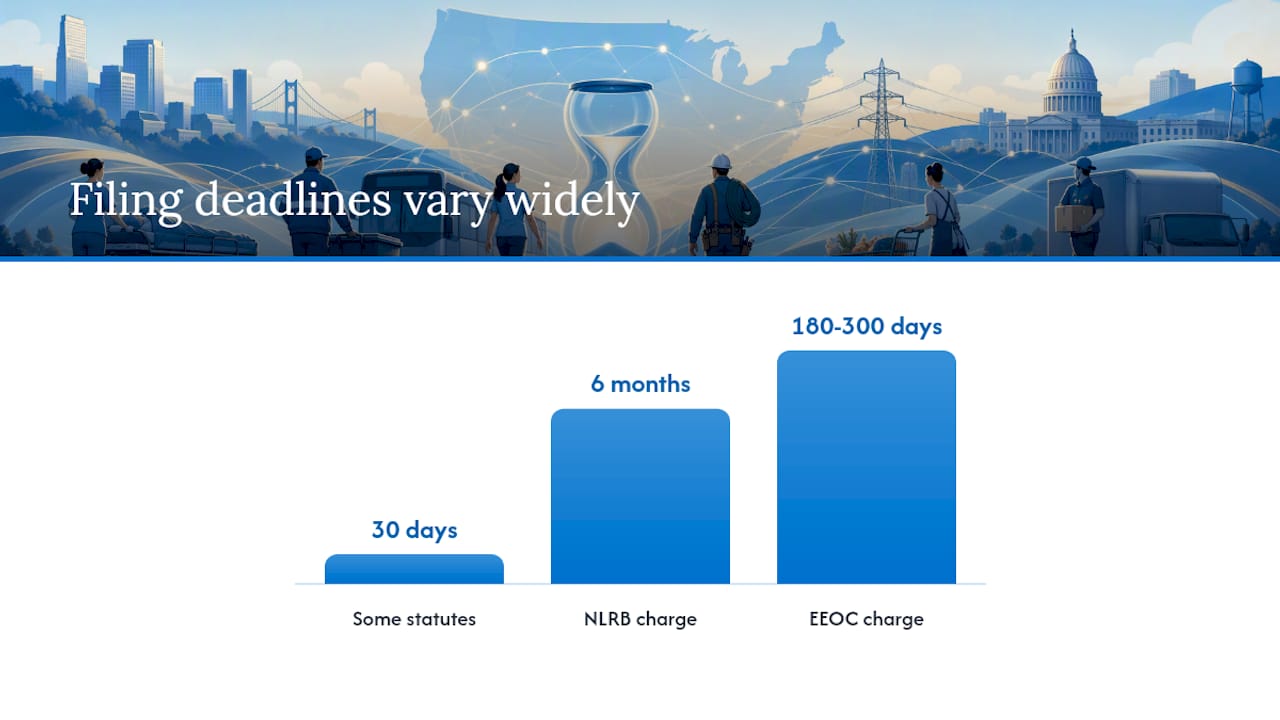
- Discrimination or accommodation denial: EEOC charge (must file within 180 or 300 days of the act, depending on your state)
- Unfair labor practice: NLRB charge (generally within six months of the act)
Typical timelines vary. DOL wage investigations can take several months depending on complexity. OSHA whistleblower complaints involve a preliminary review, then a merit determination; some statutes require filing within as few as 30 days of the retaliatory act. EEOC charges often take six months to a year before a right-to-sue letter is issued.
For workers dealing with concurrent OSHA and workers’ compensation issues, such as a needlestick exposure in a healthcare setting, immediate medical response and incident documentation are critical to preserving both claims.
Workplacefairness offers plain-language guides on each of these processes. If your situation involves ongoing threats or complex legal questions, consulting an attorney or union representative early can prevent missed deadlines. Review the employee rights guide for a broader overview of federal protections and filing steps.
How anti-retaliation and whistleblower protections work
Retaliation is one of the most common violations essential-services workers face, and one of the most misunderstood. Protected activities include:
- Filing or threatening to file an OSHA safety complaint
- Reporting patient safety concerns or financial misconduct (healthcare)
- Requesting a reasonable accommodation under the ADA
- Participating in union organizing or collective bargaining
- Cooperating with a government investigation
The critical distinction is how the complaint is framed. Whistleblower protection generally applies when you report a specific safety hazard or illegal conduct through a formal channel, not when you informally complain about working conditions. Labor law experts stress that protection turns on whether the complaint is documented as a report of a legal violation, not merely a grievance.
Pro Tip: Send your complaint as a date-and-time-stamped email to your supervisor, CC your union representative or compliance officer, and keep copies of all responses. This creates a paper trail that establishes both the content of your report and the employer’s knowledge of it.
State retaliation protections for healthcare workers exist in many jurisdictions but require following specific state procedures and timelines. Check your state’s safe harbor statute before acting. You can also find retaliation-specific guidance through Workplacefairness’s advocacy resources.
Collective bargaining and strike rights for essential-services workers
Private-sector essential workers have full NLRA organizing and collective bargaining rights. The NLRB enforces those rights and handles unfair labor practice charges when employers interfere with organizing or bargaining in bad faith.
Public-sector essential workers face a different legal landscape. Many states prohibit strikes by police, firefighters, and other public employees. The ILO’s guidance on essential services holds that restrictions on collective action should be narrowly applied and limited to situations involving an imminent threat to life or public safety. U.S. law does not uniformly follow that standard; public-sector strike rights depend entirely on state statute.
When striking is prohibited or strategically inadvisable, workers have legally safer alternatives:
- Filing unfair labor practice charges with the NLRB
- Engaging in protected concerted activity (group complaints, petitions, work-to-rule)
- Targeted bargaining demands focused on safety and staffing
- Public advocacy through unions, professional associations, or nonprofit organizations
- Filing complaints with DOL, OSHA, or EEOC to create regulatory pressure
When to involve a lawyer, union rep, or outside organization
Not every situation requires an attorney, but knowing when to escalate matters.
- Small pay dispute or overtime question: — File a DOL or state wage complaint first. Many are resolved without legal representation.
- Discrimination or accommodation denial: — File an EEOC charge. An employment attorney can help you evaluate whether to pursue litigation after receiving a right-to-sue letter.
Free resources include Workplacefairness guides, DOL and OSHA agency pages, EEOC’s public guidance, state labor department websites, legal aid organizations, and union member assistance programs. When you consult an attorney, bring your documentation: pay stubs, timecards, written complaints, employer responses, and any termination or discipline notices. The Workplacefairness attorney directory connects you with employment lawyers who handle essential-services cases. You can also review labor standards enforcement options to understand what enforcement agencies can and cannot do for you.
Key Takeaways
Essential-services designation does not remove your federal workplace rights; the FLSA, OSHA, ADA, NLRA, and Title VII apply to you regardless of how your employer or government classifies your role.
| Point | Details |
|---|---|
| Essential status changes nothing | Federal protections for pay, safety, accommodations, and organizing remain fully in force. |
| Document before you file | Date-stamped written records are the foundation of any successful wage, safety, or retaliation claim. |
| Use formal reporting channels | Whistleblower and anti-retaliation protections apply to documented, written complaints, not informal grievances. |
| Sector rules add layers | Healthcare, public safety, and transportation workers face additional state and federal rules; check your state’s specific statutes. |
| Workplacefairness is your starting point | Free guides, plain-language explanations, and an attorney directory are available at Workplacefairness for essential-services workers navigating any of these issues. |
What Workplacefairness has seen in essential-services cases
The workers who come to Workplacefairness with the strongest cases share one thing: they documented early and filed through the right channel. The workers who struggle are often those who waited, assuming their employer would correct the problem, or who raised concerns verbally without creating a written record.
There is a persistent belief that essential-services designation grants employers unusual authority to override standard protections. It does not. The DOL has been explicit on this point. What the designation does do is create pressure, and that pressure sometimes leads employers to test the limits of what workers will accept. Knowing your rights precisely, and knowing where to file when they are violated, is the most direct form of resilience available to you.
Workplacefairness has provided free employment rights information since 1994. The guides on this site cover every major federal statute discussed here, and the attorney directory can connect you with counsel if your situation requires it.
Workplacefairness guides for essential-services workers
If you work in healthcare, public safety, or transportation and you are facing a wage dispute, a safety concern, or retaliation, Workplacefairness gives you a direct path forward without the cost of a legal consultation just to understand your options. The site’s free guides cover every federal statute discussed in this article, with plain-language explanations written for workers, not lawyers.
Start with the employee rights guide for a structured walkthrough of your federal protections and the filing steps that apply to your situation. If your issue involves a specific violation pattern, the common violations guide helps you identify whether what happened to you fits a recognized legal category. When you are ready for individualized help, the Workplacefairness attorney directory connects you with employment lawyers who handle essential-services cases. Visit Workplacefairness now to find the guide that matches your situation.
Useful sources and agency contacts
- Health Care Workers and the Americans with Disabilities Act | U.S. Equal Employment Opportunity Commission
- Essential Workers — Essential Protections | U.S. Department of Labor
- Health Care Workers | U.S. Department of Labor
- Healthcare labor standards | L&I Washington
- Laws to Protect Healthcare Workers: Rights, Safety & Protections
- Healthcare Workers’ Rights: Wages, Safety, and Protections — LegalClarity
- ILO sample of practices in the definition and application of essential services
When filing any complaint, save your confirmation number and note the date. Agency timelines vary, and having a record of your filing date protects you if a statute of limitations question arises later. For healthcare and public safety workers, check your state labor department’s website for sector-specific staffing rules and mandatory overtime restrictions that may apply in your jurisdiction.
This article provides general legal information, not legal advice. Confirm current rules with the relevant federal or state agency or a qualified employment attorney before acting on any specific situation.