
No federal law requires extra pay for a split shift. A handful of states and Washington, D.C. do. In those places, you generally earn one additional hour of pay at the minimum wage on any day your schedule is split. Everywhere else, you are owed pay for the hours you work, and any bonus depends on your employer’s policy, your contract or your union agreement.
This guide explains what counts as a split shift, where the premium applies, how to calculate it, and how it differs from overtime and shift differentials. We also cover how to raise a problem if your paycheck does not add up.
TL;DR
- A split shift is a workday divided into two or more separate parts by an unpaid break longer than a normal meal period.
- Federal law does not require a split-shift premium. California, Washington, D.C. and New York are among the places with a rule.
- Where a rule exists, the premium is usually one hour of pay at the minimum wage, added on top of what you earned that day.
- Split-shift pay, overtime and shift differentials are three different things. One does not replace the others.
- Keep your own record of start times, end times and breaks. It is the strongest evidence if you ever need to file a claim.
Table of Contents
- What counts as a split shift
- Does federal law require split shift pay?
- Where split shift premiums apply
- How the premium is calculated
- Spread of hours pay
- Split shift pay, overtime and shift differentials
- Checking your own pay
- What to do if you were underpaid
- Our perspective
- Support free workplace rights information
- FAQ
- Sources
What counts as a split shift
A split shift is a single workday broken into separate segments, with an unpaid gap between them. A restaurant server who works 11 a.m. to 2 p.m., goes home, then returns for 5 p.m. to 9 p.m. has worked a split shift. So has a home health aide who sees one client in the morning and another in the evening, with an unpaid gap in between.
What matters is the gap. A normal meal period usually does not turn a shift into a split shift. Washington, D.C., for example, treats a schedule as split when daily hours are nonconsecutive, but a day in which total time out for meals is one hour or less is not a split shift, according to A Better Balance’s summary of state and city scheduling laws.
Two other situations are often confused with split shifts:
- A shift that crosses midnight. A single continuous shift that begins one evening and ends the next morning is not split just because it spans two calendar days. The work is not divided.
- Time you are truly off duty. Under the federal rule at 29 C.F.R. § 785.16, as explained in a Department of Labor opinion letter, you are not paid for off-duty periods when you are completely relieved from duty and the time is long enough to use for your own purposes.
That second point is the reason split shifts are legal in the first place. The unpaid gap is allowed under federal law when it is a genuine break. The question is whether your state adds a premium for the inconvenience.
Does federal law require split shift pay?
No. The Fair Labor Standards Act sets the federal minimum wage and overtime rules. It does not add a special payment for a divided workday. If you are completely free during the gap, the gap is generally unpaid under the federal rule described above.
That does not mean your employer can do anything it likes with the gap. Three things still apply everywhere:
- You must be paid for all time worked. If you are told to stay on the premises, answer calls or remain ready to work during the gap, it may be paid time. Our guide to the engaged to wait test for on-call pay explains how the Department of Labor looks at that question.
- Minimum wage still has to be met. Your pay for the hours you actually worked must meet the applicable federal, state or local minimum.
- Overtime is counted on hours worked. The total of all segments in the workweek counts toward overtime, not just the longest one.
If your state has no split-shift rule, check your offer letter, handbook or union contract. Some employers promise a premium even when the law does not.
Where split shift premiums apply
A few jurisdictions have written a premium into their wage rules. Because these rules change, treat the list below as a starting point and confirm the current rule with your state labor department.
| Jurisdiction | Premium | Notable limits |
|---|---|---|
| California | One hour of pay at the minimum wage, in addition to the minimum wage for that workday | Does not apply when the employee resides at the place of employment |
| Washington, D.C. | One hour of pay at the minimum wage rate, in addition to wages earned that day | Meal time totaling one hour or less does not make a split shift; does not apply to employees who live on the premises |
| Nueva York | One additional hour of pay at minimum wage when there is a split shift or the spread of hours exceeds 10 hours | Rules differ by industry wage order |
The California and D.C. entries come from A Better Balance’s state and city fact sheet, which cites California’s wage order at Cal. Code Regs. tit. 8 § 11040 and D.C. Municipal Regulations tit. 7 §§ 906 and 907. The New York entry comes from the same fact sheet, which cites N.Y. Comp. Codes R. & Regs. tit. 12, §§ 142 and 146.
Other states and cities may have their own scheduling or predictability rules that touch split shifts. Search your state labor department’s website for “split shift,” “spread of hours” and “reporting time pay.” If you work in a city with its own fair workweek law, check that law too.
How the premium is calculated
The California Department of Industrial Relations gives the clearest official explanation. In its split shift guidance, the premium is one hour at the state minimum wage, or the local minimum wage if that is higher. Any amount you earned above minimum wage that day is credited toward the premium.
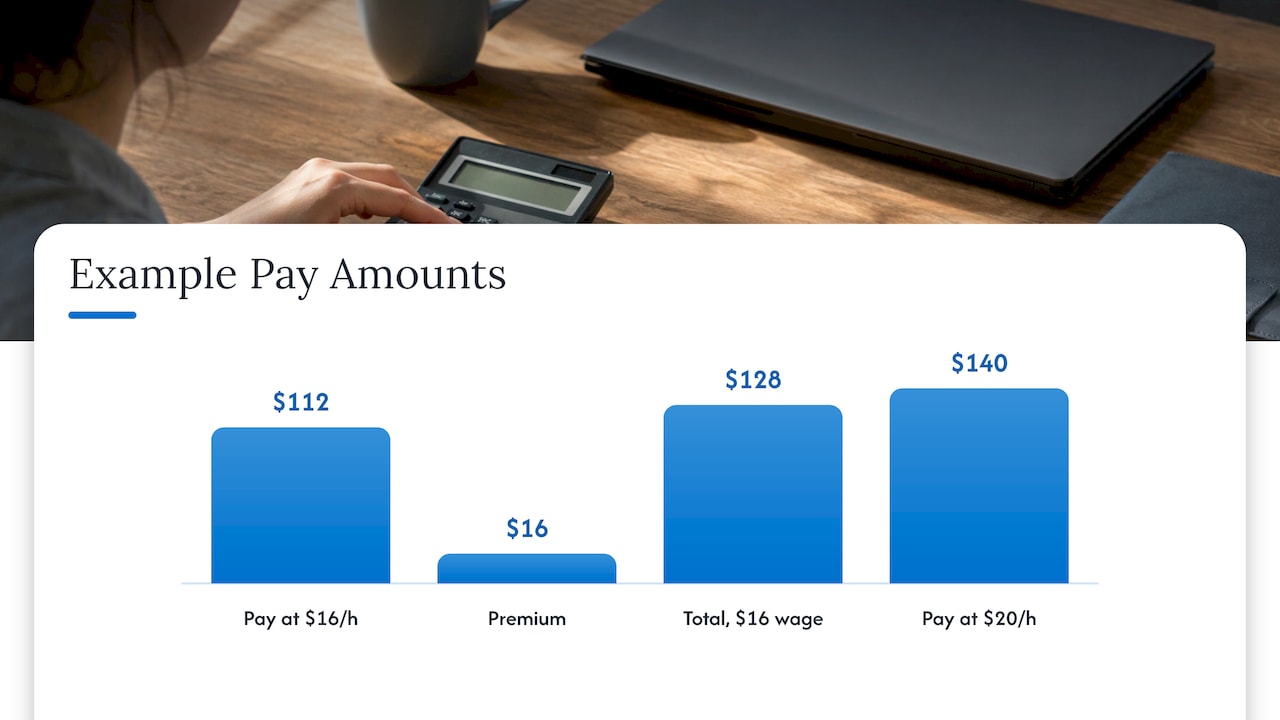
That credit is where most confusion begins. Here is a worked example using round numbers, not any real rate:
- Minimum wage in your area: $16.00 per hour.
- Your hourly rate: $16.00.
- You work 3 hours at lunch and 4 hours at dinner, a total of 7 hours.
- Your pay for the hours worked: 7 x $16.00 = $112.00.
- Premium owed: 1 hour at $16.00 = $16.00, in addition to the $112.00.
- Total: $128.00.
Now the same day with an employee who earns $20.00 an hour:
- Pay for 7 hours: $140.00.
- The minimum-wage floor for the day is 7 x $16.00 = $112.00, plus the $16.00 premium, for $128.00.
- Because the employee already earned $140.00, which is more than $128.00, the premium is treated as already covered in California.
This credit approach applies under the California rule described above. Other jurisdictions may word their rules differently, so read your own state’s wage order or ask the labor agency how it counts.
Exceptions to watch for
The California agency lists several situations where the premium is not owed: the employee lives at the workplace, the employee asks for the break for their own convenience, or the employee voluntarily picks up an extra shift. Washington, D.C. also excludes employees who live on the premises.
If your schedule was set by your employer, and not at your request, the “own convenience” exception should not apply. Keep any text messages or scheduling app records that show who chose the split.
Split shifts and overtime
The California agency states that a split shift has no impact or effect on overtime. In practice, that means two things. The premium does not itself count as hours worked toward overtime, and a split schedule does not cancel overtime you have earned. Add up every hour you actually worked in the day and week. Our overtime pay guide for labor workers walks through the federal overtime rules, and Unpaid Overtime Explained shows how to check whether your paycheck reflects them.
Spread of hours pay
Spread of hours is a close cousin of split shift pay. It looks at how long the whole workday stretches from your first start to your last finish, whether or not you are working the entire time. In New York, the rule described above requires one additional hour of pay at minimum wage when there is a split shift or when the spread of hours for the day exceeds 10 hours.
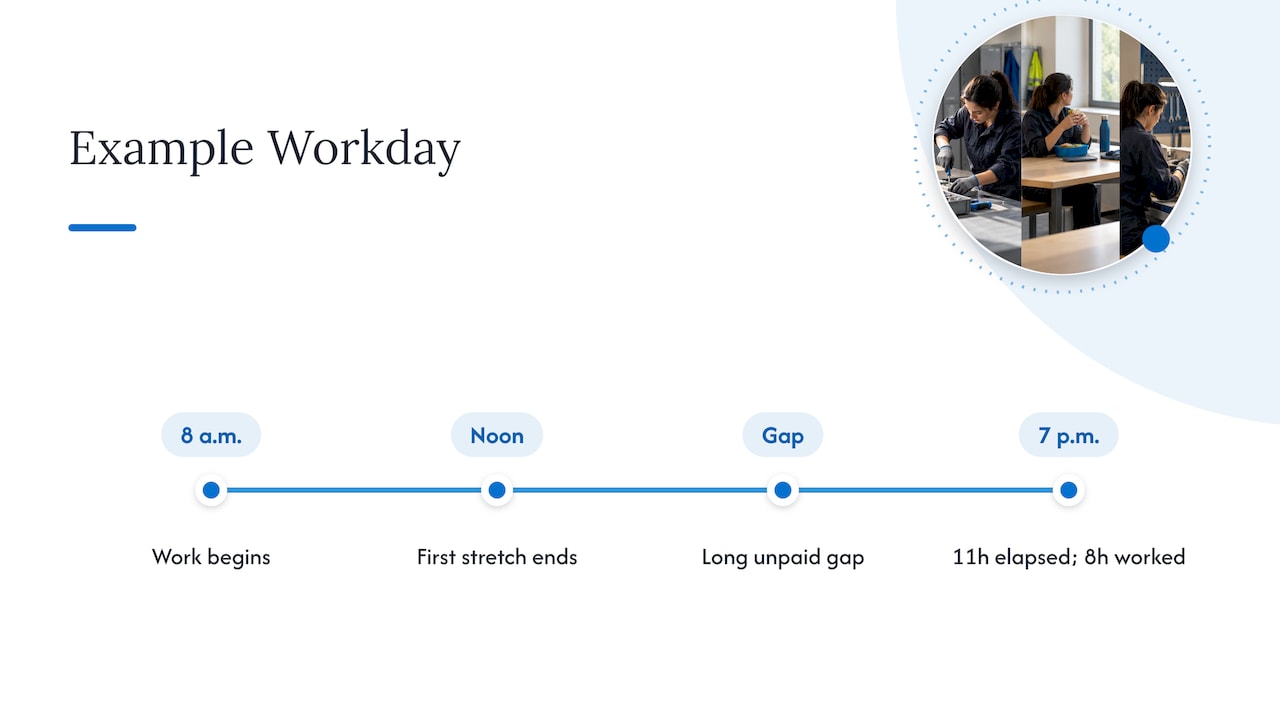
Example: you start at 8 a.m., work until noon, take a long unpaid gap, and finish a second stretch at 7 p.m. Your actual work may be only 8 hours, but the day stretches across 11 hours. Under a spread-of-hours rule, that long span can trigger the extra hour.
The New York State Department of Labor has also noted, in an announcement about home care aide minimum wage, that home care aides whose workdays last longer than ten hours may be entitled to extra daily pay equal to one hour at the minimum wage rate for spread of hours. Home care is one of the fields where long, broken days are common, so aides should look closely at their pay stubs.
Split shift pay, overtime and shift differentials
These three terms get mixed up, and the confusion costs workers money. They answer different questions.
| What triggers it | Required by federal law? | |
|---|---|---|
| Split shift premium | Your workday is divided by an unpaid gap | No, only certain states and D.C. |
| Spread of hours pay | Your workday stretches past a set length, such as 10 hours | No, only certain states |
| Overtime | You work more than the legal threshold in a workweek | Yes, for most nonexempt employees |
| Shift differential | You work an undesirable shift, such as nights, weekends or holidays | No |
A shift differential is extra pay added on top of your base rate for atypical shifts like nights, weekends and holidays. According to Miter’s guide to shift differentials, the FLSA does not require them, and when both a differential and overtime apply, the differential is included in your regular rate before the overtime multiplier is applied. For a plain explanation of how night and weekend premiums are treated differently from overtime, see this overview of shift differential pay.
The practical point: these payments can stack. A nonexempt worker in California who works a split night shift with overtime hours could be owed the base wages, a differential if the employer offers one, the split-shift premium and overtime. Each is calculated on its own terms.
Whether you are even eligible for overtime depends on your classification. Read Exempt vs Nonexempt and our 2026 overtime salary threshold guide to see where you fall.
Checking your own pay
Most split-shift problems are discovered on the pay stub, not the schedule. Use this routine for any week you worked a divided day.
- Write down every start and stop time. Include the gap. A photo of the posted schedule helps, and so does a note in your phone.
- Count the gap. Was it a short meal period or a longer unpaid stretch? Were you free to leave?
- Find your minimum wage. Check the state and local rate where you work. The higher number controls.
- Look for a separate line on your stub. In a state with a premium, it may be labeled split shift, spread of hours or something similar.
- Add up weekly hours. Make sure any overtime is paid on the total.
Rounding can also quietly shave minutes off a split schedule, since every punch in and out is another chance to lose time. Our guide to time clock rounding explains what is allowed. If you worked while off the clock during the gap, see proof for off-the-clock work, which explains what evidence you will need.
What to do if you were underpaid
Start with a calm written request. Email your manager or payroll contact, describe the days in question, list the hours, and ask for a correction. Keep a copy.
If that does not work:
- Contact your state labor agency. In states with a premium, it enforces the rule. The agency’s website usually has a wage claim form.
- Contact the U.S. Department of Labor’s Wage and Hour Division if the issue involves minimum wage or overtime under federal law.
- Speak with an employment attorney. Many offer a free first consultation, and our attorney directory can help you find one.
Wage claims have filing deadlines that differ by state and by type of claim, so do not wait. Retaliation for asking about your pay is prohibited under both federal and many state laws, but document any change in your schedule or treatment after you speak up.
Our perspective
Split shifts fall hardest on people who can least afford them: restaurant staff, home care aides, retail and hospitality workers, and others whose schedules are set by someone else. A divided day can mean hours of unpaid waiting, extra transportation costs and childcare that does not line up. A premium recognizes that cost, and where the law provides one, workers should know it exists.
We have spent decades linking the knowledge of employment rights attorneys with the people who need it. Our approach is simple: explain the rule in plain words, show the math, and point you to the agency or professional who can act. Rules differ widely by state, which is exactly why clear, free information matters. Workers who understand their pay are better equipped to ask for what is owed, and employers who understand it are better equipped to get it right.
Every workplace benefits when schedules are fair and pay is transparent. We encourage you to read your pay stub carefully, keep your own records and share what you learn with coworkers.
Max
Support free workplace rights information
Workplace Fairness provides free, plain-language information on pay, scheduling, discrimination and your options for taking action. Our work depends on readers who believe workers should understand their rights. A Workplace Fairness membership starts at $25 per year and helps keep guides like this one available to everyone.
If you are looking for a broader starting point, our guide to common work issues covers pay, leave, discrimination and more, and you can find everything on the Workplace Fairness home page.
FAQ
Is split shift pay required by federal law?
No. The federal government does not require a special payment for a divided workday. Some states and Washington, D.C. do, usually as one extra hour of pay at the minimum wage. Check your state labor department and your employment agreement.
Can my employer schedule me for a split shift?
Generally yes, since split shifts are not automatically illegal. What changes by location is whether you must receive a premium. Time you are required to stay available, or to work during the gap, may be paid time, so make sure the gap is a true break.
Do I get split shift pay if I work for tips?
In a place that has a split-shift rule, the premium is tied to the minimum wage and the workday, not to how you are paid. Tipped employees should read their state’s wage order or ask the labor agency how tips and credits are counted. Keep records of your hours either way.
How many breaks do I get on a 12-hour shift, and is that the same as split shift pay?
No, they are separate topics. Break and meal period rules are mostly set by states and differ widely, while split shift pay is a premium for a divided workday. Check your state labor department’s page on meal and rest breaks for the rule where you work.
Sources
- WHD Opinion Letter FLSA2018-20, U.S. Department of Labor
- State and City Laws and Regulations on Fair and Flexible Scheduling, A Better Balance
- Split Shift, California Department of Industrial Relations
- New York State Department of Labor announcement on home care aide minimum wage
- Guide to shift differentials in construction, Miter
- Shift Differential Pay, Salary Atlas