
Seasonal workers in the United States are protected by core federal law. The Fair Labor Standards Act and OSHA cover seasonal employees the same way they cover full-time workers, entitling them to minimum wage, overtime for hours over 40 in a workweek, and safe working conditions. Agricultural seasonal workers receive additional protections under the Migrant and Seasonal Agricultural Worker Protection Act, and visa-based workers under H-2A and H-2B programs carry their own set of employer obligations and anti-trafficking safeguards.
If you are a worker and suspect a violation, contact the DOL Wage and Hour Division or your state labor department before the filing deadline passes.
If you are an employer, start with the DOL’s MSPA compliance page and the WHD’s seasonal employment guidance to confirm your posting, disclosure, and payroll obligations before the season begins.
Core protections that apply to most seasonal workers:
- Federal minimum wage (and any higher state minimum) for all hours worked
- Overtime pay at 1.5 times the regular rate for hours over 40 in a workweek
- Safe working conditions under OSHA standards
- Anti-retaliation protections when reporting violations
- Written disclosures at recruitment (required under MSPA for agricultural workers)
- Anti-discrimination protections enforced by the EEOC
Key Takeaways
Seasonal workers in the United States are covered by the same core federal wage, safety, and anti-discrimination laws as full-time employees, with additional statutory protections for agricultural and visa-based workers under MSPA and H-2A/H-2B rules.
| Point | Details |
|---|---|
| Federal baseline applies to all | FLSA minimum wage and overtime (40-hour trigger) and OSHA safety standards cover nonexempt seasonal workers regardless of job duration. |
| MSPA adds agricultural-specific duties | Agricultural employers must provide written disclosures at recruitment, meet housing and transport standards, and retain records for three years. |
| Visa workers have explicit anti-trafficking rights | H-2A and H-2B employers may not confiscate travel documents; doing so is a recognized trafficking indicator under State Department guidance. |
| Misclassification carries serious liability | Mislabeling an employee as an independent contractor removes wage and safety protections and exposes employers to back-pay claims and OSHA citations. |
| Workplacefairness provides free guidance | Workers and employers can access plain-language rights guides, enforcement resources, and attorney referrals at no cost through Workplacefairness. |
Primary sources and agency pages
The following federal resources were used throughout this guide. Each is a primary or statutory source you can consult directly to verify rules, download forms, or file complaints.
- DOL Wage and Hour Division — Seasonal Employment: Baseline FLSA and overtime rules for seasonal employees; best for wage and hour questions.
- DOL WHD — MSPA Overview: Full MSPA compliance guidance, disclosure forms, and contractor registration information; use for agricultural employer compliance and worker rights.
- 29 USC Chapter 20, Subchapter III — MSPA Statutory Text: The statute itself, covering disclosure, posting, recordkeeping, and prohibited practices.
- 29 U.S.C. § 1832 — Wages and Working Arrangements: Statutory text on timely wage payment and prohibition on employer-only purchasing requirements.
- OSHA — Protecting Temporary Workers: Joint-employer safety responsibilities for staffing agencies and host employers; use for safety complaints and training obligations.
- U.S. Department of State — Temporary Workers (H Visas): Rights information for H-2A and H-2B visa holders; use for trafficking red flags and pre-arrival rights disclosures.
- eCFR 29 CFR Part 553 — Seasonal and Recreational Establishment Exemptions: FLSA overtime exemption rules for qualifying seasonal amusement or recreational establishments.
- New Jersey DOL — Temp Worker Protections: Example of state law exceeding federal minimums; useful for understanding how state temporary worker statutes work and what additional protections may apply in your state.
This article is general information, not a substitute for advice from a qualified lawyer. Consult a qualified legal professional about your own circumstances before acting on anything here.
Table of Contents
- What counts as seasonal employment under U.S. law?
- Which federal laws protect seasonal workers?
- How does the FLSA apply to seasonal workers’ wages and overtime?
- What does MSPA require for seasonal agricultural workers?
- What rights do H-2A and H-2B visa workers have?
- How do you assess classification risk for seasonal workers?
- Employer compliance checklist from hiring through end of season
- What can you do if your rights as a seasonal worker are violated?
- Sources
What counts as seasonal employment under U.S. law?
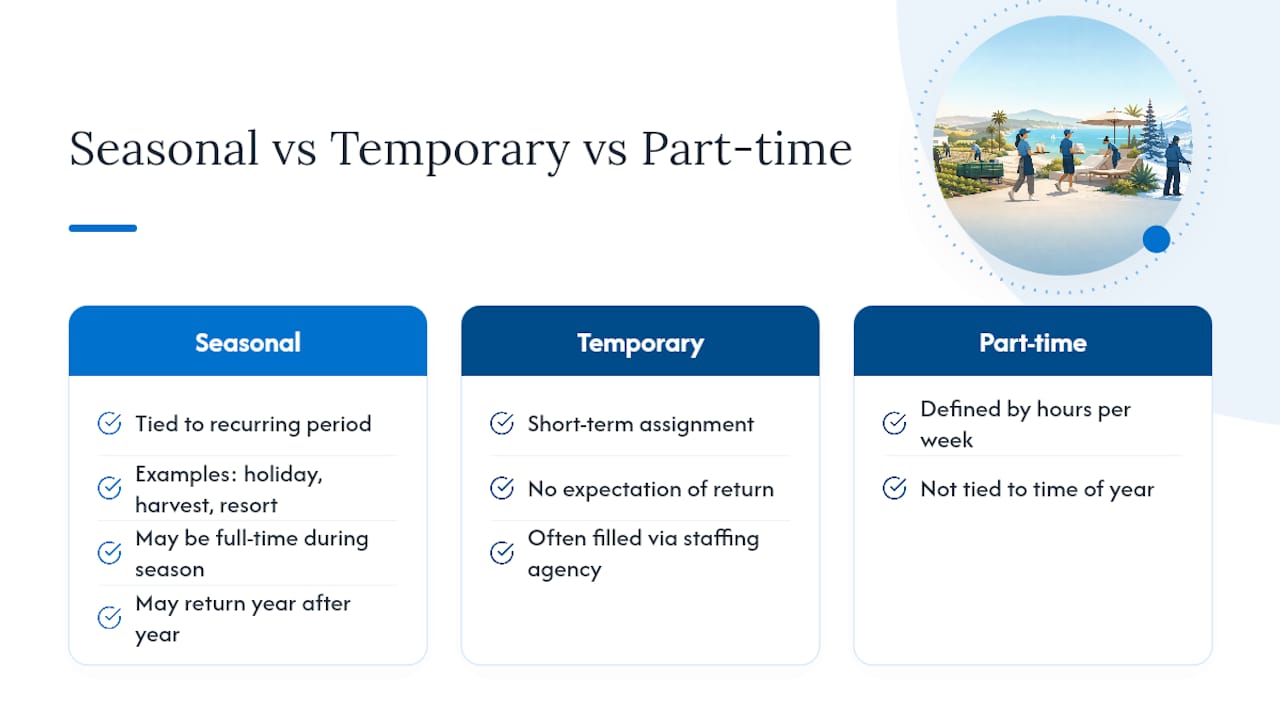
Federal law does not define “seasonal employee” for wage and hour purposes. The FLSA applies based on the nature of the work relationship, not the label an employer attaches to it. In practice, seasonal employment refers to work tied to a predictable recurring period — a harvest cycle, a holiday retail surge, a summer resort season — where the employer’s need for labor rises and falls with the calendar.
That distinction matters because it separates seasonal work from two related categories. Temporary employment typically describes a short-term assignment with no expectation of return, often filled through a staffing agency. Part-time employment is defined by hours per week, not by the time of year. A seasonal worker may be full-time during the season and may return year after year, which actually strengthens the argument that they are an employee rather than an independent contractor.
For practical compliance, treat a role as seasonal when the employer’s operational need is genuinely tied to a recurring period and the worker is not expected to remain after that period ends. Common examples include holiday retail associates hired from October through January, agricultural harvest workers employed for a specific crop cycle, and hotel or resort staff working Memorial Day through Labor Day.
One statutory boundary deserves attention: MSPA applies only to seasonal and migrant agricultural workers. A seasonal retail worker or a summer lifeguard does not fall under MSPA, but both remain covered by the FLSA, OSHA, and EEOC protections described throughout this guide.
Pro Tip: If you are unsure whether a role qualifies as seasonal for a specific statute, check the DOL’s Wage and Hour Division guidance for that statute directly — the agency publishes fact sheets that clarify coverage by industry and worker type.
Which federal laws protect seasonal workers?
The table below maps each major statute to its primary protections, the agency that enforces it, and when it becomes relevant for seasonal roles, based on general federal guidance.
| Statute / Rule | Primary Protections | Enforcement Agency | When It Applies to Seasonal Work |
|---|---|---|---|
| Fair Labor Standards Act (FLSA) | Minimum wage, overtime (40-hour trigger), recordkeeping | DOL Wage and Hour Division (WHD) | All nonexempt seasonal employees in covered enterprises |
| Occupational Safety and Health Act (OSH Act) | Safe workplace, hazard communication, anti-retaliation | OSHA | All employers with one or more employees, including seasonal hires |
| Migrant and Seasonal Agricultural Worker Protection Act (MSPA), 29 U.S.C. Ch. 20 | Written disclosures, housing/transport standards, recordkeeping, anti-retaliation | DOL WHD | Seasonal and migrant agricultural workers; farm labor contractors |
| Title VII / ADA / ADEA (via EEOC) | Anti-discrimination on race, sex, disability, age, national origin | EEOC | All employers with 20 or more employees |
| H-2A / H-2B visa programs | Wage guarantees, document protections, anti-trafficking safeguards | DOL (certification), DHS/DOS (immigration) | Employers sponsoring foreign nationals for seasonal agricultural or nonagricultural work |
| 29 CFR Part 553 | Exemptions for state/local government and seasonal/recreational establishments | DOL WHD | Seasonal amusement or recreational establishments meeting specific revenue/operational tests |
The FLSA and OSHA form the baseline. Every other statute layers on top of that foundation for specific worker categories. Understanding which layer applies to your situation is the first step toward either asserting your rights or building a compliant program.
Pro Tip: State labor law frequently exceeds federal minimums. California’s Division of Labor Standards Enforcement (DLSE), for example, enforces a higher minimum wage and stricter overtime rules than federal law requires. Always check your state labor department’s website alongside federal guidance — the higher standard is the one that controls.
How does the FLSA apply to seasonal workers’ wages and overtime?
Nonexempt seasonal workers are entitled to the federal minimum wage for every hour worked and overtime at 1.5 times their regular rate for hours over 40 in a workweek. No federal law caps the number of hours a seasonal worker aged 16 or older may work — the obligation is simply to pay overtime once that 40-hour threshold is crossed.
Overtime with piece-rate pay
Piece-rate workers earn overtime too, and the calculation is slightly different. Suppose a worker earns $0.50 per unit and picks 500 units in a 50-hour week. Total straight-time earnings equal $250. The regular rate is $250 ÷ 50 hours = $5.00 per hour. The overtime premium owed for the 10 hours over 40 is $5.00 × 0.5 × 10 = $25.00. Total pay: $275.00. The DOL’s WHD publishes fact sheets on piece-rate calculations that walk through this math in detail.
Worker checklist: verifying your pay
- Confirm your pay stub shows total hours worked, the pay rate, and any deductions itemized separately.
- Check that deductions for housing, meals, or tools do not reduce your effective hourly rate below the applicable minimum wage.
- Keep copies of your pay stubs, any written offer or recruitment notice, and your own time records (a simple daily log works).
- If you were paid by direct deposit, save the bank statement showing the deposit date and amount.
Employer checklist: payroll compliance
- Classify each worker as exempt or nonexempt before the first day of work, using the FLSA’s duties test, not just the job title.
- Track hours worked for all nonexempt workers every workweek, including any hours worked remotely or off-site.
- Calculate overtime on the workweek basis (Sunday through Saturday, or any fixed seven-day period), not on a biweekly or monthly average.
- Apply any applicable state minimum wage if it exceeds the federal rate of $7.25 per hour.
- Retain payroll records for at least three years as required under the FLSA.
One exemption worth noting: 29 CFR Part 553 addresses overtime exemptions for certain seasonal amusement or recreational establishments. These exemptions are narrow and conditional — they do not apply simply because a business operates seasonally. Employers should confirm eligibility with a qualified employment attorney before relying on them.
Statistic callout: The 40-hour workweek overtime trigger under the FLSA applies to seasonal workers the same as any other nonexempt employee. The DOL Wage and Hour Division recovers millions in back wages annually through investigations that include seasonal industries such as agriculture, hospitality, and retail.
For additional guidance on wage documentation, Workplacefairness’s day laborer wage protections guide covers recordkeeping strategies that apply equally to seasonal workers.
What does MSPA require for seasonal agricultural workers?
The Migrant and Seasonal Agricultural Worker Protection Act is the most detailed federal statute specifically written for seasonal workers. It applies to seasonal agricultural workers — those employed in agriculture on a seasonal or other temporary basis — and to the farm labor contractors and agricultural employers who hire them.
Core MSPA employer obligations
- Written disclosures at recruitment: Before a worker agrees to employment, the employer or farm labor contractor must provide a written statement covering the place of employment, wage rates, crops and activities involved, period of employment, transportation arrangements, housing details, and any deductions from wages.
- Workplace posting: A copy of the worker’s rights under MSPA must be posted at the worksite in a conspicuous location.
- Recordkeeping: Employers must retain payroll and employment records for three years, covering hours worked, wages paid, and deductions taken.
- Farm labor contractor registration: Contractors who recruit, solicit, hire, employ, furnish, or transport seasonal agricultural workers must register with the DOL unless a specific exemption applies.
- Housing and transportation standards: Employers who provide housing or transportation must meet federal safety and health standards. These standards cover structural conditions, sanitation, and vehicle safety.
- Wage payment: Under 29 U.S.C. § 1832, wages must be paid when due, and employers may not require workers to purchase goods or services exclusively from the employer.
- Anti-retaliation: MSPA prohibits retaliation against workers who assert their rights or file complaints.
Language and form requirements
Written disclosures must be provided in English and, when the worker is not fluent in English, in a language the worker understands. The DOL publishes MSPA disclosure forms in Spanish and other languages, which employers can use directly. Providing a disclosure only in English to a worker who does not read English does not satisfy the statute.
MSPA compliance checklist for workers and employers
Workers arriving at a new agricultural job should confirm they received a written disclosure before agreeing to work, that the disclosure matches actual working conditions, and that required postings are visible at the worksite, according to federal guidance. Employers should verify that every farm labor contractor they use holds a current DOL registration certificate, that all written disclosures were provided before the worker agrees to employment, and that housing and transportation meet federal safety standards before workers arrive.
What rights do H-2A and H-2B visa workers have?
Visa-based seasonal workers carry explicit federal protections that begin before they set foot in the United States. Under State Department and DOL guidance, employers sponsoring H-2A (agricultural) or H-2B (nonagricultural) workers must provide workers with information about their rights prior to visa approval. That obligation is not optional, and it is not satisfied by a brief verbal summary.
Mandatory employer duties for H-2A and H-2B positions
- Provide written information about the worker’s rights and protections before the visa is issued.
- Pay the applicable wage rate stated in the job order — for H-2A workers, this is the Adverse Effect Wage Rate (AEWR) or the applicable prevailing wage, whichever is higher.
- Cover inbound transportation costs from the worker’s home country and, upon completion of the contract, outbound transportation home.
- Not confiscate, destroy, or withhold a worker’s passport, visa, or other travel documents under any circumstances.
- Not charge recruitment fees that would be illegal under U.S. law.
Trafficking red flags every visa worker should know
If an employer confiscates your passport or travel documents, withholds your wages, restricts your movement, threatens you with deportation, or tells you that you owe a debt that must be repaid before you can leave, these are recognized indicators of labor trafficking. You have the right to keep your own documents. You have the right to leave. Contact the DOL Wage and Hour Division, the U.S. Department of State, or a local legal aid organization immediately.
Workers who experience any of these conditions can also contact the National Human Trafficking Hotline. Workplacefairness’s guide on labor trafficking indicators explains these red flags in detail and outlines the steps to get help.
For visa-specific enforcement questions, the DOL’s Office of Foreign Labor Certification and the State Department’s visa information pages are the primary resources. Workers should not wait to act — retaliation for reporting trafficking indicators is itself a federal violation.
How do you assess classification risk for seasonal workers?
The employee vs. independent contractor distinction is one of the most consequential legal questions in seasonal employment. Getting it wrong exposes employers to back-pay liability, unpaid payroll taxes, and OSHA citations. Workers misclassified as contractors lose minimum wage protections, overtime rights, workers’ compensation coverage, and unemployment insurance eligibility.
Factors courts and the DOL examine
The DOL applies an economic reality test that looks at the totality of the working relationship, not any single factor. Key considerations include:
Degree of control: Does the employer control how the work is performed, not just the result? A worker told when to arrive, what tools to use, and how to complete each task looks like an employee.
Opportunity for profit or loss: Can the worker genuinely profit from their own business decisions, or does their income depend entirely on the hours the employer assigns? True contractors bear real financial risk.
Permanency of the relationship: A worker who returns season after season to the same employer, doing the same work, has a relationship that courts often treat as employment.
Integral nature of the work: If the work is central to the employer’s core business — picking crops for a farm, stocking shelves for a retailer — that weighs toward employee status.
Joint-employer situations
When a staffing agency places a worker at a host employer’s site, both entities may share legal obligations. OSHA’s guidance on temporary workers is explicit: the staffing agency and the host employer are jointly responsible for worker safety and must coordinate training and hazard communication. A written contract between the agency and the host should specify who handles safety training, who maintains injury records, and who responds to OSHA inspections. Absent that clarity, both parties can be cited.
State law adds another layer. New Jersey’s temporary worker protections require staffing agencies to provide written assignment notifications, detailed pay statements, and advance notice of schedule changes — obligations that go well beyond federal minimums. Several other states have enacted or are considering similar “Temporary Workers’ Bill of Rights” legislation.
Pro Tip: If you are an employer using a staffing agency, do not assume the agency handles all compliance. Review the contract to confirm who is responsible for OSHA training, workers’ compensation coverage, and wage recordkeeping — then document that agreement in writing before the season starts.
Employer compliance checklist from hiring through end of season
A structured compliance process reduces enforcement risk and protects workers. The steps below apply to most seasonal hiring situations; agricultural employers must layer MSPA obligations on top.
- Before posting the job: Confirm the correct worker classification (employee vs. contractor), identify applicable state and federal wage rates, and draft a written job notice that includes the wage rate, expected hours, duration of employment, and any deductions.
- At recruitment: Provide written disclosures required by MSPA (agricultural) or applicable state law. For H-2A/H-2B positions, complete DOL certification and provide the required rights information before the visa is issued.
- Before the first day: Post required federal and state labor law notices in a conspicuous location. Confirm workers’ compensation coverage is in place. Complete I-9 employment eligibility verification.
- During the season: Track hours worked for all nonexempt workers every workweek. Pay wages on the scheduled payday — MSPA requires wages to be paid when due. Conduct a midseason safety walkthrough and document any hazards identified and corrected.
- At end of season: Issue final paychecks on or before the next regular payday (state law controls the exact deadline). Retain payroll records for at least three years under the FLSA; MSPA agricultural records also require three-year retention. Store records in a secure location, either physical or digital, with access controls.
Sample language for written offers and recruitment notices
A compliant written offer for a seasonal role should include at minimum: the employer’s legal name and address, the job title and duties, the start and anticipated end date, the wage rate and pay frequency, any deductions that will be taken, the name of the workers’ compensation insurer, and a statement that the worker’s rights are protected under applicable federal and state law. For agricultural roles, the MSPA disclosure form available from the DOL covers most of these elements and can be used directly.
Pro Tip: Run a two-part compliance audit: one at midseason (check that hours are being tracked accurately and that safety postings are current) and one at end of season (confirm all final wages were paid, records are retained, and any incidents were documented). A one-hour review at each point is far less costly than a WHD investigation.
Workplacefairness’s common employer labor law violations guide identifies the most frequent compliance failures and how to avoid them.
What can you do if your rights as a seasonal worker are violated?
Filing the right complaint with the right agency is the fastest path to a remedy. The agency you contact depends on the type of violation.
Filing paths by violation type
- Unpaid wages or overtime: File with the DOL Wage and Hour Division at dol.gov/agencies/whd or call 1-866-4-US-WAGE. The WHD investigates and, when violations are confirmed, can recover back wages and an equal amount in liquidated damages.
- Workplace safety violations or retaliation for reporting safety hazards: File with OSHA at osha.gov or call 1-800-321-OSHA. Retaliation complaints under Section 11© of the OSH Act must be filed within 30 days of the adverse action.
- Discrimination based on race, sex, national origin, disability, or age: File a charge with the EEOC at eeoc.gov. The filing deadline is generally 180 days from the discriminatory act, extended to 300 days in states with their own anti-discrimination agencies.
- MSPA violations (agricultural workers): File with the DOL WHD, which enforces MSPA. Workers may also bring a private civil action under MSPA.
- State-level wage or classification violations: Contact your state labor department. Some states, like New Jersey, allow civil actions for temporary worker violations within six years of the violation.
Evidence to collect before you file
- Pay stubs and bank records showing amounts and dates received
- Your written job offer, recruitment notice, or any text messages or emails about pay and hours
- Your own time records (a daily log of hours worked, even handwritten, carries weight)
- Photos of housing or worksite conditions if safety or MSPA housing standards are at issue
- Any written communications in which the employer threatened retaliation or withheld documents
Typical remedies
Back pay and liquidated damages under the FLSA can equal twice the unpaid wages. MSPA provides for actual damages or statutory damages of up to $500 per violation per plaintiff in a civil action. OSHA retaliation complaints can result in reinstatement, back pay, and removal of adverse records. Private lawsuits are most common when the employer refuses to cooperate with agency investigations or when the violation is willful.
Workplacefairness’s guide on labor standards enforcement walks through the complaint process in plain language and explains what to expect at each stage.
Common misconceptions about seasonal worker rights
Three myths circulate widely enough to cause real harm. Each one is directly contradicted by federal agency guidance.
Myth: “Seasonal” means fewer legal rights.
Fact: The DOL is explicit that seasonal status does not remove FLSA or OSHA obligations. An employer cannot use a short-term or seasonal label to avoid paying overtime or maintaining a safe workplace. The DOL’s seasonal employment page states this directly.
Myth: Using a staffing agency relieves the host employer of safety obligations.
Fact: OSHA’s temporary worker guidance holds both the staffing agency and the host employer jointly responsible for worker safety. Both can be cited for violations.
Myth: Visa-based workers have fewer protections because they depend on the employer for their status.
Fact: H-2A and H-2B workers retain full wage and safety rights. Threatening a worker with visa revocation to suppress a complaint is itself a federal violation and a recognized trafficking indicator.
The DOL has consistently held that the temporary or seasonal nature of employment does not diminish a worker’s entitlement to minimum wage, overtime, or a safe workplace. Enforcement actions in agriculture, hospitality, and retail confirm that the agency applies these standards regardless of how an employer characterizes the work relationship.
Consider a straightforward enforcement example: a seasonal agricultural employer fails to pay overtime to harvest workers who regularly work 50-hour weeks, reasoning that the workers are “seasonal” and therefore exempt. The WHD investigates, finds no applicable exemption, and recovers back wages for the unpaid overtime hours plus an equal amount in liquidated damages. The employer also faces civil money penalties for willful violations. This outcome is consistent with how the WHD handles wage claims across seasonal industries.
Workplacefairness compiles and explains these enforcement patterns in its employee rights guide, which draws on federal agency sources to give workers and employers a reliable reference.
Why this guide exists and how to use it
Workplacefairness was founded in 1994 as the National Employee Rights Institute, with a mission to connect employment rights attorneys with workers, advocates, and organizations committed to fairness on the job. The organization changed its name in 2001 to reflect a broader commitment: building community awareness of workplace issues and promoting progressive, equitable changes in employment law and practice.
This guide was built from primary federal sources — the DOL, OSHA, EEOC, and the U.S. Code — because seasonal workers and the employers who hire them deserve accurate, plain-language information, not generic summaries. If you are a worker facing a potential violation, the resources linked throughout this guide connect you directly to the agencies and legal aid organizations that can help. If you are an employer working to build a compliant program, the checklists and source links here give you a documented starting point.
For questions that go beyond general information, Workplacefairness’s attorney directory can connect you with an employment lawyer who handles seasonal and agricultural worker cases.
Workplacefairness is here to help you understand your rights
Seasonal work should not mean uncertain rights. Workplacefairness provides free, plain-language guides on wage claims, workplace safety, discrimination, and employment law — written specifically for workers who need clear answers without the cost of a consultation. Unlike a law firm, Workplacefairness does not represent clients; it gives you the information and referrals you need to make informed decisions and find qualified legal help when you need it.
Start with the employee rights guide for a comprehensive overview of your protections under federal law, or use the attorney directory to find an employment lawyer in your state. If you are a new or returning seasonal worker, the workplace rights guide for new employees covers the specific protections that apply from your first day on the job.
Sources
- Seasonal Employment / Part-Time Information | U.S. Department of Labor
- Migrant and Seasonal Agricultural Worker Protection Act (MSPA) | U.S. Department of Labor
- Temporary workers (H visas) information | U.S. Department of State
- 29 USC CHAPTER 20, SUBCHAPTER III: SEASONAL AGRICULTURAL WORKER PROTECTIONS
- Protecting Temporary Workers | Occupational Safety and Health Administration
- 29 U.S.C. § 1832 – Wages, supplies, and other working arrangements | Legal Information Institute
- 29 CFR Part 553 — Exemptions for State and Local Government; seasonal and recreational establishments | eCFR
- Temp worker protections | New Jersey Department of Labor