
The federal overtime salary threshold in 2026 is $684 per week, or $35,568 per year. A salaried employee who earns less than that cannot be treated as exempt from overtime under the federal executive, administrative, and professional exemptions. Earning more does not automatically make you exempt, and several states set a much higher floor than the federal one. This guide explains the numbers, the tests that sit behind them, and what you can do if you think you are owed overtime.
TL;DR
- The federal standard salary level is $684 per week ($35,568 per year) after the Department of Labor (DOL) formally rescinded the 2024 rule in May 2026.
- The federal highly compensated employee threshold is $107,432 per year, including at least $684 per week paid on a salary or fee basis.
- Salary is only one of three tests. Salary basis and actual job duties must also be met, whatever your title says.
- California, Colorado, New York, and Washington set their own higher thresholds, and your employer must follow whichever standard is better for you.
- Non-exempt employees are owed 1.5 times their regular rate for every hour over 40 in a workweek.
Table of Contents
- The federal overtime salary threshold in 2026
- Why the number alone does not decide your status
- State thresholds that exceed the federal level
- Overtime rules for 2026 beyond the salary line
- Our perspective: a threshold is a floor, not a fair wage
- How to check whether you are owed overtime
- Support the work behind these guides
- FAQ
- Sources
The federal overtime salary threshold in 2026
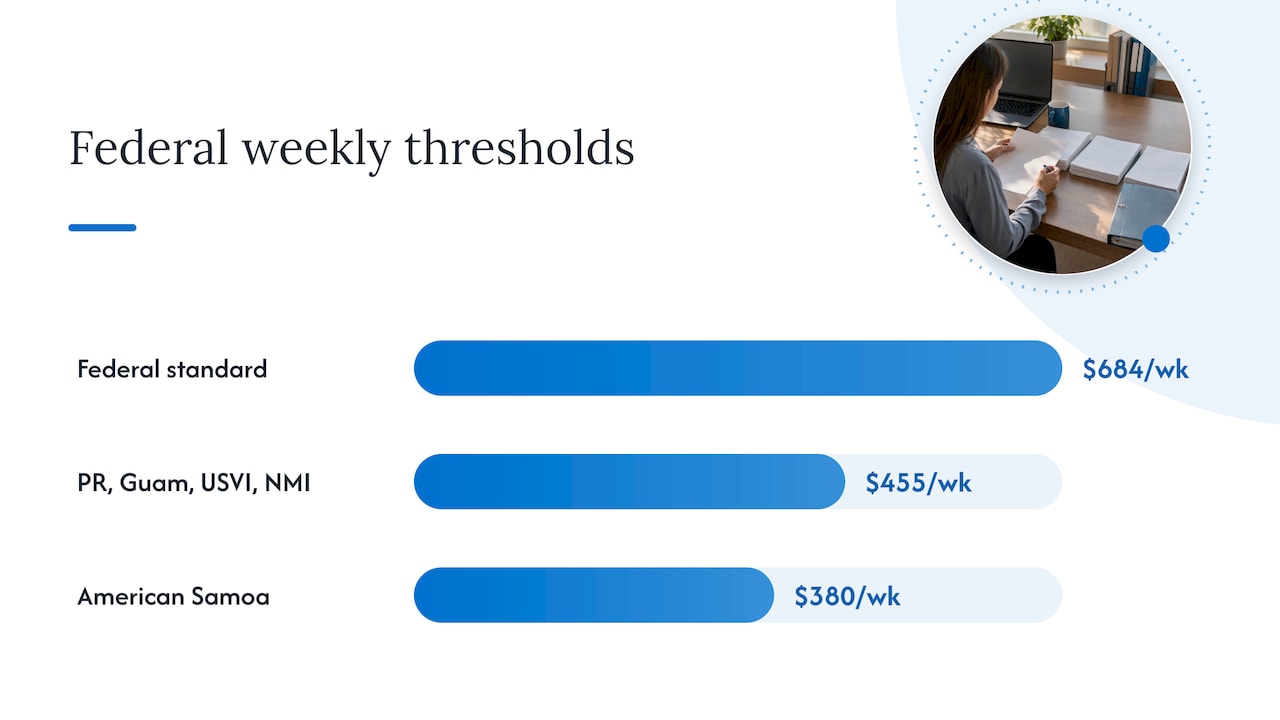
As of May 15, 2026, the standard salary level for the executive, administrative, and professional exemptions is $684 per week, which is $35,568 annually. The same notice sets the highly compensated employee (HCE) total annual compensation level at $107,432, including at least $684 per week paid on a salary or fee basis.
These are the 2019 figures. They return because federal courts vacated the DOL’s 2024 rule, and the Department then published a technical amendment to implement those judgments. Thompson Hine’s summary notes the change applied immediately, without a new comment period.
Some territories keep lower levels. The same Federal Register notice lists $455 per week for Puerto Rico, Guam, the U.S. Virgin Islands, and the Northern Mariana Islands, and $380 per week for American Samoa.
What happened to the higher 2024 numbers
The 2024 rule was meant to raise the threshold in steps. Workforce.com’s overview describes a first increase to $844 per week ($43,888 a year) on July 1, 2024, with a further increase to $1,128 per week ($58,656 a year) planned for January 1, 2025. Courts blocked that path, and the DOL has now removed the rule from the regulations. No automatic federal increases are currently scheduled.
If you read an article saying the threshold is $1,128 a week, it is out of date for federal purposes.
| Level | Weekly | Annual |
|---|---|---|
| Federal standard salary level (2026) | $684 | $35,568 |
| Federal HCE total compensation | at least $684 of it paid as salary or fee | $107,432 |
| 2024 rule, first step (vacated) | $844 | $43,888 |
| 2024 rule, second step (vacated) | $1,128 | $58,656 |
Why the number alone does not decide your status
Many employees assume that a salary above the threshold means no overtime. The law is more demanding. The DOL’s overtime guidance explains that an employee must meet a duties test as well as the salary test. Job titles such as “manager” or “director” do not settle the question. What you actually do all day does.
Three tests must all be met for an exemption to apply:
- Salary level. You earn at least the required amount: federal or state, whichever is higher.
- Salary basis. You are paid a predetermined amount that is not reduced because of the quality or quantity of your work. The DOL’s salary level page is the place to confirm how this works.
- Primary duties. Your main job is executive, administrative, or professional work as the regulations define it.
Fail any one and you are non-exempt, which means overtime is owed. Our guide on what an exempt or nonexempt classification really means walks through each test with examples.
Common misclassification patterns
We hear the same situations again and again:
- A “team lead” who spends most of the shift doing the same tasks as hourly staff, with no real authority to hire or fire.
- A salaried worker whose pay is cut when they leave early or produce less, which undermines the salary basis test.
- An employee paid just above $684 a week who is told the salary alone makes them exempt.
- A salaried worker in a high-threshold state whose employer applies only the federal number.
If any of these sound familiar, the job duties and your state’s rules deserve a closer look.
State thresholds that exceed the federal level
Federal law sets a floor, not a ceiling. When state and federal overtime laws both apply, your employer has to follow whichever is more generous to you. Several states have used that room.
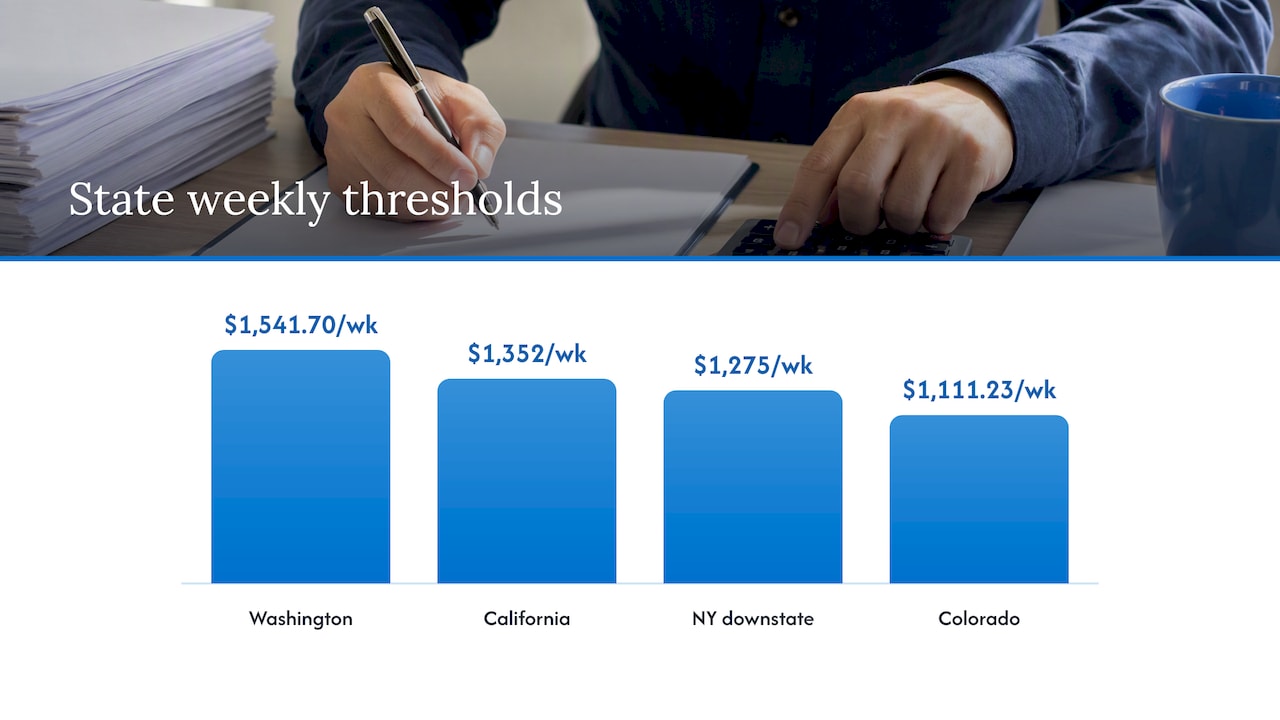
The figures below are 2026 levels reported by Symmetry’s state-by-state breakdown and, for Washington, by the Bellevue Chamber. Several of these are tied to state minimum wage, so they can change when the minimum wage does. Confirm the current figure with your state labor agency.
| Estado | Annual | Weekly | Notes |
|---|---|---|---|
| Washington | $80,168.40 | $1,541.70 | 2.25 times the state minimum wage of $17.13 per hour, rising toward 2.5 times by 2028 |
| California | $70,304 | $1,352 | Twice the state minimum wage, all employers |
| New York (NYC, Long Island, Westchester) | $66,300 | $1,275 | Higher downstate level |
| Colorado | $57,784 | $1,111.23 | Indexed by the state |
The gap is large. A salary of $58,000 clears the federal bar by more than $22,000 and still falls short of the California and Washington thresholds. Someone in those states earning that amount, and paid a flat salary to work long weeks, may be owed overtime even if their employer calls them exempt.
New York also has different levels outside the downstate area, and other states have their own rules, so check your own state’s labor department. Our 2026 guide to labor worker rights and overtime pay covers the broader picture.
Overtime rules for 2026 beyond the salary line
The threshold is the question people search for, but several other rules decide whether your overtime check is correct.
The 40-hour workweek
Under the FLSA, non-exempt employees must be paid at least 1.5 times their regular rate of pay for all hours worked over 40 in a single workweek. The federal minimum wage remains $7.25 per hour, according to the DOL’s fact sheet on the EAP exemptions. Federal law sets no cap on weekly hours for workers aged 16 and older, so the right being protected is pay, not time off. Some states add daily overtime. California is the best-known example.
Work that counts as hours worked
Small blocks of unpaid time add up quickly. Practitioners point to pre-shift tasks such as reading handoff reports, checking email, or gathering tools as compensable time. Rounding practices that consistently favor the employer draw scrutiny. We cover related situations in our guides to travel time pay, training time, and proving off-the-clock work.
New DOL opinion letters
The Wage and Hour Division continues to issue opinion letters in 2026. Xero’s summary of the guidance reports on letters covering four topics, and a recent letter on the learned professional exemption shows how the Division reads the salary and duties tests together. Opinion letters are not new law, but they show how the agency is likely to view a dispute.
Our perspective: a threshold is a floor, not a fair wage
We have followed overtime policy since our founding in 1994 as the National Employee Rights Institute, and the 2026 outcome is a familiar one. The salary line moves with court rulings and administrations, while the people affected go on working long weeks.
Advocates argue that the $684 level has fallen behind inflation and real wage growth, and proposals such as the Restoring Overtime Pay Act signal a continued push for a higher, indexed threshold, as HRCI’s coverage of the rescission notes. We have long said that workers lose most when a rule is unclear to them. Many do not know whether they are exempt, so they never ask.
Our advice is practical. Know the three tests. Keep your own record of hours. Read your state’s number, not only the federal one. And remember that equitable workplaces depend on workers who understand the standards their employers are held to. Looking back at our own coverage of earlier overtime proposals shows how often these thresholds have shifted, and why being informed matters more than any single year’s figure.
— Max
How to check whether you are owed overtime
Work through these steps in order.
- Find your pay basis. Are you paid a fixed salary, or by the hour with a salary label? If your pay is reduced when you work less, the salary basis test may fail.
- Compare your salary with both numbers. Your weekly pay must meet the federal $684 and your state’s level, if higher. Use the higher of the two.
- Describe your main duties in plain words. Do you direct other employees, use independent judgment on significant matters, or do work that requires advanced specialized knowledge? Or do you mostly do the same tasks as non-exempt colleagues?
- Log your hours. Record start, finish, breaks, and any work done before or after your shift, with dates. Texts, emails, and badge records help.
- Run the federal self-check. The DOL’s FLSA Overtime Security Advisor is a free tool that helps you work through the rules.
- Raise it. Many problems are fixed with a polite written question to HR or payroll.
If that does not work, our guide to the unpaid overtime claim process explains how to file, and our overview of unpaid overtime rights explains what you may recover. If the amounts are large or your employer retaliates, speak with an employment attorney or contact the DOL Wage and Hour Division or your state labor agency. Deadlines for claims apply, so do not wait.
Support the work behind these guides
Workplace Fairness is a free resource funded by people who believe workers should understand their rights. If these guides helped you, consider a Workplace Fairness membership, available from $25 per year. You can also explore our other guides on common work issues.
FAQ
What is the overtime threshold for 2026?
The federal salary threshold is $684 per week, or $35,568 per year, for the executive, administrative, and professional exemptions. Some states set higher levels, including Washington, California, New York, and Colorado. Use whichever is higher where you work.
Does the new overtime rule apply to salaried employees?
The 2024 rule that would have raised the threshold is no longer in effect, so federal salary levels are back to 2019 figures. Salaried employees can still be owed overtime if they earn under the applicable threshold or if their duties do not meet an exemption. Being salaried does not by itself mean exempt.
Can I be exempt if I earn more than $684 a week?
Not automatically. You must also be paid on a salary basis and perform exempt duties as your primary job. If you are in a state with a higher threshold, you must clear that number too.
Will the threshold go up again?
No federal increase is currently scheduled. Congress and the DOL may act in future, and some state thresholds rise when state minimum wages rise, so check your state’s figure each January and after any mid-year change.
Sources
- Federal Register: Defining and Delimiting the Exemptions (May 15, 2026)
- U.S. Department of Labor: Overtime Pay
- U.S. Department of Labor: Salary Levels
- U.S. Department of Labor: FLSA EAP Exemptions fact sheet
- U.S. Department of Labor: Opinion Letter FLSA2026-1
- U.S. Department of Labor: FLSA Overtime Security Advisor
- Thompson Hine: The Old Rule Is Now the New Rule
- Workforce.com: Overtime Pay Laws by State
- HRCI: DOL Finalizes Overtime Regulations Technical Amendment
- Xero: New DOL guidance on overtime
- Symmetry: 2026 Exempt Salary Thresholds by State
- Bellevue Chamber: Are Your Salaried Employees Actually Hourly Employees?