In most U.S. workplaces, your employer can search a company locker, especially when a written policy says lockers are subject to inspection. Your rights are stronger if you work for the government, if the employer let you use your own lock without keeping a key, or if the search is far broader than its stated reason. There is no single federal “locker law” for private employees. The answer depends on who employs you, what policy you signed, how the search is carried out, and your state.
This guide explains how the rules work for lockers, bags, purses and other personal property. It also covers what to do if you think a search went too far. It is about employees. Searches of students in schools follow different rules.
TL;DR
- Government employees are protected by the Fourth Amendment, so a search must be reasonable at its start and reasonable in scope. Private employees depend mostly on state law, union contracts and company policy.
- A written search policy, a master key or a kept lock combination usually removes an employee’s expectation of privacy in a locker.
- Personal bags, purses and briefcases generally receive more protection than a desk or an employer-issued locker, but a clear policy can reduce that protection.
- Searches should be limited, non-discriminatory and tied to a real business reason. Holding you in a room or blocking you from leaving can create separate legal problems for the employer.
- If you believe a search violated your rights, review the policy, write down what happened, raise it with HR, and then consider an agency or an employment attorney.
Table of Contents
- Why the answer depends on who your employer is
- The rule for public employees: reasonableness
- The rule for private employees: policy, ownership and state law
- Do you have a reasonable expectation of privacy in a locker?
- Bags, purses and other personal property
- What workplace policies usually say
- State law and union contracts
- If you are asked to consent to a search
- What to do if a search violated your rights
- Our perspective
- Support free employee rights information
- Frequently asked questions
- Sources
Why the answer depends on who your employer is
The first question is whether your employer is a government body or a private company. The Constitution restrains government, not private businesses. The Rhode Island ACLU’s workplace privacy guide explains that the Constitution protects only against government agencies. It adds that private-sector workers rely mainly on union protections, state and federal statutes, or an employment contract.
The Texas Workforce Commission describes the same split. Governmental employers must consider constitutional limits on unreasonable searches. Private employers more often face private lawsuits such as invasion of privacy, defamation and infliction of emotional distress.
| Public employer (federal, state, city, public school district) | Private employer | |
|---|---|---|
| Main legal source | Fourth Amendment and state constitutions | State privacy law, contracts, union agreements, common-law claims |
| Standard for a search | Reasonable at its start and in scope | Business reason, reasonable manner, no discrimination |
| Effect of a written policy | Can lower your privacy expectation | Often decisive in lowering it |
| Typical risk to employer | Constitutional claim | Invasion of privacy or similar tort claim |
If you are unsure which category you fall into, think about who signs your paycheck. A city sanitation worker, a state university employee and a postal worker are public employees. A retail clerk, warehouse picker or restaurant cook usually works for a private company, even when the business has government contracts.
The rule for public employees: reasonableness
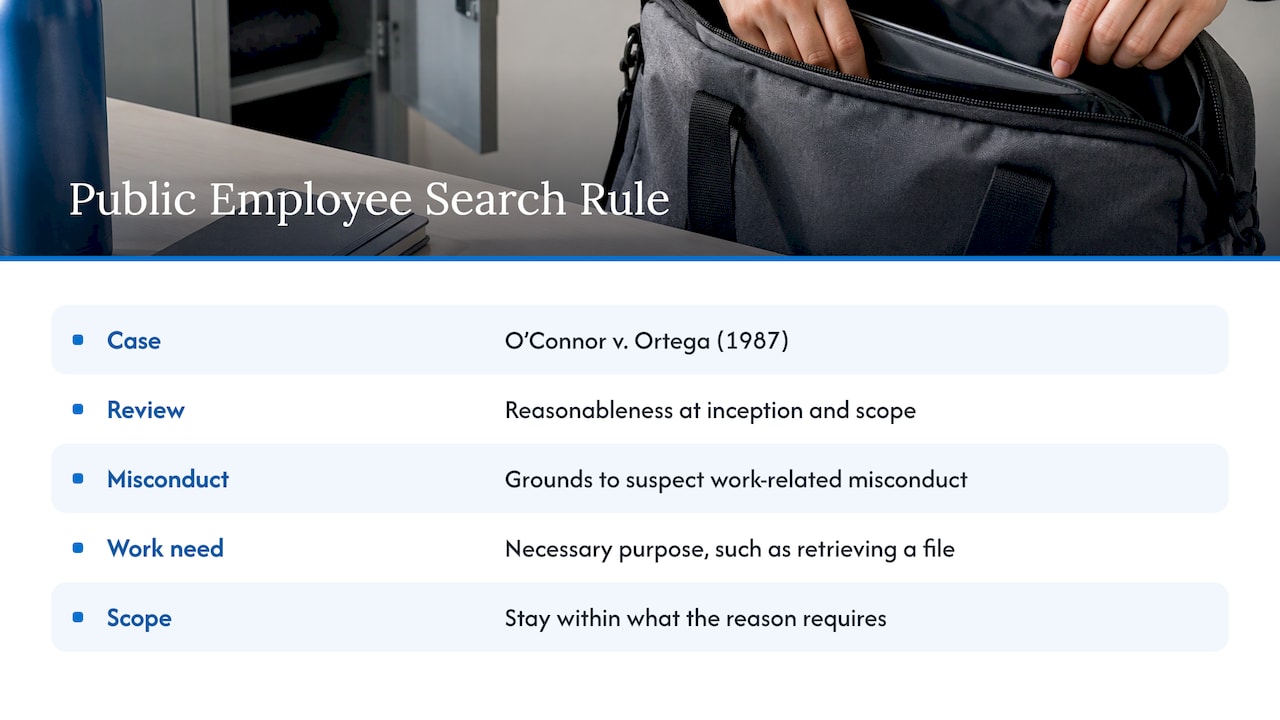
The key case is O’Connor v. Ortega (1987). The Supreme Court held that searches by government employers of employees’ private property are subject to Fourth Amendment restraints. It also held that these intrusions are judged by reasonableness under all the circumstances, looking at both the inception and the scope of the search.
In plain terms, a supervisor’s search of a public employee’s belongings is ordinarily justified at the start in two situations. One is when there are reasonable grounds to suspect the search will turn up evidence of work-related misconduct. The other is when the search is necessary for a noninvestigatory work purpose, such as retrieving a needed file. Even then, the search has to stay within what the reason requires.
The UNC School of Government adds an important practical point. It notes that a posted policy of periodic searches can make it hard for a public employee to claim an overriding privacy interest. Even when an employee does have a reasonable expectation of privacy, the employer can still justify the search with a combination of factors. These include a credible tip from a co-worker, a narrow scope, easy access to the space and a limited purpose.
What a reasonable public-sector search looks like
A search is easier to defend when:
- A specific, credible report points to a specific locker or item.
- The search covers only the space tied to that report.
- A policy told employees in advance that lockers could be inspected.
- The search is done discreetly, by authorized people, and is documented.
A search is harder to defend when it is a fishing expedition, singles out one person without a reason, or reaches into purses, pockets and personal papers that have nothing to do with the concern.
The rule for private employees: policy, ownership and state law
Private employers are not bound by the Fourth Amendment. That does not mean they can do anything. A private employer that searches in an unreasonable or intrusive way can face liability under state privacy law. Bettis Law Group, writing about South Carolina, notes that a private employer may be able to search employer-owned property at will. It also says courts generally disfavor suspicionless searches of personal belongings.
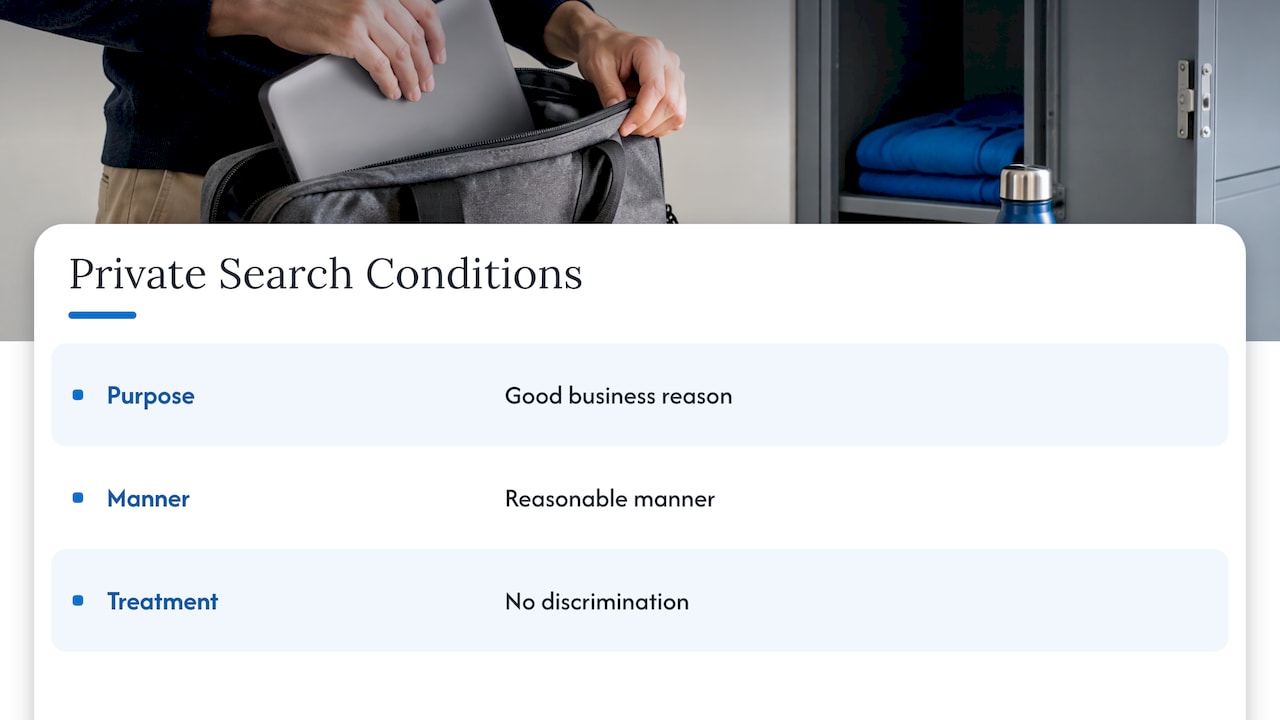
CCH Issues and Answers summarizes the general test. Property searches are generally permitted when there is a good business reason, a reasonable manner and no discrimination, for example a search aimed at only one class of employees.
Discrimination is a line employers cannot cross. The Rhode Island ACLU guide says an employer cannot enforce search policies differently on grounds such as sex or race. If only workers of one race or gender are ever searched, that is a discrimination question, not just a privacy one. Our guide to employee rights explains how discrimination protections work more broadly.
Do you have a reasonable expectation of privacy in a locker?
Courts usually ask whether you reasonably expected the locker to be private, and whether the employer’s own conduct supported that expectation. Several factors matter.
Who owns the locker and who holds the key
Lisa Guerin, J.D., writing for legal-info.lawyers.com, explains that because a desk and locker almost certainly belong to the employer, you likely lack an expectation of privacy in their contents unless the employer led you to believe it would not search. She adds that you have no right of privacy in the contents if the employer:
- gave you the combination,
- requires employees to give HR a lock combination or spare key, or
- has a policy stating that lockers are subject to search.
Your own lock
The lock matters. A Texas case, K-Mart Corp. v. Trotti, involved a worker who secured her locker with her own lock. The court found she had a reasonable expectation of privacy that the employer violated when it searched without requiring the combination, and it held that $100,000 in exemplary damages was not excessive.
The reasoning, as set out in an employment law text, is that when an employee buys and uses her own lock with the employer’s knowledge, a fact finder may conclude the employee expected privacy and the employer recognized it. The same text explains the opposite case. If a locker is unlocked, or secured with a lock the employer provided and whose combination or master key the employer kept, a jury could reasonably infer the employer kept an interest in conducting legitimate searches.
That is one court’s reasoning in one state. Outcomes vary, and a policy that clearly reserves the right to search can change the analysis.
How personal the item is
Bettis Law Group notes that in South Carolina, the more personal an item, the more likely courts find a reasonable expectation of privacy. An employee likely has fewer privacy expectations in an unlocked desk drawer than in a purse inside a locker secured by her own lock.
Bags, purses and other personal property
Search rules for lockers and for personal property overlap, but they are not identical. Ervin Cohen & Jessup LLP explains that a personal locker, handbag or briefcase is entitled to more protection than a desktop. It adds that a written policy telling workers to expect searches of all areas can significantly change their privacy expectation.
In practice, employers commonly check bags in settings such as retail stockrooms, warehouses, manufacturing plants and secure facilities. These checks are most defensible when they are routine, announced in writing, applied evenly and limited to a quick look for company property or prohibited items.
An employer who searches only after a specific accusation faces closer scrutiny. The same firm advises that a search should be limited to the areas directly implicated by the evidence. If someone was seen putting company property in one locker, the search should cover that locker, not every personal possession and work area.
Items you carry for a disability-related need can raise separate questions about accommodation and confidentiality. If those items include supplies for an assistance animal, this overview of emotional support animals at work explains how federal and state rules apply.
Detention is a different problem
A search is not a license to restrain you. Bettis Law Group states that searches in which an employee is led to believe, or is actually kept, from leaving a room or the premises are strongly disfavored and may expose the employer to civil claims for false imprisonment. If a manager blocks a door or tells you that you cannot leave until you open your bag, note exactly what was said and who was present.
What workplace policies usually say
Most private employers that search put the rules in a handbook. Guidance written for employers shows what to expect:
- The Texas Workforce Commission recommends a simple policy reserving the right to search employees, work areas, lockers, vehicles on company property and other personal items to monitor compliance with rules on security, drugs and alcohol, and contraband.
- CCH advises that a policy should describe the areas that may be searched, such as work areas, lockers, packages, purses, backpacks, electronic files and cars on company property.
- Ervin Cohen & Jessup LLP recommends that handbooks say work areas may be searched at any time, with or without notice, and that they name private areas such as lockers, briefcases and handbags.
This is advice to employers, not a legal guarantee, and policies differ widely. Your own handbook is the document that matters most. Read the sections on searches, security, property and privacy. Look for words such as “lockers,” “personal belongings” and “inspection.”
If you signed an acknowledgment, you have less room to challenge a search. LegalClarity notes that if no policy exists and an employer goes through your bag without consent, that can strengthen a later claim. Our workplace privacy rights guide covers related questions about monitoring and personal information.
State law and union contracts
There is no uniform national rule. State courts and legislatures shape the details, which is why a Texas decision about a locker lock will not automatically control a case in another state. Some states recognize common-law invasion of privacy claims that reach unreasonable intrusions, and some state constitutions apply to private conduct in limited ways. Check your state labor department’s materials, and if you are covered by a union agreement, read its search and discipline provisions.
Union contracts often set rules a handbook cannot override. They may require that a steward be present, limit when searches can occur or define what “reasonable suspicion” means. If you are in a union, tell your steward promptly after any search.
Private employees can also look at related areas of law. If surveillance or searches are used to monitor or punish workers who discuss wages or organize, the National Labor Relations Board may be involved, as the Privacy Rights Clearinghouse notes in its employment privacy overview. Our page on workplace surveillance rights explains how monitoring rules fit together.
If you are asked to consent to a search
How you respond in the moment matters. These steps are general information, not legal advice for your situation.
- Stay calm and do not physically resist. A disagreement is better handled afterward, in writing.
- Ask whether the search is mandatory. LegalClarity notes you are within your rights to ask whether consent is required and to request a witness.
- Ask which policy applies and where it is written.
- Say clearly if you do not consent, rather than staying silent. Silence can later be read as agreement.
- Notice if you are not free to leave. If you are being held, say that you want to leave and note the response.
- Write it down afterward. Record date, time, place, who was present, what was searched, what was said and any witnesses.
Because refusing a search may carry consequences under a policy you signed, think about the tradeoff. Many people comply, document the event and challenge it afterward. In a public job, or if you believe the search is discriminatory or retaliatory, speak with an employment attorney soon.
What to do if a search violated your rights
The Privacy Rights Clearinghouse suggests a sequence. Start by reviewing company policies and filing an internal HR complaint. If that does not resolve the matter, depending on the facts you may contact:
- the EEOC, for medical privacy, disability or discrimination issues,
- your state labor department, for state-specific privacy protections,
- the FTC, for improper use of background checks under the Fair Credit Reporting Act, or
- the NLRB, if surveillance is used to monitor or retaliate against workers discussing wages or unionizing.
Keep your records, and keep copies of anything you sign. Do not delete messages related to the search. Be careful about retaliation: if you complain and then face discipline, that timing should also be written down. Our guide to at-will employment rights explains where legal protections against retaliation fit, and our personnel files by state page explains how to ask for records about your own employment.
When the stakes are high, such as a termination, a false theft accusation, a physical search or detention, consult an employment attorney. Many offer free or low-cost first consultations, and our site includes an attorney directory to help you find one.
Our perspective
We founded this work in 1994 on a simple belief: people cannot use rights they do not know they have. Workplace searches are a good example. Most workers never read the handbook paragraph about lockers until a supervisor is standing at theirs.
We see the issue as one of fairness, not only of property. Searches should be tied to a real purpose, applied evenly and carried out with dignity. When they are not, systemic barriers fall hardest on workers with the least leverage, including hourly staff and those who cannot afford to lose a paycheck.
That is why we explain these rules in plain language and keep our materials current. Knowing the difference between a public and a private employer, a posted policy and a vague assumption, or a locker you lock and one the company keys, can change how you respond in the moment and what you do afterward.
We also believe in collective action. Workers who document, ask questions together and push for clear, fair written policies build equitable workplaces for everyone. Information is the first step, and we are committed to making it free.
Max
Support free employee rights information
Workplace Fairness is a free resource, and it exists because readers and supporters help sustain it. If this guide helped you understand your rights, consider becoming a member. Membership starts from $25 per year.
You can learn more and join on our membership page, or start from our home page to find guides on wages, discrimination, privacy and finding an employment attorney.
Frequently asked questions
Can my employer search my locker without telling me?
Often yes, if the locker belongs to the employer and a policy reserves the right to search. Lack of notice matters less when you have no reasonable expectation of privacy, for example because the employer holds a key or combination. Public employees have added protection, since searches must be reasonable. Your state’s law and any union contract can add limits.
Can my employer search my purse or backpack?
A private employer can often do so if a clear written policy covers it and the search is reasonable, evenly applied and tied to a business reason. Personal bags generally get more protection than a desk, so suspicionless or intrusive searches carry more risk for the employer. A government employer generally needs reasonable grounds under the Fourth Amendment.
Does using my own lock protect my locker?
It can help. In K-Mart Corp. v. Trotti, a Texas court found a privacy violation where the employee used her own lock and was not required to share the combination. The result can change if you signed a policy allowing searches or the employer required a key or combination. Check your handbook before relying on a lock.
Can an employer stop me from leaving during a search?
Searches that keep an employee from leaving a room or the premises are strongly disfavored and may support civil claims such as false imprisonment, according to a South Carolina employment law guide. If this happens, say you want to leave, write down what was said and speak with an employment attorney.
Do school locker search rules apply at work?
No. School searches of students are governed by a separate body of law and school district policies. Workplace searches turn on whether your employer is public or private, your policy, your contract and state privacy law.
Sources
- O’Connor v. Ortega, 480 U.S. 709 (1987), Cornell Legal Information Institute
- Employee Privacy and Workplace Searches, UNC School of Government
- Searches at Work: Legal Issues to Consider, Texas Workforce Commission
- Your Rights to Workplace Privacy in Rhode Island, ACLU of Rhode Island
- Privacy in the Workplace: FAQs for Employees, legal-info.lawyers.com
- Scope and Limits of Employer Control, Employment Law text
- South Carolina Employers Search or Surveil Their Employees, Bettis Law Group
- Workplace Searches, Ervin Cohen & Jessup LLP
- Searching employees’ property: When is it permitted? CCH
- Employment, Privacy Rights Clearinghouse
- Accused of Stealing at Work Without Proof? Your Rights, LegalClarity
- Emotional support animals at work