
A furlough is a temporary, employer-imposed leave from work, usually unpaid, after which you are expected to return to the same job. A layoff is a separation from the employer, and in most cases a permanent one. The practical gap is whether you are still an employee: that one fact shapes your health coverage, your PTO, your final paycheck and how you approach unemployment benefits.
We built Workplace Fairness to give employees plain-language answers to questions like this one, because the words an employer picks in a meeting often matter less than what the paperwork says. This guide explains the difference, shows where the two overlap, and tells you what to ask when you are handed either notice.
TL;DR
- Furlough: temporary unpaid time off. You stay an employee and expect to return, and you generally receive no severance.
- Layoff: the employment relationship ends. It may be permanent, or temporary with a hope of rehire, but you are no longer on the payroll.
- Benefits: health coverage during a furlough follows your employer’s plan rules. A layoff typically ends coverage and leads to a COBRA offer.
- Labels do not decide your rights. A mass separation called a furlough can still trigger 60 days of advance notice under the federal WARN Act.
- Ask for the details in writing: duration, pay, benefits, PTO and whether recall is promised.
Table of Contents
- The core difference: are you still an employee?
- Why the two words blur together
- What about a RIF?
- Furlough vs. reduction in hours
- Pay during a furlough: hourly vs. salaried
- Health insurance: where the two paths split
- PTO: use it, keep it or lose it?
- Unemployment benefits
- Advance notice: the WARN Act
- Federal employees and government shutdowns
- What to ask when you get the notice
- Perspective
- Keep learning your rights
- FAQ
- Sources
The core difference: are you still an employee?
Under a furlough, you remain on the employer’s books. You are not working and, in most cases, not being paid, but the job is yours to come back to. USC’s guidance on job displacement describes a furlough as a temporary suspension from work and a layoff as a permanent separation, with furloughed workers expected to return to their roles.
A layoff cuts that tie. You are no longer an employee, so you are generally not entitled to the benefits that depend on being one. Some layoffs are described as temporary, with the employer intending to call workers back. Even then, the relationship has ended, and a recall is an offer of a job, not a return to the old one.
Here is the comparison at a glance.
| Question | Furlough | Layoff |
|---|---|---|
| Still an employee? | Yes | No |
| Expected length | Temporary, often a set period | Usually permanent; sometimes temporary with recall |
| Regular pay | Usually none for time not worked | None |
| Indemnización por despido | Generally none | Sometimes, depending on policy or agreement |
| Health coverage | Follows the employer’s plan terms | Typically ends, with a COBRA offer |
| Accrued PTO | Usually stays on your balance | Payout depends on state law and company policy |
| Unemployment benefits | Depends on the state | Usually available if you meet earnings rules |
Why the two words blur together
Employers choose their words carefully. In an April 2020 HR Dive piece, one employment attorney observed that there is often little practical difference between the terms, and that “furlough” is used more during a crisis because it sounds softer. Another consultant quoted there notes that a long furlough can turn into a layoff when an employer’s resources run out, since labor can be a very large share of an organization’s costs.
For you, that means two things:
- Do not assume “furlough” guarantees a job waiting. An employer does not have to rehire a furloughed worker automatically when work resumes, according to the same article.
- Do not assume “layoff” means you were let go for performance. A layoff is about the employer’s needs, not your conduct.
What counts is the written notice: it should say whether your employment continues, for how long and what happens to your benefits.
What about a RIF?
You may also see the phrase reduction in force, or RIF. It is the term employers and agencies use for a permanent layoff of one or more positions. American Employers Alliance separates three situations: a furlough is temporary unpaid leave with the employment relationship intact; a temporary layoff is similar but often longer or open-ended, with recall rights; and a reduction in force severs the relationship with no expectation of recall.
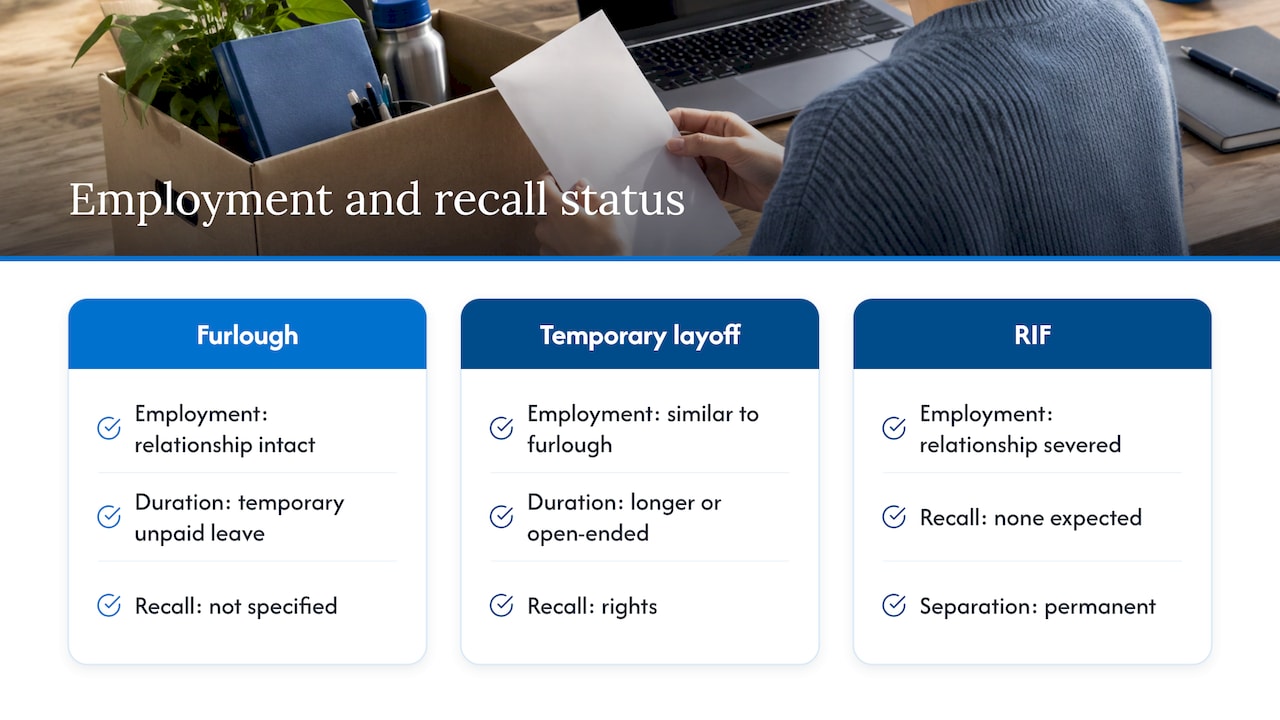
So a RIF is a type of layoff, usually the most final kind. If your notice uses RIF, treat it as a permanent separation and move quickly on benefits, final pay and your job search.
Furlough vs. reduction in hours
A furlough takes you out of work entirely for a period. A reduction in hours keeps you working but shortens the schedule. The Employers Council explains that a furlough is an employer-mandated temporary unpaid leave in which you stay employed and may be required to use accrued PTO, while reduced hours shorten the workweek, subject to any employment agreement. Workers with reduced hours may be eligible for unemployment benefits in their state.
The federal wage law draws a line here too. The U.S. Department of Labor’s Fact Sheet #70 says the Fair Labor Standards Act (FLSA) does not stop an employer from lowering an hourly worker’s rate, as long as it stays at or above minimum wage, or from cutting scheduled hours. It also does not require pay for hours you did not work.
Pay during a furlough: hourly vs. salaried
Your classification decides how a furlough or hour cut plays out. If you are not sure which category you fall into, our guide to exempt vs. nonexempt classification walks through it.
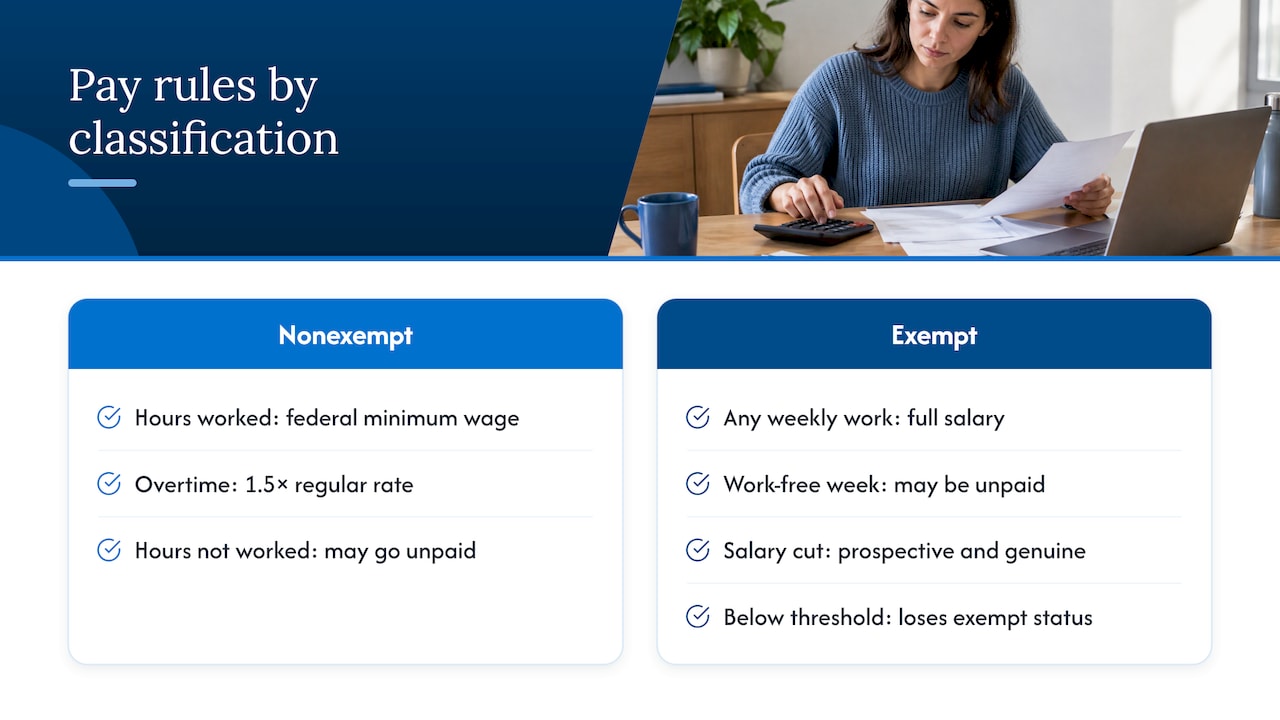
Nonexempt (hourly) employees must be paid at least the federal minimum wage for all hours worked, plus overtime at one and a half times the regular rate, per the Department of Labor. Hours not worked can go unpaid. Hours you do work must be paid, including any overtime. Our overtime guide for labor workers covers the rules in more depth.
Exempt (salaried) employees have a stricter protection. Under the same fact sheet, an exempt employee who performs any work in a week generally must receive the full predetermined salary for that week. A full week with no work at all can be unpaid. A salary cut also has limits: the Employers Council notes it must be prospective and genuine, and if the new salary falls below the weekly salary threshold, the employee is no longer exempt. You can check the current number on our FLSA salary threshold page.
If you are furloughed but still answering emails or taking calls, that is work. Keep a record of it, since proving off-the-clock hours falls on the employee.
A worked example
Imagine a salaried employee whose employer announces a furlough of every Friday for two months. The employee works Monday through Thursday. Because the employee performs work in each of those weeks, the employer generally cannot dock salary for the Fridays, per the Labor Department’s salary-basis rule. If instead the employer announces a prospective, genuine cut in the salary itself, that is a different case, and it is lawful only if the new salary still meets the exemption requirements. An hourly employee in the same workplace would simply be paid for the four days actually worked.
Health insurance: where the two paths split
This is the part that surprises people most. Coverage during a furlough follows the terms of the employer’s plan, which set the number of hours needed to stay eligible. Those terms are in your plan documents, so read them before the furlough starts.
With a layoff, the same HR Dive article reports that coverage typically ends on the last day of the month in which the layoff is issued, after which the employer offers COBRA, the federal law that lets you keep group coverage by paying the full premium yourself. COBRA gives you a window to decide, and our COBRA rights guide explains how to use your 60 days to compare it with other coverage.
If a furlough or hour cut drops you out of the plan, you may also have COBRA rights. Ask HR in writing whether your coverage continues, who pays premiums while you are not on payroll, and what happens if the furlough runs long.
PTO: use it, keep it or lose it?
There is no single federal answer, and that is the point. LexisNexis’s employer guidance says whether paid time off must be provided to furloughed employees depends on the employer’s policy, handbook and state and local law.
Practical patterns include:
- Employer lets you use PTO. Some employers allow it to soften the lost income. A written policy may even require it during a shutdown.
- Employer bars PTO use. The Philadelphia Inquirer reported that unless company policy says otherwise, employers have no obligation to let furloughed workers use paid time off. Larimer County, Colorado, for example, has a published policy under which furloughed employees keep accruing leave but may not use it except to cover benefit premiums.
- Accrual stops. J.J. Keller’s compliance guidance states no federal law requires PTO to keep accruing during a leave such as a furlough, though state or local laws may differ.
- State law may treat PTO as wages. A California labor division letter explains that California treats accrued vacation as wages, which limits what an employer can deduct.
In a layoff, whether unused PTO is paid out depends on your state’s final-pay rules and your employer’s policy. Check your handbook and your state labor department’s page on final pay.
Unemployment benefits
Unemployment insurance is run by each state, so eligibility and amounts differ. A laid-off worker who has earned enough in the base period usually qualifies. Furloughed workers are a grayer case: some states treat a furlough as a qualifying period of unemployment, and some pay partial benefits to workers whose hours were cut. The Employers Council notes that workers with reduced hours may be eligible.
Do not wait to find out. File a claim with your state unemployment agency as soon as your hours or pay drop, and let the agency decide eligibility. Many states have a waiting week and a weekly cap on benefits, so the earlier you file, the sooner a payment can start.
Advance notice: the WARN Act
The federal Worker Adjustment and Retraining Notification (WARN) Act requires covered employers to give at least 60 calendar days’ notice before a plant closing or mass layoff. HR Dive reports that attorneys advise employers not to assume calling a separation a furlough exempts them from those obligations. Several states have their own, sometimes broader, notice laws.
If your employer announces a large furlough or layoff with little warning, write down the date and the number of people affected, then ask HR whether notice was given under federal or state law. If you believe notice was required and not given, that is a question for an employment attorney, and our attorney directory can help you find one.
Federal employees and government shutdowns
Shutdown furloughs follow their own rules. According to the Coast Guard’s FAQ on the 2026 funding lapse, the Government Employee Fair Treatment Act of 2019 guarantees back pay to both furloughed and excepted federal employees once funding is restored. Health and retirement benefits continue during the lapse, though payroll deductions stop until pay resumes.
The Office of Personnel Management confirms that furloughed employees are entitled to their standard rate of pay for the furlough period after the lapse ends. Its 2026 guidance adds that furloughed employees can maintain FEGLI life insurance for up to 12 months in non-pay status, and that FSAFEDS deductions stop while enrollment continues. This is very different from a private-sector furlough, where nothing guarantees back pay.
What to ask when you get the notice
Whether it is a furlough, a layoff or a RIF, get answers in writing to these questions:
- Is my employment continuing, or ending? On what date?
- How long will the furlough last, and what happens if it is extended?
- Will I be paid for any of the time? Can I or must I use PTO?
- Does my health coverage continue? Who pays the premium?
- Is any severance offered, and does it require signing a release?
- Will unused PTO be paid out, and when is my final paycheck due?
- Is there a recall right or a rehire list?
- Can I take other work during the furlough?
Keep copies of every email, letter and plan document. Do not sign a severance agreement or release before reading it closely. It may waive claims you have, and a deadline to consider it is a reasonable thing to ask about.
Perspective
Every worker deserves to understand the paperwork before it changes their life. We have spent decades linking employment rights knowledge with the people who need it, and the layoff versus furlough question shows why. Two words that sound alike can lead to very different outcomes for your paycheck, your health coverage and your standing with an employer.
Our approach is simple: clear language, no legal jargon, and information that stays up to date. That is why we publish free guides on classification, overtime, COBRA and leave rights, so you can read your notice with the right questions in hand. Knowing your category as an exempt or nonexempt worker, knowing your plan’s hours rules and knowing your state’s final-pay rules turns a stressful announcement into a set of manageable steps.
Workers who understand their rights are better placed to ask for fair treatment, and collective awareness is how fair practices spread across workplaces. When you need a lawyer, our attorney directory can help you find an employment attorney.
Max
Keep learning your rights
Workplace Fairness began in 1994 as the National Employee Rights Institute, and our guides are free to read. If you want to help keep them that way, a Workplace Fairness membership starts at $25 per year and supports our work of explaining employee rights in plain language.
For related questions, start with our guide on FMLA eligibility, or browse our overview of common work issues. You can also explore everything at workplacefairness.org.
FAQ
Do you get paid if you are furloughed?
Usually not for the time you are off. Hourly workers need only be paid for hours worked, and salaried exempt workers must receive full salary for any week in which they do any work, according to the Department of Labor. Federal employees furloughed in a shutdown are the exception, since they are entitled to back pay once funding is restored.
Can I use PTO while on furlough?
It depends on your employer’s policy and your state’s law. Some employers allow or even require PTO use, while others, like the Colorado county policy cited above, bar it. Check your handbook and ask HR in writing.
Is a layoff the same as being fired?
No. A layoff is based on the employer’s business needs, such as budget or restructuring, not your performance or conduct. A firing is a termination for reasons tied to the individual worker. Both end the job, but a layoff typically leads to unemployment benefits and a COBRA offer.
Can I collect unemployment during a furlough?
In some states, yes, especially when hours are cut and partial benefits are available. In others, a furloughed worker is not considered unemployed because the job continues. Because rules vary, file with your state unemployment agency promptly and let it determine eligibility.
What does RIF mean?
RIF stands for reduction in force, a permanent layoff of positions. According to American Employers Alliance, it ends the employment relationship with no expectation of recall, unlike a furlough.
Sources
- USC Online: What Is a Furlough?
- HR Dive: Back to Basics on terminations, layoffs and furloughs
- American Employers Alliance: Managing Furloughs and Layoffs
- Employers Council: Layoffs vs. Terminations
- U.S. Department of Labor: Fact Sheet #70
- LexisNexis: What Employers Need To Know About Furloughs
- The Philadelphia Inquirer: What is a furlough
- Larimer County: Workforce Restructuring policy
- J.J. Keller: Must employees on leave continue to accrue vacation time
- California DIR: Salary Requirements for Exempt Employees
- U.S. Coast Guard: FAQ on the 2026 funding lapse
- OPM: Pay and Benefits Fact Sheet
- OPM: Guidance for Shutdown Furloughs