You qualify for FMLA leave if you work for a covered employer, have met the required duration of employment, fulfilled the applicable hours-of-service requirement, and your worksite meets the minimum employee count within the specified radius. Meet all four, and you’re protected for reasons like your own serious health condition, a new child, caring for a family member, or a military-related need. State law may extend those protections further.
TL;DR:
- Employees must work for a covered employer that has at least 50 employees within a 75-mile radius to qualify for FMLA leave.
- Eligibility is based on employment status on the leave start date, not when the leave is requested, and employers must determine this within five business days.
- FMLA eligibility requires at least one year of employment, not necessarily consecutive, with a minimum of 1,250 hours worked in the previous year.
- Qualified reasons for leave include childbirth, caring for a family member with a serious health condition, or military exigencies, with leave duration up to 12 weeks, and up to 26 weeks for covered servicemembers.
- Employers are responsible for providing notices, maintaining health benefits, and restoring employees to their original or an equivalent position, while employees must give timely notice and provide certification when requested.
Table of Contents
- What Are the FMLA Eligibility Requirements? A Step-by-Step Checklist
- Which Employers Have to Follow FMLA?
- What Reasons Qualify for FMLA Leave, and For How Long?
- Do Special Rules Apply to Airline Crew or Military Families?
- When Does the Employer Check Your Eligibility?
- What Do Employers and Employees Each Need to Do?
- A Workplace Fairness Perspective on FMLA Pitfalls
- Get Clear Answers Before You Request Leave
- Where to Verify These Rules Yourself
- Sources
What Are the FMLA Eligibility Requirements? A Step-by-Step Checklist
Working through the DOL’s four-part test in order saves you from guessing. Each step has its own quirks worth knowing before you assume you’re covered, or ruled out.
- Covered employer. Private employers typically must meet a threshold of employees working a significant number of weeks in a year. Public agencies and elementary or secondary schools are covered no matter how small they are.
- At least one year of employment, not necessarily consecutive. The months don’t need to be consecutive. A break in service of seven years or more generally wipes out prior time, though exceptions exist for military service obligations and time governed by a collective bargaining agreement.
- A minimum number of compensable work hours in the previous year. Only compensable work hours under the Fair Labor Standards Act count. Paid vacation, sick time, or other leave you took doesn’t add to that total, so an employee who worked reduced hours due to illness may fall just short.
- A workplace or group of worksites with a sufficient number of employees within a local radius. Your employer counts everyone on payroll at or reporting to worksites within that radius, not just the building you sit in.
Pro Tip: Keep your own paper trail: hire date, hours worked each pay period, and a copy of your job offer letter. If your employer’s headcount is close to the 50 threshold, that documentation is often what settles a dispute later.
Which Employers Have to Follow FMLA?
Coverage hinges on two separate questions: does your employer qualify as covered at all, and does your specific worksite clear the 50/75 rule? A company can be a covered employer nationally while one small satellite office fails the local headcount test.
- Private-sector employers count as covered once they hit 50 employees for 20 workweeks in the year, consecutive or not.
- Public agencies (federal, state, and local government) and public and private elementary and secondary schools are covered regardless of size.
- For employees with no fixed job site, the worksite is defined as the location they’re assigned to as their home base or from which their work is assigned.
- Field technicians, delivery drivers, and remote employees who report to a regional office are counted against that office’s headcount, not the corporate headquarters.
A remote software engineer who reports into a 15-person satellite office still counts against the employees within 75 miles of that office, unless the company can show the office is one of several worksites operating as a single integrated unit.
What Reasons Qualify for FMLA Leave, and For How Long?
Eligible employees get up to 12 workweeks of leave in a 12-month period for a defined set of reasons, and extended leave duration available for caring for certain covered servicemembers for one specific one, highlighting ongoing issues of maternity leave inequalities that affect the workplace. Fact Sheet #28 lays out the qualifying categories:
- The birth of a child, or placement of a child for adoption or foster care, within one year of the event.
- Caring for a spouse, child, or parent with a serious health condition.
- The employee’s own serious health condition that makes them unable to perform their job.
- A qualifying exigency arising from a family member’s active-duty military service.
- Up to 26 weeks in a single 12-month period to care for a covered servicemember with a serious injury or illness.
A “serious health condition” generally means inpatient care or ongoing treatment by a health care provider, not a routine cold or minor procedure. Intermittent or reduced-schedule leave is allowed for most of these reasons, but bonding leave for a new child can only be taken intermittently if the employer agrees. FMLA itself provides no paycheck. It’s unpaid, job-protected leave, though many employees layer their employer’s paid sick time or vacation balance on top of it to keep income flowing.
Do Special Rules Apply to Airline Crew or Military Families?
Two groups run into eligibility rules that look nothing like the standard 1,250-hour count, and it’s worth knowing which one might apply to you.
- Airline flight crew members meet the hours-of-service test differently: they qualify if they worked or were paid for at least 60% of their applicable monthly guarantee and logged at least a minimum number of hours worked applicable to airline flight crew for leave eligibility in the preceding 12 months, since normal hour-tracking doesn’t fit flight schedules.
- Time served in the uniformed services counts toward the 12-month and hours-worked requirements under USERRA, so returning service members don’t lose eligibility they’d otherwise have earned. Workplace Fairness breaks down the USERRA reinstatement steps in more detail.
- The seven-year break-in-service rule that erases prior employment has exceptions for military service and for breaks governed by a written collective bargaining agreement or employer policy.
- Always check your state labor department page, since several states lower the 50-employee threshold or add paid leave on top of federal protections.
When Does the Employer Check Your Eligibility?
Timing trips up more claims than any other single factor. The rule is simple but often missed: eligibility gets locked in on the date your leave is set to start, not the date you first mention it to HR.
- The snapshot date is leave commencement, not the request date. An employee who hits their 1,250th hour the week before a scheduled surgery is eligible, even if they weren’t when they first asked for time off.
- Employers must issue an Eligibility Notice within five business days of learning about the need for leave, per DOL guidance, telling the employee whether they qualify and why or why not.
- Employees generally have a reasonable period to provide medical certification when requested. Once an employer requests medical certification, the employee generally has 15 calendar days to provide it, though extensions apply in reasonable circumstances.
- Intermittent leave counts in actual increments used, typically the shortest period the employer’s payroll system tracks, which matters for partial-day absences.
A planned knee surgery gives both sides weeks to sort out eligibility and paperwork. A sudden hospitalization compresses that same five-day and 15-day clock into a much tighter window, which is exactly when documentation errors happen most.
What Do Employers and Employees Each Need to Do?
FMLA runs on a two-way obligation. Employers who skip a step expose themselves to claims; employees who miss a deadline can lose protection they otherwise earned.
Employer responsibilities:
- Provide the general notice, eligibility notice, and rights and responsibilities notice at the right points in the process.
- Maintain group health benefits on the same terms as if the employee were still working.
- Track leave usage accurately across the 12-month period, especially for intermittent leave.
- Restore the employee to the same or an equivalent position with equivalent pay, benefits, and terms.
Employee responsibilities:
- Give at least 30 days’ notice for foreseeable leave, or notice as soon as practicable when it isn’t.
- Provide medical certification when the employer requests it, within the 15-calendar-day window.
- Respond to employer requests for recertification if the health condition changes.
If certification comes back late or incomplete, best practice is for the employer to issue a written notice, grant the cure period, and spell out what happens if the paperwork still doesn’t arrive.
Pro Tip: Employees: request everything in writing, even a follow-up email confirming a phone conversation with HR. Employers: apply the same notice and certification timeline to every employee, every time. Inconsistent enforcement is one of the fastest routes to a discrimination claim.
A Workplace Fairness Perspective on FMLA Pitfalls
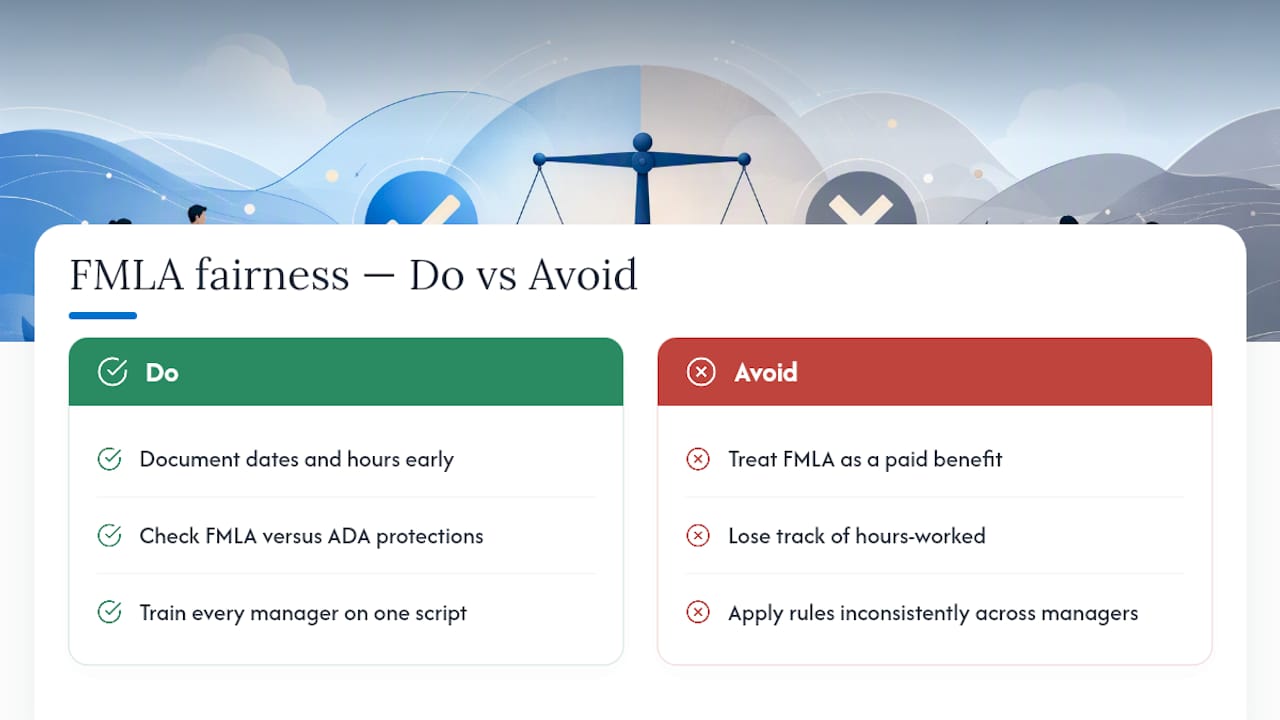
The eligibility rules themselves are clear. What trips people up is treating FMLA like a benefit instead of a legal test with hard deadlines. Employees who assume the leave is paid, or who lose track of their hours-worked count, often discover the gap only when it’s too late to fix. Employers create their own liability when one manager applies the rules loosely and another applies them by the book. That inconsistency is what turns an eligibility question into a discrimination claim.
Our practical advice: employees should document dates and hours before they need to, and check how FMLA compares to ADA protections when a health condition might qualify for both. Employers should train every manager on the same notice and certification script.
— Max
Get Clear Answers Before You Request Leave
Working through four eligibility tests on your own is harder than it sounds, especially when a break in service, a remote worksite, or military time complicates the math. Some organizations have built free guides specifically to walk you through situations like these in plain language, without the legal jargon that makes DOL fact sheets hard to parse on a stressful day.
Our Employee Rights Explained guide covers how FMLA interacts with other protections you may have as a new hire, a caregiver, or someone returning from military service. If your eligibility question involves time in the uniformed services, the USERRA rights guide lays out the five steps for asserting those protections directly. Start with whichever guide matches your situation, and use it to build your case before you ever have to raise it with HR.
Where to Verify These Rules Yourself
Every eligibility rule here traces back to federal sources you can check directly: the DOL’s FMLA overview, Fact Sheet #28, the eligibility self-check tool, and the elaws FMLA Advisor. Federal employees should also consult OPM’s leave policies. Always cross-check your state labor department’s site, since state family and medical leave laws frequently expand on these federal minimums.
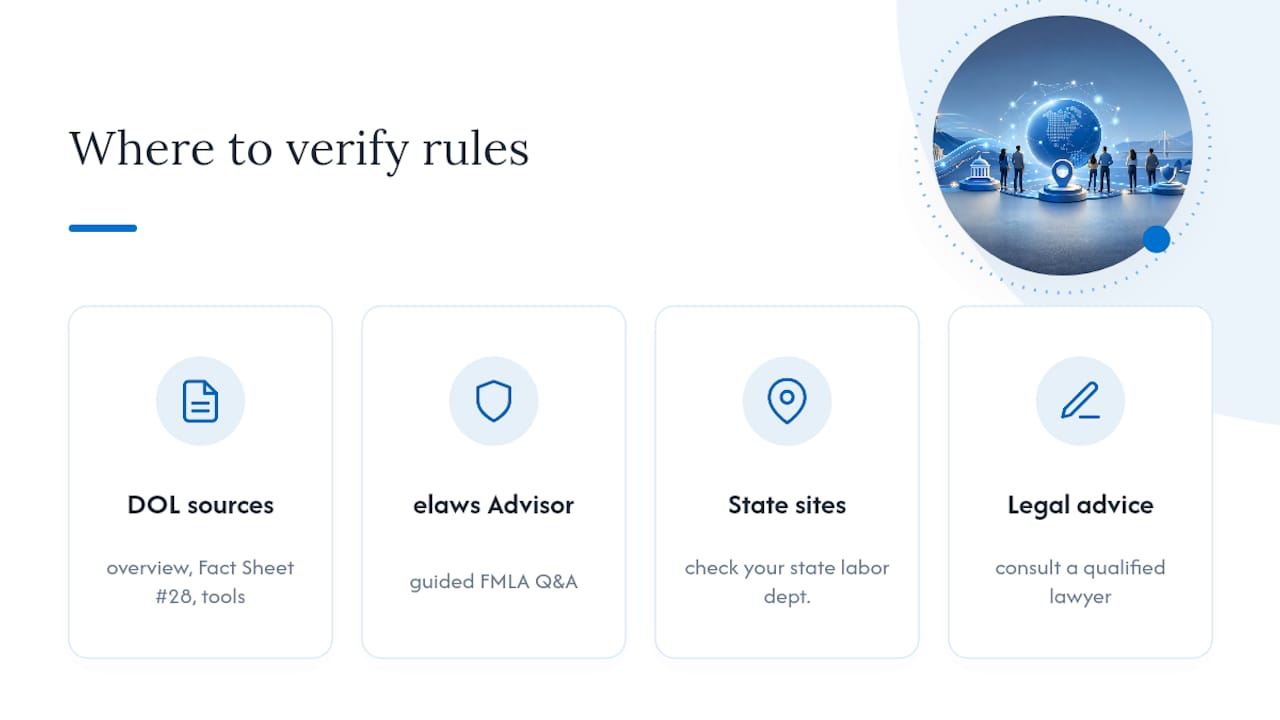
This article is general information, not a substitute for advice from a qualified lawyer. Consult a qualified legal professional about your own circumstances before acting on anything here.