
There is no single national deadline for a final paycheck. Federal law does not require an employer to hand over a former employee’s last check immediately, and some states do require it. Your deadline depends mostly on the state where you worked and on how the job ended: whether you were fired, laid off, or quit. This guide explains how to find your deadline, what the check should contain, what a late check can cost an employer, and what to do when payday passes with nothing in your account.
TL;DR
- Federal law generally ties final wages to the regular payday for the last pay period. Many states set earlier deadlines, especially after a firing or layoff.
- Deadlines differ by state and by type of separation. California, Texas, and North Carolina are three very different examples.
- Earned wages and legally required overtime belong in the final check. Vacation, sick pay, bonuses, commissions, and severance depend on state law and on your employer’s policy or agreement.
- Penalties for late pay are a state remedy. California’s waiting-time penalty is the best-known, but it is not a nationwide rule.
- If the deadline passes, document everything, send a written demand, then contact your state labor department or the U.S. Department of Labor.
Table of Contents
- What federal law says about the last paycheck
- How state deadlines differ
- What belongs in your final paycheck
- What happens when a final paycheck is late
- Our perspective: a late check is a fairness problem, not a technicality
- What to do if your final paycheck is late
- Related questions about pay at the end of a job
- Support free information about workplace rights
- FAQ
- Sources
What federal law says about the last paycheck
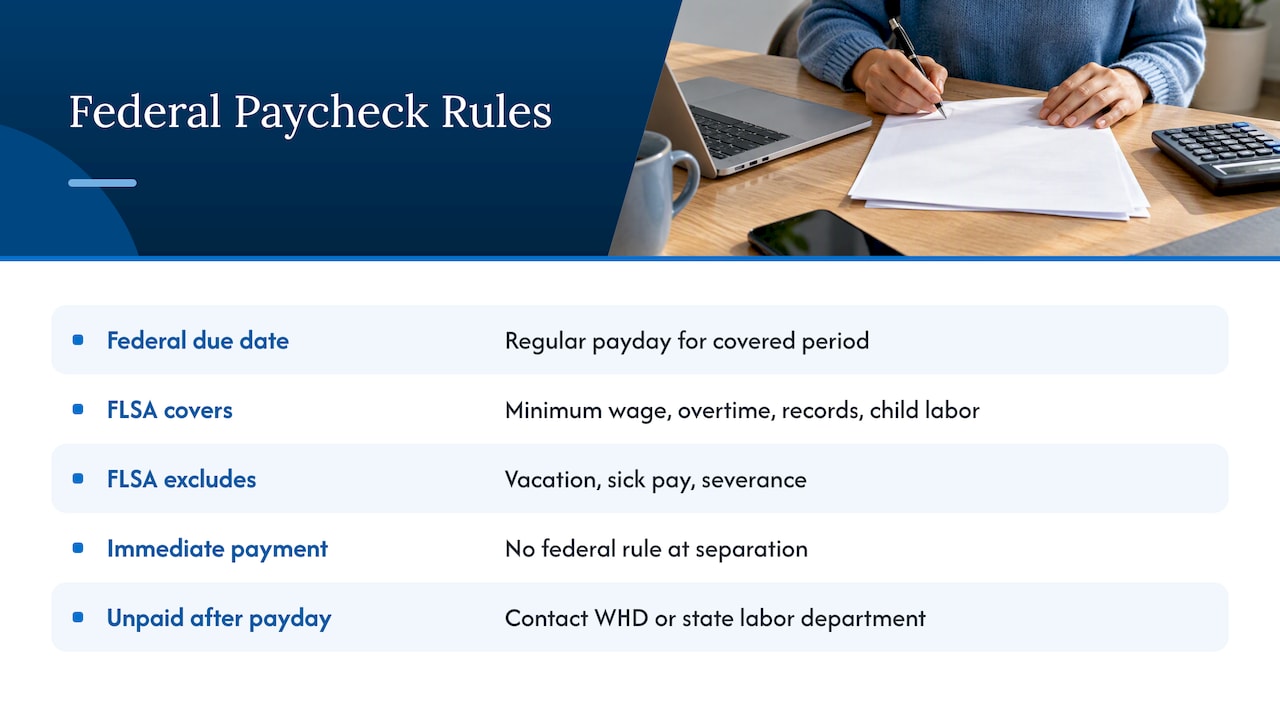
Many workers assume a nationwide rule says “you must be paid on your last day.” It does not exist. Under the Fair Labor Standards Act (FLSA), wages required by the Act are due on the regular payday for the pay period covered. That is the federal floor.
The FLSA covers minimum wage, overtime, recordkeeping, and child labor. It does not address vacation pay, sick pay, severance, or immediate payment at separation. That gap explains why your strongest claim is often under state law, a contract, or a written policy rather than under the federal statute. The Department of Labor tells workers that if the regular payday for their last pay period has passed and they have not been paid, they should contact the Wage and Hour Division or their state labor department.
So start with your state. Do not assume a deadline from a friend’s experience in another state, or from a headline about one state’s law.
How state deadlines differ
States sort final-pay timing in several ways. Some require immediate payment after a firing. Some allow a few days. Some simply say the next regular payday. The type of separation often changes the answer, which is why a layoff and a resignation can have different deadlines even in the same state.
Three examples show the range:
| Estado | Fired or laid off | Quit |
|---|---|---|
| California | Immediately | Within 72 hours, unless the worker gave at least 72 hours’ notice |
| Texas | Within six calendar days | By the next regular payday |
| Carolina del Norte | On or before the next regular payday | On or before the next regular payday |
The Department of Labor publishes a state payday requirements table that lists final-pay rules by state. Treat it as a starting point. The version we reviewed is dated January 1, 2023, and exceptions apply to particular occupations, pay components, and separation circumstances. Before you rely on any deadline, confirm it with your state labor agency or the current statute.
Which state’s law applies
In general, the controlling law is that of the state where the work was performed. If you work remotely, live in one state, and report to an employer in another, the answer can be less obvious. In that case, ask your state labor department which state’s law covers you, and record the answer.
Fired, laid off, or quit: why it matters
Legislatures treat involuntary separation as more urgent because a worker who loses a job without warning may have no income. That is why states such as California require immediate payment after a discharge. When you resign, many states give the employer until the next regular payday, because you chose the timing and could plan ahead.
If you were laid off and want to understand how severance and unemployment benefits fit alongside your last check, read our guide on severance versus unemployment.
What belongs in your final paycheck
The final check should include all wages you earned and are owed. In practice this means:
- Regular pay for every hour worked through your last day.
- Overtime required by law. Our overtime pay guide for labor workers explains how overtime is calculated.
- Any other earned wages the law or your agreement makes payable.
Deductions are limited. Deductions for items such as cash shortages, employer-required uniforms, and tools of the trade are not legal to the extent they cut into minimum wage or overtime. State law adds its own limits. If your employer says it is holding your check until you return a laptop, badge, or uniform, check your state’s rules before you accept that. Do not simply hand over or withhold property without knowing the rule where you live.
Items that depend on state law and policy
Several common pay components do not follow one national rule:
- Vacation and PTO. The FLSA does not require payout. In Tennessee, for example, unused fringe benefits are not owed unless a policy or labor agreement promises them. Other states treat earned vacation as wages. Read your handbook and your state’s rule.
- Commissions and bonuses. North Carolina states that bonuses and commissions are payable on the first regular payday after the amount becomes calculable, and they cannot be forfeited without the required notice of a forfeiture policy. Your state may differ.
- Severance. There is no general federal requirement that private employers provide it. Whether you are owed severance usually depends on an enforceable contract, plan, collective-bargaining agreement, or policy. Maryland, for instance, describes severance as not guaranteed unless it was promised in advance.
- Expense reimbursements. These depend on state law and company policy.
There is no safe short list of “states that do not require severance,” because federal law generally does not require it anywhere and the answer then turns on your contract and your state. Check your offer letter, any separation agreement, and your employer’s written policy.
Separate the undisputed from the disputed
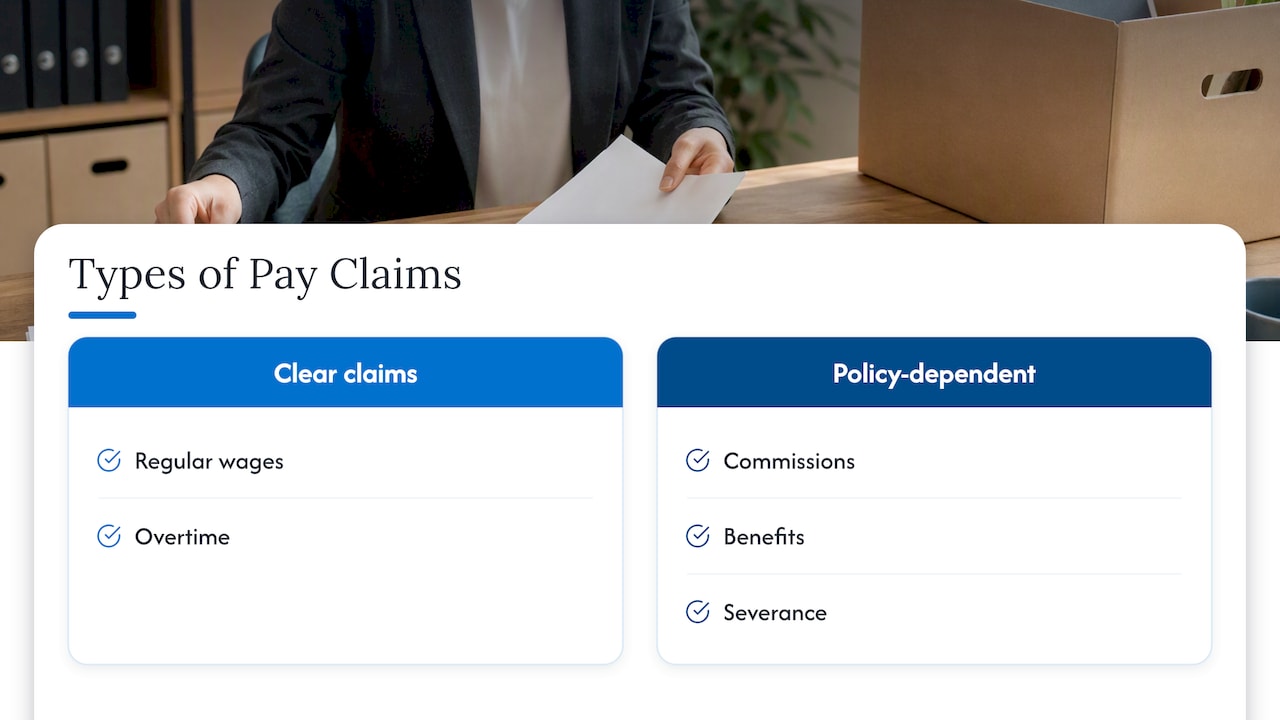
When you total what you are owed, keep two columns. In the first, list regular wages and overtime, which are the clearest claims. In the second, list commissions, benefits, and severance, where the answer depends on policy or agreement. State agencies often have authority to recover earned wages but may lack authority over benefits that rest only on a private policy. Presenting the columns separately makes your case easier to follow and protects the strongest part of it.
What happens when a final paycheck is late
Penalties for late pay are set by states, not by a national rule. Some states provide none that are specific to final pay. Others add significant amounts to what the employer owes.
California’s waiting-time penalty
California is the example most people search for. Under its law, a willful failure to pay final wages can trigger a penalty equal to the employee’s daily wage for each day unpaid, up to 30 calendar days. This is a California remedy, not a nationwide one.
A few points from the state agency are useful:
- “Willful” does not require malice. The employer must know what it is doing, the required act must be within its control, and it must fail to perform it.
- Filing an administrative wage claim does not by itself stop the penalty from accruing.
- The agency also identifies separate civil penalties for certain late-pay violations: $100 for an initial violation, and $200 plus 25% of the unlawfully withheld wages for a subsequent or willful violation, depending on the statute and the facts.
California has also extended statutory penalties to late pay during employment. An amendment signed in 2019 allows an employee to recover penalties for late payment of wages while still employed.
Outside California
If you work in another state, do not assume a daily penalty applies. Your state’s labor department or statute will say what remedies exist, which may include the unpaid wages themselves, interest, liquidated damages, or fines. Searching for “waiting time penalty” will mostly return California material. Search your own state’s labor agency website instead.
Our perspective: a late check is a fairness problem, not a technicality
We have spent three decades connecting employment rights attorneys with the workers who need to understand their rights. Founded in 1994 as the National Employee Rights Institute, we have seen how often a final paycheck problem is the first sign of a larger one.
For most workers, a final check is not extra money. It pays rent, groceries, and the gap before the next job. A delay of even a few days falls hardest on people with the least cushion, including hourly and labor workers. These are the systemic barriers that make a seemingly small rule matter.
Three things we believe:
- Know your state first. The most common mistake we see is assuming a national rule. Look up your own deadline before you act or before you accept an employer’s explanation.
- Paper beats memory. Pay stubs, schedules, texts, and emails turn a disagreement into a documented claim. Keep copies outside any employer system, because access often ends on your last day.
- Act early, calmly, and in writing. Most late checks are resolved by a clear written request. When they are not, the state agencies exist for exactly this purpose, and using them is a normal exercise of your rights.
Every organization can do its part by paying final wages on time, explaining in writing when and how they will arrive, and separating disputed items from undisputed pay. Employers that do so reduce conflict and treat departing workers with the respect they earned.
— Max
What to do if your final paycheck is late
Follow these steps in order. Agency procedures and time limits vary by state, so confirm details with yours.
- Find the due date. Use your state labor agency’s page and the Department of Labor table to identify the deadline for your type of separation. Write down the date.
- Gather your records. Collect your separation date, hours worked, pay rate, pay stubs, written pay policies, and any messages about your final pay.
- Check the amount. Compare the check, if one arrived, against your records. Confirm hours, overtime, and any deductions.
- Send a written demand. Email or mail a short, factual request that states the due date, the amount you believe is owed, and a reasonable date by which to pay. Keep a copy and proof of delivery.
- Contact the agency. If the deadline passes and your request is ignored, contact your state labor department or the Department of Labor’s Wage and Hour Division. The DOL directs workers to do this once the regular payday has passed.
- Mind the time limits. Washington, for example, says wage complaints may take 60 days or longer, and claims there must be filed within three years. Its process may require a wage release and photo identification when the agency pays out wages. Washington’s guide for unpaid workers shows what a state process looks like. Other states have different periods, so do not wait.
- Consider speaking with an employment attorney. This is especially wise if the amount is large, if penalties may apply, if you were fired in what looks like retaliation, or if severance or commissions are in dispute. Some deadlines for other claims are short. Our guide to wrongful termination laws explains why some run as little as 30 days.
A sample written demand
Keep it short and factual. For example: “My employment ended on [date]. Under [state] law, my final wages were due on [date]. I have not received them. By my records I am owed [amount] for [hours and pay period]. Please pay by [date] by direct deposit or check mailed to [address].” Do not add accusations. A calm, dated record helps both you and any agency that reviews it.
Related questions about pay at the end of a job
Are pay transparency laws the same as final paycheck laws?
No. They are separate subjects. Pay transparency rules concern discussing or disclosing pay, and the federal contractor rule the Department of Labor announced protects applicants and employees from discrimination for discussing, disclosing, or inquiring about pay. That rule does not set final-pay timing. State pay transparency requirements and their effective dates change, so check your state agency for the current list.
Can my employer fire me without a reason and still owe my pay?
In most of the country, employment is at will, which means an employer can end it for many reasons or none. It does not mean the employer can keep wages you earned. Our overview of at-will employment rights covers the limits on firing, and the final paycheck rules above apply either way.
Should I ask for my personnel file too?
It often helps. Records of your hours, pay rate, and policies can support a wage claim. Some states give employees a right to see these records, and our guide to personnel file laws by state shows where.
Support free information about workplace rights
Workplace Fairness provides free, plain-language information so employees do not need a law degree to understand their rights. If this guide helped you, you can support that work with a membership, from $25 per year. You can also explore more guides on our home page.
FAQ
When must a terminated employee receive their final paycheck?
It depends on the state. Federal law generally requires only payment by the regular payday for the period worked, while some states require much faster payment after a firing. California requires immediate payment, Texas allows up to six calendar days, and North Carolina uses the next regular payday. Check your state labor agency for your deadline.
What should I do if my employer hasn’t paid me?
Document your separation date, hours, rate, pay records, and communications, then send a written demand that states the amount and due date. If that fails, contact your state labor department or the Department of Labor’s Wage and Hour Division. An employment attorney can advise you if the amount is large or retaliation is possible.
Is there a penalty if my final paycheck is late?
In some states, yes. California can impose a waiting-time penalty of one day’s wage for each day unpaid, up to 30 calendar days, when the failure is willful. Other states have different remedies or none specific to final pay, so look at your own state’s rules.
Does my employer have to pay out unused vacation or severance?
Not automatically under federal law. The FLSA does not require vacation pay, sick pay, or severance. Your state’s law, your employment contract, a collective-bargaining agreement, or your employer’s written policy decides whether they are owed.
Sources
- Last Paycheck, U.S. Department of Labor
- State Payday Requirements, U.S. Department of Labor
- Handy Reference Guide to the Fair Labor Standards Act, U.S. Department of Labor
- Payment of Final Wages to Separated Employees, North Carolina Department of Labor
- Final Pay, Texas Workforce Commission
- Paydays, pay periods, and the final wages, California DLSE
- Waiting Time Penalty FAQ, California DLSE
- FAQs on Late Payment of Wages, California DLSE
- The Maryland Guide to Wage Payment and Employment Standards
- What You Need to Know if You Don’t Get Paid, Washington L&I
- Pay discussion protections announcement, U.S. Department of Labor