Workplace defamation happens when someone makes a false statement of fact about you, shares it with a third party, and that statement damages your reputation or your livelihood: written statements are libel, spoken ones are slander. If this sounds like your situation, the first and most urgent step is to preserve every piece of evidence you can find and note who heard or read the statement; consider talking to a lawyer once the statement has reached others and caused real harm.
TL;DR:
- Workplace defamation requires a false factual statement about you that is published to at least one other person and causes measurable harm.
- Defenses like truth, protected opinion, or internal privilege can weaken a claim, especially if the statement was made with malice or broader distribution.
- Social media posts significantly increase the difficulty of containing harm and provide timestamped evidence that can support a claim.
- Document all evidence, identify witnesses, and follow internal procedures before consulting a lawyer for serious reputational damage or financial loss.
- Employers can reduce defamation risk through clear policies, factual documentation, limiting information sharing, and routing sensitive disclosures through HR.
Table of Contents
- What Workplace Defamation Looks Like: Libel, Slander, and Common Scenarios
- The Legal Elements You Must Prove in Most U.S. States
- Common Defenses Employers or Coworkers Will Raise
- When EEOC Rules or Retaliation Protections Also Apply
- Protecting Yourself Right Now: A Step-by-Step Checklist
- When to Consult a Lawyer and What Remedies Look Like
- How Workplace Defamation Affects Mental Health and Performance
- How Employers Can Prevent Workplace Defamation Before It Starts
- How Workplace Defamation Differs From Harassment or Other Conflicts
- How Social Media Changes Workplace Defamation Claims
- A Few Honest Words on Facing This Alone
- How We Can Help You Move Forward
- FAQ
- Sources
What Workplace Defamation Looks Like: Libel, Slander, and Common Scenarios
Defamation covers false statements of fact, communicated to someone other than you, that harm your reputation. Written versions, like a termination letter or an email thread, are libel. Spoken versions, like a manager telling coworkers you were fired for theft when you weren’t, are slander. Workplace defamation often surfaces in predictable settings: references given to prospective employers, disciplinary write-ups, internal investigations, and accusations of dishonesty or criminal conduct.
Not every hurtful comment qualifies. Courts ask whether a reasonable listener would understand the statement as asserting a fact that can be proven true or false, rather than as someone’s opinion.
- “She falsified her expense reports” is a factual claim that can be checked and disproven.
- “She’s a terrible employee” reads as a subjective judgment, which generally is not defamation.
The difference between these two statements shapes nearly every defamation case we see.
The Legal Elements You Must Prove in Most U.S. States
Workplace defamation claims rest on a consistent set of elements across most states, though the exact language varies by jurisdiction. According to Cornell’s Legal Information Institute, a viable claim generally requires:
- A false statement presented as fact, not opinion or obvious exaggeration.
- Publication: the statement reached at least one person other than you.
- Identification: the statement referred to you specifically, by name or clear implication.
- Legally sufficient fault, meaning the speaker was careless or acted with intent.
- Damages: measurable harm to your reputation, job prospects, or earnings.
Publication at work rarely looks like a tabloid headline. It happens through email chains, investigator summaries, reference calls, or a coworker repeating a rumor out loud. Some states also recognize “compelled self-publication,” where you are forced to repeat an employer’s defamatory explanation to a new employer during a job interview, which can itself satisfy the publication requirement. Because defamation law is built state by state, the strength of your claim, and even what counts as publication, depends heavily on where you work.
Common Defenses Employers or Coworkers Will Raise
Anyone accused of workplace defamation has several defenses available, and understanding them helps you gauge how strong your claim really is.
- Truth is a complete defense. If the employer can show the statement was factually accurate, the claim fails regardless of how damaging it felt.
- Opinion is protected unless it implies a specific, checkable fact. The Supreme Court’s decision in Milkovich v. Lorain Journal Co. established that calling something “opinion” doesn’t shield a statement that still implies a false factual claim underneath.
- Privilege protects many internal workplace communications. Investigation reports, certain regulatory forms, and good-faith references often carry qualified or absolute privilege, meaning the speaker is protected even if the statement turns out to be wrong, as long as it was made honestly and distributed narrowly.
- Consent applies when you authorized the disclosure, such as signing a release allowing a former employer to discuss your performance.
Privilege is not unlimited. Qualified privilege can be lost when a statement is distributed more broadly than necessary or made with malice.
Pro Tip: Ask who received the statement and why; overly broad distribution is often the weak point in an employer’s privilege defense.
When EEOC Rules or Retaliation Protections Also Apply
Defamation is typically a matter of state law, but your situation may also trigger federal protections when false statements connect to a protected characteristic or to retaliation. The EEOC explains that discrimination and retaliation laws apply when conduct ties back to protected bases, like race, sex, or disability, or to protected activity, like filing a complaint. Not every unpleasant workplace statement rises to that level, so it helps to know the overlap points:
- A rumor campaign that singles out your race, sex, or disability may support both a defamation claim and a discrimination charge.
- Being falsely accused of poor performance shortly after filing an EEO complaint can suggest retaliation, even if the defamation claim alone is weaker.
- Statements used to exclude you from projects or promotions may belong in both tracks.
If you suspect this overlap, document the protected basis, the timeline of events, and any adverse action separately, since each track requires its own proof.
Protecting Yourself Right Now: A Step-by-Step Checklist
The hours and days after you learn about a false statement matter. Acting methodically protects both your well-being and any future claim.
- Save everything. Screenshot emails, texts, chat messages, and social posts before they can be edited or deleted; note the date, time, and who else was included or could see them.
- Identify witnesses. Write down who heard or read the statement, even if you only have a general sense of the audience.
- Review your employee handbook for any policy on defamation, workplace communications, or complaint procedures, since ignoring an internal process can weaken a later claim.
- Talk to HR using facts, not emotion. Describe what was said, who said it, and who heard it; avoid characterizing the speaker’s motives or venting on company systems.
- Request a correction or retraction in writing once you’ve reported the issue internally, and follow up if you don’t hear back within a reasonable window.
- Hold off on public responses. Posting your side of the story on social media can complicate your claim and may even expose you to a counterclaim.
- Talk to a lawyer before sending any formal demand letter, since a poorly worded threat can undercut your position later.
Pro Tip: Keep a simple written log of dates, names, and what was said; this single habit does more to support a claim than almost anything else you can do.
When to Consult a Lawyer and What Remedies Look Like
Not every false statement needs legal representation, but certain signs mean it’s time to talk to an employment attorney: the statement reached people outside your immediate team, you can point to lost income or a rescinded job offer, or the reputational damage is severe enough to follow you into future job searches.
An attorney will typically walk through the same elements courts use: can the statement be proven false, was it actually published to someone else, did it cause measurable harm, and does any privilege apply given your state’s law. From there, remedies vary by case.
- Compensatory damages cover lost wages, lost opportunities, and documented emotional distress.
- Punitive damages are available in some states but only in cases involving clear malice or reckless disregard for the truth.
- Injunctive relief or retraction can sometimes stop ongoing harm, such as a false statement still circulating in reference checks.
- Record correction, in specialized contexts like securities industry forms, may be available through administrative processes rather than a standard lawsuit.
Timelines and costs vary widely by state and by the complexity of the publication trail, so an early consultation helps set realistic expectations before you commit time or money to a claim.
How Workplace Defamation Affects Mental Health and Performance
A false accusation at work rarely stays contained to a single conversation. It follows you into meetings, performance reviews, and interactions with coworkers who may have heard a distorted version of events. That constant exposure takes a toll: anxiety about who knows what, difficulty concentrating, and a corrosive sense that your professional reputation, built over years, is being rewritten without your consent.
The effects often extend into job performance itself. Employees dealing with an active defamation situation report trouble focusing on daily tasks, reluctance to speak up in meetings, and strained relationships with colleagues who may have been the ones repeating the statement. Sleep disruption and heightened stress are common, and both can compound the very performance concerns that may have triggered the original false statement in a cycle that is hard to break alone.
Recognizing this impact matters for two reasons. First, documented emotional distress can factor into damages if your case proceeds. Second, and more immediately, acknowledging the toll gives you permission to seek support, whether through an employee assistance program, outside counseling, or simply confiding in someone who can help you keep perspective while you gather evidence and figure out next steps.
How Employers Can Prevent Workplace Defamation Before It Starts
Most workplace defamation claims trace back to a handful of preventable habits: managers speaking loosely about disciplinary decisions, references given informally without a documented process, or investigation findings shared with people who had no legitimate need to know. Employers who want to reduce this risk tend to build a few concrete safeguards into daily practice.
Clear policies on who can speak to the press, provide references, or discuss personnel matters cut down on careless disclosures. Limiting distribution of sensitive communications to people with a genuine business reason to know is one of the most consistently cited best practices in employer guidance on defamation risk.
Training supervisors to document performance issues with specific, factual language, rather than characterizations or assumptions, also matters. “Missed three deadlines in June” holds up; “can’t be trusted” invites a defamation claim if it turns out to be wrong. Finally, routing termination explanations and reference calls through HR rather than individual managers helps keep the language consistent and defensible. None of these steps eliminate risk entirely, but together they shrink the number of situations where a careless comment turns into a lawsuit.
How Workplace Defamation Differs From Harassment or Other Conflicts
It’s easy to lump a false rumor in with general workplace conflict or harassment, but the legal paths are distinct, and knowing the difference shapes which complaint you file and what you need to prove.
Harassment claims under federal law require conduct tied to a protected characteristic, like race, sex, religion, or disability, and typically involve a pattern of behavior severe or pervasive enough to alter your working conditions. Defamation doesn’t require any connection to a protected characteristic at all: a false claim that you stole from the company, made by someone acting out of personal spite, can be defamation even with no discriminatory motive whatsoever.
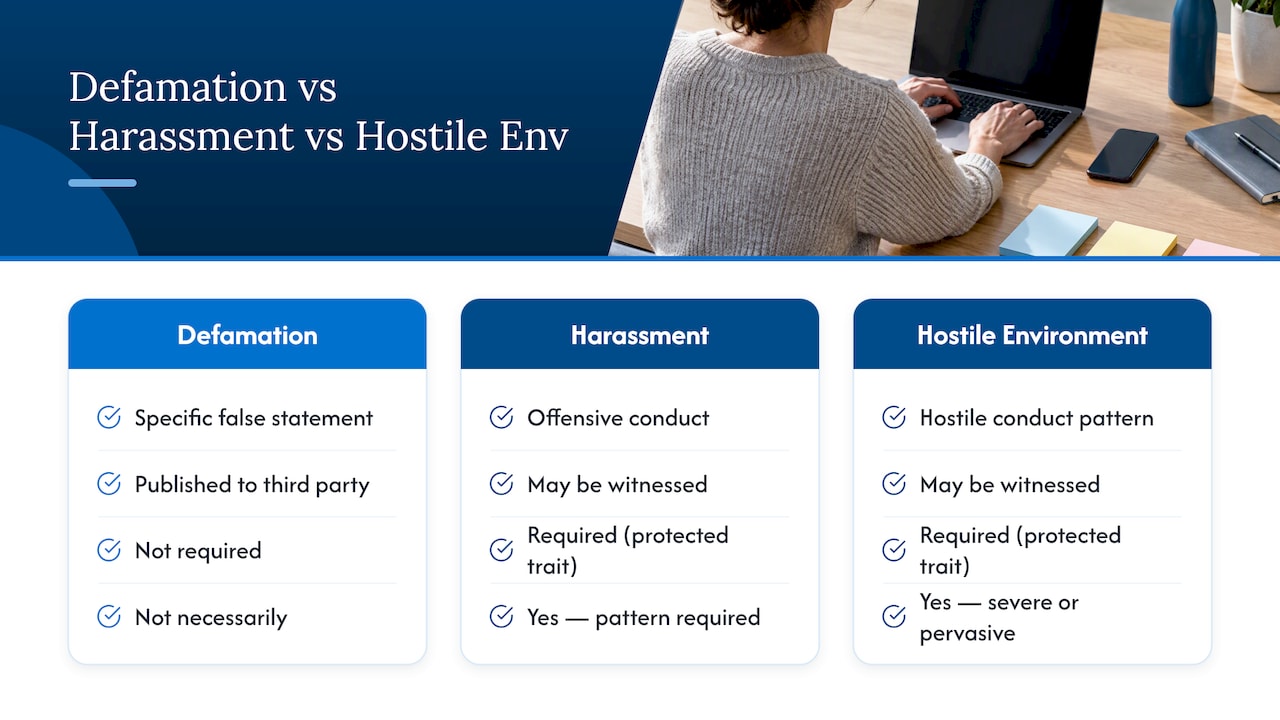
A hostile work environment claim focuses on the overall atmosphere and pattern of conduct, while a defamation claim zeroes in on a specific false statement and its spread to a third party. You can have one without the other, or both at once, which is why the earlier section on EEOC overlap matters: a single bad situation at work can sometimes support parallel claims that each require their own evidence. If you’re unsure which category your situation fits, our guide on documenting and filing a hostile work environment claim is a useful starting point alongside the defamation checklist above.
How Social Media Changes Workplace Defamation Claims
Social media has made publication easier to prove and harder to contain. A single post accusing a coworker of dishonesty or misconduct can reach dozens of people within minutes, and unlike a hallway rumor, it often leaves a timestamped, screenshot-able record that strengthens the publication element of a claim.
That same permanence cuts both ways. Courts increasingly factor in how a statement spreads online: a Facebook post in a private group with a handful of members is treated differently than a public LinkedIn post visible to a shared professional network, since broader distribution affects both the harm you can demonstrate and whether any privilege defense holds up. Employers also raise social media context as a defense, arguing that casual platforms invite hyperbole and opinion rather than factual assertions, so tone and platform norms matter in how a statement gets interpreted.
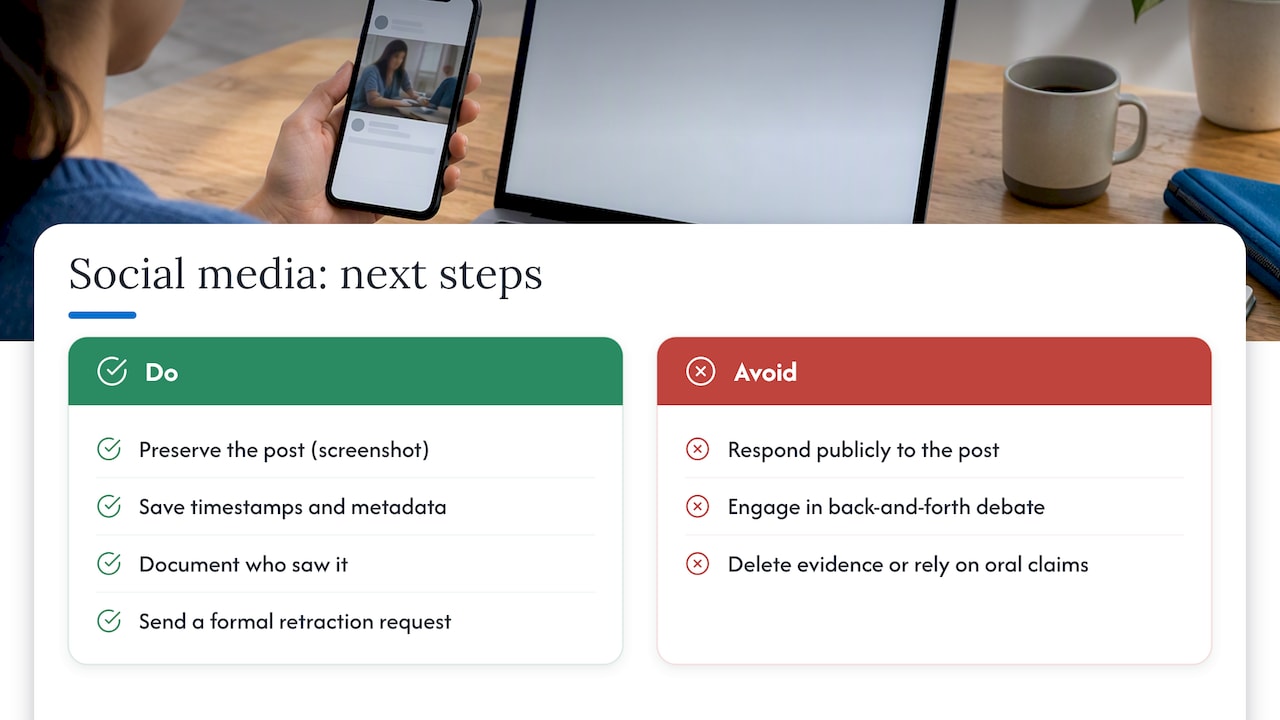
For employees, this cuts two ways. If someone defamed you online, screenshots and timestamps are some of the strongest evidence you can gather. But responding publicly, even to correct the record, can complicate your own position or invite a counterclaim. The safer path is almost always to preserve the post, document who saw it, and let any public correction happen through a formal retraction request rather than a public back-and-forth.
A Few Honest Words on Facing This Alone
Finding out someone lied about you at work is disorienting, and the instinct to defend yourself loudly is understandable. But the strongest path forward is usually the quieter one: document everything, resist the urge to escalate publicly, and bring in counsel once the facts are gathered. Most people who come through this well did the unglamorous work first.
— Max
How We Can Help You Move Forward
We offer free, plain-language guides on references, hostile work environment claims, and employee rights so you can understand your options before spending money on legal advice. When you’re ready for representation, our attorney directory connects you with employment lawyers who handle defamation and related claims.
- Our membership starts at $25 per year and supports our free resources for workers nationwide.
- Our Burnout First Aider Certification is a paid course for anyone looking to build workplace wellbeing skills.
- We provide education, not legal representation, so a lawyer is still the right call for case-specific advice.
Start with our guide to Workplace Fairness resources to see what fits your situation.
This article is general information, not a substitute for advice from a qualified lawyer. Consult a qualified legal professional about your own circumstances before acting on anything here.
FAQ
Can I sue someone for slandering me at work?
Yes, if the statement was false, presented as fact, shared with someone else, and caused you reputational or economic harm. You’ll need to show the speaker was at least careless about the truth, and any applicable privilege defense will factor into whether the claim succeeds.
What words does HR not want to hear?
HR teams take particular notice of specific, factual-sounding accusations, like claims of theft, falsified records, or criminal conduct, especially when repeated to others outside the original conversation. Vague complaints or opinions carry less legal weight than concrete claims that can be proven true or false.
Can I sue my employer for ruining my reputation?
You can, if your employer or a representative made a false factual statement about you to a third party and that statement caused measurable harm. Statements protected by privilege, such as good-faith references or internal investigation findings, are harder to challenge unless you can show they were made with malice or spread more broadly than necessary.
On what grounds can you sue an employer?
Beyond defamation, employees can pursue claims for discrimination, retaliation, wrongful termination, or harassment when the underlying conduct ties to a protected characteristic or protected activity. The EEOC oversees many of these federal protections, while defamation itself is typically pursued as a separate state law claim.
Sources
We built this guide from primary legal sources: the Cornell Legal Information Institute’s explanation of defamation law, the Supreme Court’s reasoning in Milkovich, and EEOC guidance on when federal protections apply. We have worked since our founding in 1994 to connect employees with plain-language information about their rights.
- Defamation | Wex | LII / Legal Information Institute
- Federal laws prohibiting job discrimination: Questions and answers | EEOC