There is no federal law in the United States that prohibits workplace bullying as such. But much conduct that feels like bullying is illegal harassment, and the line between the two is whether the mistreatment is based on a protected characteristic such as race, sex, religion, disability, or age. This guide explains where that line falls, what to do when you are on the wrong side of it, and which deadlines you cannot afford to miss.
TL;DR
- No federal statute bans general bullying. Federal anti-discrimination laws ban harassment based on a protected characteristic when it is severe or pervasive enough to create a hostile work environment.
- Customers, vendors, and other non-employees can be the source of unlawful harassment, and your employer may still have a duty to act.
- Report in writing through your employer’s policy, then keep your own records. Retaliation for reporting is illegal.
- A charge with the EEOC generally must be filed within 180 or 300 calendar days of the incident. An inquiry or an internal complaint does not stop that clock.
Table of Contents
- Is workplace bullying illegal in the U.S.?
- Federal laws that apply when bullying is harassment
- What about state anti-bullying laws?
- Harassment by customers, clients, and other non-employees
- How to report harassment at work
- How to file a harassment complaint with the EEOC
- If your situation is bullying without a protected trait
- What employers should have in place
- Our perspective: a gap the law has not closed
- Support free, plain-language employee rights information
- FAQ
- Sources
Is workplace bullying illegal in the U.S.?
The honest answer is: sometimes, and it depends on why it is happening. According to the EEOC, harassment is a form of employment discrimination that violates Title VII of the Civil Rights Act of 1964, the Age Discrimination in Employment Act (ADEA), and the Americans with Disabilities Act (ADA). The conduct is unlawful when it is based on race, color, religion, sex, national origin, age (40 or older), disability, or genetic information.
The law also sets a threshold. The EEOC says that petty slights, annoyances, and isolated incidents are not unlawful unless extremely serious. Harassment becomes illegal when it is so frequent or severe that it creates a hostile, intimidating, or abusive work environment, or when putting up with it becomes a condition of keeping your job.
That leaves a real gap. A manager who screams at everyone, takes credit for others’ work, or isolates one employee for no reason connected to a protected trait is often behaving badly without breaking a federal law. Workers have long named this systemic barrier, and the movement for change continues.
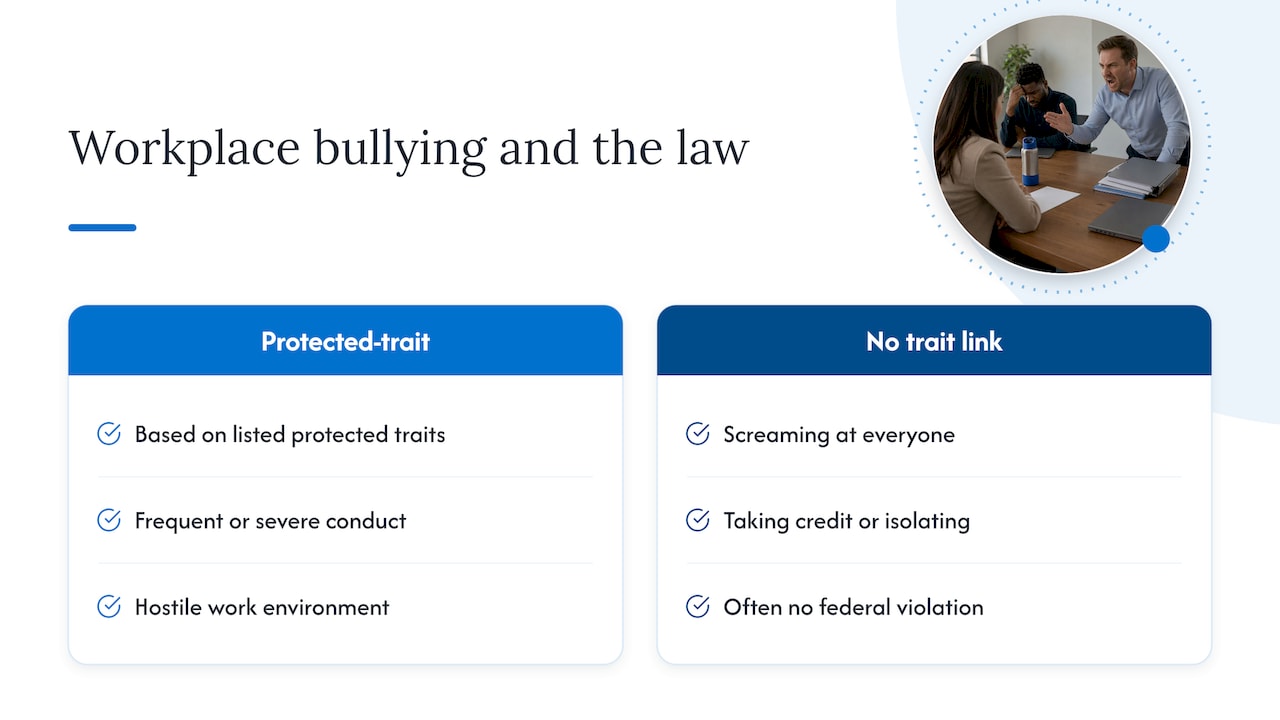
Bullying versus unlawful harassment
A useful way to sort your situation is to ask three questions.
- Is it connected to who you are? Slurs, jokes about your accent, comments about your age, or mockery of a disability point toward a protected characteristic.
- Is it repeated or very serious? A pattern, or a single extremely serious incident, matters more than one rude remark.
- Has it changed your working conditions? Being pushed out of meetings, denied shifts, demoted, or made to dread coming to work can all show a hostile environment.
If the answer to the first question is no, the conduct may still be unfair and harmful, but it generally falls outside federal harassment law. Your options then shift to employer policy, other legal theories that an attorney can assess, and the state-level rules discussed below.
Federal laws that apply when bullying is harassment
Three statutes do most of the work. The EEOC enforces them, and the Department of Labor’s overview of harassment describes the same set of protected categories, including sex (which covers pregnancy and related conditions).
| Law | What it covers |
|---|---|
| Title VII of the Civil Rights Act of 1964 | Race, color, religion, sex, national origin |
| Age Discrimination in Employment Act (ADEA) | Age 40 and older |
| Americans with Disabilities Act (ADA) | Disability |
The EEOC also lists genetic information among the protected categories. For a fuller picture of how these protections fit together, see our guide to employee rights.
Sexual harassment and quid pro quo conduct
Sexual harassment is the most familiar form of unlawful workplace harassment. It includes unwelcome advances and offensive remarks about sex, and it includes demands that tie job benefits to sexual conduct. Our pages on what the law says about sexual harassment and on quid pro quo harassment explain the elements in plain language.
Hostile work environment
Most “bullying” cases that succeed in court are really hostile work environment claims. The pattern of abuse is tied to a protected trait and is severe or pervasive. If that sounds like your situation, our guide to the hostile work environment walks through how to document it and file.
What about state anti-bullying laws?
Advocates have pushed a model “Healthy Workplace” bill for years. One HR resource reports that the bill has been introduced in 32 state legislatures, and that no state has yet enacted it as a general ban on bullying. Because legislatures change, check your own state’s current law before relying on any summary, including ours.
What does exist in many places is a patchwork:
- State and local anti-discrimination laws, which sometimes cover more employers or more characteristics than federal law.
- State civil rights agencies that take complaints and, in some places, share charge-filing with the EEOC.
- Employer-specific policies and, in some states, training requirements for harassment prevention.
This is why the 180-day versus 300-day deadline below depends on where you live. A state or local agency that enforces a similar law can extend your federal filing window.
Harassment by customers, clients, and other non-employees
Sometimes the person making your job miserable is not a coworker or supervisor. Restaurant servers, retail clerks, home health aides, hotel staff, and nurses often face abuse from customers, patients, or visitors.
The EEOC notes that harassment can come from non-employees such as customers and vendors, not only from supervisors and coworkers. When the abuse is based on a protected characteristic, the employer’s duty to respond does not disappear because the harasser is a paying customer. An employer that knows about the conduct and does nothing can face liability.
If this is happening to you:
- Tell your supervisor or HR in writing. Name the customer or describe them, give the date, and say what was said or done.
- State the connection to a protected trait if there is one, for example comments about your religion or sex.
- Ask what the employer will do. Reasonable steps might include reassigning you away from the person, banning the customer, or adding staff to the area.
- Keep a copy of your report.
Healthcare workers face a particular version of this problem, and our guide to employee rights in hospitals addresses it.
How to report harassment at work
The EEOC’s guidance for employees, What You Should Know: What to Do if You Believe You Have Been Harassed at Work, and the New Hampshire Human Rights Commission both point to the same starting place: read your employer’s policy.
Step 1: Find the policy
Look in the employee handbook or on the company intranet. A good anti-harassment or anti-bullying policy names who receives complaints, offers more than one channel, and promises protection from retaliation. If the policy tells you to report to your direct supervisor and that supervisor is the problem, use the alternative channel, such as HR or a higher manager.
Step 2: Report in writing
A verbal complaint can be forgotten or denied. The EEOC’s guidance describes reporting as a way to put the employer on notice, and written reports create a record. A short email is enough. State the facts, the dates, and that you are asking the company to address it.
Why this matters: an internal report triggers the employer’s duty to correct the problem. If the employer fails to take prompt, remedial action after learning of harassment, its legal exposure grows. The Department of Justice’s Civil Rights Division also notes that its laws carry strict time limits for complaints, so waiting for an internal process to finish can cost you options.
Step 3: Document everything
Keep your own notes, outside company systems when you can. Record dates, times, witnesses, exact words, and how the conduct affected your work. Save emails and messages that you are lawfully entitled to keep. Our guide on documenting workplace harassment evidence explains what to collect and how to organize it. If you suspect monitoring, our page on workplace surveillance rights covers what employers may and may not do.
Step 4: Know what a good response looks like
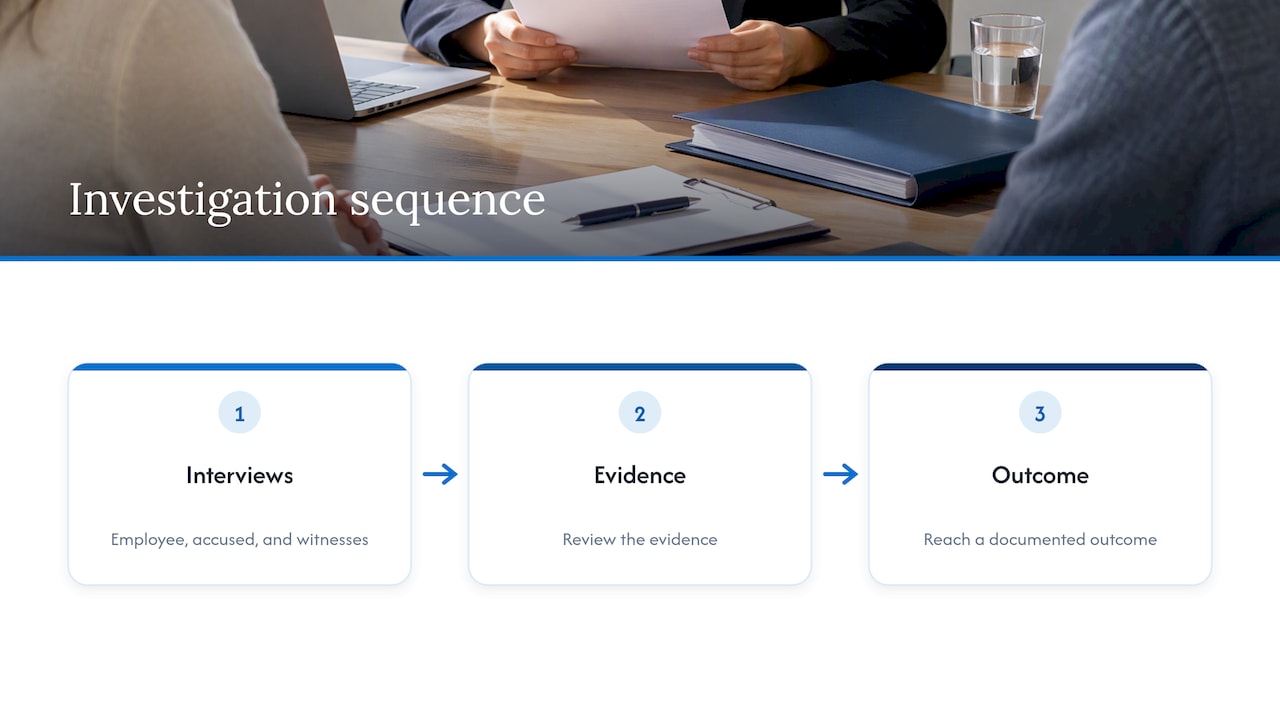
Once an employer is aware of harassment, it is expected to act promptly. State agencies list appropriate remedial steps such as a confidential investigation, training, administrative leave for the harasser, or termination. An investigation typically involves interviewing you, the person accused, and witnesses, reviewing the evidence, and reaching a documented outcome. You can ask HR for the expected timeline and whether you will be told the result.
Step 5: Watch for retaliation
Anti-discrimination laws prohibit retaliation against employees who report harassment, take part in an investigation, or oppose discriminatory practices. Demotion, schedule cuts, a sudden bad review, or termination after you complain should be documented and raised quickly. Some retaliation claims, including certain whistleblower laws, have very short windows, as we explain in our overview of 30-day deadlines for whistleblower retaliation laws.
How to file a harassment complaint with the EEOC
Internal reporting is not required to file with the EEOC, but it is often useful. If your employer has no policy, or if reporting has not worked, you have the right to file a charge of discrimination with the EEOC.
Inquiry versus charge
This distinction trips up many workers. The EEOC Public Portal explains that submitting an inquiry is different from filing a charge. An inquiry starts the conversation. A charge is a signed statement asserting that an organization engaged in employment discrimination and asking the EEOC to act.
The usual path, as USAGov describes, is:
- Submit an online inquiry.
- Schedule an interview with an EEOC staff member.
- Submit a charge of discrimination.
The interview is where staff help you decide whether to file. It is confidential and does not automatically notify your employer.
The deadlines
The EEOC’s page on how to file a charge explains that you generally have 180 calendar days from the incident to file. That period extends to 300 days where a state or local agency enforces a law prohibiting the same kind of discrimination. For age discrimination, the extension requires both a state law and a state agency enforcing it.
| Situation | Typical filing window |
|---|---|
| No state or local agency enforcing similar law | 180 calendar days |
| State or local agency enforces similar law | 300 calendar days |
Two cautions. First, the clock generally starts at the incident, not when you finish an internal complaint. Second, an inquiry is not a charge. If you are close to a deadline, do not wait for HR to wrap up. Our page on EEOC charge filing lays out the steps in detail.
If your situation is bullying without a protected trait
If the treatment is cruel but not tied to a protected characteristic, you are not out of options.
- Use the internal process. Many employers have anti-bullying or respectful-workplace policies that go beyond what the law requires. Those policies are enforceable by the employer, and following them creates a record.
- Look at the link to a protected trait. Be careful and truthful here. Do not stretch facts. But sometimes a pattern that looks like personal conflict contains comments about age, pregnancy, religion, or disability that you have not yet connected.
- Consider whether other laws apply. Retaliation for reporting wage violations, safety hazards, or illegal activity may be covered by separate laws. Our work issues overview helps you identify which one fits.
- Talk to an employment attorney. Whether conduct is legally actionable turns on specific facts and your state’s law. Many employment lawyers offer an initial consultation, and a lawyer can tell you quickly whether you have a claim.
- Protect your health. Chronic mistreatment takes a toll. Seeing a doctor or counselor is a legitimate step, and it also creates a record of how the situation has affected you.
What employers should have in place
Preventing harassment is an active responsibility for employers, not only a reaction after a complaint. The EEOC says a culture in which employees feel free to raise concerns without fear of retaliation is among the most effective tools for eliminating unlawful conduct. An effective policy usually includes:
- A clear definition of prohibited conduct, including bullying that falls short of illegal harassment.
- Multiple reporting channels, including one that bypasses the employee’s direct supervisor.
- A commitment to prompt, impartial investigation.
- A written promise of no retaliation.
- Regular training for managers and staff, with attention to anti-bias practices and bystander support.
- Clear consequences, applied equally at every level of seniority.
Every organization benefits when people can speak up early. Employees who see complaints handled fairly stay, and equitable workplaces are built one resolved complaint at a time.
Our perspective: a gap the law has not closed
We have worked since 1994 to link the knowledge of employment rights attorneys with the people who live these problems every day. What we hear consistently is that workers do not experience mistreatment in legal categories. They experience it as a manager who humiliates them, a team that shuts them out, or a customer who is allowed to cross a line.
The law, as it stands, protects against harassment tied to protected traits and against retaliation for speaking up. It does not yet protect against all abusive conduct. We think workers deserve to understand that gap honestly, rather than be told either that they have no rights or that they have a lawsuit in every case.
Our advice is practical. Learn the line between bullying and harassment. Report in writing. Document as you go. Respect the deadlines, because they are strict and they are where many workers lose rights they once had. And do not carry it alone: talk to a trusted colleague, a counselor, or an employment attorney. Progress in employment law has come from workers who spoke up and from advocates who kept the pressure on, and that legacy of resilience continues with you.
— Max
Support free, plain-language employee rights information
Workplace Fairness provides free information so that no one has to decode employment law alone. If this guide helped you, consider a Workplace Fairness membership, from $25 per year, which helps us keep these resources current and accessible. You can also browse the rest of our employee rights library.
FAQ
Can I sue my employer for bullying?
Only if the bullying also violates a law. If it is based on a protected characteristic and is severe or pervasive, you may have a harassment or hostile work environment claim. Retaliation for reporting is also unlawful. An employment attorney can assess whether your facts support a claim in your state.
Do I have to report harassment to HR before going to the EEOC?
No, you can file with the EEOC without going through HR first. But internal reporting puts your employer on notice and can strengthen a later case, and skipping it without good reason can complicate your path to a remedy. Whatever you choose, keep the 180 or 300 day deadline in mind.
Is harassment by a customer my employer’s problem?
It can be. The EEOC states that harassment may come from non-employees such as customers and vendors. If the conduct is based on a protected trait and your employer knows about it, the employer should take reasonable steps to stop it. Report it in writing so there is a record.
Does filing an EEOC inquiry stop the deadline?
No. An inquiry is exploratory, and a charge is the formal signed statement that starts an investigation. Many people lose rights by assuming an inquiry or internal complaint counted. Schedule the intake interview promptly and ask the EEOC staff member about your specific deadline.
Sources
- Harassment, U.S. Equal Employment Opportunity Commission
- Harassment, U.S. Department of Labor
- What You Should Know: What to Do if You Believe You Have Been Harassed at Work, EEOC
- How to File a Charge of Employment Discrimination, EEOC
- EEOC Public Portal
- Reporting Harassment, New Hampshire Human Rights Commission
- Discrimination, harassment, and retaliation, USAGov
- How to File a Discrimination or Retaliation Complaint, U.S. Department of Justice Civil Rights Division
- Workplace Bullying Laws: What Managers Need to Know, Paycor