
Under Title I of the ADA, an employer may deny a specific accommodation only if providing it would cause an undue hardship, meaning significant difficulty or expense measured against that employer’s own resources and operations, according to EEOC enforcement guidance. This is a narrow, individualized exception, not a general escape hatch. This guide breaks down the legal factors, the documentation both sides need, real-world examples, and the steps that protect employers and employees alike.
TL;DR:
- Small employers can face undue hardship at a much lower cost than larger companies due to their limited resources and operational scale.
- Evidence such as quotes, invoices, and staffing reports taken before denying an accommodation weigh more heavily than retrospective opinions.
- The employer’s burden is to prove undue hardship with objective, documented evidence, not generalized assumptions or preferences.
- Funding options like tax credits and government grants can significantly reduce actual accommodation costs, affecting hardship assessments.
- Conducting the interactive process and documenting all decision points promptly is essential to defend against undue hardship claims.
Table of Contents
- Understanding Undue Hardship ADA Standards and Where They Come From
- How EEOC Factors Decide Whether a Hardship Claim Holds Up
- Who Has to Prove What: Burden of Proof and the Interactive Process
- Funding, Tax Credits, and Employee-Paid Options That Can Change the Outcome
- Real Accommodation Disputes and How the Factors Actually Play Out
- When a Denial Crosses Into an ADA Violation
- Your Step-by-Step Checklist After an Accommodation Request
- Why Neutral Guidance Matters More Than Either Side Realizes
- Guides That Help You Act on This Right Now
- Where to Verify the Legal Details Yourself
- Sources
Understanding Undue Hardship ADA Standards and Where They Come From
The phrase “significant difficulty or expense” sounds simple until you try to apply it to a real workplace. That’s the point. Congress and the EEOC deliberately built a flexible standard instead of a fixed dollar threshold, because a $5,000 accommodation might be trivial for a national retailer and genuinely crippling for a five-person nonprofit.
The EEOC’s enforcement guidance expands on the statutory language by describing hardship as an action that is “unduly extensive, substantial, or disruptive,” or one that would “fundamentally alter the nature or operation of the business.” Notice what’s missing from that description: any reference to an employer simply preferring not to make a change, or finding it inconvenient. Inconvenience is not hardship. Disruption to how a business actually functions, backed by evidence, is.
Two features of this standard matter more than any other single detail:
- It’s individualized. The EEOC and courts look at each employer’s specific size, budget, and structure, not an industry average or a competitor’s practices.
- It’s fact-specific. The same accommodation request can be reasonable for one employer and an undue hardship for another, depending entirely on documented circumstances.
That means an employer can’t point to a hardship finding from another company’s lawsuit and claim the same protection. Every case starts from zero evidence and builds its own record.
For readers who want the primary source language rather than a summary, three documents form the backbone of undue hardship law:
- EEOC enforcement guidance on reasonable accommodation and undue hardship lays out the statutory test and the full factor list.
- EEOC’s employer-facing publication on ADA responsibilities translates that guidance into obligations employers can act on, including reassignment duties.
- ADA National Network guidance restates the standard in plainer language and offers the practitioner framing many HR teams find easier to apply day to day.
One detail trips up a lot of small business owners: size cuts both ways. A larger employer with deep resources is generally expected to absorb a bigger cost before hardship kicks in, while a smaller employer with a thin operating budget can establish hardship at a much lower dollar figure, according to the ADA National Network. Nobody gets a fixed number to hide behind. Everybody gets judged against their own reality.
This is also where the accommodation vs. undue hardship distinction becomes concrete. A reasonable accommodation is anything that lets a qualified employee with a disability perform essential job functions, from a modified schedule to specialized software. Undue hardship isn’t a competing right the employer holds. It’s a defense the employer must prove, accommodation by accommodation, with evidence tied to their own operation.
How EEOC Factors Decide Whether a Hardship Claim Holds Up
The EEOC doesn’t leave “significant difficulty or expense” to guesswork. Its guidance lists specific factors, and every one of them requires supporting evidence, not an executive’s impression that something feels expensive.
- Nature and net cost of the accommodation. This isn’t the sticker price. It’s the cost after subtracting any available tax credits, insurance reimbursement, or outside funding. A $12,000 quote that drops to $4,000 after a vocational rehabilitation grant is a very different number in a hardship analysis.
- The employer’s overall financial resources at that specific facility. Courts look at the budget of the actual location managing the request, not necessarily the parent corporation’s balance sheet, unless the facilities are financially interconnected.
- Number of people employed at that facility. A 400-employee distribution center has more scheduling flexibility to redistribute a task than a 6-person satellite office.
- Effect on expenses and resources, or other operational impact. This factor asks what actually happens on the floor: does the accommodation force overtime, delay production, or require hiring a temp?
- Overall financial resources, size, and structure of the entire covered entity. For multi-site employers, this factor looks past the local branch to the broader organization, especially when locations share management or finances.
- Geographic separateness and administrative or fiscal relationship between facilities. A franchise location operated independently is treated differently than a directly owned branch office under centralized control.
- Type of operation, including workforce composition and function. A hospital’s overnight ICU staffing has different constraints than a daytime call center.
- Impact on the ability of other employees to perform their duties. If an accommodation shifts real work onto coworkers in a way that measurably slows their output, that’s evidence. If it just changes who sits where, it usually isn’t.
The factors that hold up in front of the EEOC or a judge share one trait: they’re documented before the decision, not reconstructed afterward. A staffing impact analysis written the week the request came in carries far more weight than a manager’s memory of “we were just too busy that month.” Invoices, vendor quotes, overtime logs, and written cost comparisons are what turn an opinion into evidence.
Pro Tip: Build your hardship file the same week you receive the request, not after you’ve already denied it. A cost estimate dated later, written to justify a decision already made, is exactly the kind of “gut feeling” evidence the EEOC’s guidance warns against, and it rarely survives scrutiny.
Employers who lose these disputes tend to lose for the same reason: they treated undue hardship as a feeling rather than a case they had to build. “It would be too disruptive” isn’t a finding. A dated staffing report showing a notable drop in unit output during a comparable schedule change is.

Who Has to Prove What: Burden of Proof and the Interactive Process
Undue hardship is an affirmative defense, which means the employer carries the burden of proving it with objective evidence, not the employee’s burden to disprove it. The employee, meanwhile, only has to show they have a qualifying disability and that the requested accommodation would be effective at letting them perform essential job functions. That imbalance is intentional. Congress didn’t want employers denying requests first and explaining later.
Getting there runs through what the EEOC calls the interactive process, a back-and-forth conversation between employer and employee aimed at identifying a workable accommodation. It typically unfolds like this:
- The employee (or someone on their behalf) makes a request, which doesn’t have to use any magic legal language.
- The employer acknowledges the request and may ask for reasonable documentation of the disability and functional limitations if they aren’t obvious.
- Both sides discuss possible accommodations, including options the employee may not have thought to request.
- If the first option raises a real hardship concern, the employer must still look for an alternative that works, rather than stopping at “no.”
Failing to engage in this process at all is one of the fastest ways an employer ends up on the losing side of a claim, independent of whether the original accommodation really would have been a hardship. The EEOC’s guidance is explicit that generalized assumptions, unsupported by objective, individualized evidence, don’t meet the standard.
Employers should keep:
- A written acknowledgment of the request, dated when received.
- Cost estimates and vendor quotes tied to the specific accommodation.
- A written analysis of alternatives considered and why each was accepted or rejected.
- A final decision memo explaining the reasoning, signed and dated.
Employees should keep:
- A written description of the functional limitation and the specific job tasks it affects.
- Any suggested accommodations, even tentative ones.
- Medical documentation, if the employer reasonably requests it and the disability isn’t obvious.
- Copies of every email, letter, or written exchange about the request.
Practitioners who work these cases regularly describe undue hardship less as a single conclusion and more as an ongoing documented process, one where the paper trail matters as much as the outcome. If you can’t produce a dated document showing you considered at least one alternative before denying the primary request, you’re relying on testimony alone, and testimony alone rarely wins.
Funding, Tax Credits, and Employee-Paid Options That Can Change the Outcome
Before an employer can honestly claim an accommodation is an undue hardship on cost grounds, they have to check whether the real cost is actually lower than the quote suggests. This step gets skipped constantly, and it’s one of the most common reasons a hardship claim falls apart later.
Several funding channels exist specifically to reduce the net cost employers have to weigh:
- State vocational rehabilitation agencies often help fund assistive technology, job coaching, or workplace modifications for employees they’re already working with.
- Federal disability employment programs provide guidance and sometimes direct funding connections for specific accommodation categories.
- Tax credits and deductions are available to many employers for accessibility-related expenditures, which can offset a meaningful share of accommodation costs before the hardship analysis even begins.
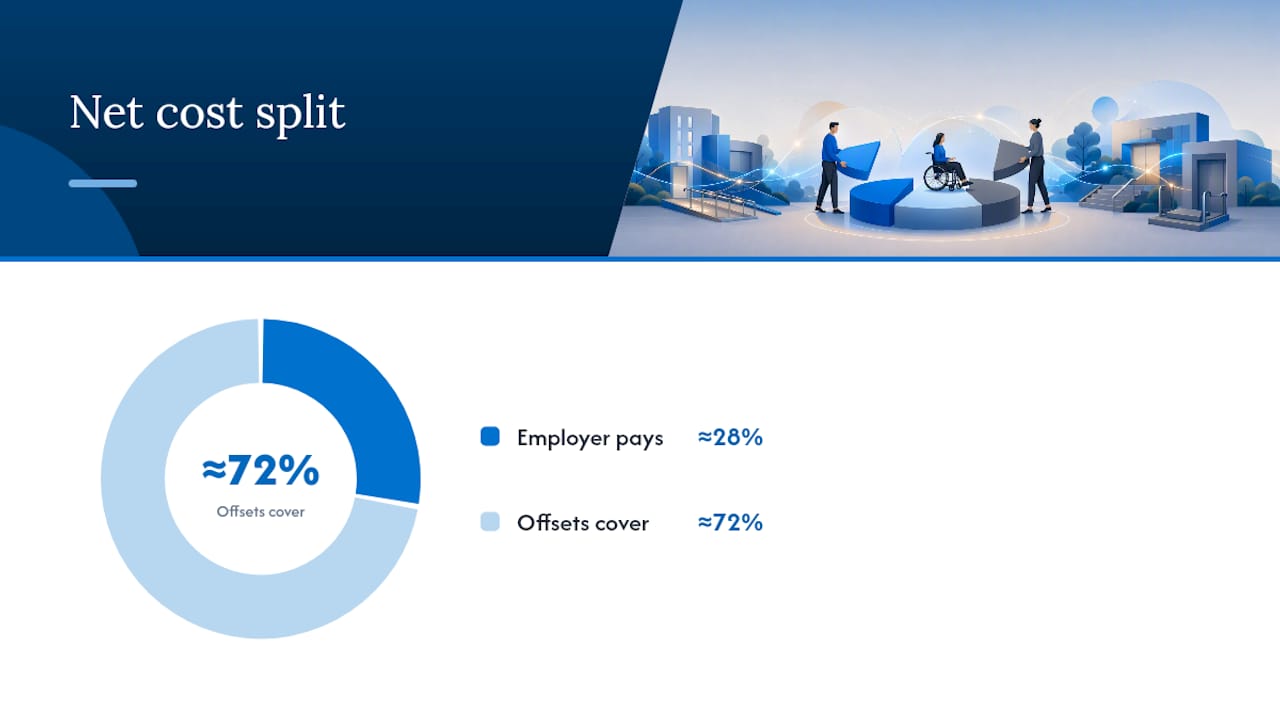
None of these sources reduce an employer’s legal obligation on their own. What they do is change the number that actually goes into the undue hardship equation. A $9,000 lift installation quote looks very different once a tax credit and a state grant bring the employer’s actual out-of-pocket cost down to $2,500.
There’s also a path that doesn’t involve outside funding at all: the employee. If cost genuinely is the only barrier to an otherwise reasonable accommodation, the ADA National Network notes that an employer can offer the employee the option to pay the portion that creates the hardship, or to supply the accommodation themselves. This isn’t a workaround employers get to impose unilaterally. It has to be offered as a genuine option, and the employee’s response, whether they accept, decline, or counter, needs to go into the same documentation file as everything else.
Whichever offset route applies, the decision memo should show the work: which agencies were contacted, what responses came back, what the net cost turned out to be after any credits, and whether the employee was given the chance to cover the gap. A hardship claim built on the sticker price alone, without evidence that offsets were investigated, is exactly the kind of thin analysis that doesn’t survive an EEOC review.
Real Accommodation Disputes and How the Factors Actually Play Out
Legal standards get clearer with examples, and undue hardship cases tend to cluster around a handful of recurring scenarios.
- Ergonomic equipment. A $600 adjustable desk or specialized keyboard is rarely a hardship for any employer with a functioning budget, and denials on cost grounds here almost never hold up.
- Modified schedules. A request to shift start times by two hours is usually low-cost for an office job but can raise real operational questions in a business running tight shift coverage, like a 24-hour manufacturing line.
- Reassignment to a vacant position. When an employee can’t perform essential functions even with accommodation, reassignment to an open role they’re qualified for is itself a recognized accommodation, not a fallback outside the ADA’s scope.
- Structural accessibility at active construction or field sites. Retrofitting a shifting job site raises genuinely harder hardship questions than a fixed office, especially for smaller contractors.
- Assistive technology and screen readers. Software-based accommodations are frequently low-cost relative to their impact, and JAN’s accommodation resources catalog dozens of these options by job type.
- On-site lift or ramp installation. This is one of the categories where facility ownership matters most: a tenant in a leased space with landlord restrictions faces a different hardship calculation than a building owner.
- Remote or telephone-based accommodations. Partner resources on accessibility support and telephone accommodations show how communication-based adjustments often resolve disputes without any facility changes at all.
An accommodation that’s a rounding error for a 3,000-employee company can be a genuine hardship for a 12-person shop. Same request, same law, different outcome, because the analysis is built around the specific employer, not the accommodation in isolation.
What resolves most of these disputes before they ever reach a charge or lawsuit isn’t a hardship finding. It’s a workable alternative: temporary remote work while equipment ships, shared assistive devices across a team, or a schedule swap instead of a full shift redesign. The employers who avoid trouble are consistently the ones who keep looking for option two and option three instead of stopping at “the first request is too expensive.”
When a Denial Crosses Into an ADA Violation
A denial isn’t automatically unlawful. A denial without a documented, individualized hardship analysis usually is. That distinction is where most ADA violations actually originate, and it’s worth understanding both the legal exposure and the process an employee would go through to challenge one.
An employer that relies on a generalized cost assumption instead of objective evidence, or that never engages in the interactive process at all, faces real liability regardless of whether the original accommodation truly would have been burdensome. Courts and the EEOC treat the failure to try as seriously as a wrongful denial itself.
Potential remedies in a successful claim can include:
- Injunctive relief ordering the employer to provide the accommodation or change its process.
- Back pay for lost wages tied to the denial.
- Compensatory and, in certain cases, punitive damages, subject to statutory caps based on employer size.
- Attorney’s fees, which can shift significant financial risk onto the employer even when direct damages are modest.
There’s a separate, equally serious risk employers need to understand: retaliation. An employer may not lawfully fire or discipline an employee simply for requesting an accommodation, even if that specific accommodation is ultimately deemed an undue hardship. The request itself is protected activity. Punishing someone for asking is a distinct violation from whatever happens with the accommodation itself.
For an employee who believes a denial was unlawful, the process usually starts with an EEOC charge rather than a lawsuit filed directly in court. Filing deadlines are strict and vary by state, and mediation is often available before a charge proceeds to a full investigation. Workplacefairness’s guide to EEOC charge filing deadlines and steps walks through the timing requirements that matter most at this stage.
Your Step-by-Step Checklist After an Accommodation Request
Both sides of an accommodation request benefit from moving in a predictable order. Skipping steps is what turns a manageable disagreement into a legal claim.
For employers:
- Acknowledge the request in writing within a few business days, even if the full evaluation will take longer.
- Open the interactive process promptly, asking clarifying questions about the limitation and the specific job tasks affected.
- Request supporting medical documentation only if the disability or need isn’t obvious, and keep the request narrowly tailored.
- Obtain real cost estimates or vendor quotes rather than relying on a rough internal guess.
- Check for funding offsets, including state vocational rehabilitation programs and applicable tax credits, before finalizing any hardship conclusion.
- Document every alternative accommodation considered, including ones ultimately rejected and why.
- Deliver a written decision with the reasoning behind it, whether the request is granted, modified, or denied.
For employees:
- Submit the accommodation request in writing, even if you raised it verbally first.
- Describe your functional limitations and exactly which work tasks they affect, in specific terms rather than general ones.
- Suggest possible accommodations if you have ideas, but understand the employer can propose alternatives too.
- Provide medical documentation if reasonably requested, focused on function rather than diagnosis.
- Keep copies of every email, letter, and note from meetings related to the request.
- If the process stalls or a schedule-related need overlaps with leave rights, review how FMLA and ADA protections differ before assuming only one law applies.
- Escalate to HR leadership or file an EEOC charge if the employer stops engaging or denies the request without explanation.
Pro Tip: If you’re the HR manager handling the request, write your decision memo the same day you make the call, not weeks later when you’re preparing for a possible charge. Contemporaneous documentation is dramatically more persuasive than a reconstruction, and reviewers can usually tell the difference.
Why Neutral Guidance Matters More Than Either Side Realizes
An organization has spent decades building resources that don’t take a side in any individual dispute, because the mission was never about winning cases. It’s about making sure both employees and employers understand what the law actually requires before a disagreement turns into litigation.
Founded in 1994 as the National Employee Rights Institute, the organization later changed its name to reflect a broader mission: connecting employment rights attorneys with workers and employers trying to get accommodation decisions right the first time. That history matters here because undue hardship disputes are rarely about bad faith on either side. More often, they’re about an employer who never learned what documentation the law requires, or an employee who doesn’t know they’re entitled to ask clarifying questions during the interactive process.
Plain-language guidance closes that gap. When employers understand that a hardship claim needs evidence, not just an impression, they build stronger, more defensible files. When employees understand what to put in writing and when to escalate, they protect their own rights without needing a lawyer for every step. Neither side benefits from confusion about a legal standard that’s genuinely learnable.
That’s the role Workplace Fairness aims to play in accommodation disputes: not an advocate for one party, but a reliable source both sides can consult before positions harden.
**
Guides That Help You Act on This Right Now
Reading about the interactive process is one thing. Actually documenting a request, or responding to one, is where most people get stuck. Guides were built specifically to close the gap between knowing the law and knowing what to write down.
If you’re an employee preparing to ask for an accommodation, the request reasonable workplace accommodation guide walks through exactly how to phrase the request and what to keep on file. If your situation involves broader questions about your legal standing at work, the Employee Rights Explained guide covers the wider landscape of protections beyond accommodation disputes alone, at no cost to you. For accommodation fights that have already stalled or turned adversarial, an employment attorney familiar with your state’s deadlines is worth consulting before you file anything, and state vocational rehabilitation agencies remain a genuine funding option worth checking before either side assumes a request is too costly. Start with the accommodation request guide today, and bookmark the employee rights resource for whatever comes next.
Where to Verify the Legal Details Yourself
Undue hardship law is detailed enough that it’s worth reading the primary sources directly rather than taking any summary at face value, including this one.
- EEOC enforcement guidance is the controlling legal standard and the first stop for the exact statutory factors.
- Job Accommodation Network offers practical accommodation ideas organized by disability type and job function.
- ADA National Network provides technical assistance and plainer explanations of how the factors apply in practice.
- U.S. Department of Labor’s Office of Disability Employment Policy covers funding programs and policy-level guidance.
- Workplace Fairness translates all of it into plain-language, step-by-step guides for employees and employers alike.
Consult the EEOC directly before filing a charge, and use JAN when you need concrete accommodation ideas for a specific job.
This article is general information, not a substitute for advice from a qualified lawyer. Consult a qualified legal professional about your own circumstances before acting on anything here.
Sources
- Enforcement Guidance on Reasonable Accommodation and Undue Hardship under the ADA
- What is considered an “undue hardship” for a reasonable accommodation? | ADA National Network
- ODEP: Myths and facts about ADA (Office of Disability Employment Policy)
- The ADA: Your responsibilities as an employer | EEOC