
There is no single, uniform federal right that guarantees transgender people access to the restroom of their choice everywhere in the United States. Instead, outcomes depend on a patchwork of Supreme Court holdings, agency decisions, and state statutes that shift by jurisdiction and setting. Recent developments in 2026, including a new EEOC federal sector appellate decision and a wave of state bathroom bills have reshaped enforcement in federal workplaces and added new legal requirements in several states. Protections vary by state and setting, so knowing your state’s rules and your options if you face denial matters more than ever.
TL;DR:
- Federal law primarily governs workplace restroom access through Title VII and a 2026 EEOC decision that allows agencies to restrict facilities to single sex, but it does not apply to private employers.
- State laws vary widely, with at least three enacted laws requiring restroom use based on sex assigned at birth, and roughly 45 bills introduced nationwide as of mid-2026.
- Courts remain split, with circuit court decisions analyzing Title IX and equal protection claims differently, leaving outcomes dependent on jurisdiction until the Supreme Court resolves key issues.
- Many states have enacted or are considering bathroom statutes, so individuals should verify their specific state laws and policies before relying on general guidance.
- Taking prompt action by documenting incidents, preserving evidence, and filing complaints with the correct agencies is crucial for protecting restroom rights when access is denied.
Table of Contents
- The legal framework: how Title VII, Title IX, and state law interact
- The court rulings and agency decisions shaping enforcement right now
- Where you live changes what the law requires
- What the rules look like in schools, workplaces, and public spaces
- What to do if your restroom access is denied
- How transgender bathroom rights evolved over time
- Why restroom access affects transgender people’s mental health and safety
- Understanding the arguments on the other side
- How race, age, and disability shape the experience of bathroom access
- Building restroom policies that work for everyone
- The organizations working to advance and defend these rights
- A publisher’s perspective on where this is headed
- Get help understanding your rights and options
- Sources
- FAQ
The legal framework: how Title VII, Title IX, and state law interact
Understanding this area starts with a common misconception. Bostock v. Clayton County established that firing someone for being gay or transgender violates Title VII’s ban on sex discrimination in employment. It did not, however, decide how restrooms, locker rooms, or other sex-segregated spaces must be handled. Courts and agencies have treated bathroom access as a distinct question, particularly where a statute includes its own sex-based exceptions, as Title IX’s implementing regulations do for facilities in schools.
That distinction shapes everything that follows. Three legal sources govern most restroom disputes, and each operates differently:
- Title VII addresses workplace discrimination and is the basis for most employment-related bathroom complaints.
- Title IX governs education programs receiving federal funding and includes regulatory language permitting sex-separated facilities in schools.
- State statutes fill gaps left open by federal law, often defining restroom access by sex assigned at birth in public buildings, schools, or both.
Because Bostock left facility-specific questions unresolved, federal agencies and courts have stepped in with their own interpretations. The U.S. Department of Education has issued guidance addressing Title IX’s application to gender identity at different points over the past several years, and that guidance has shifted with changes in federal administration priorities. Meanwhile, states without waiting for federal clarity have written their own restroom rules into law, which is why a transgender employee or student in one state may face a materially different legal reality than someone in a neighboring state. Reading any single court decision or agency memo as settling the issue nationwide is a mistake. The framework is genuinely fragmented, and that fragmentation is the story.
The court rulings and agency decisions shaping enforcement right now
The most consequential recent development is the EEOC’s 2026 federal-sector appellate decision, which held that Title VII permits a federal agency employer to maintain single-sex bathrooms and to exclude employees, including transgender employees, from opposite-sex facilities. The full decision walks through the statutory construction behind that conclusion and is explicit that its reach is limited to federal-sector complaints, not private employers nationwide.
A few points matter for reading this ruling correctly:
- It reverses aspects of prior EEOC precedent that had favored broader restroom access for transgender federal employees.
- Its binding effect applies to federal agencies as employers, not to private-sector workplaces governed by general Title VII litigation and state law.
- It arrives alongside pending Supreme Court filings, including a consolidated reply brief in which the Department of Education and other federal parties dispute whether Title IX requires particular restroom or locker-room outcomes for transgender students.
Circuit courts remain genuinely split. The 11th Circuit’s en banc opinion in Adams v. School Board of St. John’s County upheld a school district’s policy separating restrooms by biological sex, illustrating how some circuits analyze Title IX and equal protection claims differently than others. Until the Supreme Court resolves the pending Title IX matters, this circuit-level disagreement means outcomes for the same fact pattern can differ depending on where a case is filed.
Where you live changes what the law requires
State law has become the primary battleground for bathroom access questions, and the pace of legislative activity has accelerated. Trackers identified roughly 45 bathroom-related bills introduced across the country by mid-2026, with at least three enacted into law by that point. Most require people to use restrooms in public buildings and schools matching the sex listed on their birth certificate.
To assess your own state’s rules, work through this sequence:
- Check whether your state has an enacted bathroom statute. Florida, Texas, and Idaho are among the states with laws or active legislative efforts requiring restroom use based on sex assigned at birth in government buildings or schools.
- Read the specific provisions. Many statutes include single-occupancy restroom accommodations as an alternative and attach civil penalties or complaint mechanisms for violations.
- Confirm current status before relying on any summary. Legislation moves quickly, and a bill described as “pending” in one article may be enacted, amended, or struck down in court by the time you read it. Use state legislature websites and reputable legislative trackers rather than older news coverage.
No two states have written identical language, so a rule that applies in one state’s schools may not extend to that state’s private workplaces, or may not exist at all in a neighboring state.
What the rules look like in schools, workplaces, and public spaces
The same legal framework produces different practical outcomes depending on where you are. In schools, Title IX and its regulations interact with district policy and, increasingly, with state statutes governing K-12 facilities. Court decisions like the 11th Circuit’s Adams ruling show that some districts’ sex-based separation policies have been upheld, while other circuits have reached different conclusions. In workplaces, the picture splits further: federal employees are now governed by the EEOC’s 2026 federal-sector decision, while private-sector employees remain protected primarily by Title VII case law and any applicable state anti-discrimination statute rather than that federal-sector ruling.
- Federal employees: covered by the EEOC’s 2026 federal-sector decision permitting agencies to designate single-sex facilities.
- Private-sector employees: governed by general Title VII litigation, EEOC guidance, and state law, not the federal-sector decision.
- Public accommodations: subject to state bathroom statutes where they exist, plus ADA rules on service animals that can intersect with restroom access in public facilities under Titles II and III.
Pro Tip: If your workplace offers a single-occupancy restroom as an accommodation, ask whether it is optional or mandatory. A mandatory reassignment to a separate facility can itself raise a discrimination concern worth documenting.
What to do if your restroom access is denied
Acting quickly and keeping records protects your options no matter which agency ultimately handles your complaint.
- Document the incident immediately: note who was involved, the date, location, and exact words used, and identify any witnesses.
- Preserve evidence: save photos of posted signage, emails, or written policies, and write down witness contact information before memories fade.
- Consult an attorney before agreeing to any resolution, especially if you are weighing a single-occupancy accommodation against continuing to press for equal access. Workplace Fairness’s complaint process guide walks through what to expect at each stage.
| Step | Action | Where to go |
|---|---|---|
| 1 | Document what happened | Personal notes, dated |
| 2 | Preserve evidence | Photos, emails, witness names |
| 3 | File a complaint | EEOC, OCR, or state agency |
| 4 | Seek legal advice | Employment attorney or advocacy organization |
How transgender bathroom rights evolved over time
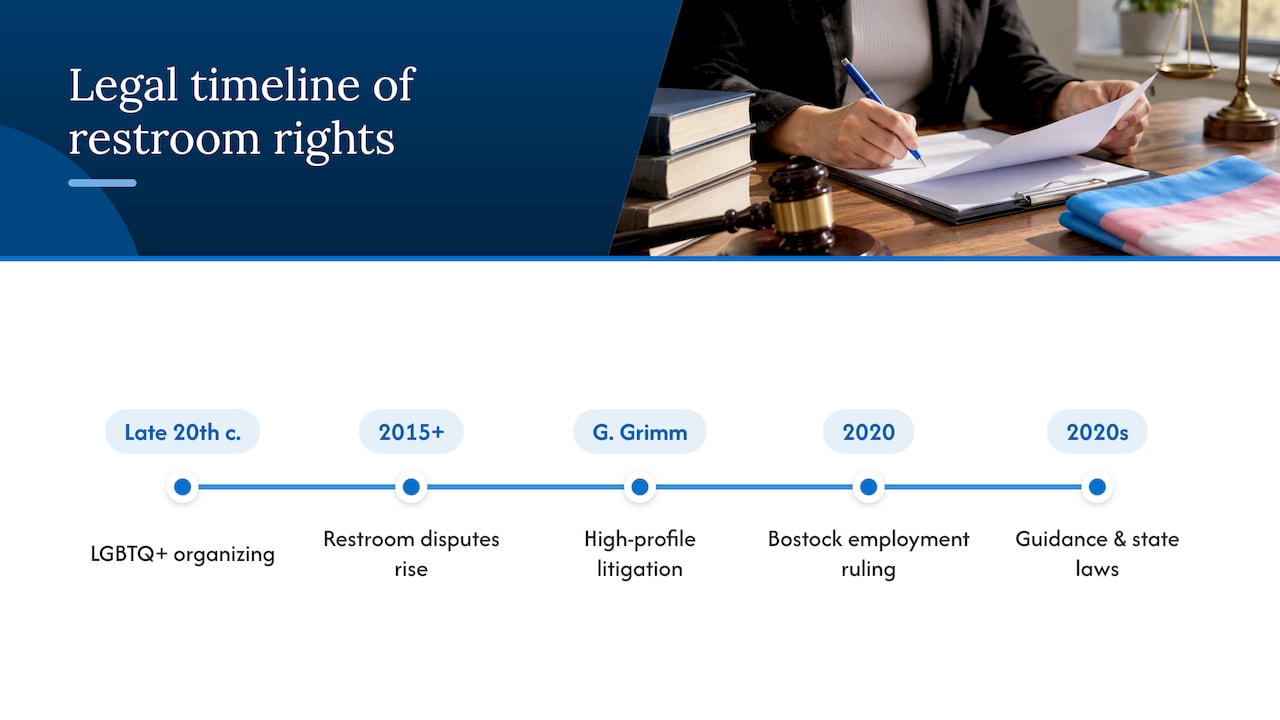
Restroom access did not become a legal flashpoint overnight. Advocacy for transgender inclusion in public facilities grew alongside broader LGBTQ+ civil rights organizing in the late twentieth century, but it entered mainstream legal and legislative debate more forcefully after 2015, as several states and school districts began adopting or contesting policies on facility access. The case of Gavin Grimm, a Virginia student who challenged his school board’s restroom policy through years of litigation, became a widely followed symbol of that era, illustrating both the possibility of legal victory and the length of time such cases can take to resolve.
Bostock’s 2020 ruling on employment discrimination reshaped the legal conversation by confirming that sex discrimination law protects transgender people in at least one major context, even though it left restroom-specific questions open. In the years since, the pendulum has swung repeatedly: some administrations and agencies expanded guidance recognizing gender identity in Title IX and Title VII enforcement, while others narrowed it, and state legislatures on both sides of the issue used that federal uncertainty to justify their own statutes. The result is the fragmented, state-by-state landscape readers face today, built not from one settled principle but from decades of incremental litigation, shifting agency guidance, and legislative responses to each new court ruling. Recognizing that history helps explain why the current rules feel unsettled rather than fixed, and why continued legal activity, not a single landmark case, is likely to keep shaping this area.
Why restroom access affects transgender people’s mental health and safety
Restroom policy is not an abstract legal question for the people it affects most directly. Scholarly commentary has argued that bathroom bills, even when framed as privacy measures, can cause real harm to transgender people by excluding them from ordinary participation in public and school life. Being denied access to a restroom consistent with one’s gender identity can mean avoiding food and water for hours, skipping school or work entirely on certain days, or facing confrontation in a moment when privacy and safety should be assumed.
For transgender students in particular, restroom exclusion often compounds other stressors tied to being visibly different in a school setting, at an age when belonging carries outsized weight. For transgender employees, the same dynamic plays out in workplaces where a restroom denial can feel like a daily referendum on whether they are welcome at all. These are not separate from safety concerns either: forcing someone into a facility that does not match their gender identity, or into a public confrontation over which door they use, increases exposure to harassment and conflict rather than reducing it. Advocates argue that policies genuinely aimed at privacy and safety for everyone are best served by accommodations that respect all parties, such as private single-occupancy options offered without singling anyone out, rather than blanket exclusions that concentrate risk on one group.
Understanding the arguments on the other side
Supporters of restrictive bathroom statutes typically frame their position around privacy and safety, arguing that sex-separated facilities protect women and children from potential harm by unfamiliar people in intimate spaces. Some also raise concerns rooted in religious or cultural beliefs about sex and gender, or argue that facility policy should be a matter of local and state control rather than federal mandate.
Legal and scholarly responses to these arguments generally make two points. First, commentary examining bathroom bills has found little support for the premise that restroom access based on gender identity increases safety incidents, while documenting concrete harms to transgender people excluded under these laws. Second, the privacy and safety concerns that motivate supporters can often be addressed without exclusion, through options like single-occupancy facilities, rather than blanket restrictions that apply to everyone regardless of individual circumstance. Where the law ultimately lands on this balance varies by state, as the current legislative activity makes clear, and reasonable people continue to disagree about how each state should weigh these interests. What the legal record does show is that courts have not treated the privacy argument as automatically outweighing anti-discrimination protections in every jurisdiction, which is part of why circuit courts remain split and Supreme Court review of related Title IX questions is pending.
How race, age, and disability shape the experience of bathroom access
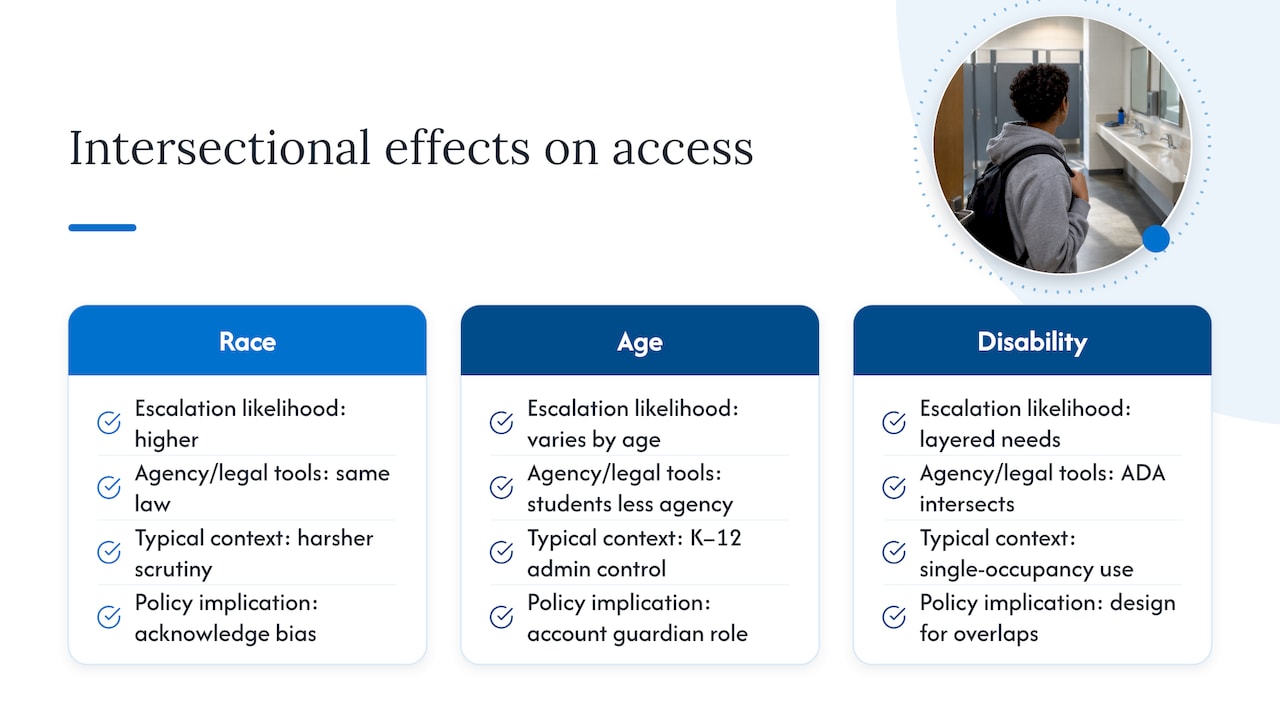
Restroom access rarely affects transgender people uniformly, because other aspects of identity change how a policy plays out in practice. A transgender person of color navigating a restroom dispute may face compounding bias, since research on workplace and school discrimination broadly shows that people of color often encounter harsher scrutiny and less benefit of the doubt in ambiguous confrontations, a dynamic that can sharpen the risk of a restroom disagreement escalating.
Age matters too. Transgender students in K-12 schools depend heavily on adult administrators and school board policy, giving them far less individual agency than an adult employee who can invoke Title VII protections or consult an attorney directly. Older transgender adults, meanwhile, may face restroom policy changes later in a career or community life, after years of navigating facilities under a different set of assumptions.
Disability adds another layer. A transgender person who also has a disability may rely on a single-occupancy or accessible restroom for reasons entirely separate from gender identity, and ADA accessibility requirements intersect with, but do not replace, the separate legal questions raised by gender-identity-based restroom policies. Someone who uses a service animal faces yet another set of rules, since ADA guidance on service animals governs access in public facilities differently than employment-related accommodation rules do. Institutions designing bathroom policy well need to account for these overlapping needs rather than treating gender identity as the only variable in the room.
Building restroom policies that work for everyone
Institutions, whether schools, employers, or public venues, that want to reduce conflict and legal exposure tend to share a few practices in common.
- Offer single-occupancy or gender-neutral options as an addition to, not a replacement for, existing facilities, so no one is forced into a separate space against their preference.
- Train staff and administrators on how to respond to restroom-related complaints or conflicts without escalating them or making assumptions about any individual’s identity.
- Put the policy in writing and make it accessible to employees or students, rather than leaving decisions to ad hoc judgment calls in the moment.
- Review policies against current law periodically, since state statutes and agency guidance are changing quickly enough that a policy written even a year ago may need updating.
None of these practices requires an institution to take a public political stance. They require clarity, consistency, and a willingness to treat restroom access as a practical operations question that deserves the same care as any other workplace or school policy.
The organizations working to advance and defend these rights
Advocacy groups have played a central role in shaping both the legal record and public understanding of restroom access, from filing and supporting litigation like the Gavin Grimm case to publishing legislative trackers that catalog the dozens of bathroom bills moving through state legislatures each year. Legal organizations file amicus briefs in circuit court cases and at the Supreme Court, helping courts understand how a ruling on Title IX or Title VII language will play out for real students and employees. Others focus on direct support, connecting transgender people facing discrimination with attorneys, mental health resources, or emergency assistance when a restroom dispute escalates into a broader workplace or school conflict.
That work matters because most individuals facing a restroom denial are not positioned to litigate the question themselves. Advocacy organizations absorb much of the research, tracking, and legal coordination that individual employees and students cannot realistically do on their own, which is part of why the legislative and court landscape described earlier in this article continues to shift as quickly as it does.
A publisher’s perspective on where this is headed
The legal debate over transgender bathroom rights often gets treated as a single question with a single answer, but the honest picture is messier and, frankly, more interesting. What stands out is how much weight has shifted to agencies and state legislatures precisely because the Supreme Court has not yet resolved the core Title IX question. That is not a failure of the system so much as a reflection of how contested this issue remains. Readers who expect a clean national rule are going to be disappointed for the foreseeable future, and the more useful posture is treating your own state’s statute and your own employer’s policy as the facts that actually govern your day, while watching the pending Supreme Court filings for the moment that could change everything at once.
— Max
Get help understanding your rights and options
An organization was founded to give employees plain-language information about their rights, free of legal jargon, and that mission applies directly to the restroom access questions covered here. If you are navigating a workplace dispute, our employee rights guide and complaint process guide walk through your options step by step, and our attorney directory can connect you with employment counsel in your state.
For readers who want deeper, ongoing support, a Workplace Fairness membership starts at $25 per year and helps fund the free resources this organization publishes for every worker who visits the site, transgender or otherwise. If workplace stress or a difficult complaint process is affecting your well-being, the SF Therapy Collective offers queer-affirming counseling resources worth exploring alongside any legal steps you take. Start with the free guides, and consider membership when you are ready for more.
This article is general information, not a substitute for advice from a qualified lawyer. Consult a qualified legal professional about your own circumstances before acting on anything here.
FAQ
Which states have transgender bathroom laws?
Florida, Texas, and Idaho are among the states with enacted or actively debated bathroom statutes requiring restroom use based on sex assigned at birth in schools or government buildings. Trackers counted roughly 45 such bills introduced nationwide by mid-2026, with at least three enacted into law, so checking your specific state’s current statute is essential before assuming a rule applies to you.
Are transgender men allowed in female toilets?
Whether a transgender man can use a men’s or women’s restroom depends entirely on the state and setting, since no uniform federal rule addresses this directly. Some states require restroom use based on sex assigned at birth in public buildings and schools, while others have no such statute, leaving the question to employer or school district policy.
Are gendered bathrooms legally enforced?
Enforcement varies: some state statutes attach civil penalties or complaint mechanisms to restroom policy violations, particularly in schools and government buildings, while many workplaces and businesses have no legally mandated gendered restroom requirement at all. Where a state statute exists, it typically applies only to the specific settings the law names, not to every restroom nationwide.
Which bathroom should a transgender employee use?
For federal employees, the EEOC’s 2026 federal-sector decision allows agencies to require restroom use based on sex, though this ruling does not extend to private employers. Private-sector employees remain governed by Title VII case law, EEOC guidance, and any applicable state anti-discrimination statute, so checking your employer’s written policy and your state’s law is the most reliable way to know your options.