On-call time becomes paid work under the Fair Labor Standards Act when an employee is “engaged to wait,” meaning restrictions on their freedom are tight enough that the time isn’t truly their own. Time spent actually responding to a call is always compensable. If you’re merely “waiting to be engaged” with freedom to live your life, federal law generally doesn’t require payment, though state law can demand more, and any compensable hours count toward overtime.
TL;DR:
- On-call time is only compensable if restrictions prevent workers from using it freely, such as needing to stay on-site or respond within minutes.
- When on-call hours are deemed hours worked, they must be paid at least minimum wage and included in overtime calculations, including premiums.
- State laws often require additional pay, like reporting-time pay, for last-minute cancellations or dismissals during on-call periods.
- Employers commonly use stipends, reduced rates, or percentage models for on-call pay, but should clearly track and itemize these to avoid undercalculation.
- Workers should document all on-call events meticulously, discuss discrepancies with HR, and escalate claims to relevant authorities if unpaid work persists.
Table of Contents
- Understanding On Call Pay Rules: The Engaged-to-Wait Test
- How Pay, Minimum Wage, and Overtime Work Together
- What State On Call Pay Laws Add to the Federal Floor
- Common On-Call Compensation Models Employers Use
- If You Think Your On-Call Hours Went Unpaid
- Why Clear On-Call Policies Matter for Every Workplace
- Get Help Understanding Your On-Call Rights
- Where to Verify the Rules Yourself
- Sources
Understanding On Call Pay Rules: The Engaged-to-Wait Test
The U.S. Department of Labor’s Fact Sheet #22 draws a line between two kinds of waiting. “Engaged to wait” means your employer controls your time so tightly you can’t use it for yourself, so it counts as hours worked. “Waiting to be engaged” means you’re free to run errands, sleep, or watch a movie until the phone rings, so it typically doesn’t.
The elaws FLSA Hours Worked Advisor walks through this with real scenarios that make the distinction concrete. A hospital resident required to sleep in an on-call room at the facility is engaged to wait. An apartment maintenance worker who carries a pager but can grocery shop, watch their kid’s soccer game, and sleep at home is usually waiting to be engaged, unless the required response time is so short it effectively traps them nearby.
Ask yourself these questions to sort your own situation:
- Must you stay on the employer’s premises or within a tight radius?
- Is your response window short enough (say, under 10 minutes) that you can’t leave home?
- Do call frequency and duration prevent normal personal activities?
- Are you disciplined for missing or delaying a response?
Answering “yes” to most of these points toward compensable time.
How Pay, Minimum Wage, and Overtime Work Together
Once on-call hours qualify as hours worked, they must be paid at least the applicable minimum wage, and they get added to your other hours for the week when calculating overtime, according to FirstHR’s payroll guidance. This is where a lot of employers stumble, because on-call math doesn’t stop at the base rate.
Here’s a simple example of how it plays out:
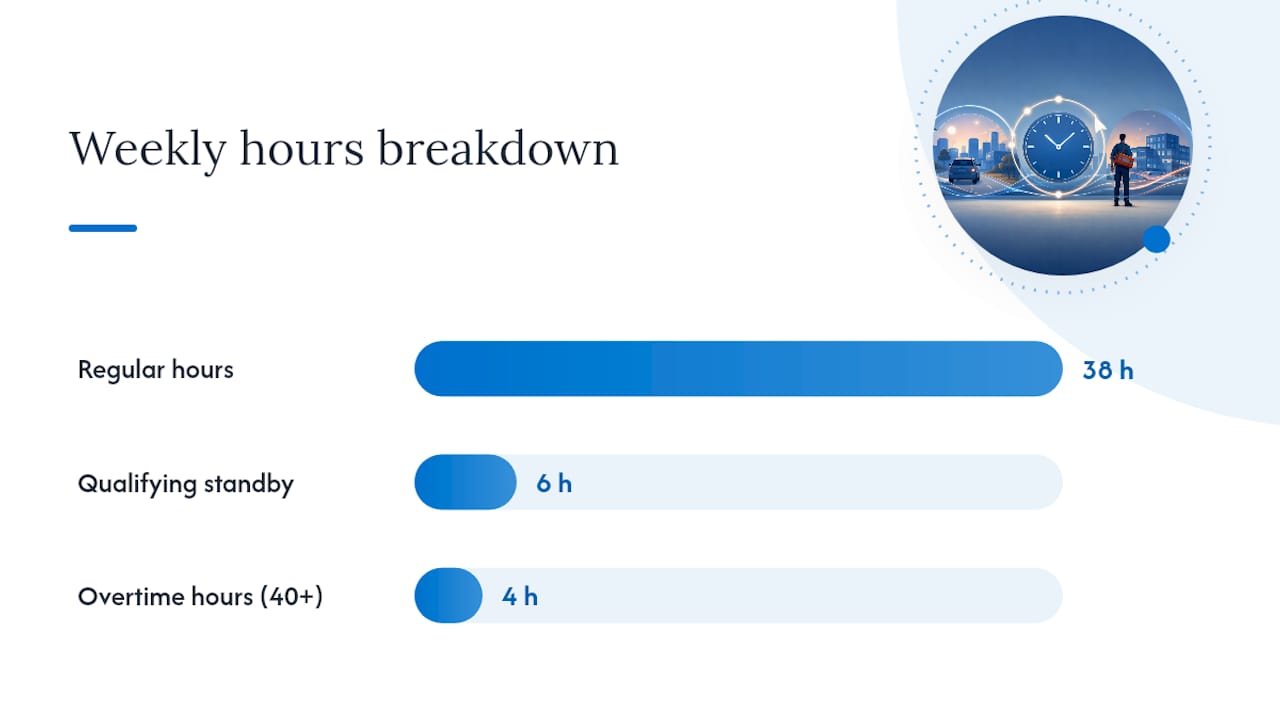
- An employee works 38 regular hours and spends 6 hours on qualifying, compensable standby time.
- Total hours worked hits 44, which is 4 hours over the 40-hour threshold.
- Those 4 overtime hours must be paid at 1.5 times the regular rate, not the base rate alone.
The regular rate isn’t just your hourly wage. UCR’s guidance on premium rates points to one of the most common employer mistakes: leaving nondiscretionary on-call premiums out of the regular rate used to calculate overtime. If an employee earns a standby premium for carrying the pager, that premium generally has to be folded into the regular rate before the overtime multiplier is applied, which quietly increases what’s owed.
Employers who calculate overtime off base pay alone, ignoring premiums, routinely underpay without realizing it.
What State On Call Pay Laws Add to the Federal Floor
Federal law sets a floor, not a ceiling, and plenty of states build higher walls on top of it. Reporting-time pay, sometimes called show-up pay, requires employers to pay a minimum number of hours when an employee reports for a shift or callback and gets sent home early or turned away, even if little or no work happens.
OnPay’s guide to on-call pay notes that states with established reporting-time rules, including California and Massachusetts, often trigger this pay for on-call employees who are told at the last minute they aren’t needed after all. That’s a separate obligation from standard on-call compensation, and it exists specifically because being put on standby and then dismissed still costs workers their time.
Before assuming the federal rule is the whole story, check these:
- Your state labor department’s website for standby, reporting-time, and predictability pay rules.
- City-level ordinances, since some cities layer on their own minimum wage or scheduling-predictability requirements.
- Whether your industry has sector-specific rules, which is common in health care and building services.
State and local rules shift often enough that verifying them directly, rather than relying on a national estimate, protects both sides.
Common On-Call Compensation Models Employers Use
Most employers who compensate standby time settle on one of three structures. A flat stipend per rotation pays a set amount for the week or shift someone carries the phone, regardless of how many calls come in. A reduced hourly standby rate pays a lower rate for all on-call hours, then switches to full pay the moment work actually starts. A percent-of-base model scales the payment to how demanding the response requirement is, so a 5-minute callback window earns more than a 30-minute one.
A workable on-call policy spells out:
- The required response time for a call to count as answered.
- How interruptions get tracked and recorded for pay purposes.
- How overtime gets calculated when standby hours push someone past 40.
- Whether employees get recovery time after a disruptive overnight incident.
Pro Tip: Keep the availability stipend and pay for actual work as two separate line items on the pay stub. Blending them makes the overtime regular-rate calculation far messier than it needs to be, and it’s one of the easiest fixes for the premium-pay mistake described above.
If You Think Your On-Call Hours Went Unpaid
Start building your own record before you raise the issue anywhere else.
- Log every on-call event yourself: date, time, call duration, and any restriction on your movement or activities. Independent logs are the strongest evidence in a wage dispute, especially when they contradict a thinner employer record.
- Bring the log to HR or payroll first, framed as a factual discrepancy rather than an accusation, and ask how the company classifies that time.
- Escalate to your state labor department or the U.S. Department of Labor if the internal conversation goes nowhere, and consider an employment attorney when back pay is substantial or your employer retaliates. If you’re salaried and buried in standby demands, it’s also worth checking your exempt versus nonexempt status.
Why Clear On-Call Policies Matter for Every Workplace
Workplace Fairness began in 1994 as the National Employee Rights Institute, built on the belief that fair treatment at work starts with workers actually understanding their rights. Confusing on-call policies leave people guessing whether their time is worth anything, and that uncertainty falls hardest on hourly workers with the least power to push back.
Workplace Fairness meets that gap with plain-language guides, a directory connecting workers to employment attorneys, and resources built to translate dense labor law into something usable. Fair on-call policies aren’t a courtesy. They’re a baseline every workplace owes its people.
— Max
Get Help Understanding Your On-Call Rights
If reading through the engaged-to-wait test left you wondering how it applies to your specific schedule, you don’t have to sort it out alone. Workplace Fairness built its resources specifically for workers who need clear answers about pay, not a law degree to get them.
Start with Employee Rights Explained, which lays out the broader legal protections around your pay and hours in plain language. If unpaid standby time is the specific issue, the Unpaid Overtime Explained guide walks through documentation and filing steps in more detail than any single article can. Both pages exist to help you figure out your next move, whether that’s a conversation with HR or a referral to an employment attorney. Read through the guide that matches your situation, and take the documentation steps outlined there before your next pay period closes.
Where to Verify the Rules Yourself
Confirm the federal baseline with the DOL’s elaws Hours Worked Advisor and Fact Sheet #22, then check your own state labor department for reporting-time or standby rules that go further.
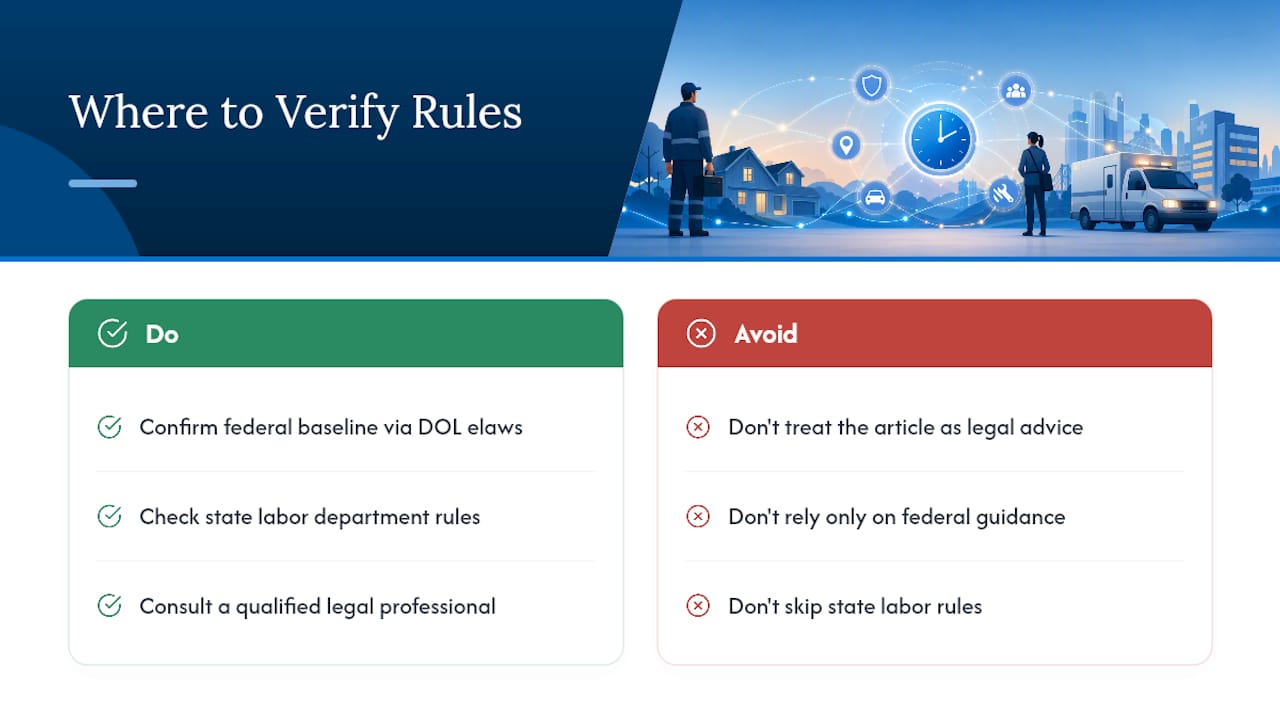
This article is general information, not a substitute for advice from a qualified lawyer. Consult a qualified legal professional about your own circumstances before acting on anything here.
Sources
- U.S. Department of Labor — FLSA Hours Worked (Fact Sheet #22)
- On-call pay: how it works and when it’s required — FirstHR
- UCR HR — Overtime, straight time and premium rates
- OnPay — On-call pay guide