
You will receive a small statutory stipend from the court, but whether your employer pays your regular wages depends on state law or company policy. Federal jurors are entitled to $50 per day under 28 U.S.C. §1871, with a possible judge-authorized increase for extended service. State court stipends vary widely, and private employers have no federal obligation to pay wages during your absence.
Pro Tip: Request a Certificate of Juror Service from the clerk as soon as your service ends, and check your employee handbook before your first day in court. Many employers have explicit jury-duty pay policies you may not know about.
Key Takeaways
Federal jurors receive $50 per day under 28 U.S.C. §1871, state stipends vary widely, and private employers have no federal obligation to pay wages during jury service.
| Point | Details |
|---|---|
| Federal baseline is $50/day | Judges may authorize up to $60/day for extended service under 28 U.S.C. §1871. |
| Employer pay depends on state law | Roughly ten jurisdictions require some employer pay; most protect the job without mandating wages. |
| Request a Certificate of Juror Service | Employers commonly require this document before applying their jury-duty pay policy. |
| Document hardship early | Bring income proof and a written estimate of lost earnings to request a hardship hearing when you report. |
| Juror fees are taxable | Report court stipends as other income; keep receipts for travel expenses that may qualify as non-taxable reimbursements. |
Table of Contents
- How does jury duty pay work under federal and state rules?
- What courts typically reimburse beyond the daily fee
- What are your rights when your employer won’t pay during jury service?
- What can you do if jury service would cause serious financial hardship?
- How and when do you actually receive your juror payment?
- Are juror fees taxable income?
- Quick answers for common jury pay situations
- Workplacefairness perspective on jury duty pay and employer obligations
- Sources
How does jury duty pay work under federal and state rules?
The federal baseline is straightforward. 28 U.S.C. §1871 sets a $50 daily attendance fee for federal jurors. A judge may authorize an increase, and U.S. Courts guidance notes that jurors serving extended terms may become eligible for up to $60 per day. Travel reimbursement and subsistence allowances are also available under the statute when circumstances require them.
State courts operate under their own statutes, and the variation is significant. Some states pay $15 or less per day; others pay nothing at all for the first day or two. A handful of jurisdictions go further and require employers to continue wages for a limited period. Roughly ten jurisdictions require some form of employer pay or have pay-specific rules, while the majority protect your job without mandating wages.
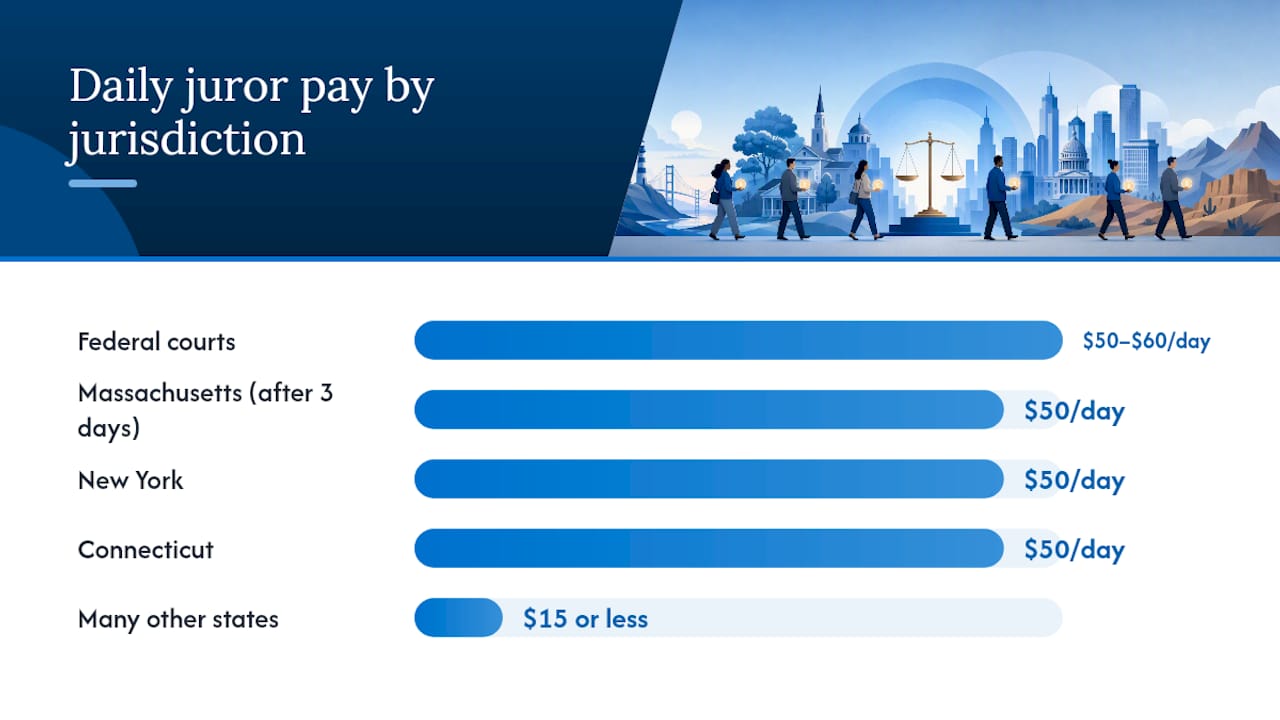
| Jurisdiction | Daily Juror Stipend | Employer Pay Required? |
|---|---|---|
| Federal courts | $50 (up to $60 for extended service) | No federal mandate for private employers |
| Massachusetts | $50/day after first 3 days | Yes, for first 3 days |
| New York | $50/day | Limited employer pay required |
| Connecticut | $50/day | Limited employer pay required |
| Many other states | $15 or less | No |
Factors that cause this variation include:
- The governing state statute and whether it contains an employer-offset provision
- Whether you are serving on a grand jury vs. a petit (trial) jury
- Length of service (some states increase pay after a threshold number of days)
- Employer size thresholds that trigger or exempt pay obligations
- Whether the employer’s policy offsets the court stipend against regular wages
What courts typically reimburse beyond the daily fee
Courts commonly reimburse travel costs, and the reimbursement structure matters when you are calculating your real out-of-pocket exposure. Mileage is typically calculated on the shortest practical route from your home to the courthouse, using a rate set by the court. Tolls and parking fees are generally reimbursable on receipt, so keep every ticket.
Subsistence allowances apply when overnight stays are required, covering lodging and meals at rates the judge determines. For grand jurors or jurors in non-contiguous states, air travel may be authorized under 28 U.S.C. §1871. These rules give judges meaningful discretion, which means the actual reimbursement you receive can differ from one courthouse to the next.
Pro Tip: When you report on day one, ask the clerk specifically about the court’s mileage rate and per-diem rules. Rates are not always posted prominently, and you cannot claim what you did not document.
What are your rights when your employer won’t pay during jury service?
Federal law protects your job but does not require private employers to pay wages during jury service. The Jury Selection and Service Act bars employers from firing, threatening, or coercing any employee because of jury service, and U.S. Courts guidance confirms that anti-retaliation protections apply to federal jury service. What the law does not do is put money in your paycheck.
Federal law shields your employment status during jury service, but wage protection depends entirely on your state and your employer’s written policy. Paycor’s state-by-state analysis confirms that most states protect the job without mandating pay, while a smaller number require employer pay or bar employers from forcing use of PTO.
In practice, employers follow one of three models:
- Continue full salary with no deduction, treating jury service like paid leave
- Offset the court stipend, paying the difference between your regular wages and the juror fee
- Require you to sign over the court check as a condition of receiving your regular wages
Massachusetts guidance describes all three scenarios and notes that the sign-over requirement is lawful in many states when the employer continues wages. Your steps when summoned:
- Notify your manager promptly and provide a copy of the summons
- Review your employee handbook for the specific jury-duty pay policy
- Request a Certificate of Juror Service from the clerk after service ends
- If your employer retaliates, document the conduct and consult an employment attorney
For broader context on employer labor law violations, Workplacefairness publishes practical guides on what constitutes unlawful employer conduct.
What can you do if jury service would cause serious financial hardship?
Judges can excuse or limit service for documented hardship, and you should be prepared to raise this at the courthouse when you first report. Do not wait to see how the trial unfolds. Courts take hardship requests seriously, particularly for self-employed individuals and hourly workers with no employer wage continuation.
Follow these steps to document your hardship:
- Gather recent pay stubs, tax returns, or bank statements showing your regular income
- Prepare a written estimate of earnings you would lose for each day of service
- If self-employed, collect letters from clients or a schedule showing work obligations that cannot be rescheduled
- Bring documentation of fixed financial obligations (rent, loan payments) that depend on uninterrupted income
- Ask the clerk, when you check in, how the court prefers hardship evidence to be submitted
Massachusetts guidance confirms that jurors can request a hardship hearing and that judges have discretion to shorten or excuse service based on documented financial strain.
Self-employed individuals face a particular challenge because there is no employer to continue wages. The court stipend rarely covers lost client revenue, which makes the hardship hearing the most practical avenue for relief.
Pro Tip: Bring printed proof of your regular income and a one-page written estimate of lost earnings. Judges respond to specifics, not general claims of hardship.
How and when do you actually receive your juror payment?
Courts generally issue juror fees after the clerk certifies your attendance, and timing varies by jurisdiction. Some courts pay at the end of each week of service; others issue a single payment after your term concludes. Direct deposit is available in some federal courts; others still issue paper checks.
Bring the following when you report:
- Your jury summons (required for check-in)
- A government-issued photo ID
- Bank account information if direct deposit is offered
- A written request for a Certificate of Juror Service
A typical payment timeline looks like this:
Summons received → Report to courthouse → Service days completed → Clerk certifies attendance → Check or direct deposit issued (days to a few weeks later)
For extended service, certification often happens periodically rather than at the end. U.S. Courts guidance notes that mileage and subsistence reimbursements are processed alongside the attendance fee. Employers commonly ask for the Certificate of Juror Service before applying their pay policy, so request it even if your employer has not specifically asked.
Are juror fees taxable income?
Yes. Juror fees are taxable income and must be reported on your federal return, typically as “other income.” The IRS treats the court stipend the same way it treats most miscellaneous income. Travel reimbursements that follow an accountable plan, meaning they match documented actual expenses, are generally not taxable.
Practical recordkeeping steps:
- Keep your Certificate of Juror Service as proof of the amount received
- Retain all receipts for mileage, tolls, parking, lodging, and meals
- Note that employer-paid wages during jury service flow through normal payroll and are reported on your W-2
- If your service was lengthy and disrupted your business income substantially, consult a tax professional about potential deductions
If you are self-employed and lost significant client revenue, those losses are not directly deductible as an offset to juror income, but a tax professional can advise on how extended service affects your overall return.
Quick answers for common jury pay situations
- Self-employed: No employer will continue your wages. Your primary options are the court stipend, a hardship hearing to limit service, and any business interruption coverage in your insurance policy.
- Federal employees: You generally receive your regular salary in place of juror fees. Coordinate with HR to avoid being paid twice for the same days.
- Long trials: Judges may authorize increased fees for extended service. U.S. Courts guidance notes the possible increase to $60 per day; ask the clerk whether your court has implemented this.
- Employer asks for your juror check: This is lawful in many states when the employer continues your wages. Check your state statute and company policy before signing anything over.
- States that require employer pay: Massachusetts, Connecticut, New York, and the District of Columbia are among the jurisdictions that require limited employer pay. Verify the current rule for your state.
Pro Tip: If your employer requires you to sign over the court check as a condition of receiving wages, confirm the arrangement is in writing and matches your employee handbook. If the policy is unclear or you feel pressured, contact HR or reach out to Workplacefairness for guidance.
If you have faced wage issues beyond jury service, a partner resource on unfair wage garnishment covers related employee recourse options worth reviewing.
Workplacefairness perspective on jury duty pay and employer obligations
Employers should treat jury service as a civic responsibility that their policies actively support, not merely tolerate. A clear, written jury-duty policy in the employee handbook, one that specifies whether wages continue, how the court stipend is handled, and what documentation employees must provide, prevents disputes and demonstrates good faith.
Employees, for their part, should not assume their employer’s policy matches the legal minimum. State law sets a floor, not a ceiling. An employer in a state with no wage-continuation mandate can still choose to pay full salary, and many do. The gap between what the law requires and what a fair employer should do is exactly where Workplacefairness focuses its advocacy.
Since its founding in 1994, Workplacefairness has worked to connect employees with plain-language information about their rights and with attorneys who can help when those rights are violated. Jury service is one of many situations where the law’s protections are real but incomplete. Understanding where the gaps are, and knowing how to document your situation, is how you protect yourself. Workplacefairness’s employee rights guide is a practical starting point for anyone navigating an employer dispute after jury service.
Sources
The rules that apply to you depend on which court summoned you and which state you work in. These sources cover the key layers:
- Juror pay
- §1871. Fees (28 U.S.C. §1871)
- Learn about compensation for jury duty
- Does Your Job Pay You for Jury Duty? 2026 State Guide
- Employees’ Rights for Jury Duty Leave by State
- Jury Duty Leave and Pay Laws by State | Ezel
State court clerk offices are the most current source for your specific courthouse’s mileage rate, per-diem rules, and payment timing. Call or check the court’s website before you report.
This article provides general information about jury duty compensation laws and is not a substitute for legal advice. Rules change and vary by jurisdiction; confirm current requirements with your state court clerk or a qualified employment attorney.