
The federal salary threshold for the FLSA white-collar overtime exemptions is $684 per week, or $35,568 per year. Employees who earn less than that cannot be treated as exempt executive, administrative or professional workers, so they are owed overtime. The 2024 rule that would have raised the number to $844 and then $1,128 per week was vacated by two federal courts, and the Department of Labor (DOL) has formally restored the earlier figures. Salary is only one part of the test, and your state may set a higher bar. This guide explains all of it in plain language.
TL;DR
- The federal minimum salary for the executive, administrative and professional exemptions is $684 per week ($35,568 per year).
- Highly compensated employees need total annual compensation of $107,432, including at least $684 per week paid on a salary or fee basis.
- The 2024 increase is not in effect. A technical amendment effective May 15, 2026 removed its text and republished the 2019 text.
- Meeting the salary number is not enough. Your actual duties must also fit the exemption, and a job title decides nothing.
- California, New York, Washington and several other states set higher salary minimums that apply to you if you work there.
Table of Contents
- The current federal numbers
- What happened to the 2024 overtime rule
- Why salary alone never makes you exempt
- The highly compensated employee test
- States that set a higher salary minimum
- Check your own situation
- Our perspective
- Support free, plain-language worker information
- FAQ
- Sources
The current federal numbers
The DOL’s earnings thresholds page sets out two levels that matter for most readers.
| Test | Weekly | Annual |
|---|---|---|
| Standard salary level (executive, administrative, professional) | $684 | $35,568 |
| Highly compensated employee (total annual compensation) | At least $684 paid on a salary or fee basis | $107,432 |
The standard level is a floor. An employee paid less than $684 for a week cannot be exempt under these three categories, no matter how impressive the job title or how senior the duties sound.
The $684 figure can also be met over longer pay periods. The regulation text published in the Federal Register on May 15, 2026 lists these minimums:
- Biweekly: not less than $1,368
- Semimonthly: not less than $1,482
- Monthly: not less than $2,964
One week is the shortest period of payment that can satisfy the requirement. If your employer pays you by the hour or by the day, you are not on a salary basis at all.
Territories have lower levels
Special levels apply in U.S. territories. The DOL lists $455 per week ($23,660 per year) for Puerto Rico, Guam, the U.S. Virgin Islands and the Northern Mariana Islands, and $380 per week ($19,760 per year) for American Samoa.
What happened to the 2024 overtime rule
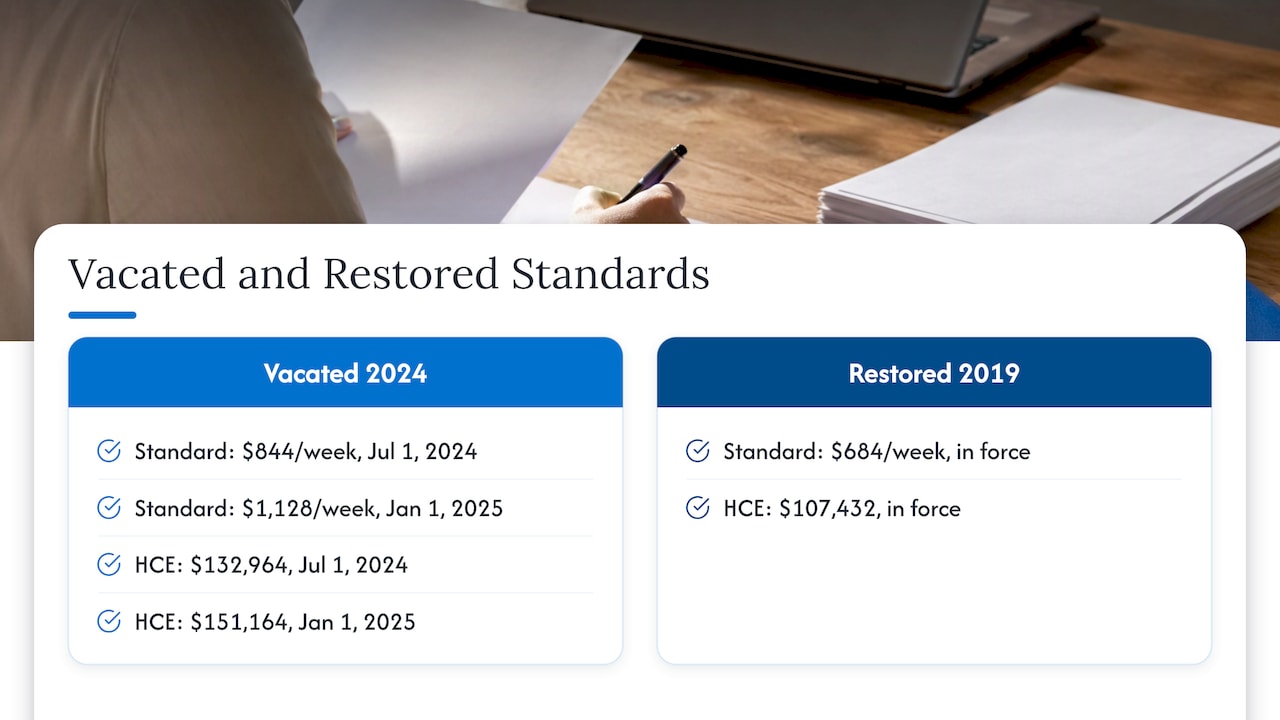
Many readers arrive here after seeing larger numbers, so the history is worth a short look. The DOL’s 2024 rule set the standard salary level to rise to $844 per week on July 1, 2024, and then to $1,128 per week on January 1, 2025. It set the highly compensated threshold at $132,964 and then $151,164 on those dates. The Federal Register notice records that two federal district courts vacated the rule.
Vacated means the rule has no legal force. For a time, though, the old text sat in the Code of Federal Regulations, which confused workers and employers alike. The DOL announced on May 14, 2026 that its technical amendment took effect on publication, restoring the 2019 regulations, with $684 per week for most exempt employees and $107,432 for highly compensated employees.
According to SHRM’s analysis, the amendment creates no new obligations. It makes the written regulations match the standards that were already in force. So if you read that the threshold was about to jump to $58,656, that number is not the law today.
We have followed these shifts for years. Our earlier coverage of proposed overtime changes shows how often the number has moved, and our overtime salary threshold guide keeps the federal and state figures side by side.
Why salary alone never makes you exempt
The FLSA requires that most employees receive at least the federal minimum wage for all hours worked, and overtime at not less than time and one-half the regular rate for hours over 40 in a workweek, as the DOL explains in Fact Sheet #17G. Exemption is the exception to that rule, and an employer who claims it has to meet every element.
Three elements must all be present for the white-collar exemptions:
- Salary basis. You regularly receive a predetermined amount each pay period, weekly or less often. That amount cannot be reduced because of variations in the quality or quantity of your work.
- Salary level. The amount must reach at least the threshold above.
- Duties. Your real work must fit the executive, administrative or professional description.
The DOL is direct on the last point: job titles do not determine exempt status. Calling someone a manager, coordinator or analyst does nothing if the daily work does not match the regulations.
The administrative exemption in practice
The administrative exemption is the one most often stretched. Under Fact Sheet #17C, your primary duty must be office or non-manual work directly related to the management or general business operations of the employer or its customers. That work must include the exercise of discretion and independent judgment on matters of significance.
A payroll clerk who follows set procedures and a team lead who decides company policy are very different jobs, even if both are called “administrators.” A salary at or above $35,568 only opens the door to the duties question.
A federal appeals court recently weighed in on duties. HR Dive reports that the 6th Circuit held the DOL’s primary duty guidance still applies after the Supreme Court’s Loper Bright decision. In practice, how the DOL reads “primary duty” remains the yardstick.
Blue-collar work is never exempt under these tests
The white-collar exemptions do not reach manual laborers. Fact Sheet #17I says they do not apply to workers whose jobs involve repetitive operations with their hands, physical skill and energy, however highly paid. A skilled tradesperson earning $120,000 is still entitled to overtime under these rules.

Who is outside the salary test
The salary requirements do not apply to outside sales employees, teachers, and employees practicing law or medicine, according to Fact Sheet #17G. Those groups are judged on other terms.
The highly compensated employee test
A streamlined test exists for people at the top of the pay scale. A highly compensated employee needs total annual compensation of $107,432 or more, of which at least $684 per week is paid on a salary or fee basis. Such employees also must perform office or non-manual work and customarily perform at least one exempt duty of an executive, administrative or professional employee.
This is still a duties test, only a lighter one. If you earn above that line but spend your days on manual work, the blue-collar rule above still protects you.
States that set a higher salary minimum
Federal law is a floor. The DOL’s action has no effect on state-law overtime exemptions, and some states have higher salary levels or different duties tests. Where both laws apply, the rule more protective of the worker controls in practice.
A December 2025 summary of 2026 state overtime salary levels lists these figures:
| State | Standard EAP salary level for 2026 |
|---|---|
| California | $1,352 per week ($70,304 per year) |
| Washington | $1,541.70 per week ($80,168.40 per year) |
| New York | $1,275 per week in specified counties, $1,199.10 per week elsewhere |
| Maine | $871.16 per week ($45,300.32 per year) |
| Alaska | $1,040 per week in 2025, rising to $1,120 per week on July 1, 2026 |
| Colorado | Proposed at $1,111.23 per week ($57,784 per year) |
Washington’s level is tied to a multiple of the state minimum wage, 2.25 times, and applies to employers of all sizes, so it rises as the minimum wage does. State figures are adjusted often, so confirm yours with your state labor department before relying on a number here.
A quick example
Imagine an assistant manager in Seattle paid a salary of $52,000 per year. That is well above the federal $35,568, so the federal salary test is met. It is below Washington’s $80,168.40, so under state law the employer cannot classify that job as exempt on salary grounds. Overtime would be owed for hours past 40 in a workweek, where Washington’s rules apply. The same pay in a state with no higher level would leave the question to the duties test.
Check your own situation
Work through these steps in order:
- Find your pay basis. Look at your pay stub. Are you paid a fixed amount per pay period, or by the hour?
- Convert to weekly. Divide your annual salary by 52. If the result is under $684, you cannot be exempt under the standard test.
- Check your state. If you work in a state with a higher level, use that number instead.
- Compare duties. Write down what you do in a typical week and compare it with the executive, administrative or professional descriptions in the DOL fact sheets.
- Count your hours. If you are nonexempt and worked more than 40 hours, keep a record. Our guide on off-the-clock work explains why records matter when you recover pay.
For a deeper look at classification, read our explainer on exempt versus nonexempt status. If you think hours went unpaid, our unpaid overtime guide covers your options, and our labor worker rights and overtime guide is written for hourly and trades workers in particular.
Common misclassification patterns
Equity in the workplace begins with accurate classification. These are the situations we hear about most:
- A worker is given a manager title and a salary just above the threshold, but spends most of the day on the same tasks as hourly staff.
- A salary is paid, but deductions are taken when the employee works fewer hours, which undercuts the salary-basis requirement.
- A worker is told that being “salaried” means no overtime, without any look at duties.
- Required training or meetings are not counted as work time. See our piece on when training time is paid.
None of these proves misclassification by itself. Each is a reason to compare your facts with the rules above and, if the gap is real, to speak with an employment attorney or your state labor agency.
Our perspective
Every salary threshold debate comes down to one practical question: who gets paid for the time they work? A figure on a page can feel abstract, but $684 a week is the line between a worker who is owed time and a half and one who is not.
We have spent decades connecting the knowledge of employment rights attorneys with the people who live these rules every day. What we see is that most workers do not need more law, they need the law in plain words. They need to know that a title is not a classification, that a salary is not a waiver, and that the state where they work may protect them more than federal law does.
The legacy of resilience among workers is built on informed action. When employees understand the thresholds, the duties tests and the records they should keep, they can raise concerns early, and equitable workplaces become easier to build. We offer that information free, because fairness should not depend on the ability to pay for it.
Max
Support free, plain-language worker information
Workplace Fairness is a free resource funded through donations. If this guide helped you understand your overtime rights, you can help us keep it available for the next worker with the same question. Membership starts from $25 per year.

Members support free guides on wages, classification and discrimination for employees across the country. Organizations that want to back this work can also look at our podcast sponsorship levels.
FAQ
What is the 2026 FLSA salary threshold?
The standard federal level is $684 per week, or $35,568 per year, and the highly compensated employee level is $107,432 per year. No federal increase is scheduled to take effect, because the 2024 rule was vacated and the 2019 text was formally restored in May 2026. State levels can be higher.
Can I be exempt just because I am paid a salary?
No. You must be paid on a salary basis, earn at least the required level, and perform exempt duties. The DOL states that job titles do not decide exempt status. If your duties do not fit, you may be owed overtime even though you receive a regular salary.
Which states have a higher exempt salary minimum?
A 2026 summary lists California, Washington, New York, Maine, Alaska and Colorado (proposed) as above the federal level. Washington and California are the highest in that list. Check your state labor department for the current figure, since these numbers are updated regularly.
Do the salary rules apply to hourly workers?
Hourly workers are not paid on a salary basis, so the white-collar exemptions generally do not fit them. Overtime at time and one-half is due for hours over 40 in a workweek. Manual and skilled trade workers also fall outside these exemptions regardless of pay.
Sources
- DOL: Earnings thresholds for the executive, administrative and professional exemptions
- Federal Register: Defining and Delimiting the Exemptions, May 15, 2026
- GovInfo: Federal Register, Volume 91, Issue 94
- DOL newsroom: technical amendment announcement
- SHRM: DOL amendment formally restores 2019 overtime exemption
- DOL Fact Sheet #17G: Salary basis requirement
- DOL Fact Sheet #17A: Executive, administrative, professional exemptions
- DOL Fact Sheet #17C: Administrative employees
- DOL Fact Sheet #17I: Blue-collar workers
- HR Dive: 6th Circuit on the DOL’s primary duty analysis
- Employco: 2026 state overtime salary levels