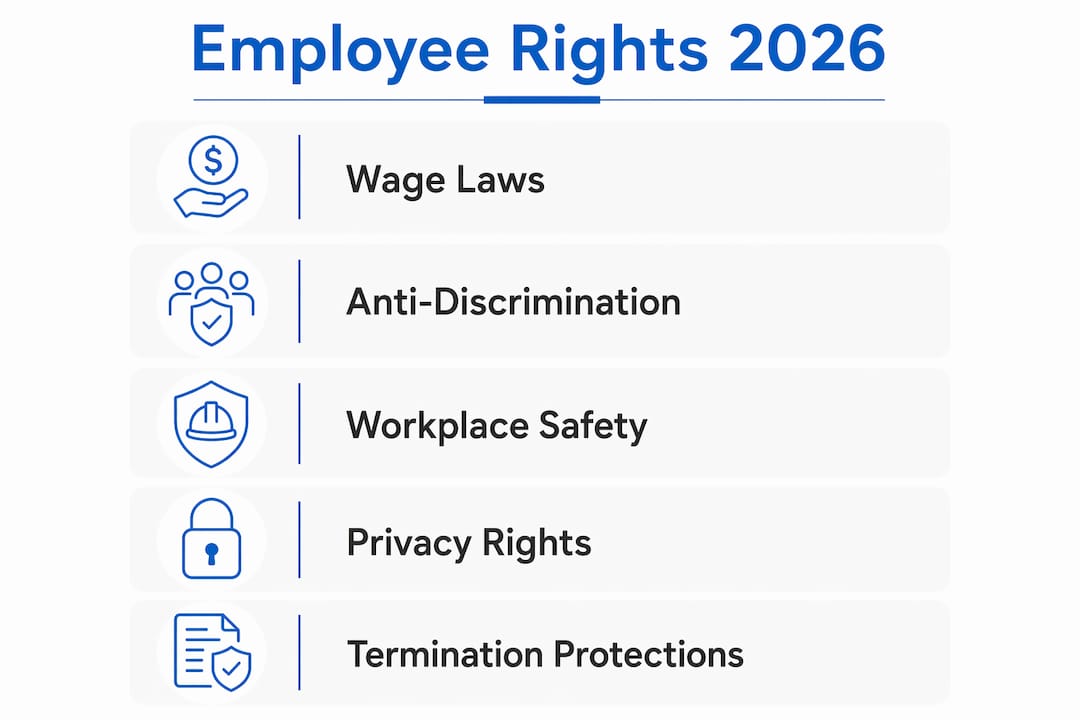
Every worker in the United States has legal protections that govern how they must be treated on the job. These protections cover pay, safety, leave, privacy, and freedom from discrimination. Understanding them is not just reassuring. It is the foundation for knowing when your rights have been violated and what you can do about it.
Your core rights as a U.S. employee include:
- Fair pay: The right to at least the federal minimum wage and overtime pay under the Fair Labor Standards Act
- Safe working conditions: OSHA-enforced protections against hazardous environments
- Freedom from discrimination: Protections based on race, sex, religion, disability, age, and more, enforced by the Equal Employment Opportunity Commission (EEOC)
- Family and medical leave: Up to 12 weeks of unpaid, job-protected leave under the Family and Medical Leave Act (FMLA)
- Privacy: Limited but real protections over personal information, medical records, and personal devices
- Protection from retaliation: The right to report violations without fear of punishment
These rights arise from a layered framework of federal statutes, including the FLSA, FMLA, the Americans with Disabilities Act (ADA), and Title VII of the Civil Rights Act. The U.S. Department of Labor and the EEOC are the two primary federal bodies responsible for enforcing them.
What federal labor laws protect your pay and leave?
The Fair Labor Standards Act is the backbone of wage protection in the United States. It sets the federal minimum wage, requires overtime pay at one and a half times the regular rate for hours worked beyond 40 in a workweek, and establishes child labor standards for workers in both the private sector and government. Most full-time and part-time employees are covered.
The FMLA adds a different layer of protection, one focused on life events rather than wages. Eligible employees are entitled to up to 12 weeks of unpaid, job-protected leave per year for serious health conditions, the birth or adoption of a child, or to care for a seriously ill family member. To qualify, you must have worked for your employer for at least 12 months and logged at least 1,250 hours in the prior 12 months. Your employer must also have 50 or more employees.
Key protections these laws provide:
- Overtime enforcement: Non-exempt employees must receive 1.5x their regular rate for every hour beyond 40 in a workweek
- Recordkeeping rights: Employers must maintain accurate time and pay records
- Job protection during leave: FMLA guarantees your position or an equivalent role when you return
- Health insurance continuation: Your employer must maintain your group health coverage during FMLA leave
The U.S. Department of Labor’s Wage and Hour Division enforces both the FLSA and FMLA. If your employer underpays you or denies lawful leave, you can file a complaint directly with the WHD at no cost.
Pro Tip: Keep your own records of hours worked and pay received. If a wage dispute arises, your personal records can support a WHD complaint even when your employer’s records are incomplete or inaccurate.
How anti-discrimination and harassment protections work for you
Federal anti-discrimination law covers far more ground than many workers realize. The EEOC enforces protections against discrimination and harassment based on:
- Race, color, and national origin
- Sex, including pregnancy, sexual orientation, and transgender status
- Religion
- Disability
- Age (40 or older)
- Genetic information, including family medical history
These protections apply across every stage of employment: hiring, promotions, pay, assignments, discipline, and termination. Harassment becomes unlawful when it is severe or pervasive enough to create a hostile work environment, or when it results in an adverse employment decision such as a demotion or firing.
Reasonable accommodations are a critical piece of this framework. Under the ADA and Title VII, your employer must provide adjustments to how work is normally done if you have a qualifying disability or a sincere religious belief that conflicts with a workplace requirement. That could mean a modified schedule, accessible equipment, or an exemption from a dress code. The right to request accommodations is protected by law, and your employer cannot penalize you for making that request.

Retaliation is its own violation. If you report discrimination, participate in an EEOC investigation, or simply tell your employer you believe a policy is discriminatory, federal law prohibits any form of punishment in response. That includes termination, demotion, reduced hours, or a hostile reassignment.
Common questions workers ask about discrimination:
Can my employer ask about my medical history during hiring? Generally, no. The ADA prohibits medical inquiries before a conditional job offer is made.
What if harassment comes from a coworker, not a manager? Your employer is still responsible if they knew or should have known about the harassment and failed to act.
How do I file a discrimination charge? You file with the EEOC, which investigates and may pursue mediation, a settlement, or litigation on your behalf.
Workplace safety rights and protections regardless of immigration status
Every worker in the United States has the right to a safe workplace, regardless of their immigration status. The Occupational Safety and Health Administration (OSHA) sets and enforces safety standards across most private-sector industries, requiring employers to eliminate recognized hazards and provide protective equipment where needed.
Labor rights apply to all workers in the United States, including undocumented workers. Minimum wage, overtime, and safety protections do not disappear because of a worker’s immigration status. The Wage and Hour Division enforces these standards without regard to documentation.
Core workplace safety rights include:
- The right to receive training on workplace hazards in a language you understand
- The right to request an OSHA inspection without employer retaliation
- The right to review records of work-related injuries and illnesses
- The right to refuse work you reasonably believe poses an imminent danger
Whistleblower protections cover employees who report unsafe conditions or violations to OSHA or other agencies. If your employer fires, demotes, or threatens you for raising a safety concern, that retaliation is itself a federal violation. You can file a whistleblower complaint with OSHA within 30 days of the retaliatory action.
Understanding evolving employee rights and workplace fairness in 2026
The legal landscape around employee rights continues to shift, particularly in areas where technology intersects with privacy. Employers increasingly use AI-driven monitoring tools, biometric time clocks, and productivity tracking software. These practices raise real questions about where employer oversight ends and employee privacy begins.
The United States has no single federal workplace privacy law. Instead, protections arise from a patchwork of statutes: the ADA limits what medical information employers can collect, the Genetic Information Nondiscrimination Act (GINA) restricts access to genetic data, and HIPAA governs health information in specific contexts. State laws add another layer, with Illinois, Texas, and Washington leading on biometric data regulation.
Emerging privacy rights workers should know about in 2026:
- Biometric data: Several states now require explicit consent before employers collect fingerprints, facial scans, or retinal data
- AI monitoring disclosures: Some states require employers to notify workers when algorithmic tools are used to evaluate performance
- Social media access: Employers in many states cannot require employees to hand over social media passwords or login credentials
- Personal devices: Monitoring a personal device requires explicit employee consent, unlike company-owned equipment
Workplacefairness has tracked these developments since 1994, connecting workers with the legal knowledge they need to assert their rights as the workplace evolves. For a deeper look at how privacy law applies to your situation, Workplacefairness offers a detailed resource on workplace privacy rights.
Pro Tip: Review your employer’s technology-use policy carefully. Courts have consistently found that employees have no reasonable expectation of privacy on company-owned devices when a clear policy exists. Knowing the policy protects you from surprises.
Protections against wrongful termination and retaliation
Most U.S. workers are employed “at will,” meaning an employer can end the relationship for any reason or no reason at all. But that principle has significant legal limits. Wrongful termination occurs when a firing violates a specific law, a contract, or established public policy.
Federal law prohibits termination based on any protected characteristic covered by the EEOC, including race, sex, disability, religion, and age. It also prohibits firing an employee for exercising a legal right, such as filing a workers’ compensation claim, taking FMLA leave, or reporting a safety violation to OSHA. These protections exist precisely because retaliation is one of the most common ways employers silence workers who speak up.
Retaliation does not have to be a firing to be unlawful. A demotion, a pay cut, a hostile reassignment, or even a sudden negative performance review following a complaint can all constitute retaliation if the timing and circumstances suggest a connection. Workers who believe they have faced retaliation should document every incident with dates, names, and details, and consult with an employment attorney or file a charge with the EEOC. Workplacefairness provides guidance on labor standards enforcement that can help you understand your options.
What you need to know about employee privacy rights at work
Privacy at work is real, but it is narrower than most workers expect. Employers can generally monitor company-owned devices, email systems, and workplace communications when they have disclosed that monitoring in a written policy. Courts have consistently upheld this practice, finding that a clear technology-use policy eliminates any reasonable expectation of privacy on employer equipment.
Where employee privacy rights carry more weight is in areas tied to personal information and off-duty conduct. Medical records shared with an employer under the ADA must be kept confidential and stored separately from a personnel file. Genetic information collected under GINA cannot be used in employment decisions. Personal devices brought to work retain stronger privacy protections, and monitoring them without consent can expose an employer to liability under state wiretapping laws.
Social media is a growing frontier. Workers should know that their social media rights include protection from employers demanding passwords or forcing access to private accounts in states with social media privacy laws. Off-duty social media activity generally falls outside an employer’s reach unless it directly harms the business or violates a lawful workplace policy. Understanding where these boundaries sit gives you the clarity to protect your personal information without fear.
Key Takeaways
U.S. workers are protected by a layered framework of federal laws covering pay, leave, safety, privacy, and equal treatment, and knowing those laws is the first step toward asserting them.
| Point | Details |
|---|---|
| FLSA covers most workers | The Fair Labor Standards Act sets minimum wage, overtime, and recordkeeping standards for most full-time and part-time employees. |
| FMLA requires 12 weeks leave | Eligible employees can take up to 12 weeks of unpaid, job-protected leave per year for qualifying family or medical reasons. |
| EEOC enforces anti-discrimination | Federal law prohibits discrimination based on race, sex, religion, disability, age (40+), and genetic information across all employment decisions. |
| Immigration status does not limit rights | Minimum wage, overtime, and safety protections apply to all workers in the U.S. regardless of immigration status. |
| Privacy rights depend on context | Employer monitoring of company devices is broadly permitted with disclosure; personal devices and medical records carry stronger protections. |