
Evidence of workplace discrimination is anything that shows an employer treated you worse because of a protected trait, such as age, race, sex, religion, disability or national origin. It can be a direct statement, a document, a pattern of unequal treatment or an explanation that does not hold up. Most employees will not find a single dramatic proof. They will build a record, piece by piece, and that record can carry a claim.
This guide explains the types of evidence, how the legal framework uses them, what age discrimination proof tends to look like, and what to do this week if you suspect you are being treated unfairly.
TL;DR
- Direct evidence, such as an admission of bias, is rare. Most cases are built on circumstantial evidence: timing, patterns, comparisons and shifting explanations.
- The standard legal framework asks you to show a basic case, lets the employer give a lawful reason, then asks whether that reason is a pretext.
- Start documenting now. Routine retention cycles can erase emails and notes before you ever file.
- Deadlines are short: typically 180 days to file an EEOC charge, or up to 300 days in some states and localities.
- Complaining about discrimination is itself protected. Retaliation is a separate claim.
Table of Contents
- Direct and circumstantial evidence: the difference that matters
- How the legal framework uses your evidence
- Proving age discrimination: what the evidence looks like
- Start documenting now
- Retaliation: the claim people forget
- Deadlines you cannot afford to miss
- Our perspective
- Where to go for support
- FAQ
- Sources
Direct and circumstantial evidence: the difference that matters
The law recognizes two kinds of proof. Direct evidence speaks for itself, such as an eyewitness account or a confession. In a workplace case, that might be a manager saying in an email, “We need someone younger in this role,” or a written policy that excludes a protected group.
Circumstantial evidence is different. It is indirect proof that gives rise to a logical inference that a fact is true. It does not announce discrimination. It lets a reasonable person conclude that discrimination is the most likely explanation.
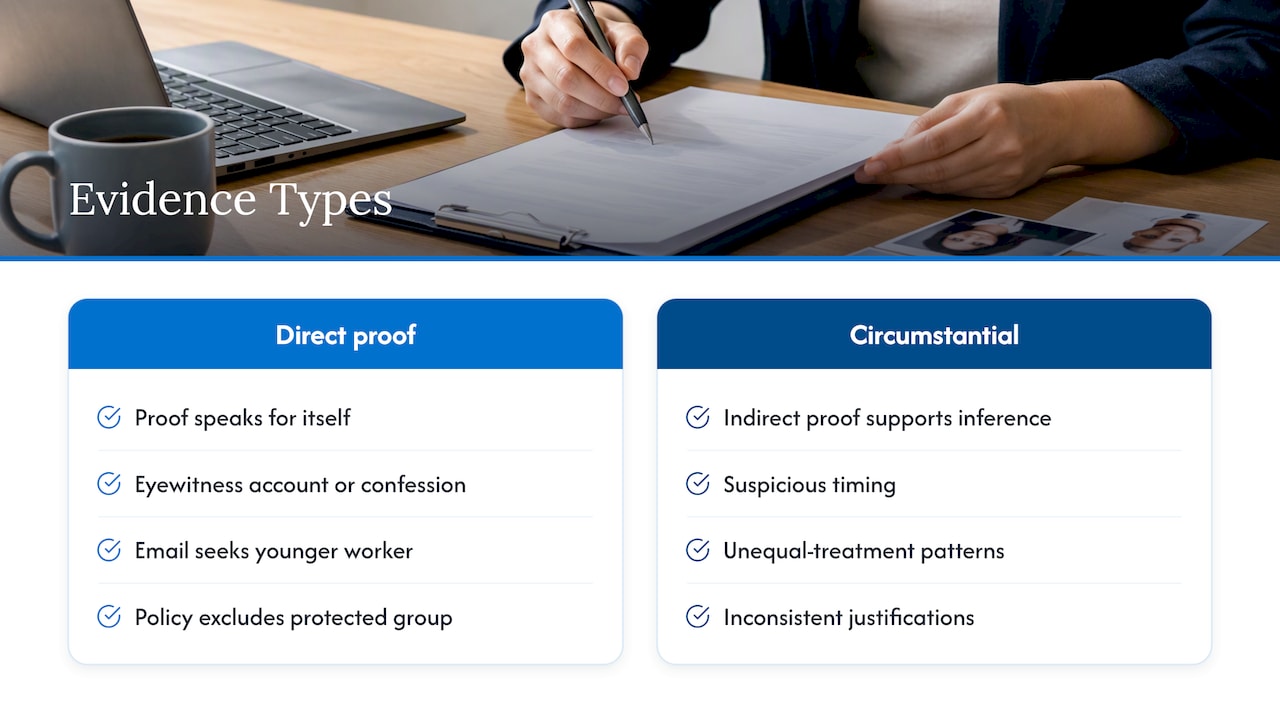
This distinction matters because the first kind is uncommon. The Department of Justice’s guidance on proving intentional discrimination notes that direct proof is rare and most cases rest on circumstantial evidence, including suspicious timing, patterns of unequal treatment and inconsistent justifications. Do not wait for a smoking gun. Most people who prove discrimination never had one.
Examples of each
| Type | What it looks like at work |
|---|---|
| Direct | A written or recorded remark linking a decision to your protected trait, from the person who made the decision |
| Direct | A job posting or policy that openly excludes people with your trait |
| Circumstantial | A termination days after you disclosed a pregnancy, a medical condition or your age-related plans |
| Circumstantial | Years of strong reviews, then a sudden decline once a new supervisor arrives |
| Circumstantial | Coworkers outside your protected group who broke the same rule and kept their jobs |
| Circumstantial | An employer who gives one reason at the time and a different reason later |
How the legal framework uses your evidence
Courts and the EEOC commonly analyze intentional discrimination claims through a three-step framework known as McDonnell Douglas. The EEOC describes it in its compliance guidance on theories of discrimination, and it asks the following:
- Prima facie case. You show evidence that an adverse action occurred under circumstances that support an inference of discrimination.
- Legitimate reason. The employer must state a lawful, non-discriminatory reason for what it did.
- Pretext. You then show that the stated reason is a false excuse covering the real one.
The EEOC has applied this three-part evidentiary scheme from McDonnell Douglas Corp. v. Green in its own decisions. Think of the steps as a way to organize your evidence, not as a script you must perform perfectly.
What counts as an adverse action
Many people assume only firing or demotion qualifies. The Supreme Court’s April 2024 decision in Muldrow v. City of St. Louis clarified that an employee challenging a job transfer under Title VII needs to show only “some harm” to an identifiable term or condition of employment. The harm does not have to be significant. If you were moved to a worse shift, a less visible role or a different location because of a protected trait, document what changed.
Proving pretext
Pretext is where most cases are decided. Your goal is to show the employer’s stated reason does not match the facts. The DOJ guidance points to treatment of similarly situated coworkers who do not share your protected trait as a common method. Useful pretext evidence includes:
- Comparators who had the same job, supervisor and conduct but faced no discipline
- A stated reason that changes between the termination meeting, the HR file and the response to an agency charge
- A policy applied to you but not to others
- Performance criticism that appears only after you raised a concern or revealed a protected trait
- Positive reviews, awards or written praise that contradict the claimed performance problem
Proving age discrimination: what the evidence looks like
Age is one of the protected bases the EEOC lists, alongside race, color, sex, religion, national origin, disability, genetic information and retaliation, in its Get the Facts series. Because employers rarely admit age bias, age cases lean heavily on circumstantial proof.
Common examples
AARP’s guide to signs of age discrimination describes patterns that can support a claim. Experts quoted there emphasize that discrimination seldom happens in isolation. It shows up as patterned changes, such as:
- A sudden drop in performance reviews after years of high marks
- Exclusion from meetings that similarly situated coworkers attend
- Coded language, such as “culture fit,” that may signal a preference for younger hires
- Being passed over for training or promotion in favor of someone noticeably younger
- Layoff or restructuring decisions that fall mostly on older staff
None of these proves a claim alone. Together, with dates and names attached, they can form an inference that age played a role. Our guide to types of workplace discrimination explains how age fits among the other protected categories.
Building an age discrimination record
For an age claim, gather the following if you can lawfully access it:
- Your performance reviews across several years, to show the before and after
- Job descriptions and postings for your role, and for the role given to someone else
- The ages or approximate ages of those hired, promoted or retained, if you have personal knowledge
- Written comments about retirement, energy, “fresh ideas” or “digital natives” from decision-makers
- Records of training or projects offered to others and denied to you
Remarks from the person who made the decision carry more weight than offhand comments from a peer. Note who said what, when, and who else heard it.
Start documenting now
Employers must retain records once a charge is filed. They are not required to keep every internal communication indefinitely, so emails and notes can disappear through ordinary cleanup cycles. If you suspect discrimination, do not wait for a formal charge to begin.
A practical documentation routine
- Write a dated timeline. Record each incident the same day if possible: what happened, who was present, what was said and how it affected your pay, duties or schedule.
- Keep your own copies of your own records. Save performance reviews, offer letters, pay stubs, commendations and your job description. Be careful about forwarding confidential company material. When in doubt about what you may keep, ask an employment attorney before you copy anything.
- Identify witnesses. List coworkers who saw or heard the conduct, and note whether they still work there.
- Use writing. After a verbal conversation, send a short, factual email summarizing it. This creates a record that cannot easily be denied.
- Track comparators. Write down who was treated differently, for what conduct, and how you know.
- Store it safely. Keep notes on a personal device or in personal paper files, not on a work computer or account that can be cut off.
State laws on access to your own personnel records vary. Our personnel files by state page shows what you may request where you live.
Retaliation: the claim people forget
If you complain to HR, file a charge or serve as a witness, and then face an adverse action, you may have a separate claim. The EEOC’s retaliation brochure explains that retaliation means treating employees badly because they complained about discrimination or took part in a proceeding. Its guidance also makes clear that you are protected for opposing discrimination even if the original claim is later found unsubstantiated.
That is why timing evidence matters twice. Record the date you raised a concern, and record every change in treatment that followed.
Deadlines you cannot afford to miss
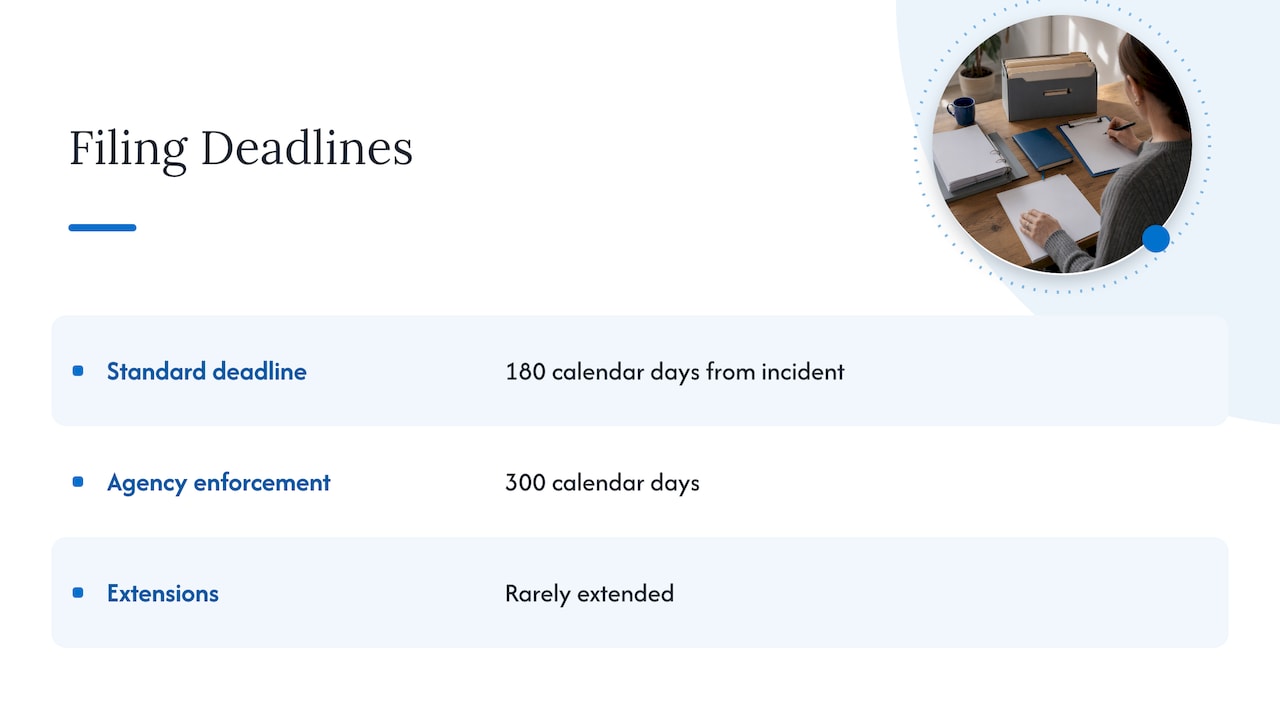
The clock is short. According to the EEOC’s page on how to file a charge, you typically have 180 calendar days from the incident, extended to 300 calendar days if a state or local agency enforces a law against discrimination on the same basis. The agency states that these deadlines are rarely extended.
To see how filing works in practice, read our EEOC charge filing guide and the workplace discrimination complaint process. If you are weighing a promotion denial, our summary of an important Sixth Circuit decision on discriminatory failure to promote shows how courts look at those facts.
Our perspective
We founded this organization in 1994, as the National Employee Rights Institute, to connect the knowledge of employment rights attorneys with the people who need it. That mission shapes how we see evidence cases.
The workers we hear from often believe they have nothing, because no one ever said anything openly biased. We want you to understand that this is the normal situation, not a weak one. Systemic barriers rarely announce themselves. They appear as a changed schedule, a missing invitation, a review that does not match the years before it. Naming those patterns, with dates, is how workers turn a feeling into a record.
We also believe fairness is a shared responsibility. Employers who keep consistent standards, train managers to avoid biased language and respond seriously to complaints protect their people and themselves. Employees who document carefully and act within the deadlines protect their own rights and, often, those of the coworkers who follow.
No article replaces advice about your specific facts. Evidence rules, deadlines and state laws differ, and an employment attorney or the EEOC can tell you what applies to you.
— Max
Where to go for support
Workplace Fairness is a free resource, sustained by people who believe workers should understand their rights in plain language. If this guide helped you, consider a Workplace Fairness membership, available from $25 per year. Membership supports the free guides and tools that help employees organize their evidence and understand their options. You can also explore more from our home page.
FAQ
What is the difference between direct and circumstantial evidence of discrimination?
Direct evidence proves bias on its face, such as a written statement that you were let go because of your age. Circumstantial evidence requires an inference, such as timing, unequal treatment of comparable coworkers or an explanation that keeps changing. Because direct evidence is rare, most successful cases rely on circumstantial proof.
How do I prove discrimination at work without a witness?
Witnesses help, but documents can carry weight too. Dated notes, emails, performance reviews, pay records and the employer’s own written reasons can show a pattern or a false explanation. Build a timeline and keep copies of your own records, and tell an attorney or the EEOC about any people who might corroborate it.
What is pretext in a discrimination case?
Pretext means the employer’s stated reason for its action is a false excuse for the real, discriminatory one. You can show it by pointing to inconsistent explanations, comparators who were treated better, or a record that contradicts the claimed reason. It is the third step in the McDonnell Douglas framework.
Is a single age-related comment enough to prove age discrimination?
A single remark can be useful, especially if the decision-maker said it close to the decision and about the decision. By itself, it may not be enough. It is strongest when combined with timing, comparators and a record showing the stated reason does not hold up.
How long do I have to file a charge?
Typically 180 calendar days from the incident, or up to 300 days if a state or local agency covers the same type of discrimination. The EEOC says these limits are rarely extended, so start early and confirm your deadline with the agency or an attorney.
Sources
- American Bar Association: Evidence
- Cornell Legal Information Institute: circumstantial evidence
- U.S. Department of Justice: Proving Intentional Discrimination
- EEOC: Theories of discrimination
- EEOC decision applying McDonnell Douglas
- Supreme Court: Muldrow v. City of St. Louis
- EEOC: Get the Facts series
- AARP: Signs of age discrimination
- EEOC: Evidence guidance
- EEOC: Retaliation brochure
- EEOC: How to file a charge