
Yes, employers can change your working conditions, but that power has real limits. If you belong to a union, your employer must bargain over pay, hours, and other mandatory subjects before acting unilaterally. If you’re covered by a written contract, its terms bind your employer just as much as they bind you. And no matter your status, federal law forbids changes made in retaliation or driven by discrimination.
The most important thing you can do right now is document the change in writing and preserve every email, memo, or schedule notice tied to it. Then talk to your union representative or an employment attorney before you sign anything or agree to new terms.
- Unionized workplaces: employers generally must bargain before changing mandatory subjects of employment.
- Contract-covered employees: written promises and handbook policies can limit what an employer may alter.
- Everyone: retaliatory or discriminatory changes are illegal regardless of union status.
Key Takeaways
Employers can lawfully change working conditions only within the limits set by union contracts, written agreements, and federal anti-discrimination and labor law; for more on why feeling stuck at work happens and ways to address it, see Why Feeling Stuck at Work: Causes and Real Fixes.
| Point | Details |
|---|---|
| Document immediately | Write down every detail of the change, including date, source, and communication method, the moment it happens. |
| Union rights are stronger now | The NLRB’s return to the “clear and unmistakable waiver” standard limits employer unilateral changes to bargaining subjects. |
| At-will has real limits | Written contracts, handbook promises, and past practice can override at-will assumptions for non-union employees. |
| Retaliation is always illegal | Changes tied to protected activity or protected status violate EEOC and NLRB rules regardless of union status. |
| Act fast on deadlines | Filing windows for agency charges vary by claim and state, so don’t delay seeking legal or union advice. |
Table of Contents
- What Counts as a Change in Working Conditions?
- How Does the NLRB Limit Unilateral Changes for Union Workers?
- Can Non-Union Employees Push Back on a Change?
- What Federal Laws Limit Employer-Imposed Changes?
- What Should You Do if a Change Feels Unlawful?
- Where Do You File a Complaint, and How Fast Do You Need to Act?
- Do the Rules Change by Industry or State?
- What Notice Must an Employer Give Before Changing Your Job?
- Ready to Protect Your Rights?
- Where to Find Primary Sources and Further Guidance
- What Employees and Union Reps Get Wrong About This Fight
- Frequently Asked Questions
- Sources
What Counts as a Change in Working Conditions?
A change in working conditions covers any material shift to how, when, or where you work, or what you’re paid to do it. Courts and agencies generally sort these into a handful of categories: compensation, hours and scheduling, job duties or title, benefits, worksite location, and reporting structure when it affects your authority or pay.
Not every tweak rises to the level of a legal issue. A one-time schedule swap during a holiday week is minor. A permanent shift from day shift to overnight, a substantial pay cut, or the elimination of health coverage is material. The test agencies and courts apply asks whether a reasonable employee would consider the change significant enough to affect their job.
- Pay/compensation: A reduced hourly rate or eliminated commission structure is material; a temporary bonus adjustment usually isn’t.
- Hours/schedule: Cutting someone from full-time to part-time changes benefits eligibility and counts as material.
- Duties/position: A demotion in title or stripped supervisory authority is material, even without a pay cut.
- Benefits: Dropping employer-paid health coverage or retirement contributions is a substantial change.
- Worksite/location: A forced relocation that lengthens a commute significantly can qualify.
Repeated small changes can add up. A study on physical and non-physical workplace factors found that psychosocial shifts, like reduced autonomy or added surveillance, produce measurable effects on employee well-being, sometimes more than physical changes do.
How Does the NLRB Limit Unilateral Changes for Union Workers?
If you work under a collective bargaining agreement, your employer generally cannot change mandatory subjects of employment, wages, hours, or working conditions, without first bargaining with your union. The National Labor Relations Board treats this duty as central to the National Labor Relations Act, and an employer that acts alone can be charged with an unfair labor practice.
This is called the unilateral change doctrine, and it has taken on new weight recently. The NLRB has moved back toward the “clear and unmistakable waiver” standard, meaning an employer can only claim it already has bargaining rights over a subject if the union’s waiver of that right appears in specific, unambiguous contract language. Vague or general management-rights clauses no longer cut it. A recent NLRB decision and a related case analysis both walk through how this standard narrows what employers can justify as already-bargained-for authority.
For union reps, this shift changes strategy at the table:
- Push for specific contract language rather than accepting broad management-rights clauses.
- Demand written notice before any change affecting mandatory subjects.
- Document every bargaining request, employer response, and refusal in real time.
If bargaining stalls, the Federal Mediation and Conciliation Service can bring in a neutral mediator to help break the impasse.
Pro Tip: Preserve contemporaneous bargaining offers, meeting notes, and any written refusal from management. In NLRB proceedings, dated records almost always outweigh recollections.
Can Non-Union Employees Push Back on a Change?
Most non-union employees work at will, meaning an employer can generally change pay, duties, or schedule without your consent. But “at will” isn’t absolute. A written employment contract, an offer letter with specific promises, or handbook language describing set procedures can all create enforceable limits your employer has to honor.

A pay cut that breaks a written salary guarantee, the sudden removal of a promised bonus structure, or a demotion that contradicts a signed agreement can all amount to a breach of contract. Established past practice sometimes matters too, particularly if your employer has consistently followed an unwritten policy for years.
If a change becomes so severe that a reasonable person would feel forced to quit, you may have a constructive discharge claim. This is a narrow, fact-specific area of law, and resigning before getting legal advice can cost you unemployment benefits or weaken a future claim. Talk to an employment attorney before you walk away.
What Federal Laws Limit Employer-Imposed Changes?
Several federal agencies set hard limits on what employers can do, regardless of union status. Retaliation and discrimination are illegal everywhere, and wage-and-hour rules apply no matter what your handbook says.
- EEOC/Title VII: Changes made because of race, sex, age, disability, or other protected status, or in retaliation for a complaint, violate federal law. The EEOC’s retaliation guidance makes clear that even changes framed as ordinary business decisions can be unlawful if timing and context point to retaliation.
- DOL/Wage and Hour Division: Reclassifying employees or cutting pay below minimum wage or overtime requirements violates the Fair Labor Standards Act.
- OSHA: Changes that create unsafe conditions, or retaliation against employees who report safety hazards, are prohibited.
- NLRB: Unilateral changes to mandatory bargaining subjects in union settings can trigger unfair labor practice charges.
Employers sometimes frame an adverse change as a routine business decision. That framing rarely survives scrutiny when the timing lines up closely with a complaint, a safety report, or protected activity.
State labor departments often add protections beyond federal law, so it’s worth checking your state’s specific rules, especially around notice requirements and pay transparency.
What Should You Do if a Change Feels Unlawful?
Document everything before you do anything else. A clear paper trail is the single most valuable asset you’ll have if this dispute ever reaches an agency or a courtroom.
- Write down the change in detail: date, what changed, who told you, and how.
- Request written confirmation from your employer describing the change and its effective date.
- Raise the issue internally through HR or your manager, in writing, so there’s a record.
- Notify your union representative immediately if you’re covered by a collective bargaining agreement.
- File a charge with the appropriate agency if internal resolution fails.
- Consult an employment lawyer before signing any new agreement or resigning.
Pro Tip: When you write an objection, state the facts plainly: “On [date], my hourly pay was reduced from $X to $Y without prior notice.” Attach pay stubs, schedules, emails, and the names of any witnesses. Specific, dated evidence carries far more weight than a general complaint about unfair treatment.
Where Do You File a Complaint, and How Fast Do You Need to Act?
Which agency handles your complaint depends on what kind of change you’re facing.
- NLRB: Unfair labor practices and unilateral changes affecting bargaining subjects.
- EEOC: Discrimination or retaliation tied to a protected characteristic or protected activity.
- DOL/Wage and Hour Division: Unpaid wages, misclassification, or overtime violations.
- OSHA: Safety-related changes or retaliation for reporting hazards.
- State labor departments: State-specific wage, notice, or leave violations.
Deadlines vary significantly by claim type and state, so don’t wait to find out the exact number. Some retaliation and discrimination charges must be filed within a matter of months of the incident. Acting quickly protects your options even if you’re still deciding whether to pursue a formal complaint. Usa is a solid starting point for locating the correct federal office, and a union representative or employment attorney can help you sort out which forum and deadline applies to your specific situation before you file.
Do the Rules Change by Industry or State?
Change-in-working-conditions rules aren’t uniform across the country. Federal protections under the NLRA, Title VII, and the Fair Labor Standards Act apply nationwide, but states layer on their own rules, and some are considerably more protective than federal law requires.
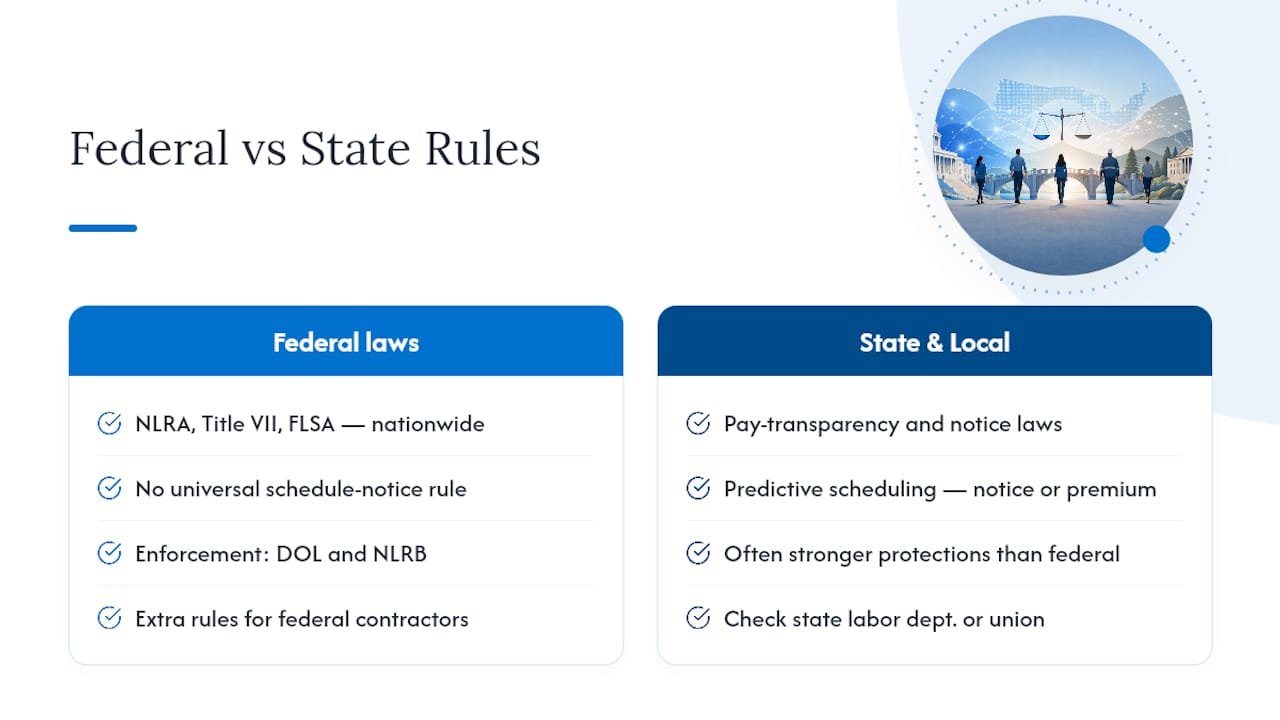
States with strong pay transparency and notice laws often require advance written notice before schedule or wage changes take effect, something federal law doesn’t universally mandate. Predictive scheduling laws in cities like San Francisco and Seattle, for example, require employers to give retail and food service workers advance notice of schedule changes or pay a premium for last-minute shifts. No comparable federal rule exists for most private-sector employees.
Industry matters too. Public-sector employees often have separate bargaining frameworks and grievance procedures distinct from private-sector NLRA coverage. Federal contractors face additional wage and benefit rules tied to their contracts. Healthcare and transportation workers frequently operate under industry-specific safety regulations that affect what counts as an unsafe or unlawful change to their conditions.
Regulatory priorities shift with each administration, and enforcement emphasis at agencies like the DOL and NLRB has moved noticeably in recent years, which affects how aggressively certain violations get pursued. If you’re unsure which framework governs your job, checking your state labor department’s website or asking a union representative is faster and more reliable than guessing based on general workplace law.
What Notice Must an Employer Give Before Changing Your Job?
Notice requirements depend heavily on your employment status and location. Union contracts typically spell out specific advance-notice periods for schedule or policy changes, and skipping that notice can itself be a contract violation independent of the underlying change.
For non-union employees, federal law sets few blanket notice requirements outside specific contexts like mass layoffs under the WARN Act, which requires 60 days’ notice for qualifying plant closings or mass layoffs. Outside that narrow rule, many employers can change schedules or duties with little or no formal notice unless a contract, handbook, or state law says otherwise.
That gap is exactly why documentation matters so much. If your employer typically emails schedule changes a week in advance and suddenly starts giving same-day notice, that shift in practice, especially if it coincides with a complaint or protected activity, can become relevant evidence in a retaliation claim.
Good employers communicate proactively regardless of what the law technically requires: written notice, a clear explanation of the reason for the change, and an opportunity for questions. If your employer skips all of that and springs a major change on you without explanation, treat it as a signal to start documenting immediately and to review your state’s notice requirements, which sometimes fill in gaps federal law leaves open.
Ready to Protect Your Rights?
You don’t have to sort through federal statutes and NLRB decisions alone. Workplacefairness has spent decades turning employment law into plain language that working people can actually use, starting from our founding in 1994 as the National Employee Rights Institute. Our employee rights guide walks through your protections in detail and connects you to next steps, including how to find an employment attorney if your situation calls for one. If you’re newer to the workforce and want a broader grounding in your baseline protections, our guide for new employees is a strong place to start.
Where to Find Primary Sources and Further Guidance
Start with the agencies themselves before relying on secondary summaries. The NLRB’s overview of employer and union rights explains bargaining obligations directly, and the EEOC’s retaliation fact sheet lays out what counts as unlawful retaliation. For bargaining impasses, the FMCS offers mediation resources. Workplacefairness’s employee rights guide and discrimination complaint walkthrough translate these rules into plain steps. Save document names and dates as you go, they matter when you file.
What Employees and Union Reps Get Wrong About This Fight
Most workers assume the fight over a bad workplace change starts and ends with proving the change was unfair. It doesn’t. The fight starts with proving the change happened, exactly when, exactly how, and who authorized it. Agencies and arbitrators don’t rule on fairness; they rule on evidence, and workers without dated records lose winnable cases constantly.

The bigger blind spot, though, is timing. Employees wait weeks to consult a union rep or attorney because they want to “see how it plays out.” That instinct is understandable and usually costly. Filing windows are short, and evidence degrades fast, memories fade, emails get deleted, witnesses change jobs. The NLRB’s tightened waiver standard is genuinely good news for union workers, but it only helps if bargaining demands and employer refusals were documented in writing at the time.
If there’s one thing worth prioritizing above all else, it’s this: treat the first 48 hours after a change as the most important evidentiary window you’ll get. Write it down, get it in writing back, and loop in your union representative or a lawyer before the trail goes cold.
Frequently Asked Questions
Can my employer legally cut my pay without notice?
It depends on your status. Union employees are generally protected by the duty to bargain, so a pay cut without negotiation can violate the NLRA. Non-union employees are usually at will, but a written contract or handbook promise can still make an unannounced cut unlawful.
What is the “clear and unmistakable waiver” standard?
It’s the NLRB’s standard requiring specific, unambiguous contract language before an employer can claim a union already waived its right to bargain over a workplace change. General management-rights clauses no longer satisfy this standard on their own.
How long do I have to file a complaint about a change in working conditions?
Deadlines vary by claim type and state, and some discrimination or retaliation charges must be filed within months of the incident. Because timelines are strict and vary, contact the relevant agency or an attorney as soon as possible rather than assuming you have unlimited time.
Does quitting after a bad change hurt my legal options?
It can. Resigning may limit unemployment benefits or weaken a constructive discharge claim unless the facts clearly support one. Get legal advice before resigning whenever possible.
Where should I file if I think my employer discriminated against me?
File with the EEOC for discrimination or retaliation tied to a protected characteristic. Workplacefairness’s discrimination complaint guide walks through the process step by step.
This article is general information, not a substitute for advice from a qualified lawyer. Consult a qualified legal professional about your own circumstances before acting on anything here.
Sources
- Employer/Union Rights and Obligations
- Fact Sheet: Retaliation Based on the Exercise of Workplace Rights is Unlawful
- The influence of physical and non-physical factors on employee well-being in office spaces