
No federal law requires private employers to offer bereavement leave, paid or unpaid. Federal civilian employees have narrow, separate rules through the Office of Personnel Management. Six states, California, Illinois, Maryland, Oregon, Vermont, and Washington, now mandate some form of bereavement leave for eligible private-sector workers. Illinois goes furthest, with its Family Bereavement Leave Act guaranteeing unpaid, job-protected time off per qualifying loss.
TL;DR:
- Only six states currently mandate bereavement leave for private workers, with coverage and duration varying significantly, and some fold it into existing sick or family leave programs.
- Illinois offers unpaid, job-protected leave with a 60-day usage window and includes reproductive losses like miscarriage and stillbirth, setting a detailed legal standard.
- Federal law provides limited funeral leave only for military deaths; private employers are free to set their own policies without a federal mandate, and FMLA may apply if grief leads to a serious health condition.
- Building a clear bereavement policy should specify eligible relationships, leave duration, documentation, and whether the leave is paid or unpaid to ensure compliance across multiple states.
- Employees should promptly notify their employer, gather appropriate documentation, and know their state’s specific rules to secure protected leave, especially since many states do not have standalone bereavement laws.
Table of Contents
- Bereavement Leave Laws by State: Who’s Covered and for How Long
- Federal Bereavement Leave Rules: What OPM and the FLSA Actually Say
- Illinois’s Family Bereavement Leave Act: A Model Worth Understanding
- Building a Bereavement Policy: A Checklist for Employers
- How to Request Bereavement Leave and What to Do If It’s Denied
- Why the Bereavement Leave Patchwork Deserves More Attention
- Get Free Guidance on Your Bereavement Leave Rights
- Sources
- FAQ
Bereavement Leave Laws by State: Who’s Covered and for How Long
Coverage depends entirely on where you work, not on any national bereavement leave law. Here’s how the six mandate states compare, based on current state-by-state guides and 50-state compliance charts:
- California: Employers with five or more workers must allow up to five days of bereavement leave per qualifying death. Leave can be unpaid, but employees may substitute accrued vacation, personal time, or sick leave.
- Illinois: Under the Family Bereavement Leave Act, eligible employees get unpaid leave per event, with a cap across a 12-month period for multiple losses.
- Maryland: State law lets employees use accrued sick and safe leave for bereavement purposes tied to a family member’s death, rather than creating a separate leave bucket.
- Oregon: The Oregon Family Leave Act (OFLA) covers bereavement as one of several protected reasons for leave, typically up to two weeks per qualifying event, running alongside other OFLA entitlements.
- Vermont: Employers must permit use of earned sick time for bereavement, following the same accrual and usage rules that apply to other qualifying sick leave reasons.
- Washington: Bereavement leave is folded into the state’s Paid Family and Medical Leave program in specific circumstances, plus separate sick leave rules that allow use for grieving a family member.
A pattern worth noting: several states don’t create a freestanding “bereavement leave law” at all. Instead, they fold grief-related time off into existing paid sick leave or paid family leave programs. That distinction matters when you’re checking your rights, because the eligibility rules, accrual caps, and documentation requirements you need to check are the ones governing sick or family leave generally, not a standalone bereavement statute. Completion windows also vary. Illinois requires the leave to be used within 60 days of the event, and missing that window can forfeit the protection even for a sympathetic employer.
Federal Bereavement Leave Rules: What OPM and the FLSA Actually Say
The Fair Labor Standards Act sets minimum wage and overtime rules, but it says nothing about bereavement pay. That’s why private employers are free to offer generous paid leave, no leave at all, or anything in between, unless their state steps in with a mandate.
Federal civilian employees operate under a different framework entirely. OPM guidance permits limited funeral leave in specific circumstances tied to military deaths, plus broader use of accrued sick leave for bereavement purposes. The Department of Labor’s funeral leave page reinforces that this is a federal-employee-specific benefit, not something private-sector workers can claim under the same statute.
Where things get more complex is FMLA overlap:
- Routine bereavement, attending a funeral, handling estate matters, sitting with a grieving family, does not trigger FMLA protection on its own.
- FMLA can apply when grief develops into a diagnosed serious health condition, such as clinical depression requiring ongoing treatment, and the employee otherwise meets FMLA eligibility thresholds.
- The two types of leave run on separate clocks and separate legal tests, so an employee shouldn’t assume one covers the other automatically.
Illinois’s Family Bereavement Leave Act: A Model Worth Understanding
Illinois offers the most detailed statutory bereavement protection in the country, and its structure is worth understanding even if you work elsewhere, because other states often borrow from it when drafting new bills.
Eligibility mirrors FMLA: you need 12 months of employment and 1,250 hours worked, at an employer with 50 or more employees, per the Illinois Department of Labor’s FAQ. Covered relationships include spouses, domestic partners, children, siblings, parents, parents-in-law, grandchildren, grandparents, and stepparents. Notably, the law also extends to certain reproductive losses, including miscarriage, unsuccessful IVF cycles, failed adoption, and stillbirth, not just death in the traditional sense.
Key mechanics employees and HR teams should track:
- Unpaid leave per qualifying event.
- A completion window from the date the employee learns of the event or loss.
- A cap on total bereavement leave within any 12-month period, covering multiple qualifying losses.
- Employers may request “reasonable documentation,” such as a death certificate, obituary, or written confirmation from a healthcare provider for reproductive losses, per the statute text.
Enforcement runs through the Illinois Department of Labor, which accepts complaints, and employees also retain the right to pursue a civil action if the employer retaliates or denies protected leave.
Building a Bereavement Policy: A Checklist for Employers
A written policy protects both the organization and the people it employs, especially when your workforce spans multiple states with different rules.
- Define eligible relationships clearly. Spell out which family members and relationships qualify, and consider extending coverage to domestic partners and reproductive loss, since more states are moving that direction.
- State duration and pay treatment explicitly. Note whether leave is paid, unpaid, or a substitution of accrued PTO, and whether that varies by tenure or role.
- Set a completion window. Borrow Illinois’s 60-day model even in states without one; it gives employees a clear deadline and protects the company from open-ended claims.
- Establish documentation standards. Accept an obituary, death certificate, or funeral home confirmation, similar to the norms outlined by Paycor’s compliance guide.
- Apply the most protective rule for multi-state teams. When an employee could fall under two overlapping state or local rules, HR teams should default to whichever offers more leave or fewer restrictions.
- Train managers on privacy and consistency. Grief disclosures are sensitive; make sure supervisors know what to ask for and what to keep confidential.
- Coordinate with payroll and leave-tracking systems. A dedicated leave tracker helps prevent errors when bereavement leave, sick time, and FMLA all touch the same employee file.
Pro Tip: Even in states with no bereavement mandate, put your policy in writing anyway. An unwritten “we’ll figure it out” approach is where most wrongful denial complaints start.
How to Request Bereavement Leave and What to Do If It’s Denied
Knowing your state’s rules is only half the equation. Here’s the practical sequence for actually getting the time off you’re entitled to.
- Notify your employer promptly. Most policies expect notice as soon as reasonably possible, often within 48 hours where circumstances allow, though sudden deaths obviously complicate strict timelines.
- Gather documentation early. An obituary, funeral home statement, or death certificate typically satisfies employer requests; for reproductive loss under laws like Illinois’s FBLA, a healthcare provider’s note may be required instead.
- Decide how to structure the time off. Determine whether you’re using unpaid statutory leave, substituting accrued PTO or sick time, or, in rare cases, layering in FMLA if grief has triggered a diagnosed condition.
- Escalate if denied. If your employer refuses leave you’re legally entitled to, you can file a complaint with your state labor department, Illinois workers use the Department of Labor’s process, or consult employee rights resources to understand your next legal step.
Why the Bereavement Leave Patchwork Deserves More Attention
The conventional wisdom treats bereavement leave as a minor HR footnote, something companies handle with a sympathy card and a few unpaid days off. That framing misses what’s actually happening at the state level. Illinois didn’t just tack grief onto existing sick leave; it built a standalone statute with FMLA-style eligibility thresholds, a defined completion window, and explicit recognition of reproductive loss as a qualifying event. That’s a meaningful legal statement about what grief actually requires, and it’s likely to influence future state bills.
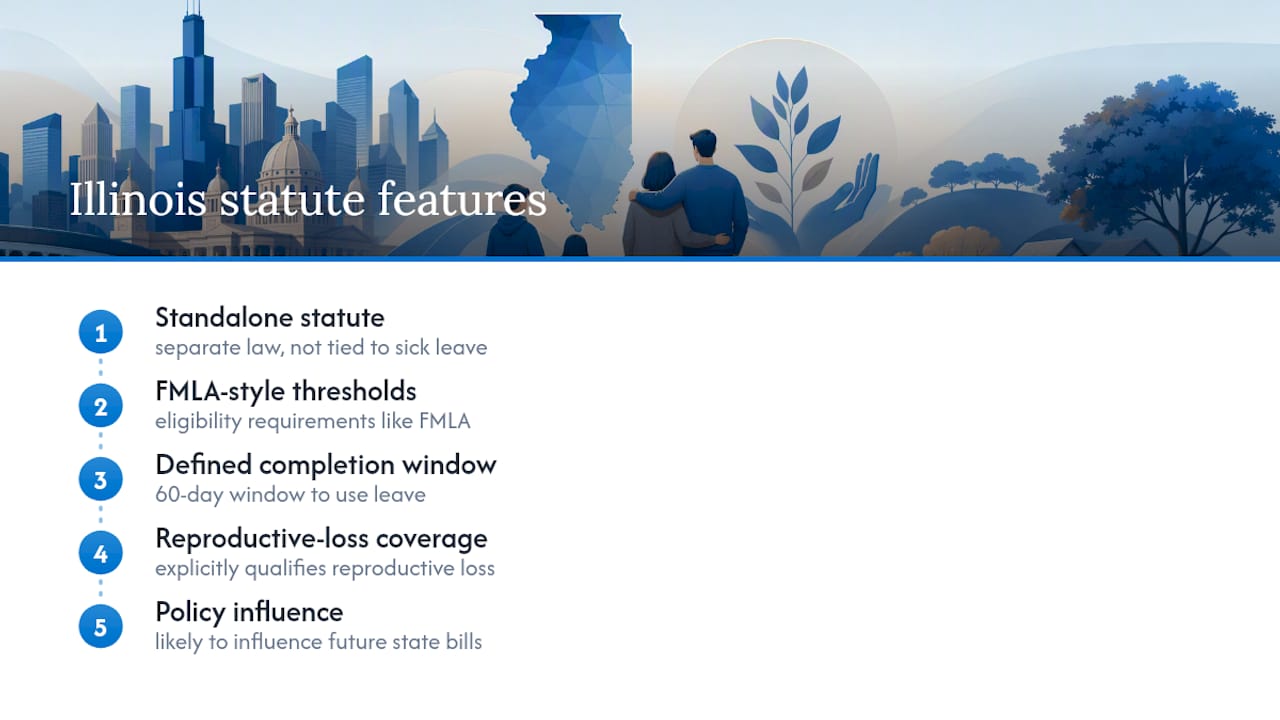
What gets underestimated most is the completion window. Employees assume they can take bereavement leave “whenever things settle down.” In states with a defined window, like Illinois’s 60 days, that assumption can cost you the protection entirely. If you’re grieving and also trying to track a legal deadline, the system has failed you a little, but the deadline still applies.
The other blind spot is the false comfort of “my employer offers three days, so I’m covered.” Three days might satisfy a company policy, but it says nothing about whether you’re also entitled to unpaid protected leave under your state’s law, layered on top. Workers who only check their handbook, and never check their state’s actual statute, routinely leave protections on the table.
— Max
Get Free Guidance on Your Bereavement Leave Rights
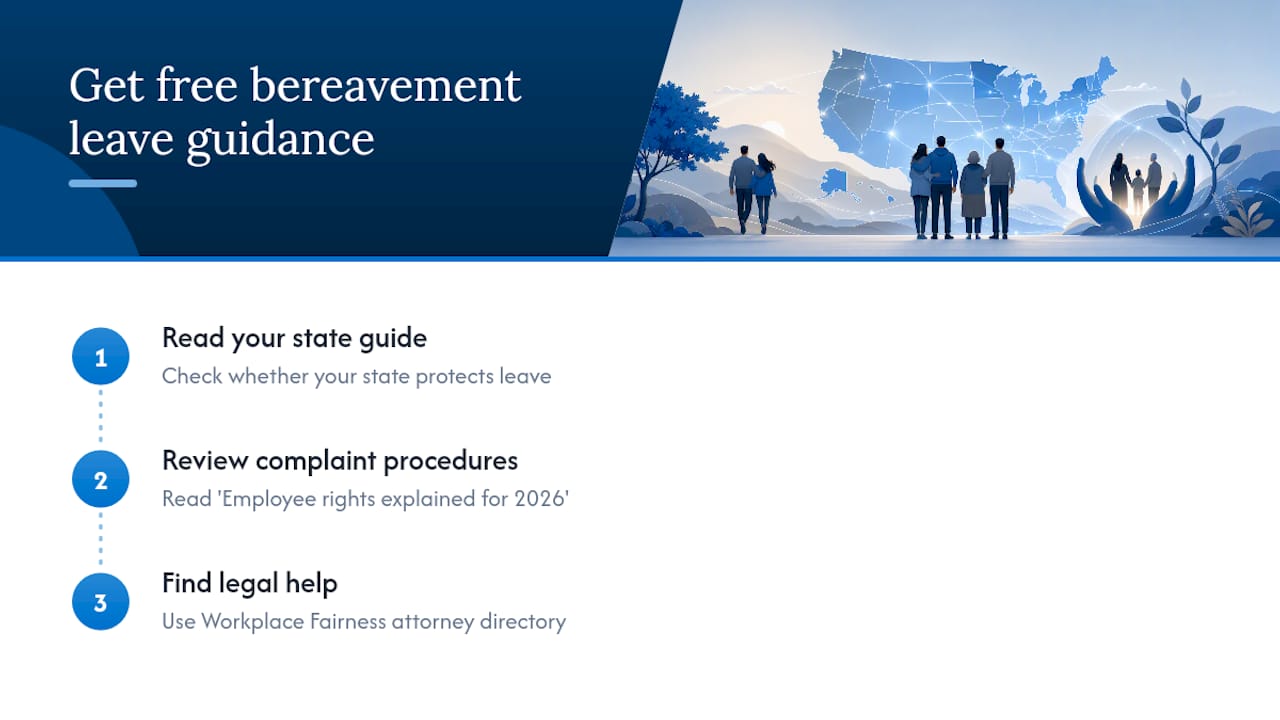
There are free, plain-language employment law resources available to help you check whether your state protects your leave before you ever pick up the phone. If your employer denied leave you believe you’re entitled to, or you’re unsure whether Illinois’s FBLA, California’s mandate, or another state law applies to your situation, Workplace Fairness’s guide to employee rights breaks down exactly what protections exist and how to check eligibility.
From there, readers who need to escalate a denied claim can review employee rights explained for 2026 for state complaint procedures, or use Workplace Fairness’s attorney directory if the situation calls for legal representation. Start by reading the guide that matches your state before you draft a complaint or contact HR again.
This article is general information, not a substitute for advice from a qualified lawyer. Consult a qualified legal professional about your own circumstances before acting on anything here.
Sources
- Leave for funerals and bereavement | U.S. Office of Personnel Management (OPM)
- Family Bereavement Leave Act FAQs | Illinois Department of Labor
- Bereavement Leave Laws: 2026 State-by-State Employers’ Guide | Mosey
- Bereavement leave laws by state | 50-state chart | Brightmine (LexisNexis)
FAQ
How Many Days Off Do You Get When a Family Member Dies?
It depends entirely on your state and employer policy; there’s no universal number, but common ranges run from three days under typical employer policies to up to two weeks under Illinois’s Family Bereavement Leave Act.
What States Have Mandatory Bereavement Leave?
California, Illinois, Maryland, Oregon, Vermont, and Washington currently require some form of bereavement leave, though the duration, pay requirements, and mechanism (standalone leave versus sick leave usage) vary by state.
Who Counts as Immediate Family for Bereavement Leave?
Definitions vary by state, but Illinois’s FBLA covers spouses, domestic partners, children, siblings, parents, parents-in-law, grandparents, grandchildren, and stepparents, plus certain reproductive losses.
Why Is Bereavement Leave Often Only Three Days?
Three days is a common employer default rather than a legal requirement in most states; it reflects typical company policy, not a federal or universal state standard, and workers in mandate states may be entitled to significantly more.
Is Bereavement Leave Required to Be Paid?
Not usually. Most state mandates, including Illinois’s FBLA, guarantee unpaid but job-protected leave, though employees can often substitute accrued PTO or sick leave to receive pay during that time.