
What is sexual harassment in the workplace?
Sexual harassment at work is unlawful sex discrimination under Title VII of the Civil Rights Act of 1964. The U.S. Equal Employment Opportunity Commission defines it as unwelcome sexual advances, requests for sexual favors, and other verbal or physical conduct of a sexual nature that affects employment conditions, interferes with work performance, or creates an intimidating, hostile, or offensive work environment. Title VII covers employers with 15 or more employees, including state and local governments, employment agencies, and labor organizations.
Conduct qualifies as sexual harassment when any of the following apply:
- Submission to the conduct is made an explicit or implicit condition of employment
- Accepting or rejecting the conduct influences employment decisions such as hiring, promotion, or termination
- The conduct unreasonably interferes with work performance or creates a hostile, intimidating, or offensive environment
Harassment can be verbal, physical, or non-verbal. It does not require economic harm to the victim. A hostile environment alone is sufficient for unlawful conduct under federal law.
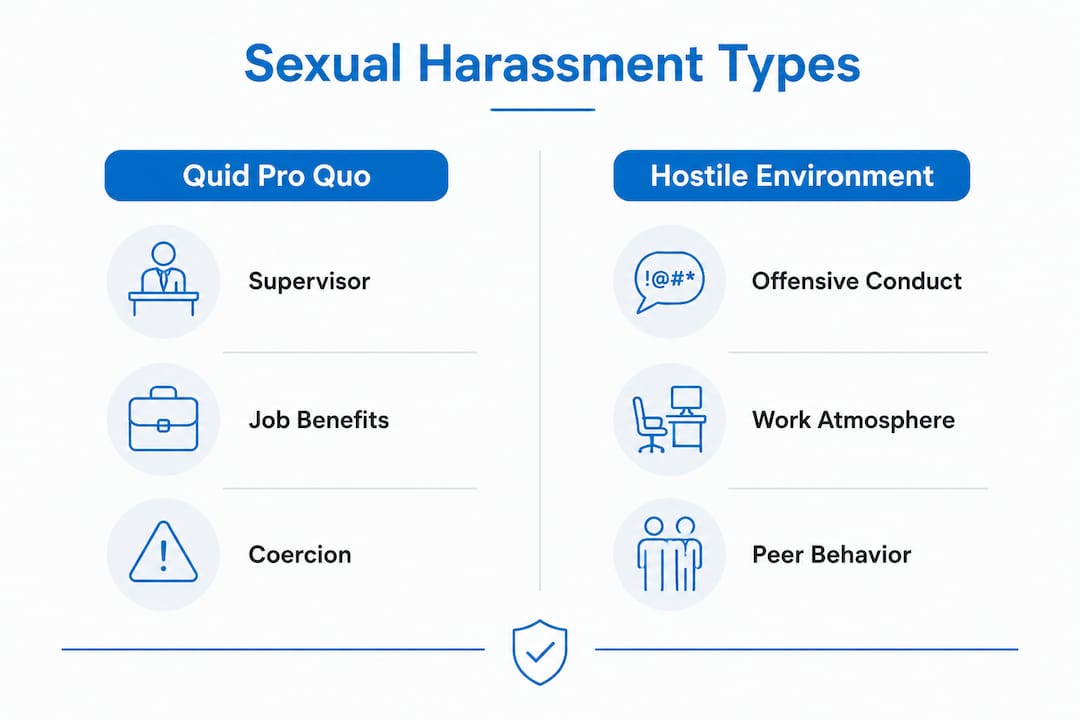
The two types of workplace sexual harassment
The EEOC recognizes two distinct categories of sexual harassment, though they often overlap in practice.
Quid pro quo harassment occurs when submission to or rejection of sexual conduct directly affects employment decisions. A supervisor who conditions a promotion on a subordinate’s compliance with sexual requests is a textbook example. The word “quid pro quo” is Latin for “this for that,” and the power dynamic is central to this form of harassment.
Hostile work environment harassment involves conduct that is severe or pervasive enough that a reasonable person would find the workplace intimidating, hostile, or abusive. Unlike quid pro quo, no single employment action needs to occur. Workplace harassment examples in this category include:
- Repeated sexual jokes or comments about a person’s body
- Displaying sexually explicit images or objects in shared spaces
- Persistent unwanted touching, including hugging or groping
- Spreading rumors about a coworker’s sex life
- Sending unsolicited sexual messages or emails
- Making lewd gestures or mimicking sexual acts
The line between these two types is not always clear. A hostile environment can escalate into quid pro quo territory when a supervisor uses authority over employment decisions to force compliance with sexual conduct.
Who can be a harasser, and who can be a victim?
Sexual harassment does not follow a predictable pattern of gender or workplace rank. Any person, regardless of sex or sexual orientation, can be a harasser or a victim. Same-sex harassment is fully covered under Title VII.
Harassers can include:
- Direct supervisors or managers
- Supervisors in other departments
- Co-workers at any level
- Third parties such as clients, customers, or vendors
Victims are not limited to the person directly targeted. Anyone affected by the offensive conduct, including bystanders, may have a valid claim. Harassment also does not have to be explicitly sexual. Offensive remarks about a person’s sex, such as repeatedly making derogatory comments about women in general, can constitute illegal sex-based harassment under federal law.
Legal protections and employer responsibilities
Title VII and the EEOC establish a clear framework of employer obligations. Employers are not only prohibited from harassing employees themselves; they are responsible for preventing and stopping harassment by anyone in the workplace, including senior leaders, co-workers, and non-employees.

Employer liability follows specific rules. An employer is automatically liable for harassment by a supervisor that results in a negative employment action such as termination, demotion, or loss of wages. For harassment that creates a hostile environment without a tangible employment action, an employer may avoid liability by showing it had a reasonable prevention and correction policy and that the employee unreasonably failed to use it. Employers can also be liable for third-party harassment if they knew or should have known about the conduct and failed to act promptly.
Filing a charge with the EEOC is the primary federal remedy. Private-sector employees generally must file within 180 days of the harassing act, or within 300 days if a state or local anti-discrimination law also applies. Federal employees operate under different timelines. The EEOC investigates complaints, attempts mediation, and can pursue litigation on behalf of victims.
Key employer responsibilities include:
- Establishing and communicating a clear zero-tolerance sexual harassment policy
- Providing regular training to all employees and managers
- Creating accessible, confidential complaint procedures
- Investigating complaints promptly and thoroughly
- Taking corrective action proportionate to the severity of the conduct
- Following up to confirm harassment has not resumed and retaliation has not occurred
Understanding your workplace rights as an employee is the foundation for knowing when and how to act.
Preventing and addressing sexual harassment: expert guidance
Prevention is the most effective tool for eliminating sexual harassment, according to EEOC guidance. Employers who wait for a formal complaint before acting have already allowed harm to occur. The goal is to stop offensive conduct before it reaches the legal threshold of severity or pervasiveness.
Effective prevention rests on three pillars: clear communication, consistent training, and accessible complaint channels. Employees need to know that harassment will not be tolerated and that reporting it will not cost them their jobs. Managers need training not just on definitions, but on how to recognize early warning signs and respond without escalating conflict.
Early intervention matters. Isolated incidents that do not yet meet the legal standard for harassment can still damage workplace culture and signal that more serious conduct may follow. Addressing these situations quickly protects employees and reduces organizational risk.
One common source of confusion is the difference between harassment and legitimate performance management. Transferring, disciplining, or demoting an employee for documented performance reasons is not harassment, provided those actions are carried out reasonably and consistently. Clear communication about performance expectations reduces the risk of misinterpretation on both sides.
Pro Tip: Build a workplace culture where respectful conduct is modeled from the top. When leaders visibly uphold anti-harassment standards, employees are more likely to report concerns early, before situations escalate.
How to report sexual harassment at work
Reporting sexual harassment starts with your employer’s internal complaint process. Most organizations with effective sexual harassment policies designate a specific HR contact or a neutral third party for receiving complaints. Document incidents as they occur, including dates, times, locations, what was said or done, and the names of any witnesses.

If internal reporting does not resolve the situation, or if you fear retaliation, you can file a charge directly with the EEOC at eeoc.gov or by calling 1-800-669-4000. The EEOC will notify the employer, investigate the complaint, and determine whether reasonable cause exists. State and local fair employment agencies often provide parallel channels with their own timelines and remedies. Workplacefairness also offers civil rights legal resources that can help you understand your options before you file.
What protections do you have after reporting?
Retaliation against an employee who reports sexual harassment is independently unlawful under Title VII. This means your employer cannot fire you, demote you, reduce your hours, reassign you to a less desirable role, or otherwise punish you for making a good-faith complaint. The protection extends to employees who participate in an EEOC investigation or serve as witnesses, not just those who file the original complaint.
If retaliation occurs, you can file a separate retaliation charge with the EEOC. Courts treat retaliation claims seriously, and a retaliation finding can result in reinstatement, back pay, compensatory damages, and in some cases punitive damages. Keeping detailed records of any adverse actions taken after you report is critical to building a retaliation claim.
How sexual harassment affects victims and workplace culture
The impact of sexual harassment extends well beyond the individual targeted. Victims commonly experience anxiety, depression, reduced job performance, and in many cases leave their jobs entirely to escape the situation. The psychological toll can persist long after the harassment ends.
For the broader workplace, unchecked harassment erodes trust, reduces morale, and drives away talented employees who no longer feel safe. Teams where harassment goes unaddressed tend to see higher turnover, lower productivity, and a culture of silence that makes future misconduct more likely. Organizations that take harassment seriously, by contrast, build environments where people can do their best work without fear.
Recognizing workplace harassment early, responding to it decisively, and supporting those who come forward are not just legal obligations. They are the foundation of a fair and equitable workplace for everyone.
Key Takeaways
Sexual harassment at work is unlawful sex discrimination under Title VII, covering unwelcome sexual conduct that affects employment conditions or creates a hostile work environment, with employers legally required to prevent, investigate, and correct it.
| Point | Details |
|---|---|
| Legal definition | Sexual harassment violates Title VII and covers unwelcome sexual advances, requests, or conduct affecting employment or creating a hostile environment. |
| Two recognized types | Quid pro quo ties employment decisions to sexual conduct; hostile environment involves severe or pervasive conduct a reasonable person would find abusive. |
| Who is covered | Any person regardless of sex or gender can be a harasser or victim; third parties like clients and vendors are also covered. |
| Employer liability | Employers are automatically liable for supervisor harassment causing adverse actions, and can be liable for third-party harassment if they fail to act promptly. |
| Prevention is primary | Clear policies, regular training, and accessible complaint procedures are the most effective tools for stopping harassment before it escalates. |