
Yes, federal law can protect you if you refuse unsafe work, but only when three narrow conditions line up: you have a good faith, reasonable belief that the danger is imminent, there’s no time to get OSHA to inspect, and your employer already refused to fix it. If your employer retaliates anyway, you have 30 days from that retaliation to file an OSHA whistleblower complaint. Miss that window, and you may lose your legal remedy entirely.
TL;DR:
- OSHA protection for refusing unsafe work applies only if there is a good-faith, reasonable belief of imminent danger involving serious harm, and the employer has refused to fix the hazard.
- Workers must immediately notify their supervisor, request correction, clearly state their refusal, and document the hazard to preserve legal protections.
- The 30-day deadline to file an OSHA whistleblower complaint starts after retaliation such as discipline or firing; filing late can result in losing legal remedies.
- Proper refusal procedures require asking the employer to fix the hazard before refusing and staying on site unless explicitly ordered to leave, to avoid job abandonment claims.
- Common pitfalls include leaving without clearance, refusing out of discomfort rather than danger, and addressing routine hazards that are part of the job, which can void protection.
Table of Contents
- When Can You Legally Refuse Unsafe Work?
- How Do You Refuse Unsafe Work the Right Way?
- What Happens If Your Employer Retaliates?
- What Mistakes Void Your Legal Protection?
- Protected or Not? Three Quick Scenarios
- Why Trust This Guide?
- An Honest Note on Safety and Risk
- Get Legal Support and Official Resources
- Sources
- FAQ
When Can You Legally Refuse Unsafe Work?
OSHA’s standard is specific, and it exists to separate genuine emergencies from everyday workplace friction. To qualify for protection, your refusal generally needs to meet all of the following:
- You have a good-faith belief that the danger is real, not manufactured to avoid an unpleasant task.
- A reasonable person in your position would also conclude the danger is serious.
- The danger involves death or serious physical harm, and it’s imminent, meaning it could happen right now, not next month.
- There’s no reasonable time to get OSHA to inspect the hazard through normal channels, or you already asked your employer to fix it and they didn’t.
That “reasonable person” piece matters more than most workers realize. OSHA’s own work refusal standard doesn’t protect you just because you’re scared. It protects you when a typical worker in your shoes, looking at the same exposed wiring or the same faulty scaffold, would reach the same conclusion. Subjective anxiety about a task, without objective hazard evidence, generally doesn’t clear that bar.
Your employer’s baseline obligation comes from the General Duty Clause of the OSH Act, which requires a workplace free of recognized hazards. That’s the backstop behind every refusal claim. OSHA and the Department of Labor’s whistleblower program enforce these protections nationally, but some industries layer on additional statutes. Truck drivers, for instance, have refusal protections under separate transportation safety law, and airline and railroad workers have their own whistleblower statutes with different filing deadlines. If you work in a regulated industry, check whether a sector-specific law applies before you assume OSHA’s rule is your only shield.
How Do You Refuse Unsafe Work the Right Way?
The sequence you follow in the first few minutes often determines whether your refusal holds up later. OSHA lays out a clear path, and skipping a step is the single most common way workers accidentally void their own protection.
- Notify your supervisor immediately. Point to the specific hazard. Don’t just say the job “feels dangerous.”
- Ask for the hazard to be corrected or ask for reassignment. Give your employer the chance to fix it or offer other work first.
- State your refusal clearly and calmly. Something like: “I believe this task presents an imminent danger of death or serious injury. I’m asking you to correct it before I continue, or reassign me to other work.”
- Stay at the worksite unless your employer orders you to leave. Leaving voluntarily can look like job abandonment instead of a protected refusal.
- Document everything. Note the time, the names of witnesses, and the exact hazard. Photograph it if you can do so safely.
- Keep copies of any written safety requests, texts, or emails you send about the hazard.
Wording matters here more than people expect. Saying “I’m not comfortable with this” sounds like preference. Saying “I believe this presents an imminent danger and I’m asking you to fix it” tracks the legal standard almost word for word, which helps if OSHA or an attorney later reviews your case. If you work construction, the hazard categories tend to repeat: unguarded fall risks, unshored trenches, energized equipment. Our guide on construction worker safety rights covers jobsite-specific scenarios in more depth.
Pro Tip: Send your safety request in writing, even if you already said it out loud. A text to your supervisor timestamped before the refusal is often the single strongest piece of evidence in a retaliation case.
What Happens If Your Employer Retaliates?
If you get disciplined, demoted, or fired for a protected refusal, you have exactly 30 days from the date of the retaliatory act to file an OSHA whistleblower complaint. This deadline is strict, and OSHA doesn’t grant extensions for forgetting or for waiting to “see if things blow over.”
To file, you can call OSHA directly at 1-800-321-OSHA (1-800-321-6742) or contact your regional OSHA area office. Before you call, gather what you can:
- Dates and times of the refusal and the retaliation.
- Names of any supervisors or coworkers who witnessed either event.
- Copies of your written safety requests or texts.
- Any documentation of the hazard itself, including photos.
OSHA’s own guidance stresses that workers shouldn’t walk off the worksite simply because they’ve filed a complaint. Staying put, unless ordered to leave, keeps your legal footing intact.
The 30-day window applies to OSHA’s general whistleblower provision, but it isn’t universal across every federal statute. Some transportation and environmental whistleblower laws give you 180 days instead of 30, which is exactly why the deadline should be the first thing you confirm, not an afterthought. If your case involves lost wages, a demotion, or termination, this is also the point where talking to an employment attorney stops being optional and starts being smart. Our breakdown of the workplace discrimination complaint process walks through what escalation actually looks like.
What Mistakes Void Your Legal Protection?
Workers lose protection more often from procedure than from a weak underlying case. The pattern shows up again and again in enforcement actions.
- Leaving the site without being told to. This is the single most common way a protected refusal turns into a job abandonment claim.
- Refusing without asking your employer to fix the hazard first. Skipping this step undercuts the “no time to correct” element of the standard.
- Refusing out of discomfort, not danger. Disliking a task, or finding it unpleasant, isn’t the same as facing imminent serious harm.
OSHA frames work refusal as a last resort, not a first response. Reporting the hazard often resolves it faster than refusing outright, and it preserves your protection either way.
Two more limits matter. Normal, disclosed job hazards, like the routine risks of firefighting or logging, generally don’t qualify since they’re conditions of the job itself, not sudden imminent dangers. And if you’re in a union, follow your contract’s refusal procedure and loop in your union representative. OSHA does not enforce collective bargaining provisions, so your contract remedy and your OSHA remedy run on separate tracks.
Protected or Not? Three Quick Scenarios
- A scaffold plank cracks under your foot. You tell your supervisor, ask for repair or reassignment, and refuse to climb back up until it’s fixed. Likely protected. Document the crack, note witnesses, and stay on site.
- You smell gas and start feeling dizzy near a chemical line. You report it immediately, and your employer shrugs it off. Likely protected. Log your symptoms, photograph the area if safe, and call OSHA if the hazard isn’t addressed.
- You’re asked to work a double shift you find exhausting but not dangerous. No imminent threat of death or serious injury exists. Likely not protected as a refusal. Raise it through HR or your union contract instead.
Why Trust This Guide?
Workplace Fairness has published plain-language employee rights guidance since 1994, when the organization began as the National Employee Rights Institute. This guide draws directly on OSHA’s own refusal standard, the whistleblower program’s clarifying guidance, and Department of Labor enforcement materials, not secondhand summaries.
An Honest Note on Safety and Risk
Refusing unsafe work is a real legal right, but it’s a narrow one, and narrow rights punish sloppy execution. Document everything, use OSHA and DOL channels when your employer won’t act, and don’t wait to see what happens if you get disciplined. If retaliation follows, talk to an employment attorney before the 30-day window closes, not after.
— Max
Get Legal Support and Official Resources
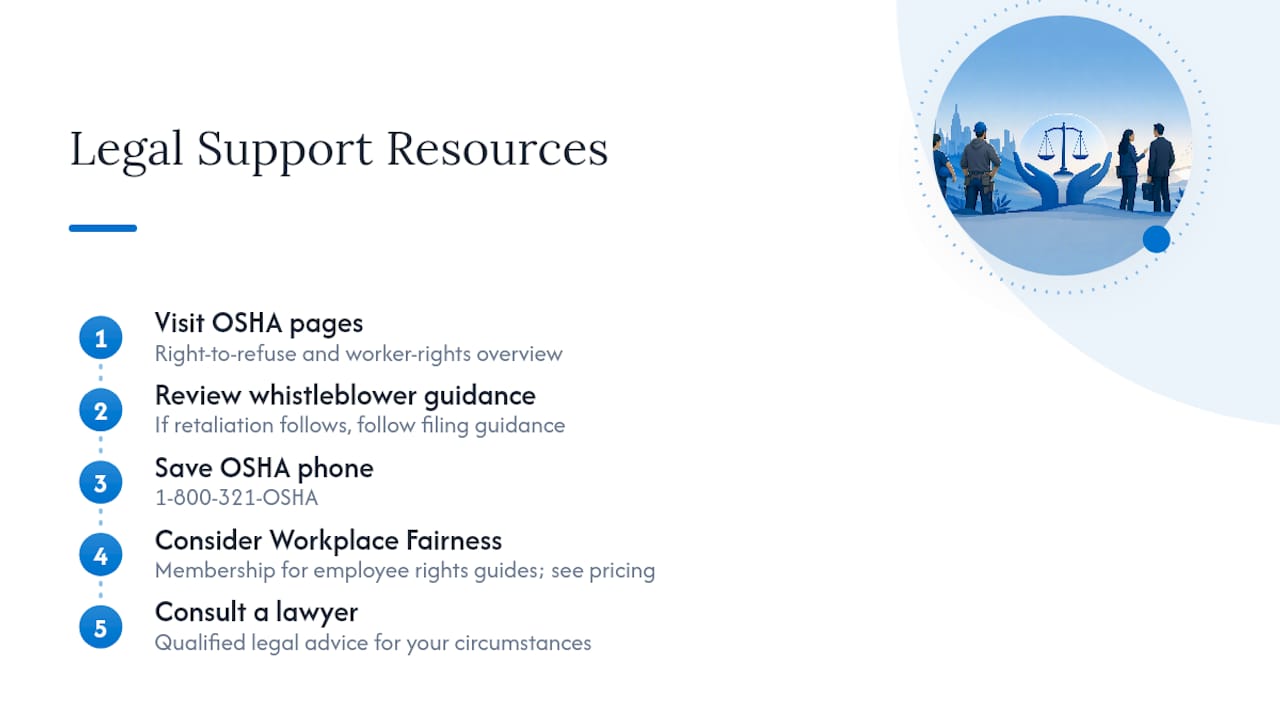
Start with OSHA’s own right to refuse dangerous work page and its broader worker rights and protections overview, then review whistleblower filing guidance if retaliation follows. Keep OSHA’s line handy: 1-800-321-OSHA. For ongoing access to employee rights guides, consider a Workplace Fairness membership; current prices are listed on their pricing page.
This article is general information, not a substitute for advice from a qualified lawyer. Consult a qualified legal professional about your own circumstances before acting on anything here.
Sources
- Workers’ Right to Refuse Dangerous Work | Occupational Safety and Health Administration
- Clarification of the Work Refusal Standard under 29 CFR … | Whistleblower Protection Program
FAQ
Can I be fired for refusing to work in unsafe conditions?
Not legally, if your refusal meets OSHA’s imminent danger standard: a good-faith, reasonable belief in serious harm, with no time for an inspection and no employer fix. If you’re fired anyway, you can file an OSHA whistleblower complaint within 30 days of the retaliation.
Can I refuse to do something unsafe at work?
You can, but protection only applies when the danger is imminent and a reasonable person would agree, not simply because a task feels risky or unpleasant. Ask your employer to correct the hazard first, and stay on site unless ordered to leave.
What are examples of unsafe acts that could support a refusal?
Common examples include unguarded fall hazards, unshored trenches, live electrical work without lockout procedures, and chemical exposure without proper ventilation or protective equipment. Each still has to meet the imminent danger and good-faith standard to qualify for protection.
Can you get fired for refusing to work?
Yes, if the refusal doesn’t meet the legal test, an employer can discipline or terminate you without it counting as retaliation. That’s why documenting the hazard, notifying your employer, and following OSHA’s recommended steps matters before you ever say no to a task.