
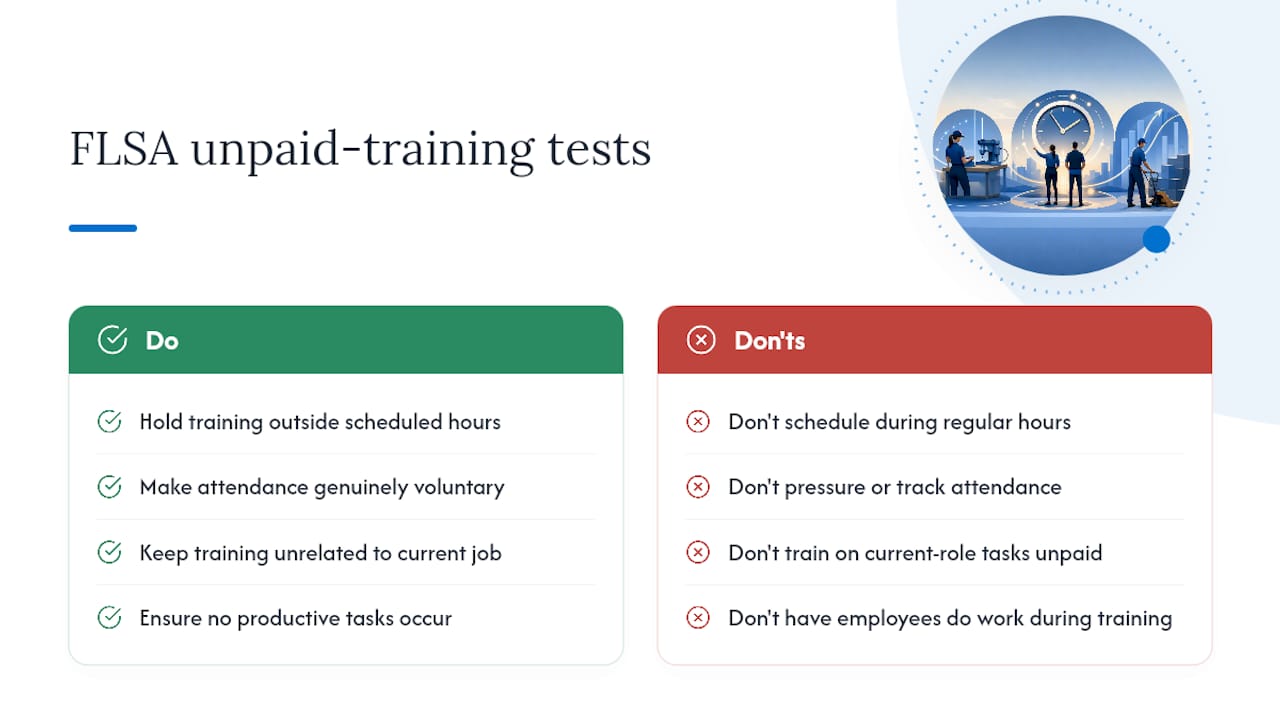
Under the Fair Labor Standards Act, training time is work time, and it must be paid unless four specific conditions are all met at once. Those conditions are: the training happens outside regular working hours, attendance is genuinely voluntary, the training is not directly related to the employee’s present job, and the employee performs no productive work during it. Exceptions exist, and some states go further than federal law. The rest of this guide breaks down exactly how that test works.
TL;DR:
- Training during scheduled work hours or immediately before or after a shift must be paid, as it is considered work time under the FLSA.
- Training that occurs outside regular hours, is voluntary, unrelated to the current job, and involves no productive work can be unpaid if all four conditions are met; failure of even one condition mandates payment.
- Employers should document all training sessions, including invitations and timestamps, and avoid tracking attendance for evaluation to maintain clear voluntary status.
- Most disputes arise when employers label training as voluntary but implicitly require attendance, risking liability for unpaid hours.
- Pre-employment or certification training required before starting work generally counts as hours worked and must be paid unless explicitly exempted by limited legal exceptions.
Table of Contents
- Understanding Training Time Pay Under the FLSA
- Common Scenarios: Does Training Pay Apply?
- Exempt vs. Nonexempt Status and Training Pay
- Documenting Training Hours and Protecting Your Pay
- What to Do If You Weren’t Paid for Training
- Practical Tips From Workplace Fairness
- Why Clear Training Pay Policies Matter
- How Workplace Fairness Supports Fair Training Policies
- Sources
- FAQ
Understanding Training Time Pay Under the FLSA
The Fair Labor Standards Act treats training the same way it treats any other task an employer asks an employee to do: as compensable work, unless the employer can show all four unpaid-training conditions apply. Miss even one, and the clock has to run. Here’s what each condition actually means in practice.
Outside regular working hours. This one sounds simple until you meet an employee with a rotating schedule or a part-time worker with no fixed shift. “Regular hours” means the hours that employee is normally scheduled to work, not a company-wide 9-to-5. Training squeezed into a lunch break or bolted onto the end of a shift almost always counts as within regular hours.
Attendance is voluntary. Voluntary means voluntary, not “technically optional but everyone knows you should show up.” The DOL has been direct about this: if an employee reasonably believes skipping the session will hurt their standing, their raise, or their job, the training stops being voluntary the moment that belief takes hold, according to Fact Sheet 71. A manager saying “attendance is optional, but I’ll be taking notes on who’s there” defeats voluntariness just as surely as an explicit mandate.
Not directly related to the employee’s present job. Training that sharpens skills the employee already uses in their current role is directly related and must be paid. Training aimed at a different job or a future promotion, taken purely by choice, leans toward unpaid.
No productive work performed. If a “training session” has the employee answering calls, processing orders, or covering the floor, the session is work, full stop, regardless of what the employer calls it.
A narrow set of exceptions covers bona fide apprenticeship programs and certain public-employee certification courses under 29 C.F.R. §553.226, but those exceptions are limited and fact-specific. They don’t give private employers a general pass.
Common Scenarios: Does Training Pay Apply?
Most disputes come down to a handful of recurring situations. Here’s how the rules typically play out:
- Training during a scheduled shift or bolted onto it. If training happens during work hours, or immediately before or after a shift where attendance is effectively required, it’s paid. There’s rarely a real argument otherwise.
- After-hours training that’s genuinely optional and unrelated to the job. This is the narrowest lane for unpaid training, and it only holds up if the employer can document that all four conditions were met. One HR Q&A example involves a “Supervisor School” program open to hourly workers eyeing a management track. Because attendance was optional and the content targeted a future role rather than the current one, unpaid status held.
- Pre-employment or condition-of-hire training. A substantial portion of civilian workers need some form of pre-employment credential, license, or certification, according to the Bureau of Labor Statistics. When an employer requires a specific training module before a candidate can start, that candidate is often functioning as an employee for pay purposes the moment the required work begins. Many employers reduce risk by treating the training date as the hire date.
- Training-related travel. Ordinary commuting to a training site doesn’t count, but travel required as part of the job, especially overnight travel away from home, often is compensable. The rules mirror general travel-time pay rules, not a separate training carve-out.
- Tipped employees and state add-ons. Tipped workers must be paid at least the applicable minimum wage for training time, and several states impose stricter training-pay rules than the federal floor. Always check your state labor agency before assuming federal law is the last word.
Exempt vs. Nonexempt Status and Training Pay
Classification changes the mechanics, not the underlying obligation. Nonexempt employees must have training hours counted toward total hours worked for that week, which means those hours factor into overtime calculations once the 40-hour threshold is crossed. A nonexempt employee who works a full 40-hour week and then attends four hours of mandatory Friday-evening training is owed overtime for those four hours.
Exempt employees are paid on a salary basis, so a single training session rarely changes their paycheck. But employers should still track hours during heavy training periods.
- Multi-day mandatory trainings can blur classification lines if job duties shift.
- Employers who dock exempt salary for training absences risk destroying the exemption entirely.
- Clean recordkeeping protects both sides if a dispute surfaces later.
Documenting Training Hours and Protecting Your Pay
Good records settle most training-pay disputes before they become disputes. Employees should keep:
- Training invitations, emails, or calendar entries showing scheduled times
- Screenshots or timestamps from online modules
- Sign-in sheets or session confirmations
Employers protect themselves with a written voluntary-attendance policy, signed acknowledgments for each session, and schedules that clearly separate paid hours from optional after-hours programs. Calculating what’s owed usually means applying the employee’s regular rate, folding training hours into overtime where the 40-hour threshold applies, and rounding consistently with existing timekeeping policy.
Pro Tip: If pre-employment training is required before a candidate’s first official day, consider recording that training date as the actual hire date. It closes the most common gap employers fall into and heads off a wage claim before it starts.
What to Do If You Weren’t Paid for Training
- Raise it with HR or payroll first. Bring your documentation, cite the specific dates and hours, and ask for a written response.
- File a complaint with the DOL Wage and Hour Division if internal escalation doesn’t resolve it. The Division looks at whether all four unpaid-training conditions were genuinely satisfied, not just whether the employer labeled the session “voluntary.”
- Know your timeline. FLSA claims generally carry a two-year statute of limitations, extended to three years for willful violations, and remedies can include back pay and, in some cases, liquidated damages.
- Talk to Workplace Fairness or an employment attorney if the amount owed is substantial or your employer retaliates for raising the issue.
Practical Tips From Workplace Fairness
The most common employer mistake we see is calling something “optional” while quietly tracking attendance for performance reviews. Fix it by putting the voluntariness in writing and keeping attendance data separate from evaluations entirely.

Employees collecting evidence don’t need to make a scene. Save calendar invites, forward confirmation emails to a personal account, and note start and end times as sessions happen. Quiet documentation protects you without escalating anything before you’re ready.
For more on related wage issues, see our guide on off-the-clock work and how missing hours get recovered.
Why Clear Training Pay Policies Matter
Wage disputes over training time rarely start with bad intent. They start with vague policies and managers who never got a clear answer themselves. Employers who write down the four-factor test, apply it consistently, and document every voluntary session avoid most of these claims before they happen. Employees deserve that clarity too, and Workplace Fairness exists to make the rules legible to the people living under them.
— Max
How Workplace Fairness Supports Fair Training Policies
An organization like Workplace Fairness provides HR teams and workers with accessible resources, free of legal jargon, to make wage rules easier to understand and apply. If your organization needs a structured way to train managers on burnout, boundaries, and fair treatment, the Burnout First Aider Certification offers a credentialed training path built for exactly that purpose.
A Workplace Fairness membership, starting at $25 a year, gives advocates and HR teams ongoing access to guides and templates that make policy updates faster to draft and easier to defend if a wage claim ever surfaces. If your organization wants deeper visibility and support, Diamond-level sponsorship is available at $500 a year. Start with the membership page to see what fits your team’s needs today.
This article is general information, not a substitute for advice from a qualified lawyer. Consult a qualified legal professional about your own circumstances before acting on anything here.
Sources
- Fact Sheet #22: Hours Worked Under the Fair Labor Standards Act (FLSA)
- Q&A: When is employee training time paid under the FLSA?
- 29 C.F.R. §553.226 (and related CFR sections)
FAQ
Do I get paid for my training days?
In most cases, yes. Training during your regular hours, or training that’s mandatory, job-related, or involves productive work, must be paid under the FLSA.
Do employees usually get paid for training?
Most training falls into paid territory because it fails at least one of the four unpaid-training conditions, most often the voluntariness or job-relatedness tests. Truly optional, unrelated, after-hours training is the exception, not the rule.
What is the 7-minute rule for employees?
The 7-minute rule refers to a common rounding practice where employers round time clock entries to the nearest quarter hour, treating short increments as rounding down or up. It applies to general timekeeping and must be applied consistently, not selectively against employees.
Are training hours considered hours worked?
Yes, unless the training meets all four conditions under 29 C.F.R. §785.27: outside regular hours, voluntary, not directly related to the current job, and no productive work performed. If any one condition fails, the hours count as hours worked.