
A tip credit lets your employer pay you a cash wage below the full minimum wage and count part of your tips toward the difference. Federal law sets strict conditions on that arrangement: you must be told about it in advance, your cash wage plus tips must reach the minimum wage every workweek, and your employer may never keep your tips. We wrote this guide so you can check your own paystub against those rules.
TL;DR
- Under federal law, the cash wage can be as low as $2.13 an hour, and the employer can claim up to $5.12 an hour in tips to reach the $7.25 minimum wage.
- Your employer must tell you about the tip credit before using it. Without that notice, the employer cannot take the credit.
- If cash wage plus tips fall short of the minimum wage in a workweek, your employer must make up the difference.
- Some states allow no tip credit at all, and many others set higher cash wages than the federal floor. The higher number applies to you.
- A tip credit and a tip pool are different things. The credit is about wages. The pool is about how tips are shared.
Table of Contents
- What a tip credit is
- The notice your employer must give you
- A worked example: checking your own week
- Overtime when you are paid a tip credit
- Non-tipped duties and the 80/20 rule
- Which states allow a tip credit
- Tip credit versus tip pool
- How to protect yourself
- Perspective
- Keep this resource free and growing
- FAQ
- Sources
What a tip credit is
The Fair Labor Standards Act (FLSA) is the federal law that sets the minimum wage and overtime rules. It allows an employer to count some of a tipped employee’s tips toward the minimum wage. According to the Department of Labor’s Fact Sheet #15, the employer must pay at least $2.13 an hour in direct cash wages. It may claim a credit of up to $5.12 an hour, which is the gap between $2.13 and the $7.25 federal minimum wage.
The credit is a ceiling, not a guarantee. The employer can only count tips you actually received. Your cash wage plus tips must equal at least the minimum wage in each workweek, and the employer must pay any shortfall. A Congressional Research Service report explains the trade-off plainly: the higher the credit, the less the employer pays in cash. With no credit, the employer pays the full minimum wage in cash.
The credit also applies only to hours you work in a tipped occupation, according to the federal regulation at 29 CFR 531.59.
Who counts as a tipped employee
The law defines a tipped employee as someone in an occupation where they customarily and regularly receive more than $30 a month in tips (DOL Fact Sheet #15). Servers, bartenders and hairdressers are typical examples. Dishwashers, cooks and janitors typically are not, according to Epstein Becker Green. Full-time, part-time, permanent and temporary workers can all qualify. A slow month does not by itself disqualify a job, as long as you meet the $30 threshold more than occasionally.
The Department of Labor’s 2025 opinion letter confirms the same point: an employer may take a tip credit only for employees in occupations that customarily and regularly receive tips.
The notice your employer must give you
The tip credit is not automatic. Your employer must inform you, orally or in writing, before taking it. Fact Sheet #15 lists what the notice covers:
- The cash wage you will be paid, which must be at least $2.13 an hour.
- The amount of the tip credit being claimed, which cannot exceed $5.12.
- That the credit cannot be more than the tips you actually receive.
- That you keep all your tips, except in a valid tip pool.
- That the credit does not apply to employees who were not informed.
An employer that fails to give this information cannot take the tip credit. In that case, the employer owes the full minimum wage in cash. If you were never told, or were told only part of this, that is worth raising.
Some states ask for more. New Jersey’s Department of Labor says that, beginning January 1, 2027, employers using a tip credit must pay a minimum cash wage of $6.61 an hour and must inform employees of the same points (NJ My Work Rights). The Department of Labor’s state tipped-wage table also lists states that require a signed certification each month or pay period, so look up your state.
A worked example: checking your own week
Say you are a server in a state that follows the federal rule. You work 30 hours in a week and your employer pays $2.13 an hour in cash.
- Your cash wages: 30 x $2.13 = $63.90.
- The minimum wage owed for the week: 30 x $7.25 = $217.50.
- Tips you must have received for the employer to rely on the credit: at least $217.50 – $63.90 = $153.60.
If you received only $120 in tips, your cash wages plus tips come to $183.90. Your employer must pay the remaining $33.60. The test is run by workweek, not by shift, so one slow night does not allow a shortfall if the week as a whole falls under the minimum.
Overtime when you are paid a tip credit
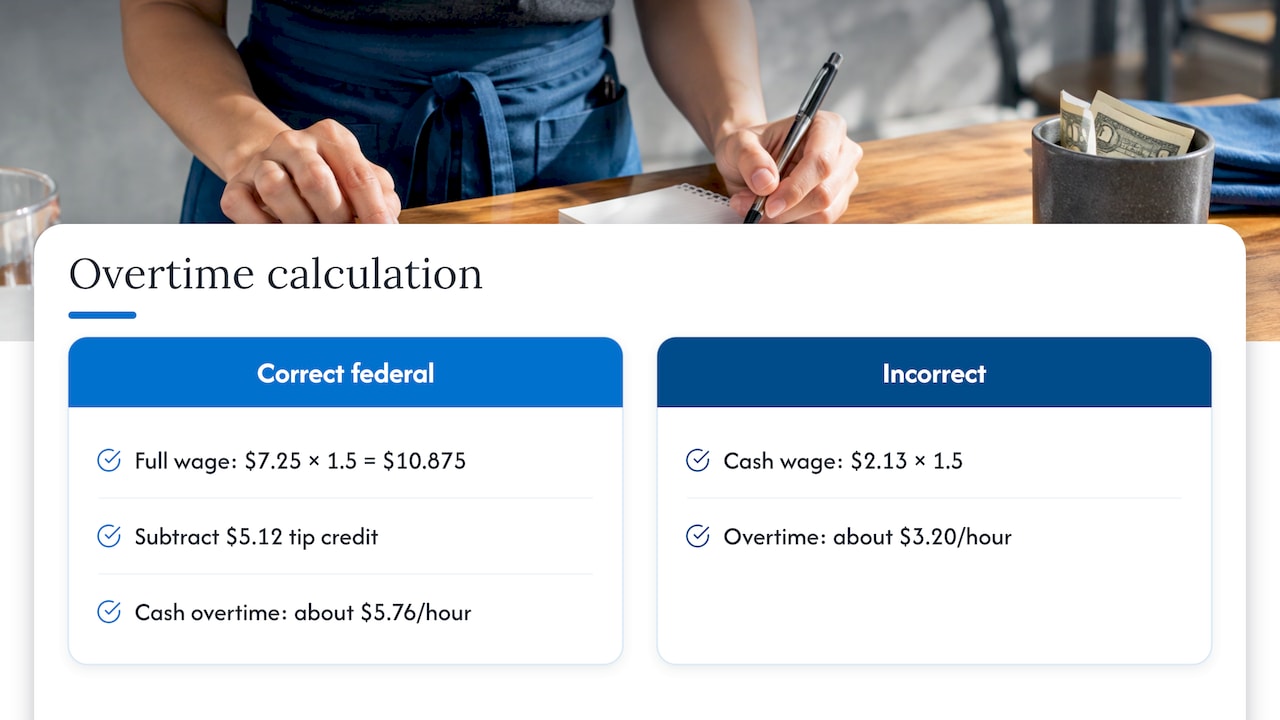
Overtime is the question many tipped workers get wrong, so look at your paystub with care. Overtime is based on the full minimum wage, not on your $2.13 cash wage. At the federal minimum, time and a half is $7.25 x 1.5 = $10.875 an hour. The employer may still subtract the same $5.12 credit, so the cash overtime rate is about $5.76 an hour. It is not $2.13 x 1.5, which would be about $3.20.
The overtime hours still need to be in a tipped occupation for the credit to apply. If your state sets a higher minimum wage, run the same math with your state’s numbers. For more on how overtime is calculated in general, see our guide to labor worker rights and overtime pay. If you suspect unpaid hours, our article on off-the-clock work explains why records matter.
Non-tipped duties and the 80/20 rule
Most servers do some work that does not earn tips directly, such as rolling silverware or cleaning. For years the question was how much of that work an employer could assign while still taking the credit.
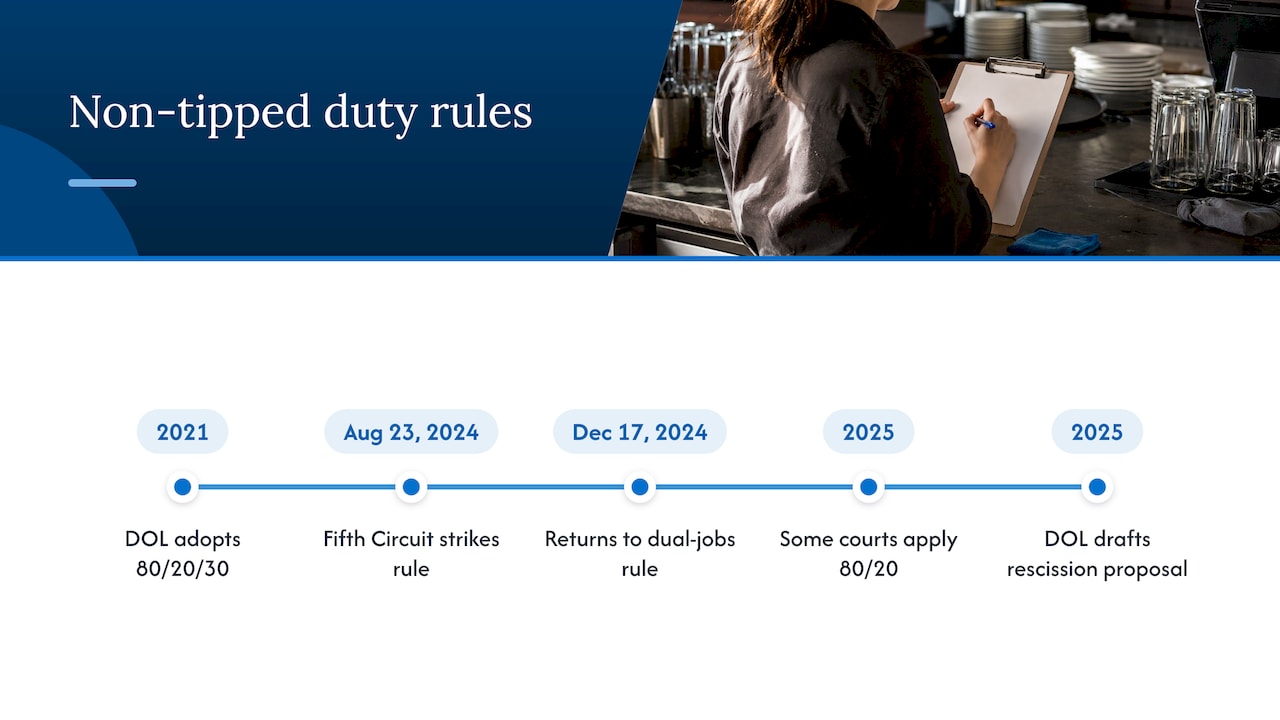
In 2021 the Department of Labor adopted a rule often called 80/20/30, which limited non-tipped duties. The Fifth Circuit struck it down nationwide on August 23, 2024, because the statute asks whether you are engaged in a tipped occupation, not whether each task produces tips. On December 17, 2024, the Department of Labor issued a final rule removing the restrictions and returning to the earlier dual-jobs regulation (Legal 500, 2024 review).
The picture is still moving. According to Legal 500’s 2025 review, some district courts outside the Fifth Circuit were still applying a version of 80/20 in 2025, and the Department of Labor had drafted a proposal to rescind the dual-jobs regulation. If you spend much of your shift on non-tipped work, check your state rules, which can be stricter than federal law.
Which states allow a tip credit
Federal law is the floor. States can require more, and the higher standard governs. The Department of Labor’s state table shows that Alaska, California, Guam, Minnesota, Montana, Nevada, Oregon and Washington require the full minimum wage before tips. Pew Research Center notes that the no-credit states are mostly in the West and all have minimum wages above the federal level. In those states, tips are extra income on top of the full wage.
Other states allow a credit but set a higher cash wage than $2.13. The table lists, for 2026:
| State | Rule listed by the Department of Labor |
|---|---|
| Arizona | $12.15 cash wage, $3.00 maximum credit |
| Colorado | $12.14 cash wage, $3.02 credit |
| Florida | $11.98 cash wage, $3.02 credit |
| New Jersey | $15.92 combined minimum, $9.87 maximum credit, $6.05 minimum cash wage |
| New York | $17.00 combined minimum in NYC, Long Island and Westchester, $16.00 elsewhere; tipped rates vary by region and employer type |
These figures are published for 2026 and change as states update their minimum wages, usually on January 1. New York’s Department of Labor lists 2027 tipped cash wages of $3.65 an hour in NYC, Long Island and Westchester restaurants and $3.40 elsewhere. Michigan’s minimum wage is scheduled to reach $15.00 on January 1, 2027 and then adjust annually. Always confirm your state’s current table before you rely on a number.
Tip credit versus tip pool
These two terms get mixed up, but they answer different questions. The tip credit decides how much your employer must pay in cash wages. A tip pool decides how tips are shared among workers.
According to Fact Sheet #15:
- If your employer takes a tip credit, it may require a pool only among employees who customarily and regularly receive tips, such as servers, bussers and bartenders.
- If your employer pays the full $7.25 federal minimum wage in cash, the pool may also include workers such as dishwashers and cooks.
- In both cases, employers, managers and supervisors may not take any part of the pool.
- Whether or not a credit is taken, an employer may never keep any portion of your tips for any purpose.
For a closer look at who can share in a pool, read our tip pooling laws guide.
How to protect yourself
You do not need a lawyer to start. These steps build a record you can use.
- Ask for or save the written notice about the tip credit, or write down when and how it was explained to you.
- Keep your own log of hours, cash wages and tips each week.
- Compare your paystub with your state’s table. Check the cash wage, the credit, and the overtime rate.
- Check that no manager or owner shares in a pool.
- If something does not add up, contact your state labor department or the Department of Labor’s Wage and Hour Division. Both accept complaints, and the law protects workers who raise them.
Separately, a federal tax deduction for qualified tips exists. Under the One Big Beautiful Bill Act, signed July 4, 2025, workers in customarily tipped occupations may deduct up to $25,000 of qualified tips for tax years 2025 through 2028, and employer reporting on Form W-2 is enforced starting in 2026, according to Legal 500’s summary. A tax professional can tell you how it applies to your return.
Perspective
We founded this organization in 1994, and our idea has stayed the same: workers should be able to understand their own rights without paying someone to translate them. Tip credit rules show why. The cash wage on a paystub can look small and confusing, yet the law attaches clear conditions to it: notice, a workweek test, and tips that belong to you.
We believe knowledge is where fairness starts. When a server knows that overtime is figured on the full minimum wage, or that a missing notice means no credit, a conversation with an employer changes. Our guides, written in plain language and kept up to date, are built to put that knowledge in your hands, and our attorney directory helps when you need to go further.
Every workplace is stronger when its rules are understood by everyone in it. We hope this guide helps you, your coworkers and the employers who want to get it right.
Max
Keep this resource free and growing
Workplace Fairness is a free resource for employees, and it runs on the support of readers who value clear information about their rights. If this guide helped you, you can support our work through a Membership, starting at $25 per year. For a wider overview of your rights on the job, start with our employee rights guide.

FAQ
Which states do not allow a tip credit?
According to the Department of Labor’s state table, Alaska, California, Guam, Minnesota, Montana, Nevada, Oregon and Washington require the full minimum wage before tips. Montana has a lower rate for small businesses not covered by the FLSA. In these places, tips are on top of the full wage.
Who qualifies for the tip credit?
Only employees in an occupation where they customarily and regularly receive more than $30 a month in tips. Servers and bartenders typically qualify. Cooks and dishwashers typically do not. The credit also applies only to hours worked in the tipped occupation.
What happens if my employer never gave me a tip credit notice?
Under federal law, an employer that does not provide the required information cannot take the tip credit. The employer would owe the difference up to the full minimum wage. Gather your paystubs and hours records, then contact your state labor department or the Wage and Hour Division.
Can my employer keep part of my tips?
No. Federal law bars employers, managers and supervisors from keeping any part of your tips, whether or not a tip credit is taken. A valid tip pool can share tips among eligible workers, but the employer and managers cannot take a share.
Sources
- DOL Fact Sheet #15: Tipped Employees Under the FLSA
- CRS: Tip Credit and Tip Pooling Provisions of the FLSA
- 29 CFR 531.59, The tip wage credit
- DOL: Minimum Wages for Tipped Employees
- DOL opinion letter FLSA-2025-03
- Epstein Becker Green: the tip credit
- New Jersey My Work Rights: Tipped Workers
- New York State Department of Labor: Minimum Wage for Tipped Workers
- DOL: State Minimum Wage Laws
- Pew Research Center: Minimum wage and tip credit rules vary by state
- Legal 500: 2024 Wage and Hour Developments
- Legal 500: 2025 Wage and Hour Developments