
Federal law sets a thin floor: employers must reimburse remote work costs only when those costs push your pay below $7.25 an hour, the federal minimum wage. Most W-2 employees cannot deduct home office costs on their federal return, while self-employed workers can, using either the simplified or regular method. Your best move right now is practical, not legal: start tracking every remote work expense, check whether your state requires reimbursement, and ask your employer for an accountable-plan reimbursement backed by receipts.
TL;DR:
- Most employees will not be legally entitled to reimbursements if remote work costs do not reduce their hourly wage below $7.25, the federal minimum wage.
- States like California, Illinois, and New York require reimbursement for necessary expenses when remote work is mandatory, but enforcement varies widely.
- Reimbursements under an IRS accountable plan are tax-free if properly documented, whereas stipends are generally taxed as wages without receipts.
- W-2 employees cannot claim the federal home office deduction, but self-employed workers can choose between simplified and regular methods if they meet strict use criteria.
- Tracking expenses such as internet, phone, and utilities, and submitting receipts through the correct channels, increases chances of reimbursement and legal protection.
Table of Contents
- Remote Work Expenses and the Law: Federal Floor, State Ceiling
- Accountable Plans vs. Stipends: Why the Tax Treatment Changes Everything
- The Home Office Deduction: Who Actually Qualifies
- Recurring Costs Worth Tracking, and Who Usually Pays
- How to Request Reimbursement: A Step-by-Step Approach
- When Your Employer Says No
- Why Reimbursement Fairness Is a Workplace Rights Issue
- Get Reimbursement Templates and Legal Referrals
- Sources
- FAQ
Remote Work Expenses and the Law: Federal Floor, State Ceiling
The federal baseline is narrower than most employees assume. Under the Fair Labor Standards Act, your employer only has to reimburse work-related costs when those costs would drag your effective hourly pay below $7.25. If you already earn well above minimum wage, the federal government generally will not force your employer to cover your internet bill or your laptop.
States fill that gap unevenly. A handful of jurisdictions require reimbursement for “necessary” expenses employees incur to do their jobs, and “necessary” typically covers things like a portion of internet, phone service, and equipment the employer requires you to use. States and jurisdictions with employee-protective reimbursement rules include:
- California
- Illinois
- New York
- Massachusetts
- Minnesota
- Washington, D.C.
The scope and enforcement mechanism differ by state, so the same expense that gets automatically reimbursed in Chicago might get denied in a state with no statute at all.
One distinction matters more than most employees realize: whether remote work is required or voluntary. When your employer mandates remote work as a condition of the job, state guidance tends to treat the resulting costs as necessary business expenses. If you chose to work from home for convenience while a desk sat open at the office, your claim gets weaker, even in a protective state. Knowing your state’s actual language matters more than assuming a national rule applies. For more on how wage protections interact with unreimbursed costs, see this guide to overtime and worker rights.
Accountable Plans vs. Stipends: Why the Tax Treatment Changes Everything
How your employer structures a reimbursement determines whether that money is tax-free or taxable wages. An IRS-accountable plan requires three things: the expense has a clear business connection, you substantiate it with dates, amounts, and purpose, and you return any excess above what you actually spent. Meet those conditions, and the reimbursement never touches your W-2 as income.
A flat monthly stipend handled outside that structure is a different animal. Without receipts or a return-of-excess mechanism, a stipend gets reported as taxable wages, subject to income and payroll tax just like your salary. A $100 monthly “remote work allowance” that shows up as flat pay costs you more in taxes than the same $100 delivered through a properly documented accountable plan.
Two practical steps protect your paycheck:
- Ask HR specifically for reimbursement “under an accountable plan,” not a general stipend.
- Keep dated receipts and a simple log of business use for every recurring cost you submit.
Pro Tip: Employers usually build a 30 to 60 day substantiation window into accountable plans. Submit your documentation early in that window rather than waiting until the deadline, since late submissions are the most common reason reimbursement requests get rejected outright.
The Home Office Deduction: Who Actually Qualifies
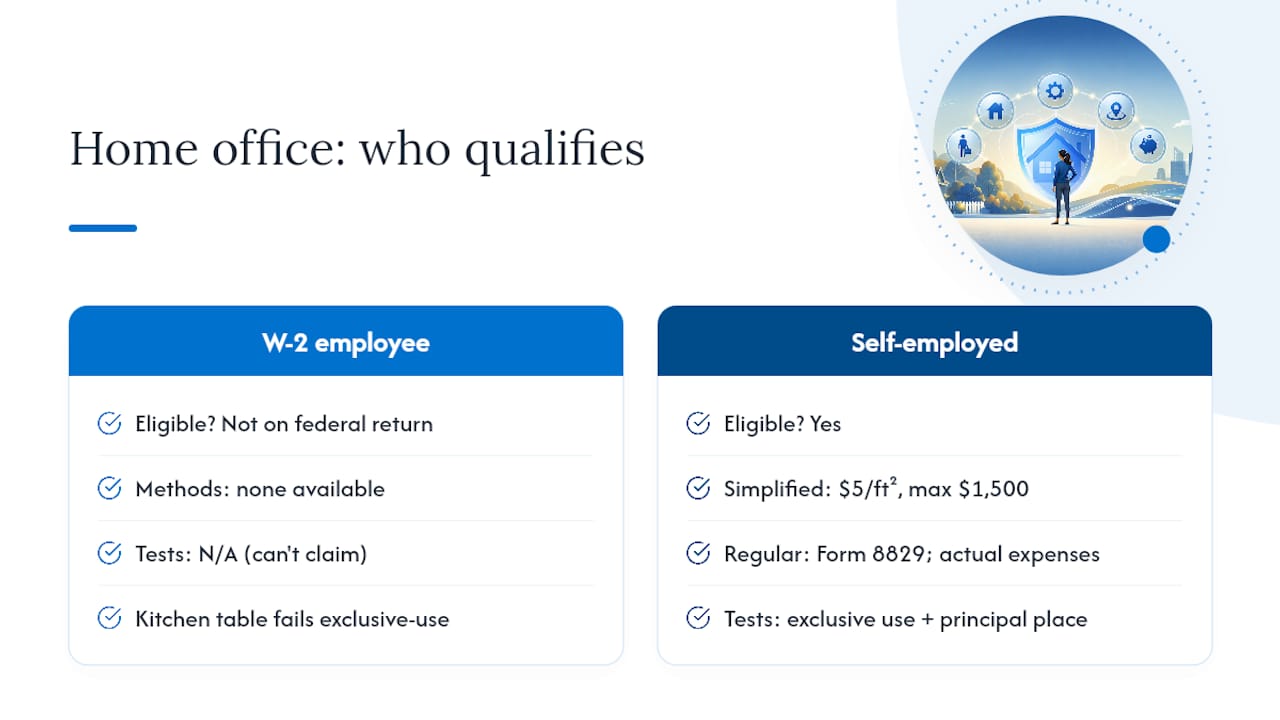
If you’re a W-2 employee, the answer is almost certainly not you. Since the 2017 tax law changes, employees generally cannot claim the federal home office deduction on their federal return, regardless of how much of your living room doubles as an office. This rule holds through at least 2025 tax filings.
Self-employed taxpayers, freelancers, and contractors face a different set of rules entirely. You can choose the simplified option, which pays $5 per square foot of home office space up to 300 square feet, for a maximum deduction of $1,500. Or you can use the regular method, which requires Form 8829 and lets you deduct the actual business-use percentage of mortgage interest, rent, utilities, insurance, and depreciation.
Either method requires passing two qualification tests, per IRS Topic 509: the space must be used exclusively for business, and it must serve as your principal place of business. A kitchen table that also hosts family dinners generally fails the exclusive-use test, even if you work there eight hours a day.
Recurring Costs Worth Tracking, and Who Usually Pays
Internet, phone, and utilities top the list of remote work expenses that employees underestimate over a full year. Here’s what to prioritize, in the order most employers actually reimburse:
- Internet service — usually reimbursed at a percentage tied to business use, not the full bill.
- Phone plan — a flat monthly amount or a documented business-use percentage.
- Software subscriptions — fully reimbursable when required for the job.
- Utilities — the hardest to substantiate, since separating business-use electricity from household use requires real calculation.
- Equipment — laptops, monitors, and chairs, where employer-provided hardware beats a reimbursement claim every time, since you avoid depreciation math entirely.
Companies handling shared household costs usually pick one of three models: a percentage-of-usage formula, a flat monthly allowance regardless of actual cost, or a hard cap per category. None of these are required by federal law outside the minimum-wage floor, so the model you get depends entirely on your employer’s policy and, where applicable, your state’s statute.
How to Request Reimbursement: A Step-by-Step Approach
Getting reimbursed rarely happens by asking once. It happens by building a case an employer’s HR or finance team cannot easily dismiss.
- Run a remote-work audit. Pull three months of bills for internet, phone, and any relevant utilities. Calculate your actual business-use percentage rather than guessing, and multiply that percentage against your monthly cost to get an incremental figure.
- Build a reimbursement packet. Include receipts, dates, a one-line business purpose for each item, your calculated business-use percentage, and a requested payment timeline.
- Submit through the right channel. Route the packet to HR or your direct manager, whichever your company’s expense policy names, and ask explicitly for accountable-plan treatment.
- Set a follow-up date. Give the request 30 to 60 days, then ask for written confirmation of approval and an expected payment date.
- Escalate if the timeline slips. If nothing moves after your follow-up, raise it with HR leadership, and if that stalls too, consider a state labor agency complaint.
Pro Tip: Cite your state’s actual statute or agency guidance by name when you submit the request, not just “I think California requires this.” Employees who reference specific legal language tend to see faster resolution than those who make a general appeal to fairness.
When Your Employer Says No
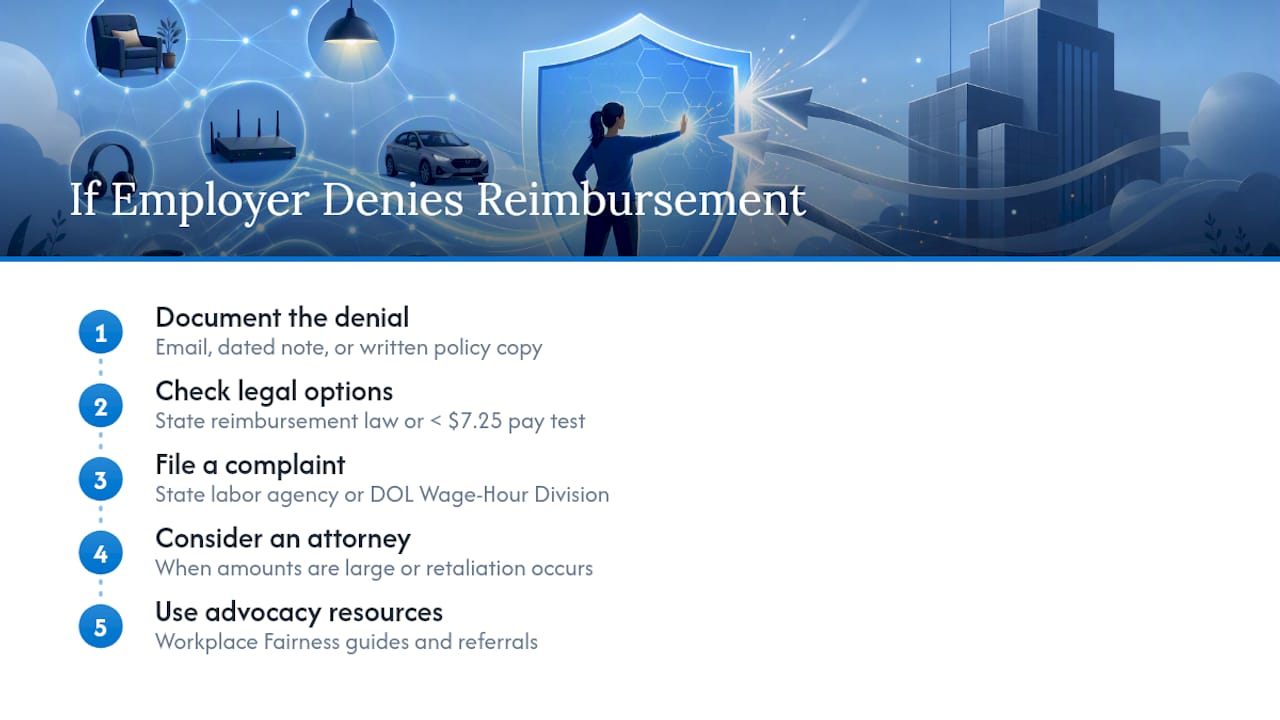
Start by documenting the denial in writing. An email reply, a dated note from a conversation with HR, or a copy of a written policy that excludes reimbursement all matter later if you need to escalate.
If you live in a state with a reimbursement statute, or if your unreimbursed costs are dragging your effective pay below $7.25 an hour, you have two formal paths: file a complaint with your state labor agency, or contact the DOL’s Wage and Hour Division directly. Both routes exist specifically for situations like this.
Some cases warrant an employment attorney, particularly when the unreimbursed amount is significant or your employer retaliates after you raise the issue. Workplace Fairness maintains resources to help you understand your rights as an employee and find the right next step before costs pile up further.
Why Reimbursement Fairness Is a Workplace Rights Issue
An organization has spent decades building resources for employees who face gaps between what the law promises and what employers actually deliver. Remote work expenses sit squarely in that gap. A worker earning near minimum wage who absorbs unreimbursed internet and equipment costs is experiencing a real erosion of pay, even when no single expense looks dramatic on its own.
We believe every employer running a remote or hybrid team should adopt an accountable plan, publish a clear reimbursement timeline, and set caps tied to documented costs rather than arbitrary limits. Employees deserve predictability, not guesswork, about what gets covered and when. If your workplace lacks that structure, certain resources and memberships can point you toward templates and legal referrals that make the ask easier.
— Max
Get Reimbursement Templates and Legal Referrals
This organization provides employee-rights context built specifically around fairness in pay and reimbursement, backed by extensive advocacy work rather than a sales pitch.
If you’re building a reimbursement packet, a state complaint, or you just want to understand where your rights actually stand, Membership starts at $25 per year and gives you access to guides, policy updates, and templates you can bring straight to HR. Organizations looking to build a genuinely fair remote work culture from the top down can also explore the Burnout First Aider Certification as a way to support employee wellbeing alongside financial fairness. Joining as a member supports the nonprofit work behind these resources, and it gets you practical material you can use the same day. Start with membership if you want templates and referral help now.
This article is general information, not a substitute for advice from a qualified financial advisor. Consult a qualified financial professional about your own circumstances before acting on anything here.
Sources
- Fair Labor Standards Act (FLSA) — U.S. Department of Labor
- Simplified option for home office deduction — Internal Revenue Service
- Remote employee reimbursement rules by state — Paycor resource center
FAQ
Can W-2 employees deduct home office expenses on federal taxes?
Generally no. Since the 2017 tax law changes, W-2 employees cannot claim the federal home office deduction, while self-employed taxpayers can use the simplified or regular method.
Is internet service a reimbursable remote work expense?
Often yes, but usually only for the business-use percentage, not the full bill, and whether it’s required depends on your state’s law and your employer’s policy.
How does an accountable plan differ from a stipend?
An accountable plan requires substantiated receipts and return of excess funds, keeping reimbursement tax-free, while an unsubstantiated stipend is generally treated as taxable wages.
Where do I file a complaint if my employer won’t reimburse me?
You can file with your state labor agency if your state has a reimbursement statute, or contact the DOL’s Wage and Hour Division if the issue involves the federal minimum-wage floor.
Do unreimbursed remote work costs affect unemployment benefits?
Unreimbursed expenses themselves don’t directly determine eligibility, but documented income loss from uncovered costs can matter if you later dispute wage calculations tied to a claim.