
Yes: under the Pregnant Workers Fairness Act, a covered employer must provide reasonable accommodations for your known pregnancy-related limitations unless doing so causes undue hardship. The EEOC has enforced this law since June 27, 2023, with final regulations effective June 18, 2024. Your first move: tell your employer, in plain words, what limitation you have and what change would help.
TL;DR:
- Employers can deny accommodations only if they demonstrate that providing them would cause significant difficulty or expense specific to the request.
- Minor or temporary pregnancy-related issues, such as morning sickness or brief lifting restrictions, qualify as known limitations without needing a doctor’s note.
- Requests like flexible schedules, longer breaks, or assistance with manual tasks are considered reasonable accommodations employers must consider promptly.
- Pregnant workers can be considered qualified even if temporarily unable to perform some job functions, as long as they can do so soon with reasonable accommodation.
- Proper documentation of conversations, requests, and responses is essential for enforcement if an employer denies or delays accommodations.
Table of Contents
- What the Pregnant Workers Fairness Act requires
- Who counts as a “known limitation” and a “qualified employee”
- What accommodations can you actually ask for?
- How to request PWFA accommodations, step by step
- Employer obligations when you ask for help
- Filing a charge with the EEOC: your enforcement path
- PWFA vs. ADA: how the laws work together
- Key dates you should know
- Scripts, records, and knowing when to call a lawyer
- Where to go next for official guidance
- Our take: the law is generous, the follow-through isn’t automatic
- Sources
What the Pregnant Workers Fairness Act requires
The Pregnant Workers Fairness Act, codified at 42 U.S.C. 2000gg, sets a straightforward rule: if you have a physical or mental limitation connected to pregnancy, childbirth, or a related medical condition, your employer must make reasonable changes to your job so you can keep working, unless that change creates significant difficulty or expense for the business. That last part, “undue hardship,” is the employer’s main defense, and we’ll walk through what it actually takes to prove.
The law applies to private employers meeting the coverage thresholds defined in the statute, along with federal agencies, Congress, employment agencies, and labor organizations. If your workplace has fewer than 15 employees, PWFA protections likely don’t reach you, though your state may fill that gap. Some states set the coverage threshold much lower, so it’s worth checking local law even if you think you’re outside federal protection.
Undue hardship isn’t a vague excuse an employer can wave around. The EEOC requires employers to point to real, specific difficulty or expense tied to your particular request, not general discomfort with pregnancy or assumptions about what you can handle. A small retail shop might struggle to justify denying a stool for a cashier who needs to sit periodically. An employer claiming hardship needs to show its work, not just say no and hope you don’t push back.
This is the heart of pregnancy accommodations law in practice: the presumption favors the worker. Employers who deny requests without a genuine hardship analysis are the ones who end up facing EEOC charges.
Who counts as a “known limitation” and a “qualified employee”
A “known limitation” simply means you or someone speaking for you told your employer about a physical or mental condition connected to pregnancy, childbirth, or a related medical condition. You don’t need a doctor’s note to trigger this. You don’t need to say the words “Pregnant Workers Fairness Act.” You just need to communicate that something about your condition is making part of your job harder.
The EEOC has been explicit that this covers minor and even episodic issues, not just severe complications. Morning sickness that hits for a few weeks counts. A temporary lifting restriction from your OB counts. Needing to leave early twice a month for prenatal appointments counts. The interpretive guidance published alongside the EEOC’s final rule makes clear that figuring out whether a condition relates to pregnancy is usually easy to sort out once employer and employee actually talk.
“Qualified employee” is the other half of the equation. Normally, being qualified for a job means you can perform its essential functions. The PWFA carves out an important exception: if you’re temporarily unable to perform one or more essential functions, you can still be considered qualified, as long as you could perform them in the near future and your employer can reasonably accommodate the gap in the meantime. That’s a meaningful departure from how the ADA typically works, and it’s the provision that lets pregnant workers request things like temporary duty changes without fear of being labeled unqualified for their own jobs.
What accommodations can you actually ask for?
Reasonable accommodations under the PWFA cover far more ground than most workers expect. The EEOC’s guidance lists a range of options, and none of them require your employer’s permission to even ask.
- Additional or longer bathroom breaks
- A modified or flexible work schedule
- Leave for prenatal appointments, recovery, or related medical needs
- Temporary reassignment or suspension of a job duty you can’t currently perform, like heavy lifting
- Modified seating, or the option to sit rather than stand for long stretches
- Help with manual labor, such as a coworker temporarily lifting boxes for you
Leave sits in an interesting spot on this list. Your employer can offer leave as an accommodation, but they can’t force it on you if a different accommodation would let you keep working. If moving you to a lighter-duty station solves the problem, your employer can’t push you out on unpaid leave instead just because it’s simpler for scheduling. This distinction matters enormously for anyone worried about lost income during pregnancy.
Pro Tip: Accommodations aren’t a one-time grant. What works in your first trimester might not work in your third, and postpartum recovery brings its own set of needs. Revisit the conversation with your employer whenever your situation changes. You’re allowed to ask again.
Light duty during pregnancy deserves a specific mention here, since it’s one of the most requested accommodations and one of the most misunderstood. Employers sometimes claim they have no “light duty” program and therefore can’t help. Under the PWFA, that excuse doesn’t hold up the way it once did. The law can require an employer to create a temporary adjustment even without a formal light-duty policy, if it doesn’t rise to the level of undue hardship.
How to request PWFA accommodations, step by step
Requesting an accommodation isn’t a formal legal filing. It’s a conversation, and the EEOC has intentionally kept the bar low for starting one.
- State the limitation. Tell your employer or supervisor, in your own words, what’s physically or mentally difficult right now. “I’m having trouble standing for full shifts because of my pregnancy” is enough. You don’t need medical jargon.
- Name the change you need. Follow up with the specific adjustment: a stool, a schedule shift, help lifting, or extra breaks. Employers respond faster to a concrete ask than a vague complaint.
- Expect the interactive process to start. Once your employer knows about the limitation, EEOC guidance calls for a prompt, informal back-and-forth to land on something that actually works for both of you. This isn’t a one-way employer decision; it’s meant to be collaborative.
- Provide documentation only if it’s reasonable. Under the final rule, employers can request supporting documentation in some cases, but it has to be limited to confirming the limitation and the need for accommodation. A demand for your full medical history is not reasonable documentation, and pushing back on overbroad requests is fair game.
Sample phrasing helps more than people expect. Try: “I have a pregnancy-related limitation that’s making [specific task] difficult, and I’d like to request [specific change].” That single sentence, said out loud or put in an email, is often all it takes to start the clock on your employer’s obligation.
Employer obligations when you ask for help
Once your employer knows about your limitation, the clock starts. Delay isn’t neutral. The EEOC’s final rule expects employers to engage promptly, not shelve your request until it’s convenient. An employer also cannot simply hand you an accommodation you didn’t ask for and never discussed, or force you onto leave, without first going through the interactive process together.
Undue hardship is the employer’s escape hatch, but it’s narrower than most people assume. It requires showing significant difficulty or expense tied to your specific request, factoring in things like the size of the business, its financial resources, and the nature of the operation. A national chain claiming hardship over a $40 stool faces a much steeper climb than a five-person shop with a razor-thin margin.
If your employer denies a request or drags things out, start documenting immediately. Write down dates, names of who you spoke with, and what was said. Save every email or text. Keep copies of any doctor’s notes or appointment slips you shared. That record becomes essential if you eventually need to escalate to an EEOC charge, and it’s far easier to build in real time than to reconstruct months later from memory.
Filing a charge with the EEOC: your enforcement path
If your employer denies a reasonable accommodation, retaliates against you, or otherwise violates the PWFA, you can file a charge with the EEOC, either online or at a local field office. The agency has accepted PWFA charges since June 27, 2023, and it investigates them the way it handles other employment discrimination claims.
Remedies can include back pay for wages you lost, along with injunctive relief that forces the employer to change its practices going forward. There’s a nuance worth knowing here: if an employer can show it made a good-faith effort to identify and provide a reasonable accommodation, damages may be limited even when that effort ultimately fell short. That’s an incentive built into the law to reward employers who try, not just those who succeed on the first attempt.
Don’t assume the EEOC is your only path. Many states and cities have their own pregnancy accommodation laws, sometimes with lower coverage thresholds or faster timelines than the federal process. If your state has one, filing there in parallel, or first, might get you relief sooner than waiting on a federal investigation.
PWFA vs. ADA: how the laws work together
The Pregnancy Discrimination Act (PDA) bars treating you worse because you’re pregnant, but it never required employers to actively accommodate you. The ADA requires accommodations, but only for conditions that meet its legal definition of disability, and normal, uncomplicated pregnancy usually doesn’t qualify.
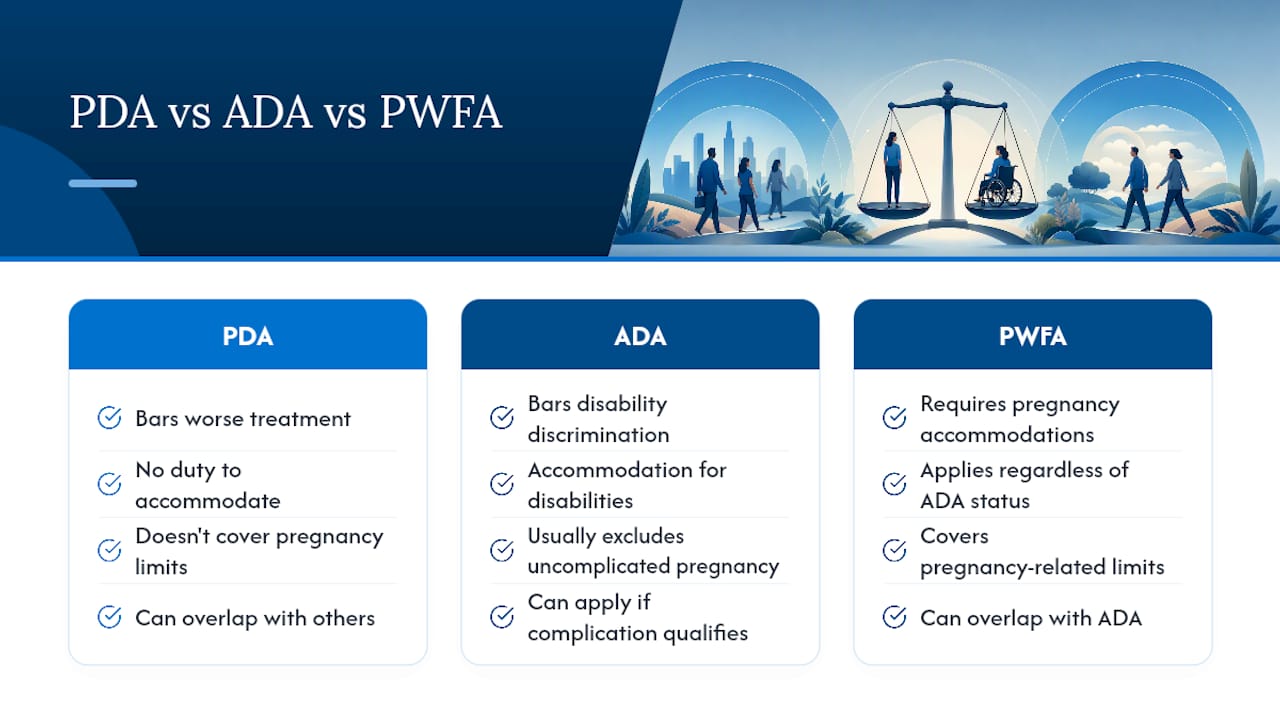
The PWFA closes that exact gap. It requires accommodations for pregnancy-related limitations regardless of whether they’d ever clear the ADA’s disability bar. That’s the single biggest practical difference: PWFA vs. ADA isn’t about which law is “stronger,” it’s about which one actually applies to your everyday pregnancy symptoms. Morning sickness alone was never going to qualify as an ADA disability. Under the PWFA, it can still get you a real accommodation.
These laws can and do overlap. If your pregnancy involves a complication that independently qualifies as an ADA disability, like severe preeclampsia, you may have claims and protections under both statutes simultaneously. Knowing all three, the PDA, the ADA, and the PWFA, gives you the strongest possible footing when you sit down with HR.
Key dates you should know
Congress enacted the Pregnant Workers Fairness Act as Pub. L. 117-328, codified at 42 U.S.C. 2000gg. The EEOC began accepting charges under the law on June 27, 2023, the date it went into effect. The agency then published its final rule and interpretive guidance in the Federal Register, with that regulation taking effect June 18, 2024. If you’re researching pregnant workers fairness act 2026 developments, know that the core statute and regulations have been fully enforceable since those 2024 dates, with no sunset in sight.
Scripts, records, and knowing when to call a lawyer
We built these resources around one idea: workers do better when they know exactly what to say and what to save. Here are two scripts you can adapt today.
In person: “I’m dealing with a pregnancy-related limitation that’s making [task] hard right now. Could we talk about [specific accommodation], like a modified schedule or help with lifting?”
By email: “I wanted to follow up on our conversation about my pregnancy-related limitation. As discussed, I’m requesting [specific accommodation] starting [date]. Please let me know what additional information you need to move forward.”
Email creates a timestamp and a paper trail automatically, which is why we lean toward it whenever a conversation stalls.
Build a simple documentation habit alongside those requests:
- Log the date and who you spoke to every time you raise the issue.
- Save every email, text, or written response from your employer.
- Keep copies of appointment slips or notes your doctor provides.
- Write a short summary of verbal conversations within 24 hours, while details are fresh.
Pro Tip: A denial doesn’t have to be dramatic to count. If your manager just keeps “forgetting” to follow up, that delay itself becomes part of your record. Document the silence, not just the outright no.
If your employer denies a reasonable request outright, retaliates against you for asking, or you’re unsure whether your situation qualifies, that’s the point to consult an employment attorney or explore how to formally request a reasonable accommodation through Workplacefairness’s guidance. Simple confusion about your rights is best solved with free resources; active denial or retaliation usually calls for legal counsel who can evaluate your specific facts. As your needs shift throughout pregnancy and postpartum recovery, resources like this stage-by-stage planning guide can help you think through what accommodations to raise next.
Where to go next for official guidance
Start with the EEOC’s own explainer on the PWFA for plain-language coverage of your rights, and the Federal Register final rule if you want the full regulatory text and interpretive guidance behind it. The EEOC’s page on pregnancy discrimination explains how the PDA and ADA fit alongside the PWFA.
On the Workplacefairness side, our guide to requesting a reasonable workplace accommodation walks through the process in more detail, and our broader employee rights guide covers protections beyond pregnancy if you want the fuller picture.
Our take: the law is generous, the follow-through isn’t automatic
The Pregnant Workers Fairness Act is one of the more worker-favorable statutes on the books, and that’s exactly why so many people underuse it. The common advice out there treats this like a legal chess match, heavy on jargon, light on what to actually say on a Tuesday morning to your shift supervisor. That’s backwards. The law was built so you don’t need a lawyer to start the process. You need two sentences and a willingness to say them out loud.
Where conventional advice really falls short is documentation. Most guides mention it as an afterthought. We’d put it first. An employer’s undue-hardship defense lives or dies on specifics, and your ability to counter a denial lives or dies on your own paper trail. Prioritize the conversation, then prioritize writing it down. Everything else, the statute, the interactive process, the EEOC charge, only matters if you can show what actually happened. If you take one thing from this article and use it before your next shift, make it that.
— Max
Sources
- What You Should Know About the Pregnant Workers Fairness Act | U.S. Equal Employment Opportunity Commission
- Implementation of the Pregnant Workers Fairness Act — Federal Register