No. There is currently no federal law guaranteeing paid family leave for most private-sector workers. The Family and Medical Leave Act provides unpaid, job-protected leave to eligible employees, and it remains the only nationwide standard. States have stepped in with their own paid family leave programs, each with different funding rules, benefit amounts, and eligibility requirements. This guide walks through the federal framework, real state examples, and the steps to take when filing a claim.
TL;DR:
- Most private-sector workers remain ineligible for federal paid family leave, with FMLA only offering unpaid, job-protected leave for specific criteria.
- Eligibility for FMLA depends on employer size, employee tenure, and hours worked, leaving many workers at small companies without coverage.
- Paid leave benefits often do not guarantee job protection unless combined with FMLA, which only applies under certain employer and employee conditions.
- Federal efforts like the FAMILY Act and tax credits aim to establish a national paid leave system, but until enacted, access depends heavily on where a worker lives.
Table of Contents
- Federal framework: what FMLA provides, eligibility, and limits
- How state paid family leave programs work
- State highlights: what real paid leave programs pay out
- FMLA versus state paid leave: what each one actually protects
- How to file a paid family leave claim step by step
- Common pitfalls that delay or derail a claim
- Federal advocacy and employer incentives shaping the future
- Why paid family leave access still depends on where you live
- Get ongoing support for navigating leave and workplace rights
- Sources
- FAQ
Federal framework: what FMLA provides, eligibility, and limits
The Family and Medical Leave Act is the foundation of leave protection in the United States, and understanding its limits matters as much as understanding its promise. FMLA guarantees eligible employees up to 12 workweeks of unpaid, job-protected leave within a 12-month period for the birth or adoption of a child, a serious health condition, or caring for a family member with one. Military caregivers may qualify for up to 26 weeks to care for a covered service member. The Department of Labor confirms that no federal law currently requires this leave to be paid.
Eligibility hinges on three tests working together, and missing any one of them disqualifies a worker regardless of need:
- The employee must have worked for the employer for at least 12 months (not necessarily consecutive).
- The employee must have logged at least 1,250 hours in the 12 months before the leave begins.
- The employer must generally have 50 or more employees within a 75-mile radius.
That third test leaves a meaningful gap. Millions of workers at small businesses fall outside FMLA’s coverage entirely, which is one reason state programs matter so much for real-world access to leave.
FMLA also interacts with paid leave in ways that surprise many workers. Employers may require, or employees may choose, to substitute accrued paid leave (like vacation or sick time) to run concurrently with FMLA. This is called concurrent leave: the unpaid FMLA clock and the paid leave balance draw down together, so a worker’s job stays protected while their paycheck stretches a little further, at least until the paid balance runs out. For a fuller breakdown of who qualifies, Workplace Fairness’s FMLA eligibility guide walks through the four DOL tests in detail.
How state paid family leave programs work
Every state paid family leave program is built around three basic questions: who pays for it, what qualifies as a covered reason, and how much a worker actually receives. Once you understand this framework, you can read almost any state’s rules without getting lost in the details.
Funding follows one of two models. Most mandatory programs use a social insurance approach, funded through small payroll tax contributions from employees, employers, or both, pooled into a state fund that pays benefits when a claim is approved. A smaller number of states allow employers to meet requirements through private insurance or self-insured plans instead of the state fund, provided they meet minimum benefit standards.
Covered reasons are fairly consistent across programs, even when the details differ:
- Bonding with a new child after birth, adoption, or foster placement.
- Caring for a family member with a serious health condition.
- Managing the worker’s own serious health condition (in states that combine family and medical leave).
- Certain military exigencies, such as a family member’s deployment.
Benefit design is where states diverge the most. Most programs replace a percentage of a worker’s average weekly wage, often on a sliding scale that replaces a higher share of income for lower earners and a lower share for higher earners, up to a capped weekly maximum. Many programs impose a short waiting period before benefits begin, and most allow intermittent leave for treatments, appointments, or reduced schedules rather than requiring one continuous block of time away. States that combine family and medical leave under a single program, like Washington, also cap the combined total so a worker cannot exceed a set number of weeks across both leave types in a single year. Understanding these mechanics before a life event happens makes the difference between a smooth claim and a confusing one.
State highlights: what real paid leave programs pay out
Numbers make the patchwork concrete. Here is what a handful of established programs actually provide as of 2026.
| State | Maximum leave duration | Approximate benefit | Funding source |
|---|---|---|---|
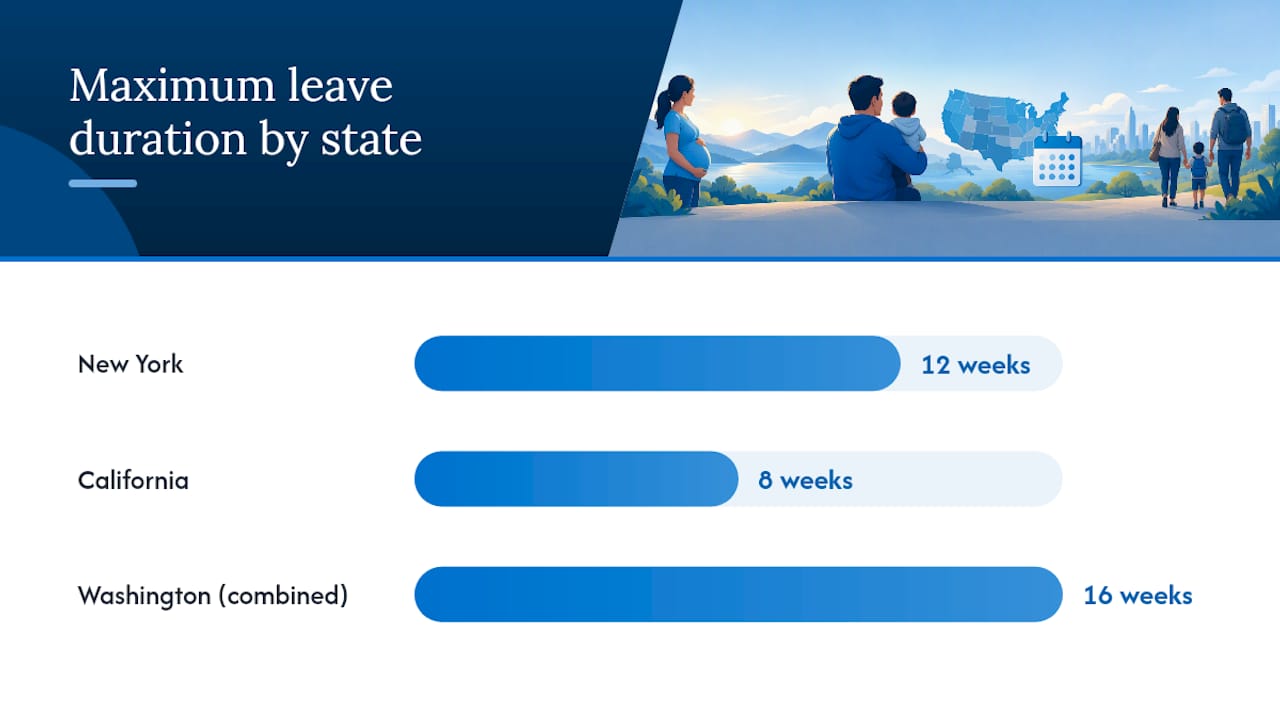
| New York | Up to 12 weeks | Weekly cap of $1,228.53, maximum total benefit of $14,742.36 | Employee payroll contribution at a small percentage of gross wages |
| California | Up to eight weeks | Roughly 60% to 70% of wages, depending on earnings | State Disability Insurance (SDI) contributions |
| Washington | Up to 12 weeks family, 16 weeks combined family and medical | Weekly benefit between $100 and $1,647 | Shared employer and employee payroll premiums |
New York’s program illustrates how quickly the numbers add up. The 2026 maximum total benefit reaches $14,742.36 across a claim, funded by an employee contribution rate of 0.432% of gross wages, capped annually at $411.91. That contribution is often automatic, deducted from paychecks long before most workers ever file a claim.
California’s Paid Family Leave, administered through the EDD, offers up to eight weeks per 12-month period for bonding or caregiving, with wage replacement generally landing between 60% and 70% depending on the worker’s earnings history. Filing runs through SDI Online, and eligibility depends on prior SDI contributions rather than a separate qualifying test.
Washington’s Paid Leave program stands out for its combined structure: up to 12 weeks for family leave alone, up to 16 weeks when family and medical leave are combined, and up to 18 weeks in cases involving pregnancy-related incapacity. Weekly benefits range from $100 to $1,647 depending on the worker’s prior income, giving lower earners a proportionally larger share of their wages replaced.
Rhode Island and Massachusetts round out the picture of a country moving, unevenly, toward paid leave as a standard rather than an exception. Both states run comprehensive programs that combine family and medical leave under one payroll-tax-funded system, reflecting a broader shift among Northeastern and Western states toward guaranteed wage replacement during major life events. As of 2026, fourteen states and the District of Columbia have enacted mandatory, comprehensive paid family and medical leave programs, with newer programs in Delaware, Maine, Maryland, and Minnesota joining the group this year.
FMLA versus state paid leave: what each one actually protects
Confusing FMLA with a state paid leave program is one of the most common and costly mistakes workers make. The two laws solve different problems, and knowing which one applies to your situation changes how you plan.
FMLA protects your job. It says nothing about your paycheck. State paid family leave does the opposite in most cases: it replaces a portion of your wages but does not automatically guarantee your job will be there when you return, unless the state law says otherwise or you also qualify for FMLA at the same time.
A few distinctions worth holding onto:
- FMLA job protection depends on employer size and tenure; a worker at a 30-person company may not be FMLA-eligible even while qualifying for state paid leave benefits.
- Receiving a paid leave benefit does not always mean 100% wage replacement. Most programs replace a percentage, not the full paycheck.
- Job protection under state programs varies. Some states extend protections similar to FMLA even to smaller employers; others do not, leaving a gap where a worker can be paid but not guaranteed reinstatement.
The safest approach is to check both: whether FMLA applies to your employer and tenure, and whether your state’s paid leave law extends job protection beyond what FMLA offers. The two working together, not one substituting for the other, is what actually secures both income and a job to return to.
How to file a paid family leave claim step by step
Filing a claim correctly the first time saves weeks of delay. Most denials trace back to a missed document or a late submission rather than an actual ineligibility, so treat the paperwork with the same seriousness as the leave itself.
- Notify your employer according to company policy, ideally in writing, and keep a copy or a scent email as proof of the date you informed them.
- Identify your state’s claim portal, such as SDI Online in California, the NYS Workers’ Compensation Board system in New York, or the PaidLeave WA portal in Washington.
- Gather required documentation before you file: medical certification for a serious health condition, birth or adoption records for bonding leave, recent wage statements, and any employer response forms your state requires.
- Submit your claim promptly once leave begins. Most programs do not pay retroactively for long unexplained delays.
- Keep copies of every form, confirmation number, and communication with your employer or the state agency.
- If your claim is denied, request the specific reason in writing and file an appeal through your state agency’s process within the stated deadline.
Pro Tip: Photograph or scan every document you submit before mailing or uploading it, so you have your own timestamped record if the agency claims something never arrived.
Employer cooperation matters more than most workers expect. Many states require the employer to complete a response form confirming employment dates and wage information, and a slow or incomplete employer response is a frequent, avoidable cause of processing delays.
Common pitfalls that delay or derail a claim
A few recurring problems trip up otherwise straightforward claims, and knowing them in advance is the best defense.
- Some employers require accrued paid time off to run concurrently with FMLA, which can deplete a worker’s vacation or sick balance faster than expected while still preserving job protection.
- Claims are frequently denied for documentation gaps, incorrect forms, or filing after the state’s deadline, all of which are avoidable with careful preparation.
- Workers sometimes assume paid leave and job protection travel together automatically; in states without extended protections, they do not.
Pro Tip: If your employer disputes your leave or pressures you to use paid time off in a way that contradicts written policy, document every conversation and contact your state labor agency or the U.S. Department of Labor before your leave ends, not after.
When a claim stalls or a denial feels unjustified, the state agency that administers the program is the first call. For broader questions about your rights, Workplace Fairness’s guide on FMLA and workplace protections explains how these laws intersect with other forms of protection you may not know you have.
Federal advocacy and employer incentives shaping the future
Momentum toward a national paid leave standard continues to build, even without a law in place yet. The FAMILY Act, a long-standing federal proposal, would create a national paid family and medical leave insurance program funded through small payroll contributions, similar to the state social insurance models already running in places like New York and Washington. It has not been enacted.
On the employer side, a federal tax credit for paid family and medical leave already exists and was made permanent under 2025 legislation, building on a credit that originated in the 2017 Tax Cuts and Jobs Act. The credit gives employers a financial incentive to offer qualifying paid leave voluntarily, even in states without a mandatory program.
- The FAMILY Act would establish a national paid leave insurance system if passed, closing gaps left by the current state-by-state patchwork.
- The permanent employer tax credit rewards voluntary paid leave policies, particularly useful for employers in states with no mandatory program.
- Advocates argue that federal action would reduce the inequality of access that currently depends heavily on which state a worker happens to live in.
Until federal legislation changes, where you work will keep determining what kind of leave you can count on.
Why paid family leave access still depends on where you live
Paid family leave should not function as a geography lottery, yet in 2026 it largely still does. A worker in New York can plan around a defined weekly benefit and a clear filing process. A worker in a state with no program, or one whose employer falls below FMLA’s size threshold, is left negotiating leave informally or going without pay entirely. That gap is not a personal failing; it is a structural one, and closing it is why Workplace Fairness exists.
We built our guides to translate dense legal language into steps workers can actually follow, whether that means checking FMLA eligibility or understanding a state agency’s claim form. If you are unsure where you stand, our resources and attorney directory can help you find legal assistance suited to your situation.
— Max
Get ongoing support for navigating leave and workplace rights
Understanding your rights under FMLA and your state’s paid leave program is the first step, but questions rarely stop at the first form. Workplace Fairness offers a free FMLA eligibility guide to help you check the DOL’s four tests against your own employment situation.
For readers who want continued access to updates on employment law as it evolves, Workplace Fairness membership starts at $25 per year and keeps you connected to current guidance as state and federal rules change.
This article is general information, not a substitute for advice from a qualified lawyer. Consult a qualified legal professional about your own circumstances before acting on anything here.
Sources
FAQ
Which states will have paid family leave in 2026?
As of 2026, fourteen states and the District of Columbia have mandatory, comprehensive paid family and medical leave programs, with newer programs active in Delaware, Maine, Maryland, and Minnesota. Coverage details, including funding and benefit amounts, vary by state, so checking your specific state’s program page is the only way to confirm your own benefit.
Which state has the best paid family leave?
There is no single “best” program, since states differ in duration, wage replacement, and eligibility rules. New York offers a $14,742.36 maximum benefit with a weekly cap of $1,228.53, while Washington offers longer combined leave of up to 16 weeks, so the better fit depends on your circumstances and location.
Which is better, FMLA or PFL?
FMLA and state paid family leave solve different problems and are not interchangeable. FMLA provides unpaid job protection for eligible workers at covered employers, while state paid leave provides partial wage replacement that does not always come with the same job protection, so understanding both is more useful than ranking one above the other.
Do you get paid 100% on FMLA?
No, FMLA itself provides unpaid leave and includes no wage replacement. Some workers use accrued paid time off concurrently with FMLA, or qualify for a state paid family leave program that pays a percentage of wages, such as California’s roughly 60% to 70% wage replacement, but the FMLA law alone does not include payment.