Most U.S. workers are covered by the federal minimum wage of $7.25 per hour, but a defined list of jobs and situations is exempt, and a second list allows a lower “subminimum” rate. Being exempt is not the same as being paid a salary or holding a title like “manager.” Each exemption has exact conditions, and your state may protect you more than federal law does. This guide explains who is exempt, who can legally be paid less, and how to check where you stand.
TL;DR
- The federal minimum wage is $7.25 per hour. Executive, administrative, professional, outside sales and certain computer employees are exempt from it only when they meet both a duties test and a salary test.
- A salary or a job title alone never creates an exemption. The job’s actual duties and the pay level must both qualify.
- Some workers may be paid less than $7.25 by rule: tipped employees (with a tip credit), workers under 20 in their first 90 days, certain full-time students, and workers with disabilities under a government certificate.
- Your state law may set a higher wage, narrower exemptions or higher salary thresholds. The rule that is better for you applies.
- If your pay does not match your exemption, you can check your classification and file a wage claim with a labor agency.
Table of Contents
- Two different things called “exempt”
- Who is exempt from both minimum wage and overtime
- Who can be paid less than $7.25
- Your state may give you more
- How to check whether your exemption is real
- Support free, plain-language rights information
- Our perspective
- FAQ
- Sources
Two different things called “exempt”
People use the word “exempt” loosely, and that causes real confusion. Two separate ideas are mixed together:
- Exempt from the Fair Labor Standards Act (FLSA) rules. The FLSA is the federal law that sets the minimum wage and overtime. Some workers fall outside the minimum wage rule, the overtime rule, or both.
- Allowed a lower wage. Other workers are still covered by the law, but the law lets an employer pay a reduced rate under set conditions, often with a government certificate.
Knowing which one applies to you matters. An exempt worker may have no minimum wage right at all under federal law. A worker on a lower rate still has rights: a floor, limits on how long the rate lasts, and in many cases paperwork the employer must hold.
If you want a plain overview of how classification works, our guide to exempt vs nonexempt status covers the basics.
Who is exempt from both minimum wage and overtime
The U.S. Department of Labor (DOL) keeps a Handy Reference Guide to the FLSA. It lists the workers exempt from both minimum wage and overtime pay:
- Executive, administrative and professional employees, including teachers and academic administrative staff
- Outside sales employees
- Certain computer-related occupations
- Employees of certain seasonal amusement or recreational establishments
- Employees of certain small newspapers, and newspaper delivery workers
- Seamen on foreign vessels
- Fishing operations workers
- Farmworkers on farms that use no more than 500 man-days of farm labor in any calendar quarter of the prior year
- Casual babysitters and companions to the elderly or infirm
The guide stresses that these exemptions are narrowly defined, so the exact terms and conditions of each one must be met. A job that looks similar to one on the list is not automatically covered.
The white-collar exemptions: duties and salary
The executive, administrative, professional, outside sales and computer exemptions are the ones most office workers hear about. According to DOL Fact Sheet #17G, employees generally must meet job-duty tests and be paid on a salary basis of at least $684 per week, which is $35,568 per year. Certain computer employees may instead qualify when paid hourly at not less than $27.63. The same fact sheet is clear that paying a salary does not by itself create the exemption: every salary and duties requirement must be met.
That means three things for you:
- Title is not the test. Being called a “supervisor” or “associate manager” does not decide anything. What you actually do most of the time does.
- Salary is only half the test. A worker paid $50,000 who spends the day on routine, non-managerial tasks may still be non-exempt.
- Salary basis has rules. The pay must generally be a predetermined amount that is not reduced because of variations in quality or quantity of work.
There is also a category for very high earners. DOL Fact Sheet #17H explains that a highly compensated employee is exempt when total pay reaches the regulatory level, the primary duty is office or non-manual work, and the employee regularly performs at least one exempt duty. Commissions and nondiscretionary bonuses can count toward that pay, but board, lodging, insurance and retirement benefits cannot.
For the current federal figure and why it keeps appearing in the news, see our page on the FLSA salary threshold. Our earlier coverage of proposed overtime changes shows how these numbers have been contested.
Who can be paid less than $7.25
The second group is not exempt from the law. These workers can lawfully receive a reduced wage when strict conditions are met. The DOL’s subminimum wage page lists the main categories.
| Group | What the employer may pay | Key condition |
|---|---|---|
| Tipped employees | $2.13 cash wage per hour | Tips must bring total pay to at least $7.25 per hour |
| Workers under 20 | At least $4.25 per hour | Only for the first 90 consecutive calendar days, and not to displace other workers |
| Full-time students (retail, service, agriculture, higher education) | Not less than 85 percent of the minimum wage | Employer needs a DOL certificate |
| Student-learners | Under a DOL certificate | Part of a vocational training program |
| Workers with disabilities that impair productivity | Wage based on productivity | Employer needs a WHD certificate |
The DOL’s minimum wage questions and answers confirm the youth, student and tipped rules above.
Tipped employees
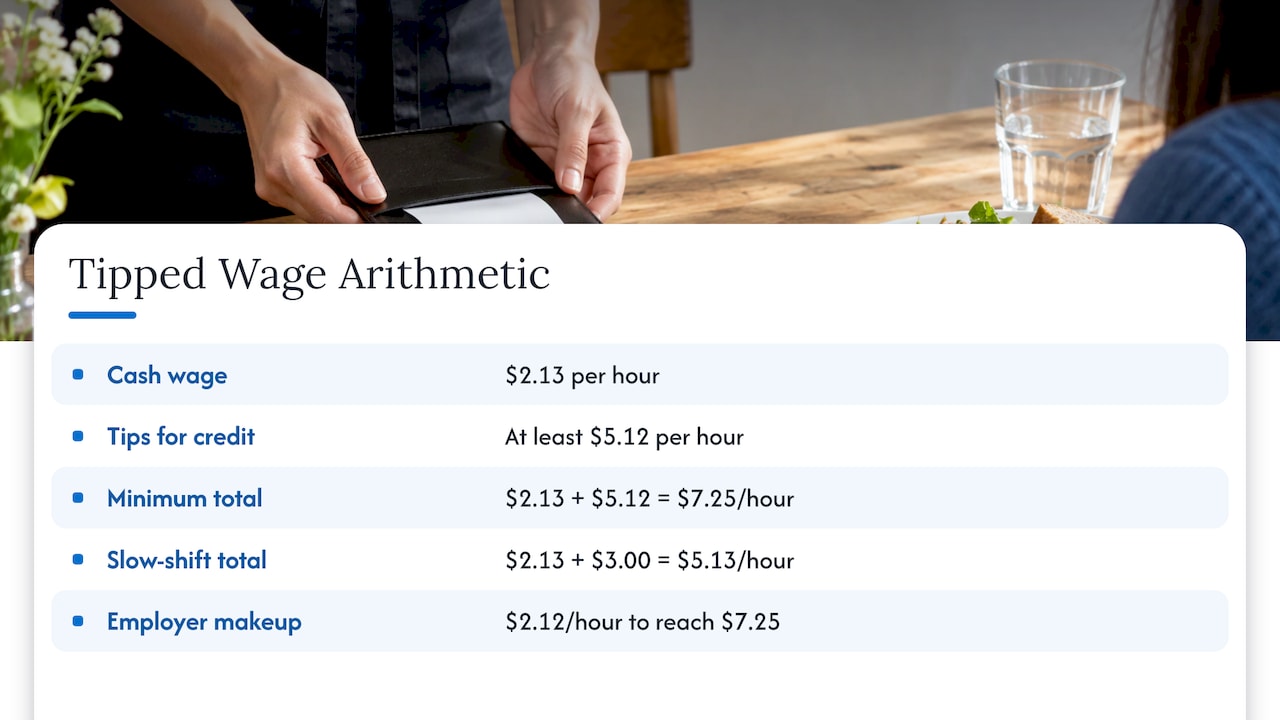
Tipped work is the lower-wage arrangement most workers actually meet. Under the FLSA, a tipped employee is one who customarily and regularly receives more than $30 a month in tips. According to the Congressional Research Service’s FLSA overview, the employer may pay a cash wage of $2.13 per hour if the employee receives at least $5.12 an hour in tips. That $5.12 is called the tip credit. If tips fall short, the employer must make up the difference.
A worked example. You work a slow shift and your tips average $3.00 per hour. Your $2.13 cash wage plus $3.00 in tips is $5.13, well below $7.25. Your employer owes you the extra $2.12 per hour, so that your total reaches $7.25.
The same CRS overview notes that as of January 1, 2023, seven states (Alaska, California, Minnesota, Montana, Nevada, Oregon and Washington) and Guam do not allow a tip credit at all. There, tipped employees must receive a cash wage at least equal to the higher of the federal or state minimum. Check your state’s current rule, since states can change it.
Young workers
An employer may pay workers under 20 at least $4.25 per hour during their first 90 consecutive calendar days of employment. After that, or when the worker turns 20, the full minimum applies. The employer may not use this rule to push out existing workers. The CRS overview describes the purpose as creating job opportunities for young people, especially disadvantaged youth.
Full-time students
Under section 14(b) of the FLSA, full-time students may be paid not less than 85 percent of the minimum wage in retail or service establishments, in agriculture, or by a college or university. The employer must first obtain a DOL certificate. The DOL instructions for forms WH-200, WH-201 and WH-202 explain that the WH-202 covers employers with six or fewer full-time students working at subminimum wages on any one workday. If you are a student paid less than $7.25, you can ask whether your employer holds a certificate.
Workers with disabilities
Section 14© lets employers pay special minimum wages to workers whose earning or productive capacity is impaired by a disability, but only with a certificate from the DOL’s Wage and Hour Division (WHD). The CRS overview explains that the wage must be commensurate with the productivity of experienced workers without disabilities doing the same work in the same area, and that hourly workers’ productivity must be reviewed and their wages adjusted at least every six months. A worker with a disability is not exempt just because of the disability. The certificate and the productivity measurement are the legal basis.
Your state may give you more
Federal law is a floor, not a ceiling. The DOL says where a state sets a higher rate, the higher rate applies. California’s labor agency states that when federal, state and local laws conflict, employers must follow the stricter, most employee-beneficial standard, as explained in its minimum wage FAQ.
State exemptions often differ from federal ones:
- California exempts outside salespersons, an employer’s parent, spouse or child, and apprentices properly indentured under the state’s apprenticeship division. Learners may be paid not less than 85 percent of the minimum wage during their first 160 hours in an occupation with no similar prior experience, according to the same FAQ.
- Minnesota has exemptions for more than 20 types of workers, according to the Minnesota Department of Labor and Industry. They include nonprofit volunteers, elected officials, police and firefighters. The department also says that paying a salary or using a title like “supervisor” does not make a worker exempt without meeting the state duties tests, and employers must tell employees in writing the basis for an exempt designation.
- North Dakota exempts groups such as golf caddies, hunting and fishing guide staff and motion picture actors or extras, under its administrative code.
Salary thresholds for white-collar exemptions can also be higher in some states than the federal $35,568. An employee who passes the federal test may still be non-exempt under state law, and the law of the state where you work controls. Look up your state labor department’s current figures, because they are adjusted on a schedule that varies by state.
How to check whether your exemption is real
Use this short routine before you assume you have no minimum wage or overtime rights:
- Write down what you actually do. List your main tasks over a typical week. Note how much time goes to managing people, exercising independent judgment or doing routine work.
- Compare your pay to both tests. Check your pay against the federal $684 per week level and against your state’s level, if it has one. Use whichever is higher.
- Check the salary basis. Look at whether your pay is reduced when you work fewer hours or have a slow week. Deductions can undermine the claim of salary status.
- Match your job to a named exemption. If your employer says you are exempt, ask which exemption applies. Employers are expected to know. In Minnesota, they must tell you in writing.
- For a reduced wage, ask about the certificate. Student, learner and disability rates require government certificates. A tipped worker should track tips and hours.
- Keep records. Save pay stubs, schedules, job descriptions and messages about your duties.
If the answers do not add up, you may have been misclassified. Our guide to common employer labor law violations shows how wage problems usually look in practice, and what labor standards enforcement means for workers explains how agencies investigate. Domestic workers and day laborers have specific protections too: see our guides on domestic workers’ rights and day laborer wage protections.
For a broader view of your legal footing, employee rights explained is a good next read. If you decide to pursue back pay, a wage claim with your state labor department or the DOL’s Wage and Hour Division, or a consultation with an employment attorney, are the formal routes. Deadlines apply, so act promptly.
Support free, plain-language rights information
We built Workplace Fairness so that employees can read about wage rules without legal jargon. Our information is free. Members help keep it that way: Membership starts from $25 per year.
If you want to keep learning about your rights at work, the Workplace Fairness home page is the place to start.
Our perspective
Minimum wage exemptions were written for specific reasons. Lawmakers meant the youth rate to open doors for young people, and they meant the disability certificate to encourage hiring. Those aims are stated in the federal record. But a rule that depends on conditions only works when workers know the conditions.
That is why we focus on clear explanations. Every exemption in this guide comes with a test, a limit or a certificate. When workers can name the test, they can see whether their employer has met it. Many wage problems start with a misunderstanding of one word: exempt.
We believe fair workplaces are built when employees and employers share the same understanding of the rules. We offer free, plain-language information, an attorney directory for finding employment lawyers, and guides for pursuing claims, so that you can act with confidence. Reading your rights carefully is the first step toward equitable pay.
Max
FAQ
Who is exempt from the federal minimum wage?
Executive, administrative, professional and outside sales employees, certain computer workers, some farmworkers, casual babysitters and several other groups are exempt, according to the DOL’s Handy Reference Guide. Each exemption has specific conditions that must be met. Your state may not recognize the same exemptions.
Does being on salary make me exempt?
No. A salary is only one part of the test. You must also meet the duties requirements, and the pay must reach the required level, which federally is $684 per week for the white-collar exemptions. Your job title does not decide it either.
Can my employer pay me less than $7.25 an hour?
Only in specific cases: a tipped job where tips bring you to $7.25, your first 90 days if you are under 20, a certified student rate, or a certified rate for a worker with a disability. Outside those cases, covered workers must receive at least $7.25, or the higher state or local rate.
Does my state’s minimum wage matter if I am federally exempt?
Yes. Federal law sets a floor, and the stricter standard applies. A worker who is exempt under the federal test may still be covered by a state minimum wage or overtime law, and the state where you work controls.
Sources
- DOL Handy Reference Guide to the FLSA
- DOL Fact Sheet #17G: Salary Basis Requirement
- DOL Fact Sheet #17H: Highly-Compensated Employees
- DOL Questions and Answers About the Minimum Wage
- DOL Subminimum Wage
- DOL Instructions for Forms WH-200, WH-201 and WH-202
- Congressional Research Service: The Fair Labor Standards Act
- California DLSE Minimum Wage FAQ
- Minnesota Department of Labor and Industry: Minimum wage, overtime exemptions
- N.D. Admin Code 46-02-07-02