
If you are hurt at work, you have the right to report it, and the sooner you do so in writing, the safer your benefits and your job are. Federal law protects you from retaliation for reporting, and your state’s workers’ compensation rules set the deadlines that decide whether your claim survives. Those deadlines are short, some as short as 30 days, so the first step is always the same: tell your employer now and keep proof that you did.
We built this guide for employees and labor workers who want the process in plain language: what to say, who to tell, how long you have, and what to do if your employer pushes back.
TL;DR
- Report any work injury or illness to your supervisor or employer right away, in writing, and keep a copy.
- Notice deadlines are set by each state and range from about two weeks to several months, so check your state’s workers’ compensation agency.
- Employers cannot legally punish you for reporting. A federal retaliation complaint generally must be filed within 30 days.
- Your employer’s duty to report serious injuries to OSHA is separate from your duty to notify your employer.
- Keep your own records: medical notes, pay stubs, receipts and every message about the injury.
Table of Contents
- Your Right to Report a Work Injury
- How to Report an Injury, Step by Step
- Deadlines: Why Timing Decides Your Claim
- What Your Employer Must Report to OSHA
- Protection From Retaliation
- If Your Employer Will Not Document the Injury
- Keep Your Own Records
- Special Situations
- Free Help When You Need It
- Our Perspective
- FAQ
- Sources
Your Right to Report a Work Injury
Reporting an injury is not a favor you ask of your employer. OSHA’s worker rights page states that federal law entitles workers to a safe workplace, the right to report an injury or illness and to get copies of their medical records, and the right to review records of work-related injuries and illnesses.
OSHA also explains why reporting matters beyond your own claim. In its guide to recordable injuries, it calls reporting your right and vital to safety and health programs, because employer records help reveal injury trends and hazards that need to be corrected. When you report, you protect yourself and the coworkers who work the same machines, floors and shifts.
Two systems are involved, and it helps to keep them apart:
- Workers’ compensation is run by your state. It pays medical costs and part of your lost wages for job-related injuries and illnesses. Your notice and claim deadlines come from here.
- OSHA is the federal workplace safety agency. It sets recordkeeping and reporting duties for employers and protects you from retaliation.
How to Report an Injury, Step by Step
The details differ by state, but the routine is consistent.
- Get medical care first. In an emergency, call 911 or go to the emergency room. California’s guide for injured workers says to tell medical staff the injury is job-related so it is recorded that way from the start.
- Tell your supervisor or employer immediately. A verbal report is a start, but it is hard to prove later. Follow it with a written notice.
- Put it in writing. Missouri’s Department of Labor says written notice should state the date, time and place of the injury, its nature, and your name and address. That is a sound template in any state.
- Keep a copy and a record of delivery. Missouri advises keeping a written record of the mailing date, or, if you hand it over, the date, time, and the recipient’s name and title. Email works too: save the sent message.
- Complete the claim form. In California, the employer must give or mail you a Workers’ Compensation Claim Form (DWC 1) within one working day after you report the injury or the employer learns of it. You fill out the employee section, describe every part of the body affected, sign it and file it right away. Other states use their own forms.
- Follow your state’s next steps. Michigan’s agency lists the sequence as notify your employer, get medical attention, and have the employer file a Report of Injury (WC-100) if the disability may last more than a week.
What to Include in Your Report
Keep it factual and short. Write down:
- The date, time and exact location of the incident
- What you were doing and what went wrong
- Every body part affected, including minor symptoms
- Names of any witnesses
- Whether you sought medical care and where
For injuries that develop slowly, such as repetitive strain or exposure to chemicals, California’s guide says to report as soon as you learn or believe the condition was caused by your job. You do not need to wait for a diagnosis to give notice.
Our guide to examples of workplace injury claims shows how different kinds of injuries, from sudden accidents to gradual conditions, are typically described in a claim.
Deadlines: Why Timing Decides Your Claim
There is no single national deadline for telling your employer. Each state sets its own, and missing it can cost you benefits. The official state pages show how much the rules vary:
| State | Notice to employer | Claim filing |
|---|---|---|
| California | Within 30 days or you could lose your right to benefits | See state guidebook |
| Missouri | Report immediately; failure to report within 30 days may jeopardize benefits | See state agency |
| Virginia | Immediately, no later than 30 days (60 days from when an occupational disease is communicated) | Generally within two years |
| Michigan | Within 90 days of the injury | Up to two years from the injury or when disability manifests |
| Utah | Failing to report within 180 days may disqualify you | See state guide |
| Minnesota | 14 days is on time; later notice faces tiers of risk | Claim petition within three years of the First Report of Injury, or six years from the injury if none was filed |
Minnesota’s information sheet on reporting a work injury shows how graduated the rules can be. Notice at 15 to 30 days can justify a denial only if the employer shows it was harmed by the delay. At 31 to 180 days, a denial is allowed unless a listed excuse applies. After 180 days, benefits are generally barred.
The lesson from these tables is simple. Do not rely on the longest deadline in your state. Report the same day or the next day, and treat the shortest number you see as your real deadline.
Notice Is Not the Same as a Claim
Telling your employer about the injury and filing a claim with the state can be two separate acts. Virginia’s Commission warns that even when an employer or its insurer voluntarily pays benefits, you must still file a claim to protect your rights. Ask your state agency whether your notice also starts your claim.
What Happens After You Report
Once your employer knows, the clock moves to the employer and its insurer. In Utah, for example, the employer has 7 days to pass the claim to its insurer, and the insurer has 14 days to file the First Report of Injury, with copies to you. The insurer must decide whether the claim is compensable within 21 days of receiving it, plus up to 24 more days for investigation, according to Utah’s employee guide. Other states have their own timetables, so look for them on your state agency’s page.

What Your Employer Must Report to OSHA
A common question is whether employees must report every injury to OSHA. You do not. The reporting duty to OSHA falls on employers, and it works in two layers.
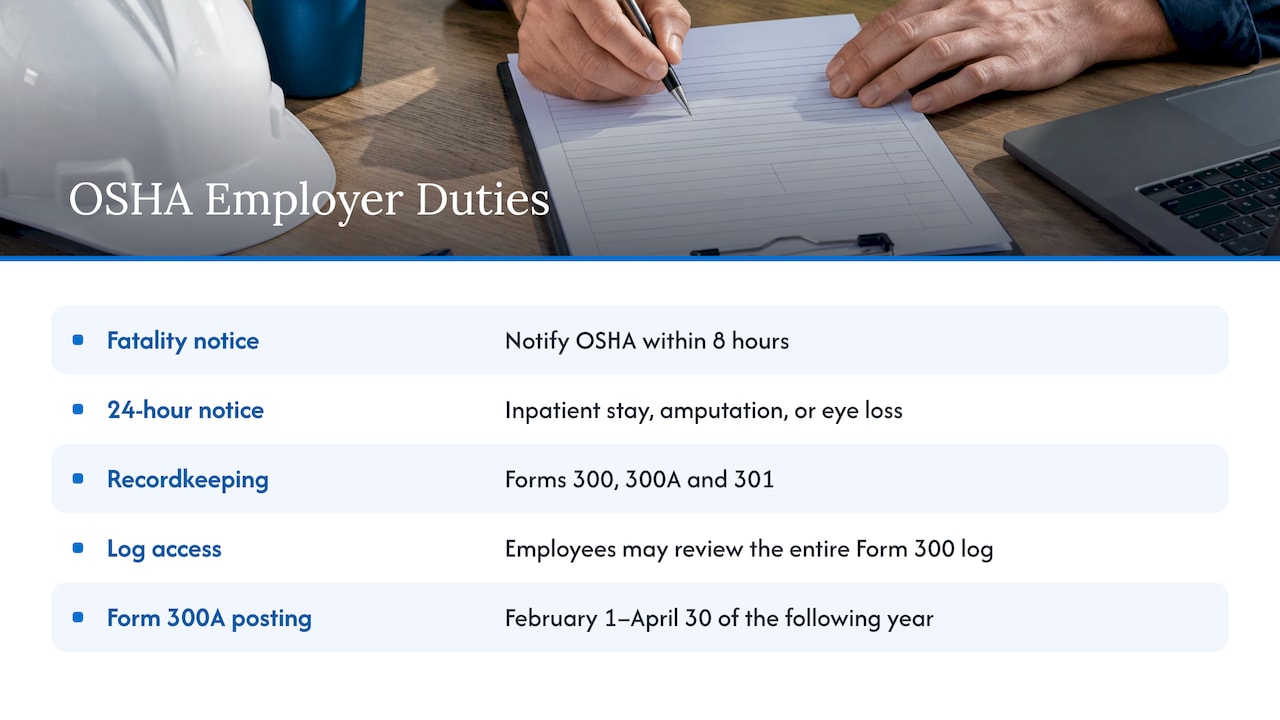
Serious-incident reporting. According to OSHA’s guide, all employers must notify OSHA of a work-related fatality within 8 hours, and of an inpatient hospitalization, amputation or loss of an eye within 24 hours. The Department of Labor’s Employment Law Guide adds that this can be done by phone at 1-800-321-OSHA (6742), through the nearest OSHA area office, or online.
Recordkeeping. Covered employers must record work-related injuries and illnesses on OSHA Forms 300, 300A and 301. Current and former employees and their representatives may request copies. The Department of Labor says employees have the right to review the entire Form 300 log, and employers must post the Form 300A summary from February 1 until April 30 of the following year.
What does that mean for you? If your injury is serious, your employer has its own deadline to call OSHA. If it is not, your employer may still have to log it. In both cases your written report is what makes sure the record exists. You can also ask to see the log to confirm your injury was entered.
Since 2024, certain larger employers in high-hazard industries also submit injury data to OSHA electronically. This does not change what you need to do as an employee.
Protection From Retaliation
Workers sometimes stay quiet because they fear for their jobs. The law is on your side. Section 11© of the OSH Act makes it illegal to retaliate against an employee for reporting a work-related injury or illness, raising a safety concern, filing an OSHA complaint or taking part in an inspection, as OSHA’s retaliation publication explains.
OSHA’s list of prohibited actions is broad. It includes:
- Firing or laying off
- Demoting, or denying overtime or promotion
- Disciplining or reducing pay or hours
- Intimidation or threats
- Reassignment to a less desirable position
- Reporting a worker to police or immigration authorities
- Applying policies that discourage injury reporting, such as certain incentive programs
That last item matters on many job sites. If a safety bonus is lost whenever someone reports an injury, or a manager hints that reports will count against you, it may amount to illegal retaliation.
The 30-Day Window for Retaliation Complaints
If you believe you were punished for reporting, you may file a complaint with OSHA within 30 calendar days of the adverse action. You can call 1-800-321-OSHA (6742), write to your nearest OSHA office, or file online, in any language, and no special form is required, according to OSHA’s worker rights publication. In states with approved state plans, workers must file with both state and federal OSHA offices. If OSHA finds merit and a voluntary settlement is not reached, the Department of Labor may take the case to federal court.
This deadline is short and separate from your workers’ compensation deadlines. Our guide to 30-day deadlines for U.S. whistleblower retaliation laws compares it with other federal protections, and our article on refusing unsafe work explains what to say when a task is dangerous.
If Your Employer Will Not Document the Injury
Some employers ignore a report, delay the paperwork or urge you to say the injury happened off the job. You still have options.
- Get the form yourself. In California, if your employer does not give you the DWC 1, you can get one from an Information & Assistance officer, fill it out and give it to your employer. Most states have an agency office or website that offers the same.
- Know what an employer cannot do. Virginia’s Commission states that an employer cannot prevent you from filing a claim or force you to say the injury did not happen at work.
- Ask who is reporting it. Virginia requires the employer or its insurance carrier to report the injury to the Commission within ten days of learning of it, and the employer should offer a list of at least three medical providers.
- Contact your state agency. Every state has a workers’ compensation office that can tell you how to file independently.
- Consider speaking with an employment attorney. If a claim is denied or you were disciplined for reporting, a lawyer can review the facts. Our site includes an attorney directory for finding employment lawyers.
If you were fired or demoted after reporting, count the days. The 30-day OSHA window may already be running.
Keep Your Own Records
Your employer’s file is not the only one that counts. California’s guide advises injured workers to keep copies of everything, including postmarked envelopes, a log of how the condition affects your work, pay stubs and time sheets from before and after the injury, and records of out-of-pocket costs such as prescriptions and travel to appointments.
A simple folder, paper or digital, should hold:
- Your written report and proof of delivery
- Claim forms and any letters from the insurer
- Medical records and work-status notes
- Photos of the scene or the injury
- Names and contact details of witnesses
- A dated diary of symptoms, missed shifts and conversations with managers
If your employer’s account later differs from yours, this record is what settles it.
Special Situations
Some jobs carry their own risks and rules. Warehouse workers face repetitive-motion and lifting injuries, and construction workers face falls and equipment hazards. Our guides to warehouse worker rights and construction worker safety rights cover what applies on those sites. For a broader view, see our overview of employee rights in the U.S.
If your injury keeps you off work for an extended time, you may also need to understand leave and health coverage. Our pages on FMLA eligibility and COBRA rights explain how those protections can work alongside a workers’ compensation claim.
Free Help When You Need It
Workplace Fairness provides free, plain-language information on employee rights, workplace protections and claims, along with an attorney directory for finding employment lawyers. Our content stays free because readers support it. A Workplace Fairness membership starts at $25 per year and helps us keep these guides current for the next worker who needs them.

If you want to keep exploring your rights, start from our home page and browse by topic.
Our Perspective
Workplace Fairness began in 1994 as the National Employee Rights Institute and took its present name in 2001. Our purpose has stayed the same: link the knowledge of employment rights attorneys with the people who need it, in words anyone can follow.
Injury reporting is where that purpose is tested. A worker in pain, worried about a paycheck, should not also have to decode deadlines or guess whether speaking up is safe. Reporting is a right, and every worker deserves to know it before the moment arrives, not after a deadline has passed.
We believe equitable workplaces are built when employees and employers treat reports as information that makes everyone safer, not as an accusation. Our guides are written to give you the rule, the next step and the confidence to take it. If this page helped you, share it with a coworker.
Max
FAQ
Do I have to report every injury to OSHA?
No. The duty to report serious incidents to OSHA belongs to your employer. Employers must notify OSHA of a work-related fatality within 8 hours and of an inpatient hospitalization, amputation or loss of an eye within 24 hours. Your responsibility is to tell your employer promptly. You may file a complaint with OSHA if your employer retaliates or ignores a hazard.
What if I did not report my injury right away?
Report it now, in writing, and then check your state’s deadline. Some states allow weeks and others months, and late notice is sometimes excused or only counts against you if your employer was harmed by the delay. Minnesota, for instance, uses graduated tiers. Contact your state workers’ compensation agency promptly, because the rules turn on dates.
Can my employer fire me for reporting an injury?
Federal law prohibits retaliation for reporting a work-related injury or illness. If you are fired, demoted, disciplined or threatened, you may file an OSHA complaint within 30 calendar days of the action. Do not wait, and keep records of what was said and when.
Is a verbal report enough?
It may start the process, but a written report is much safer. Include the date, time, place and nature of the injury, keep a copy, and record how and when it was delivered. Written proof prevents disputes about whether and when your employer was told.
Do I need a lawyer to report an injury?
No. You can report and file a claim yourself using your state’s forms. A lawyer becomes worth considering if your claim is denied, your employer disputes that the injury happened at work, or you were punished for reporting.
Sources
- OSHA: Recordable Injuries and Illnesses, What Workers Need to Know
- OSHA: Worker Rights and Protections
- OSHA: Protection From Retaliation for Engaging in Safety and Health Activities
- OSHA: 11© Desk Aid
- OSHA: Derechos de los trabajadores
- U.S. Department of Labor: Employment Law Guide, Occupational Safety and Health
- California DIR: Workers’ Compensation in California, A Guidebook for Injured Workers
- Missouri Department of Labor: Report Your Injury
- Virginia Workers’ Compensation Commission: Injured Workers
- Minnesota DLI: Information sheet, Reporting a work injury
- Utah Labor Commission: Employee’s Guide to Workers’ Compensation
- Michigan LEO: Filing a Claim