A hostile work environment exists under federal law when unwelcome conduct tied to a protected characteristic becomes severe or pervasive enough to create an intimidating, hostile, or abusive workplace. One rude comment usually isn’t enough. A pattern of slurs, threats, or repeated sexual comments often is. If you’re unsure where your situation falls, documentation and timing matter more than you think.
TL;DR:
- Repeated insults, threats, or sexual comments tied to protected characteristics are more likely to qualify as creating a hostile work environment than isolated incidents.
- Employers are liable if harassment by supervisors results in tangible employment actions, but only liable for coworker misconduct if they knew or should have known and failed to act.
- Filing deadlines are strict, typically within a few months for EEOC claims, making early documentation and internal reporting crucial for preserving your rights.
- Physical severity, such as assault or credible threats, can establish a hostile environment even if it occurs only once, regardless of pattern.
- Gathering detailed evidence and preserving digital and physical documentation outside company systems strengthens your case significantly.
Table of Contents
- What Counts as a Hostile Work Environment Under the Law
- Hostile Work Environment Examples: What Qualifies and What Doesn’t
- When Is an Employer Liable for a Hostile Workplace Lawsuit?
- How to Report Workplace Harassment and Meet Filing Deadlines
- Building Your Evidence: A Documentation Checklist
- What a Hostile Work Environment Claim Can Actually Win You
- Retaliation: A Separate Violation With Its Own Protections
- State Rules Vary, So Check Local Deadlines
- Why Trust This Guide
- An Advocate’s Closing Note
- Get Help Filing Your Hostile Work Environment Claim
- Sources
What Counts as a Hostile Work Environment Under the Law
Federal law doesn’t protect employees from every unpleasant boss or awkward coworker. It protects them from conduct tied to a specific set of characteristics: race, color, religion, sex, national origin under Title VII of the Civil Rights Act of 1964, disability under the Americans with Disabilities Act (ADA), age 40 and older under the Age Discrimination in Employment Act (ADEA), and genetic information under the Genetic Information Nondiscrimination Act (GINA). Harassment untethered to one of these categories, however miserable it makes your workday, generally falls outside federal protection.
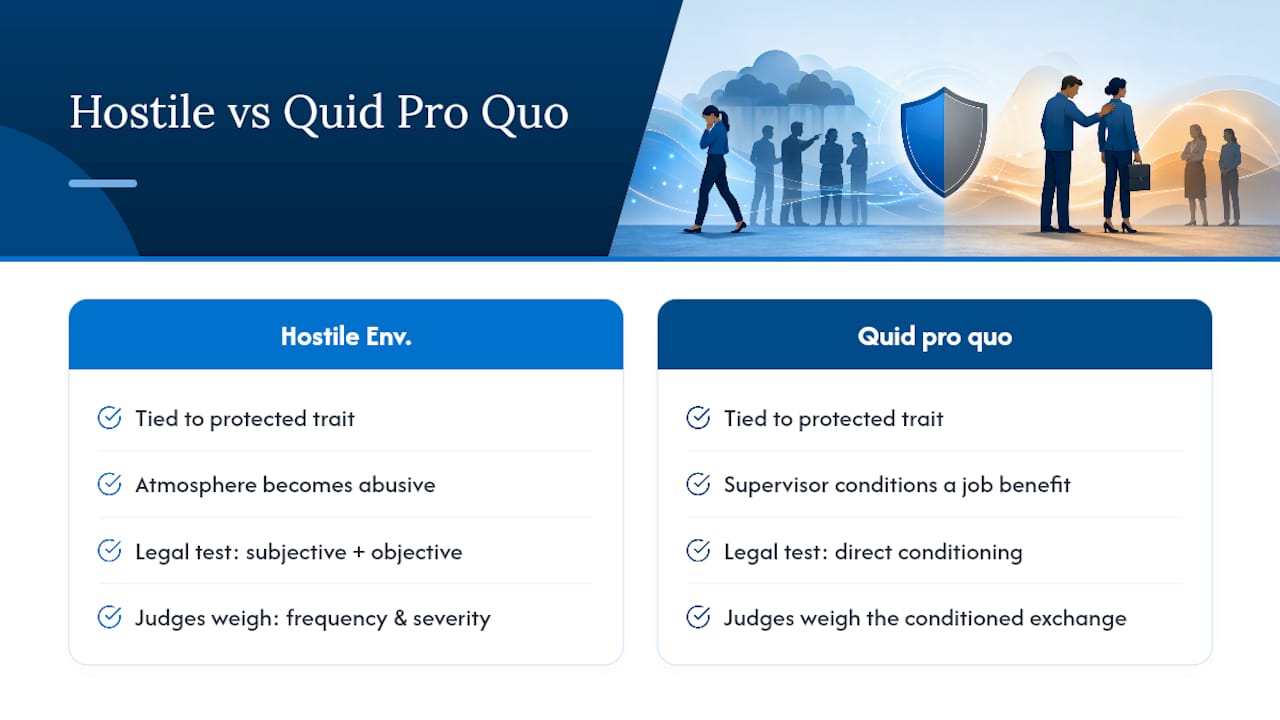
The legal test itself has two parts. First, subjective: did the conduct actually feel hostile or abusive to you? Second, objective: would a reasonable person in your position see it the same way? Both have to be true. Courts won’t credit a claim based purely on personal sensitivity, and they won’t dismiss one just because a supervisor claims “everyone laughed.”
There’s no checklist that spells out “severe or pervasive.” The Supreme Court addressed this directly in Meritor Savings Bank v. Vinson, holding that harassment altering the conditions of employment can violate Title VII even without a diagnosable psychological injury. Judges weigh frequency, severity, whether it involved physical threats, and how much it interfered with your ability to do your job.
This is where hostile work environment claims diverge sharply from quid pro quo harassment. Quid pro quo involves a direct trade: a supervisor conditions a job benefit, a raise, a promotion, avoiding termination, on submission to unwelcome sexual advances. A hostile environment doesn’t require any such exchange. It’s about the atmosphere itself becoming abusive, which is why understanding the difference between the two matters before you decide how to frame a complaint.
Hostile Work Environment Examples: What Qualifies and What Doesn’t
Patterns matter more than any single incident, with one major exception you’ll see below.
Conduct that typically qualifies when tied to a protected characteristic:
- Repeated slurs, racial jokes, or derogatory comments about religion, gender, or national origin
- Persistent unwanted sexual comments, propositions, or innuendo
- Display of offensive images, cartoons, or materials targeting a protected group
- Explicit threats of violence or retaliation
- Sabotage of someone’s work product tied to bias, such as deliberately withholding information they need to succeed
- Unwanted physical touching or groping
Conduct that usually does not rise to a legal violation:
- A single off-color joke or awkward comment, especially if immediately corrected
- General rudeness, micromanagement, or a boss who’s simply difficult
- Personality conflicts that have nothing to do with a protected trait
- Isolated criticism of your performance, even if delivered harshly
The exception to the “pattern” rule is physical severity. A single incident, such as a physical assault or a credible threat of violence, can be severe enough on its own to satisfy the legal standard, even without repetition. The EEOC has been explicit that petty slights and isolated annoyances don’t clear the bar. Context and repetition usually decide these cases, but severity alone can too.
When Is an Employer Liable for a Hostile Workplace Lawsuit?
Who did the harassing makes everything about your case.
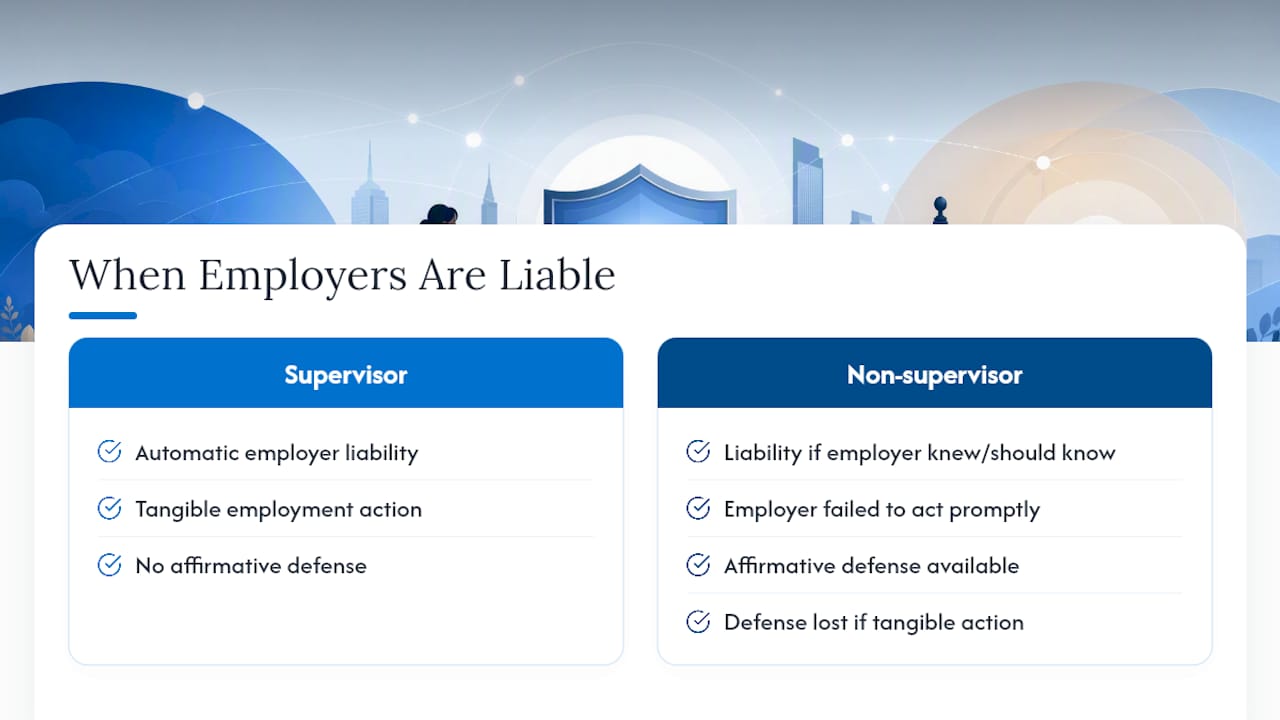
If a supervisor’s harassment results in a tangible employment action, termination, demotion, a pay cut, or an undesirable reassignment, the employer is automatically liable. There’s no wiggle room here. The law treats a supervisor’s authority as an extension of the company itself.
Harassment from coworkers, clients, or a supervisor that doesn’t lead to a tangible action works differently. The EEOC’s guidance holds employers liable only if they knew or should have known about the conduct and failed to take prompt, appropriate corrective action. That “should have known” language is doing a lot of work. A company that gets multiple complaints and shrugs won’t survive scrutiny.
This is also where the affirmative defense comes in. An employer can avoid liability for non-supervisor harassment by showing it reasonably tried to prevent and correct the conduct (through a real anti-harassment policy and complaint process) and that the employee unreasonably failed to use those channels. Notably, this defense disappears entirely once a tangible employment action occurs. For whistleblowers, the practical lesson is blunt: using the internal complaint process, even one you don’t fully trust, often strengthens your legal position rather than weakening it.
How to Report Workplace Harassment and Meet Filing Deadlines
Start internally when it’s safe to do so. Tell your supervisor, HR, or whoever your employee handbook designates, and put it in writing. A dated email creates a record that a hallway conversation never will.
If internal reporting doesn’t resolve things, or if you’d rather skip straight to an external agency, you can file a charge with the EEOC. Many states also maintain their own civil rights agencies, and dual filing often lets one charge satisfy both federal and state requirements simultaneously.
Timing is unforgiving. The federal deadline to file an EEOC charge is usually within a few months from the incident, with some states allowing a longer filing period through their own anti-discrimination agencies. Miss it, and you may lose your right to sue entirely, regardless of how strong your case is. Check your state’s exact rule rather than assuming the extended deadline applies to you.
After filing, expect one of several paths: mediation, a formal investigation, a dismissal, or eventually a right-to-sue letter that clears you to take the matter to federal court.
Building Your Evidence: A Documentation Checklist
Cases built on memory alone rarely hold up. Cases built on dates, screenshots, and names usually do.
- Log every incident with the date, time, location, exact words or actions used, and who else was present.
- Save digital evidence immediately, including emails, texts, Slack messages, and screenshots before anything can be deleted.
- Keep physical copies of offensive images, notes, or documents when possible.
- Preserve your own performance reviews to counter any retaliatory claim that you were a poor performer.
- Write contemporaneous notes the same day an incident happens; a note written six months later carries far less weight.
- Identify potential witnesses early and note what they saw, without pressuring them to file anything on your behalf.
Documentation practices like these, saving communications and building detailed incident logs, consistently strengthen a claim when it reaches an investigator or an attorney.
Pro Tip: Store your documentation somewhere outside company systems, like a personal email or cloud drive. If you’re terminated, you could lose access to your work computer and everything on it within hours.
What a Hostile Work Environment Claim Can Actually Win You
A charge that resolves through EEOC conciliation can produce back pay, reinstatement, policy changes, or a negotiated settlement without ever reaching a courtroom. If conciliation fails and you receive a right-to-sue letter, a federal lawsuit opens the door to compensatory damages for emotional distress, punitive damages in cases of malice or reckless indifference, and injunctive relief forcing the employer to change its practices.
Timelines vary widely. An EEOC investigation can take anywhere from several months to over a year depending on caseload and complexity, and a lawsuit that follows can add another year or more before resolution. Settlement is common at multiple stages along the way.
If your situation involves a tangible job loss, repeated incidents, or resistance from HR, it’s worth consulting an employment lawyer early rather than after your deadline has nearly expired. Bring your incident log, any written complaints you filed, your employee handbook, and copies of relevant emails to your first consultation. A lawyer can tell you within one meeting whether your documentation supports the legal standard or needs more before you file.
Retaliation: A Separate Violation With Its Own Protections
Retaliation is its own legal claim, independent of whether your original harassment complaint succeeds. It includes demotion, termination, sudden exclusion from meetings or projects, a poor performance review that appears out of nowhere, or any adverse change to your duties following a complaint.
Here’s the part many employees don’t realize: even if your hostile work environment claim doesn’t meet the legal bar, retaliation for reporting it in good faith can still be illegal on its own. That protection exists precisely because the law wants people to come forward without fear.
Document retaliation the same way you document harassment: dates, specifics, witnesses, and saved communications. If your industry involves safety violations alongside harassment, additional whistleblower protections through OSHA or other agencies may apply, so it’s worth checking whether your situation triggers more than one avenue of protection.
State Rules Vary, So Check Local Deadlines
Federal law sets a floor, not a ceiling. Many states run their own civil rights or labor agencies with separate filing deadlines, broader protected categories, or different damage caps than federal law allows.
Some states extend filing windows well beyond the federal 300 day maximum; others align closely with EEOC timing. The safest approach is checking your state’s labor or civil rights agency website directly, or asking an employment attorney familiar with your jurisdiction. If you’re uncertain whether your deadline is approaching, treat it as urgent. Filing early and amending later beats missing a window that can’t be reopened.
Why Trust This Guide
Workplace Fairness has worked to protect employee rights since 1994, when it was founded as the National Employee Rights Institute. This guide draws directly on EEOC harassment guidance, Department of Labor standards, and Supreme Court precedent in Meritor, cross-checked against each source’s own language rather than secondhand summaries. Federal law forms the backbone here, but state rules vary, so verify local specifics before you file.
An Advocate’s Closing Note
If there’s one thing worth repeating, it’s this: document before you decide what to do. Too many employees wait until they’re certain their case is strong enough, and by then, memories have faded and emails have been deleted. Talk to an employment lawyer early, even if you’re not ready to file. Workplace Fairness built its resources for exactly this moment, when you’re not sure what you’re dealing with but know something is wrong. The protections exist. Use them.
— Max
Get Help Filing Your Hostile Work Environment Claim
Workplace Fairness gives you what a law firm’s intake call often can’t: free, plain-language answers before you ever pay for legal advice. You don’t need to guess whether your situation qualifies or hunt through statute text to find your filing deadline. Our guides break down the exact steps, from your first internal complaint to a federal lawsuit, in the order you’ll actually need them.

Start with our complete guide to employee rights, which walks through documentation, deadlines, and how to find the right attorney for your specific claim. If you’re closer to filing, our EEOC charge filing guide lays out the deadlines and steps in order, so you’re not calculating your 180 day or 300 day window on your own. Read through the guide that matches where you are right now, then take the next step with a clearer picture of what your case needs.
This article is general information, not a substitute for advice from a qualified lawyer. Consult a qualified legal professional about your own circumstances before acting on anything here.
Sources
- Harassment | U.S. Equal Employment Opportunity Commission
- Meritor Savings Bank v. Vinson — U.S. Supreme Court opinion (excerpt) via LII / Cornell Law
- Harassment | U.S. Department of Labor
- What Is a Hostile Work Environment: Signs & Examples | Dovetail