
Exempt employees are not entitled to overtime pay under federal law; nonexempt employees are. That single distinction rests on three tests: how someone is paid, how much they’re paid, and what they actually do at work. Get any one of those tests wrong, and the classification can unravel, along with the paycheck that depends on it.
TL;DR:
- Misclassification risks increase if any of the three tests—salary basis, salary level, or duties—are not properly met, risking overtime violations and penalties.
- Federal law sets a $684 weekly salary threshold for exempt status, but actual exemption depends more on the employee’s primary duties fitting specific categories.
- Job titles alone do not determine exemption status, and employees performing routine tasks or with job descriptions misaligned with their duties are often wrongly classified.
- Employers must continuously verify their employees’ duties and pay structures through documentation, as duties can evolve and lead to liability if overlooked.
- State laws may impose higher thresholds or stricter duties tests, requiring employers to track and comply with the most protective standards to avoid legal exposure.
Table of Contents
- Exempt vs Nonexempt: The Core Definitions and the Overtime Rule
- The Three Tests for White-Collar Exemptions
- Exemption Categories: Quick Criteria and Real Examples
- How to Determine Classification: A Step-by-Step Checklist
- State Law, Recordkeeping, and Overtime Math
- What Happens When Employers Get It Wrong
- Where Workplace Fairness Fits Into This Conversation
- The Duties Test Deserves More Attention Than the Salary Number
- Free Guides That Help You Act on This
- Sources
Exempt vs Nonexempt: The Core Definitions and the Overtime Rule
Nonexempt employees are protected by the Fair Labor Standards Act’s minimum wage and overtime rules, which means they must earn at least minimum wage and receive 1.5 times their regular rate for every hour worked past 40 in a single workweek. Exempt employees fall outside those protections because their job meets a specific legal standard, not because of a title on a business card or the fact that they receive a salary.
That last point trips up more employers than any other. Being salaried does not make someone exempt. A salaried customer service rep who spends the week answering phones is very likely still owed overtime.
Some quick, real-world examples:
- Commonly nonexempt: retail associates, customer service reps, most hourly warehouse and production workers.
- Commonly exempt: operations managers who supervise staff and set schedules, HR directors who exercise independent judgment, licensed accountants performing professional-level work.
- Almost always nonexempt regardless of pay: police officers, firefighters, paramedics, and other first responders, along with most blue-collar tradespeople, per DOL guidance.
The Three Tests for White-Collar Exemptions
An employer can’t pick and choose which test to apply. To classify someone as exempt under the standard white-collar categories, all three must be satisfied at once, and failing even one generally means the worker is nonexempt.
- Salary basis. The employee receives a fixed, predetermined amount of pay each period, regardless of hours worked or quality of output. Employers generally can’t dock this pay for partial-day absences or minor rule violations, though the DOL’s compliance guide allows certain nondiscretionary bonuses and incentive payments to count toward salary.
- Salary level. Federal law sets a minimum salary threshold per week, which applies nationwide unless a state sets a higher bar, according to the DOL. Highly compensated employees fall under a separate, higher total-compensation threshold, and employers may credit nondiscretionary bonuses and commissions for up to 10% of that salary requirement.
- Duties test. The employee’s “primary duty,” meaning the principal or most important part of the job, must match one of the exempt categories: executive, administrative, professional, computer, or outside sales.
A number worth memorizing: $684 a week is the federal salary line separating exempt from nonexempt for most white-collar roles, and it applies nationwide unless a state sets a higher bar, according to the DOL.
Miss the salary basis, fall short on salary level, or perform duties that don’t fit an exempt category, and the analysis stops there. The employee is nonexempt.
Exemption Categories: Quick Criteria and Real Examples
Each white-collar category has its own duties test, and the details matter more than most job descriptions let on.
- Executive: Primary duty is managing the business or a department, regularly directing at least two full-time employees, with real input into hiring and firing decisions.
- Administrative: Office or non-manual work directly related to business operations, involving independent judgment on significant matters, such as HR policy or financial analysis.
- Professional: Learned professionals (attorneys, registered nurses, licensed accountants) need advanced knowledge in a specialized field. Creative professionals (writers, designers) need invention, imagination, or talent in a recognized artistic field.
- Computer employees: Systems analysts, programmers, and software engineers performing specific technical duties qualify, either under the standard salary test or an alternate hourly rate of at least $27.63.
- Outside sales: Primary duty is making sales away from the employer’s place of business. There’s no federal salary threshold here at all, a detail that surprises a lot of employers who assume every exemption requires a minimum salary.
- Highly compensated employees (HCE): A much higher total-compensation threshold applies, but the duties requirement loosens. The employee only needs to perform one exempt duty regularly, not all of them.
Pro Tip: If a field sales rep spends most of the week in the office processing orders rather than meeting clients, the outside sales exemption likely doesn’t apply anymore. Location and primary duty drive this one, not the paycheck.
How to Determine Classification: A Step-by-Step Checklist
Classification isn’t a one-time guess. It’s a documented process, and the paper trail matters as much as the conclusion.
- Pull the job description and compare it to actual daily tasks. Titles carry no legal weight; actual duties do.
- Confirm the salary basis. Is pay fixed and predetermined, or does it fluctuate with hours or performance?
- Check the salary level against federal and state thresholds. Some states set the bar higher than the federal $684 per week.
- Map the primary duty against the specific exemption category. Time spent on a task is a guide, not the sole factor.
- Document the reasoning. Keep org charts, payroll records, and a written rationale explaining why the classification was made.
| Red flag | What it usually means |
|---|---|
| Salaried employee performs mostly routine, non-discretionary tasks | Likely nonexempt despite salary |
| Job title says “manager” but employee rarely supervises anyone | Executive exemption probably doesn’t apply |
| Pay gets docked for partial-day absences | Salary basis may be broken |
| Outside sales rep works mostly from a desk | Exemption likely doesn’t apply |
When the answer isn’t clear, or when a worker suspects they’ve been misclassified, a state labor agency, the Department of Labor, or an employment attorney can review the specifics. Workplacefairness’s overtime rights guide walks through the same checklist in plainer terms for workers trying to figure out where they stand.
State Law, Recordkeeping, and Overtime Math
Federal law sets a floor, not a ceiling. When state law is more protective, whether through a higher salary threshold or a stricter duties test, the state standard controls for employees working there.
Employers must keep accurate time and pay records for every nonexempt employee, and while recordkeeping requirements are lighter for exempt staff, basic identity and payment records are still required under the FLSA.
- Track actual hours worked, not just scheduled shifts.
- Calculate the “regular rate” correctly. It includes most bonuses and incentive pay, not just base wages.
- Multiply that regular rate by 1.5 for every hour over 40 in the workweek.
- Consider low-cost timekeeping software over honor-system logs. Digital time clocks create the audit trail that protects both sides in a dispute.
What Happens When Employers Get It Wrong
Misclassification isn’t a paperwork slip. It’s a wage violation with real financial exposure, and employers who treat it casually tend to regret it.
- Workers wrongly classified as exempt can recover back overtime pay for hours worked over 40.
- Courts frequently add liquidated damages, often doubling the amount owed, plus attorney’s fees.
- The statute of limitations for wage violation claims is generally measured in a few years, with a longer period possible for willful violations.
- Employers commonly rely on job titles or salaried status alone as a defense, which the DOL and courts routinely reject once actual duties are examined.
- Union contracts and collective bargaining agreements can add their own overtime rules on top of the FLSA floor.
Workers who suspect misclassification should document hours worked, raise the issue internally first, and escalate to a state agency, the DOL, or an attorney if nothing changes. Workplacefairness’s overtime pay claim guide breaks down that escalation path in more detail.
Where Workplace Fairness Fits Into This Conversation
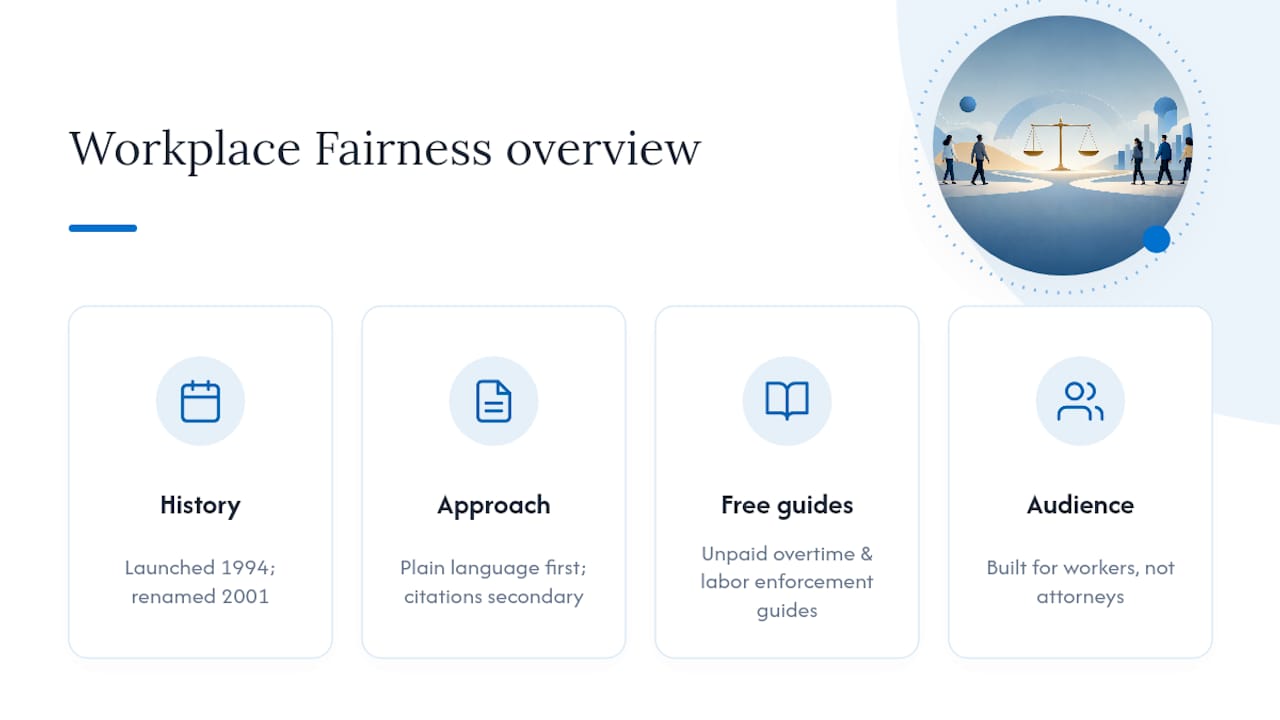
Workplace Fairness has worked on employee rights since 1994, when it launched as the National Employee Rights Institute before taking its current name in 2001. That history shapes how we approach classification questions: plain language first, legal citations second, and always with an eye toward what a worker can actually do with the information.
Beyond this explainer, Workplacefairness maintains free guides on unpaid overtime claims and how labor standards enforcement works at the state and federal level. Neither guide requires a fee or a login. Both were built for readers trying to figure out their own situation, not attorneys already fluent in the regulations.
The Duties Test Deserves More Attention Than the Salary Number
Most people fixate on the $684 weekly threshold because it’s a clean, memorable figure. That’s a mistake. The duties test is where nearly every real misclassification dispute actually gets decided, and it’s the test employers skip most often.

Here’s what the conventional advice gets wrong: it treats classification as a payroll decision made once, at hiring, and forgotten. Duties change. A marketing coordinator hired for strategic planning can drift into data entry within a year, and nobody revisits the exemption. That drift is where liability quietly builds.
If you’re an employer, the priority isn’t checking whether salaries clear $684 a week. It’s auditing what people actually do, quarterly if possible, and keeping the paperwork that shows your reasoning. If you’re a worker, the priority is tracking your own hours and tasks regardless of what your pay stub says. Salaried status feels like a settled question. Legally, it rarely is.
— Max
Free Guides That Help You Act on This
Workplacefairness built Employee Rights Explained: Your 2026 U.S. Legal Guide as the starting point for readers who need more than a definition, they need a plan.

Unlike a law firm consultation with a bill attached, this guide is free and written for people without a legal background. It walks through wage protections, discrimination basics, and what to do when something feels off at work, all without jargon or a paywall. Pair it with the unpaid overtime guide if your concern is specifically about hours and pay rather than classification alone. Whether you’re an employee trying to figure out if you’re owed back pay or an employer trying to get ahead of a compliance gap, start with the Employee Rights Explained guide and use it to map your next move before you talk to anyone else.
This article is general information, not a substitute for advice from a qualified lawyer. Consult a qualified legal professional about your own circumstances before acting on anything here.
Sources
- Fact Sheet #17A: Exemption for Executive, Administrative, Professional, Computer & Outside Sales Employees Under the Fair Labor Standards Act (FLSA)
- nonexempt employee | Wex | US Law | LII / Legal Information Institute