A firing is wrongful only when it violates a law, a contract, or public policy. Most U.S. jobs are at-will, so that is the first thing to check against the exceptions below. If your termination may have broken one of those protections, preserve your records now: dates, messages, and the stated reason for your firing matter from day one, and filing deadlines can be as short as 30 days.
TL;DR:
- EEOC discrimination charges have 180 days, or 300 where a state or local agency enforces a similar law; right to sue notices allow 90 days.
- OSHA whistleblower deadlines range from 30 to 180 days, while NLRB charges generally have six months, so identify the legal route promptly.
- Save a dated timeline, termination messages, performance reviews, and witness statements; internal HR complaints do not pause EEOC or OSHA filing clocks.
- Proven claims may bring reinstatement, back pay, front pay, or damages, but available relief depends on the statute, evidence, and employer size.
Table of Contents
- What Wrongful Termination Means Under At-Will, Contract, and Public-Policy Rules
- Common Unlawful Reasons Employers Fire Workers and the Laws That Protect You
- Deadlines and Where to File: EEOC, OSHA, NLRB, and State Agencies
- What to Do Right Now: Evidence Checklist After Termination
- Remedies and Likely Outcomes: What You Can Recover
- When to Consult an Employment Lawyer and What to Expect
- Workplace Fairness Resources You Can Use Right Now
- A Practical Word on Moving Forward After a Firing
- Get Support and Next Steps Through Workplace Fairness
- FAQ
- Sources
What Wrongful Termination Means Under At-Will, Contract, and Public-Policy Rules
At-will employment is the default relationship for the overwhelming majority of U.S. workers. It means an employer can end your job for almost any reason, or no reason, without warning, as long as the reason is not illegal. Montana is the one state that departs from this rule, requiring good cause for dismissal once an employee completes a probationary period, according to Usa. Everywhere else, “at-will” is the starting point, and your task is to show that your case falls into a recognized exception.
The first exception is contractual. When an employer gives you a written contract, an offer letter with specific terms, or a union agreement that spells out when and how termination can happen, that document can override the at-will default. Some employee handbooks also create implied promises, though many employers write explicit disclaimers to prevent that outcome. If your firing broke a specific written commitment, you may have a breach-of-contract claim separate from any statutory one.
The second exception covers public policy and statutory protections. Federal and state laws carve out categories of firing that are illegal regardless of at-will status, including terminations based on:
- A protected trait such as race, sex, age, disability, national origin, or genetic information.
- Retaliation for reporting discrimination, filing a safety complaint, or taking legally protected leave.
- Refusal to commit an illegal act at an employer’s direction.
- Exercising a civic duty, such as serving on a jury or voting.
- Reporting a safety violation or participating in a government investigation.
Our at-will employment guide walks through how these exceptions interact with state law, since the practical effect of at-will status varies depending on which exception applies to your facts. Identifying the right legal basis early shapes everything that follows, from which agency you contact to how long you have to act.
Common Unlawful Reasons Employers Fire Workers and the Laws That Protect You
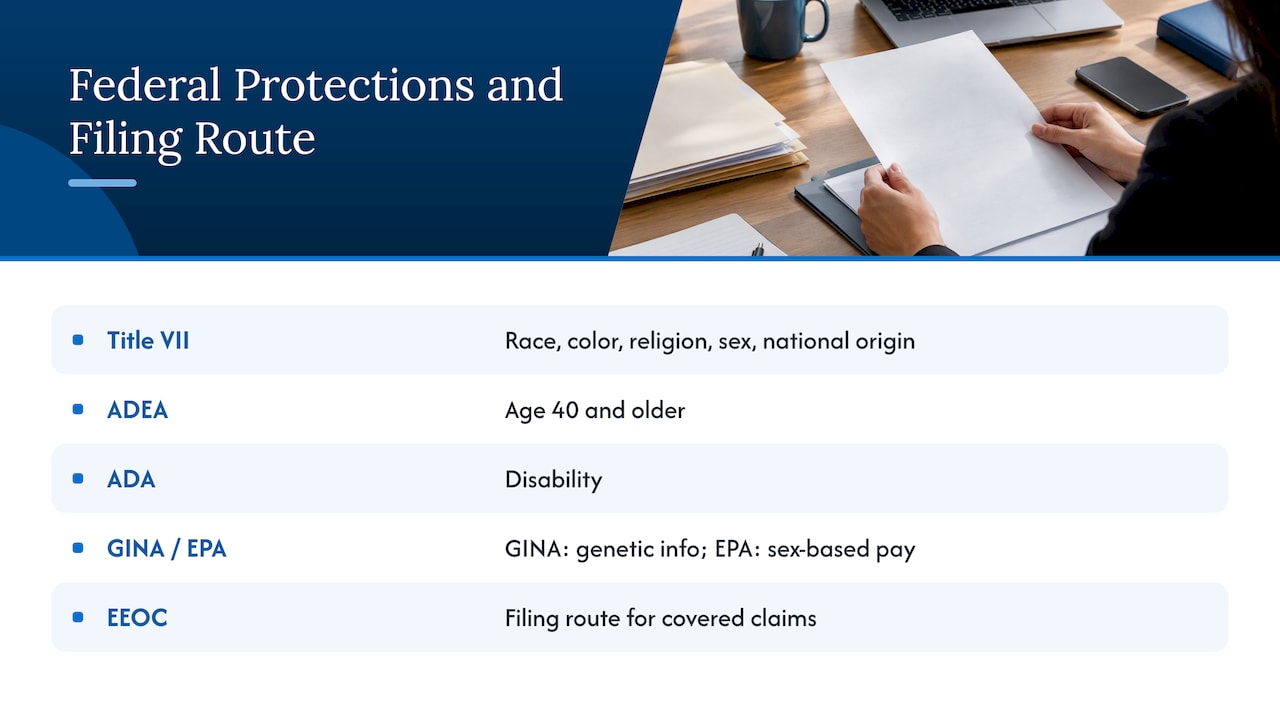
Several federal statutes define the specific firing reasons that cross the line from at-will into illegal. Discrimination based on race, color, religion, sex, or national origin is barred by Title VII of the Civil Rights Act. Age discrimination against workers 40 and older falls under the ADEA. Disability-based firing is covered by the ADA, genetic information by GINA, and pay discrimination tied to sex by the Equal Pay Act. These laws apply to covered employers and give workers a path to file with the EEOC when they believe one of these factors drove their termination.
Retaliation claims cover a different but equally broad category. Firing someone for filing an EEOC charge, taking FMLA leave, or raising a safety concern can violate the law even when the underlying complaint is never proven. The EEOC’s own guidance states that retaliation protections apply independently of whether the original discrimination claim succeeds, and employers cannot punish a worker simply for participating in the process, according to EEOC enforcement guidance.
Numerous federal whistleblower statutes are enforced through OSHA’s Whistleblower Protection Program, covering workers who report safety violations, environmental hazards, or other regulatory concerns. Separately, the National Labor Relations Act protects what is known as protected concerted activity: employees discussing wages, circulating a petition, or refusing unsafe work together, and in some cases a single worker acting with co-workers’ authority, according to the NLRB. Our protected concerted activity guide covers examples beyond union settings, since this protection is not limited to organized labor.
Beyond these statutes, public-policy claims can apply when a firing follows jury duty, voting, or refusing an employer’s instruction to break the law.
Deadlines and Where to File: EEOC, OSHA, NLRB, and State Agencies
Filing windows differ sharply by agency and legal theory, and missing one can end a claim before it starts. Calculate your deadline from the date of the adverse action, not from when you finished any internal complaint process.
- EEOC discrimination charges must generally be filed within 180 days of the firing, extended to 300 days where a state or local fair employment agency enforces a similar law, according to the EEOC.
- After an EEOC Notice of Right to Sue, you have 90 days to file a federal lawsuit, a deadline that starts running the moment the notice is issued.
- OSHA whistleblower complaints range from 30 to 180 days depending on the specific statute involved, with the OSH Act’s Section 11© carrying the shortest window at 30 days, according to OSHA.
- NLRB unfair labor practice charges follow their own six-month filing period under the National Labor Relations Act, separate from both EEOC and OSHA timelines, according to the NLRB.
State fair employment agencies often run parallel processes with their own deadlines and sometimes broader protections than federal law. Checking your state agency alongside the federal one can preserve rights that might otherwise lapse.
- File through the EEOC’s public portal for discrimination charges.
- Submit OSHA whistleblower complaints through the agency’s whistleblower complaint process.
- File unfair labor practice charges with your regional NLRB office using the agency’s charge-filing guidance.
Our EEOC charge filing guide breaks down the paperwork step by step for readers preparing a 2026 filing.
What to Do Right Now: Evidence Checklist After Termination
Acting in the days immediately after a firing protects your options later, whether you pursue an internal complaint, an agency filing, or both.
- Write down a timeline while memory is fresh: dates, who was present, what was said, and the reason given for termination.
- Save every relevant communication, including emails, text messages, Slack or Teams threads, and any written policy the employer cited.
- Collect your performance reviews, especially any that contradict the stated reason for firing.
- File an internal HR complaint if your workplace has one, but do not wait for its outcome before checking your external filing deadline, since internal grievance timelines do not pause EEOC or OSHA clocks, according to the EEOC.
- Ask former coworkers who witnessed relevant events whether they are willing to provide a written statement.
- Note any pattern of retaliation, such as a sudden change in treatment after you raised a complaint or used protected leave.
Pro Tip: File your EEOC or OSHA complaint as soon as you know the deadline is approaching, even if your internal HR investigation is still open; you can pursue both tracks at once.
Our EEOC charge filing guide includes the specific information each agency intake form requires, so you can prepare documentation before you sit down to file.
Remedies and Likely Outcomes: What You Can Recover
Workers who prove a wrongful termination claim can recover several forms of relief, depending on the statute involved and the strength of the evidence.
- Reinstatement to your former position, when that remains a practical option.
- Back pay covering wages lost between termination and resolution.
- Front pay when reinstatement is not feasible, covering expected future lost wages.
- Compensatory and punitive damages, available under some statutes and capped by employer size under federal discrimination law.
- Injunctive relief, such as a court order requiring policy changes.
OSHA’s whistleblower program alone can award reinstatement, back pay with interest, and compensation for expenses, with punitive damages possible in some cases, according to OSHA’s whistleblower guidance. Public-sector claims often follow different procedural rules than private-employer claims, including separate notice requirements. Most cases resolve through settlement rather than trial, and the size of a recovery usually tracks the strength of the documentary evidence, the employer’s size, and which statute applies. Settlement tends to resolve faster than litigation, though it typically trades a lower certain amount for the unpredictability and longer timeline of a courtroom outcome.
When to Consult an Employment Lawyer and What to Expect
Some situations call for legal counsel beyond what an agency filing alone can resolve. Consider reaching out to an employment attorney when your case involves significant lost wages, complex facts that touch multiple legal theories, an urgent need for injunctive relief, or claims that cross state lines.
Employment lawyers typically evaluate a claim’s strength before taking it on, weighing the documentary evidence against the applicable statute and deadline. Fee arrangements vary:
- Contingency fees, where the attorney takes a percentage of any recovery and you pay little or nothing upfront.
- Hourly billing, more common for complex contract disputes.
- Hybrid arrangements that combine a reduced hourly rate with a smaller contingency share.
Before a first consultation, bring your timeline, saved communications, performance reviews, and any termination paperwork. Ask how the attorney evaluates the strength of your evidence, what deadlines apply to your specific claim, and what outcomes are realistic given your facts.
Workplace Fairness Resources You Can Use Right Now
We built Workplace Fairness in 1994, originally as the National Employee Rights Institute, to give workers plain-language information about the rights the law already gives them. These resources are ready when you need them:
- Our at-will employment guide for understanding your baseline protections.
- Our EEOC charge filing guide for step-by-step filing instructions.
- Our employee rights explainer for broader context on your protections.
A Practical Word on Moving Forward After a Firing
Document everything first, then move fast. Internal complaints have their place, but they should run alongside an agency filing, never instead of one, since statutory clocks do not wait for HR to finish an investigation. When your facts are complicated or the stakes are high, bring in an employment lawyer who can tell you, specifically, what your evidence supports.
— Max
Get Support and Next Steps Through Workplace Fairness
We know that reading about deadlines and legal theories is only the first step. Our membership gives you ongoing access to plain-language guides, practical checklists, and referral paths as you figure out your next move.
- Review our EEOC charge filing guide before you submit anything to the agency.
- Explore membership for continued access to our resources as your situation develops.
This article is general information, not a substitute for advice from a qualified lawyer. Consult a qualified legal professional about your own circumstances before acting on anything here.
FAQ
How hard is it to sue for wrongful termination?
Difficulty depends on your evidence and which legal theory applies: discrimination and retaliation claims usually require documentation connecting the firing to a protected activity or trait. Claims backed by written communications, a clear timeline, and witness statements are generally stronger than those relying on memory alone.
What are some examples of wrongful termination?
Examples include firing someone for their race, sex, age, or disability, retaliating against an employee for filing an EEOC charge or using FMLA leave, and terminating a worker for refusing to break the law or for serving on jury duty. Breach of a written employment contract can also support a wrongful termination claim.
How much money can you get if you were wrongfully terminated?
Recoverable amounts vary widely based on lost wages, the statute involved, and employer size, and can include back pay, front pay, and in some cases compensatory or punitive damages. OSHA’s whistleblower program, for example, can award reinstatement and back pay with interest when a claim is proven, according to OSHA.
Can HR overturn a termination?
HR can sometimes reverse a termination decision internally, but pursuing an internal complaint does not pause the statutory deadlines for filing with agencies like the EEOC or OSHA. Preparing an external filing while an internal review is underway protects your rights if HR does not resolve things in your favor.
Sources
- Usa
- Timeliness | U.S. Equal Employment Opportunity Commission
- Questions and Answers: Enforcement Guidance on Retaliation and Related Issues | EEOC
- Whistleblower Protection Program | OSHA
- Concerted activity | National Labor Relations Board