
For most consumer debts, such as credit cards, medical bills and personal loans, federal law lets a creditor with a court judgment take no more than the lesser of two amounts: 25% of your weekly disposable earnings, or the amount by which those earnings exceed 30 times the federal minimum wage. At $7.25 an hour, that second figure is $217.50 a week. Child support, back taxes and defaulted federal student loans follow different rules, and your state may protect more of your pay than federal law does. This guide walks through each limit, shows the math with real numbers, and explains what to do when a garnishment takes more than it should.
TL;DR
- Ordinary debts: a garnishment cannot exceed the lesser of 25% of your disposable earnings or the amount above $217.50 a week, and this cap holds no matter how many garnishment orders you have.
- Disposable earnings are what is left after legally required deductions such as taxes, not after health insurance, union dues or retirement contributions.
- Child support can reach 50% to 65% of disposable pay, defaulted federal student loans up to 15%, and tax levies follow IRS exemption tables instead of a percentage.
- If state law protects more of your pay than federal law, the lower garnishment amount applies.
- Garnishment ordinarily requires a court judgment first, so respond to any lawsuit papers you receive.
Table of Contents
- What the federal limit actually says
- How disposable earnings are calculated
- Worked examples at weekly pay
- Different debts, different limits
- When state law is stricter
- Does a garnishment end after seven years?
- What to do if you are being garnished
- Perspective: why these limits matter at work
- Get the full picture of your pay rights
- FAQ
- Sources
What the federal limit actually says
The cap comes from Title III of the Consumer Credit Protection Act (CCPA), enforced by the U.S. Department of Labor’s Wage and Hour Division. According to the Department’s Fact Sheet #30, the limit on an ordinary garnishment is the lesser of:
- 25% of your disposable earnings for the week, or
- the amount by which your disposable earnings for the week exceed 30 times the federal minimum wage.
Because the federal minimum wage is $7.25 an hour, 30 times that is $217.50. Whichever calculation leaves you with more money is the one that applies. The cap also applies to the total, not to each order. Two creditors cannot each take 25%.
This matters for a question workers raise often: someone sees one garnishment at 25% and a second one starting, and wonders whether the total can climb. For ordinary consumer debts it cannot exceed the federal cap, though different kinds of orders, such as support or student loans, are governed by their own limits, covered below.
The purpose is simple. As the Consumer Financial Protection Bureau explains, federal and state laws set limits and exemptions so that people keep something to live on.
How disposable earnings are calculated
Everything depends on this number, and it is smaller than most people expect to see on a paystub, yet larger than many fear.
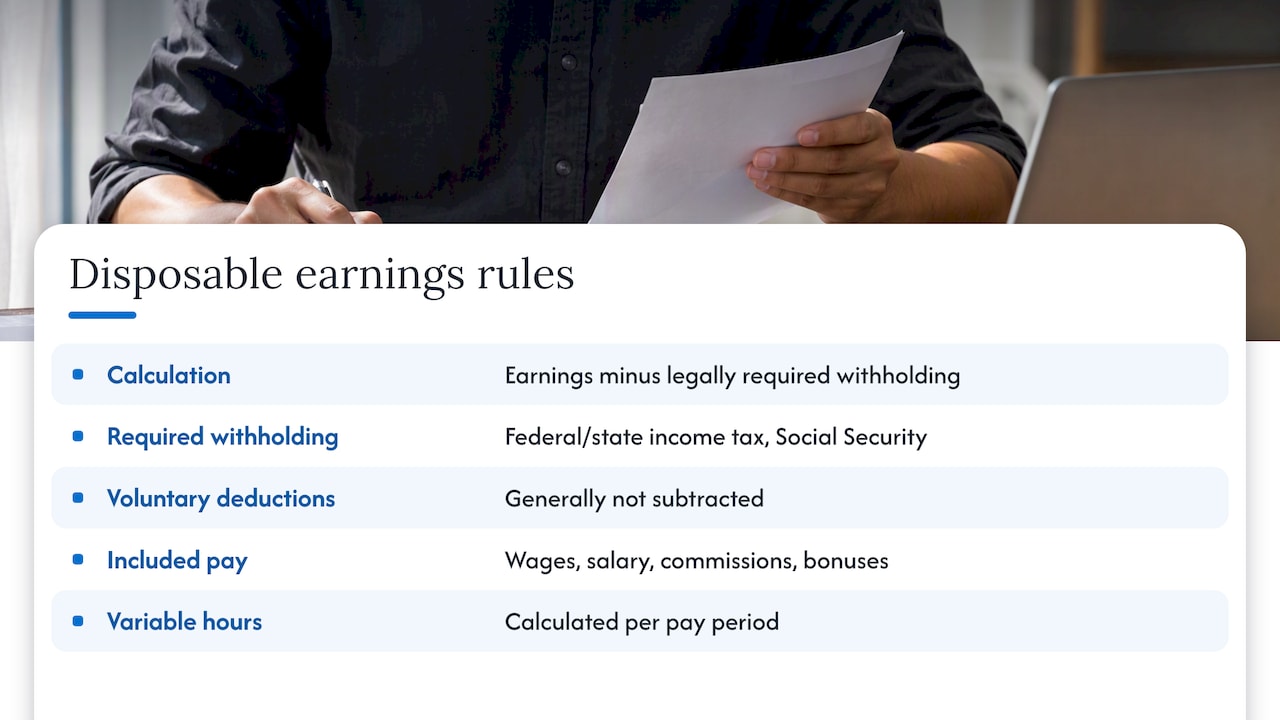
Disposable earnings are your total earnings minus amounts the law requires your employer to withhold, such as federal and state income tax and Social Security. The Department of Labor states that deductions not required by law, including union dues, health and life insurance and retirement plan contributions, generally are not subtracted when figuring disposable earnings.
In practice, that means a voluntary 401(k) contribution does not shrink the amount a creditor can reach. Two workers with the same gross pay can have the same disposable earnings even if one contributes heavily to benefits and the other does not.
Earnings, for this purpose, include wages, salary, commissions, bonuses and similar pay for personal services. If you are paid an hourly wage and your hours vary, the calculation is run per pay period, so a short week can change the amount withheld.
Worked examples at weekly pay
The table below applies the federal rule to a weekly paycheck. These are illustrations of the formula, not predictions for your case.
| Weekly disposable earnings | 25% of that amount | Amount above $217.50 | Maximum garnishment |
|---|---|---|---|
| $200.00 | $50.00 | $0 (none above the floor) | $0 |
| $250.00 | $62.50 | $32.50 | $32.50 |
| $300.00 | $75.00 | $82.50 | $75.00 |
| $600.00 | $150.00 | $382.50 | $150.00 |
| $1,000.00 | $250.00 | $782.50 | $250.00 |
A few patterns stand out:
- Below $217.50 a week in disposable earnings, ordinary garnishment cannot take anything. This is the protection for the lowest-paid workers.
- Between $217.50 and roughly $290 a week, the “amount above the floor” rule is the limiting factor. Your take-home never drops below $217.50.
- Above roughly $290 a week, the 25% cap governs. Past that point, a bigger paycheck means a bigger garnishment, but you keep at least 75%.
The $290 crossover is simple arithmetic: 25% of a number equals that number minus $217.50 when the number is $290.
For biweekly, semimonthly or monthly pay periods, the 30-times-minimum-wage floor is scaled to the length of the period, so ask your payroll department or the Wage and Hour Division how the figure is set for your schedule. You can reach the Division at 1-866-487-9243.
Different debts, different limits
The 25% cap covers ordinary consumer debt. Several kinds of debt follow other rules. The Department of Labor summarizes the federal CCPA limits and exceptions in Fact Sheet #30.
Child support and alimony
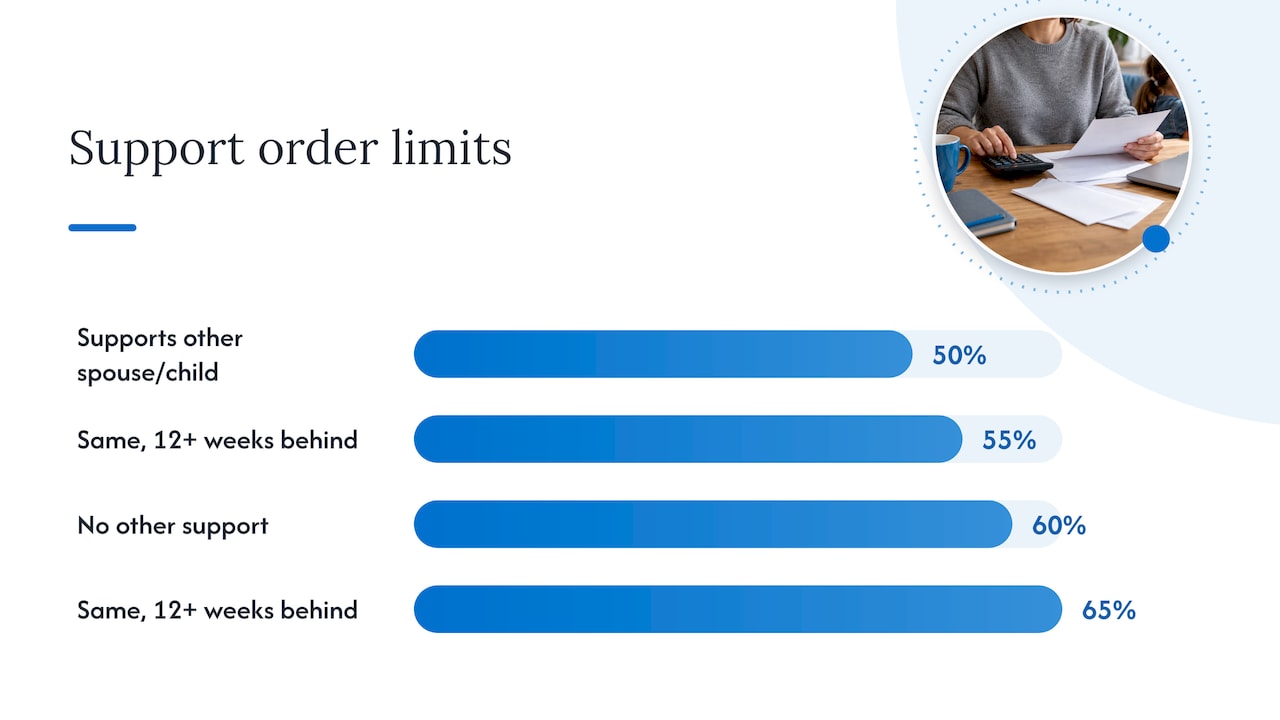
Support orders can take a much larger share. The limit is 50% of disposable earnings if you support a spouse or child other than the one covered by the order, and 60% if you do not. Either figure rises by 5 percentage points if you are more than 12 weeks behind. A worker who is far behind and has no other dependents can therefore face a limit of 65%.
Defaulted federal student loans
Federal student loans in default can be collected through administrative wage garnishment, which does not require a court judgment. The Treasury Department’s calculator for these orders states that the percentage on the order may not exceed 15%. If you have defaulted federal loans, you generally receive a notice before garnishment begins and can request a hearing, so open your mail and respond on time.
Federal and state taxes
The CCPA’s limits do not apply to debts for federal or state taxes, or to certain bankruptcy court orders. An IRS wage levy works differently: the amount you keep is based on your standard deduction and the dependents you claim for the year of the levy. Your employer uses the IRS’s Publication 1494 exemption tables, which vary by pay period, filing status and number of dependents.
One deadline matters here. The IRS says that if you do not return the Statement of Dependents and Filing Status within three days, it treats you as married filing separately with no dependents, which leaves you with a smaller exempt amount. Return the form promptly.
Summary of the main limits
| Type of debt | Federal limit on garnishment |
|---|---|
| Credit cards, medical bills, personal loans | Lesser of 25% of disposable earnings or earnings above 30 times the federal minimum wage |
| Child support or alimony | 50% (supporting another spouse or child) or 60% (not), plus 5% if more than 12 weeks behind |
| Defaulted federal student loans | Up to 15% |
| Federal or state taxes | Not limited by the CCPA; IRS levies use exemption tables |
When state law is stricter
Federal law is a floor. When state law differs, the rule that results in the lower amount of earnings being garnished must be followed. Some states protect a larger share of pay, some use a higher multiple of the minimum wage, and some have protections for heads of household.
A small number of states go further. Summaries compiled by debt-relief organizations list North Carolina, Pennsylvania, South Carolina and Texas as states that largely prohibit wage garnishment for ordinary consumer debt. Even there, exceptions generally remain for child support, taxes, student loans and certain other obligations. This is why a search result about “Texas wage garnishment” and one about “Alabama wage garnishment” can read so differently.
Because rules change, confirm your state’s current law through your state attorney general, your state labor department or a legal aid office before assuming either more or less protection than described here.
Does a garnishment end after seven years?
Not automatically. The seven-year figure usually comes from credit reporting, where most negative items leave your report after about seven years. That is a different clock from the ones that govern collection.
Two other time limits matter. The statute of limitations sets how long a creditor has to sue, and it typically runs three to ten years depending on the debt and the state. Once a creditor wins a judgment, though, the judgment has its own life. One consumer-finance overview notes that judgments commonly last 10 to 20 years and can often be renewed, and that taxes, federal student loans and child support are not bound by the seven-year idea at all.
If you have a judgment against you, find out its date, whether it was renewed and what your state’s rule is. A court clerk can tell you the status of a case, and a legal aid office or an employment or consumer attorney can tell you what it means.
What to do if you are being garnished
A wage garnishment for an ordinary debt generally follows a lawsuit and a judgment. Acting early is usually where workers have the most leverage.
- Do not ignore a lawsuit. If you do not respond to a summons, the creditor can win by default, and that judgment is what opens the door to your paycheck.
- Read the order and your pay stub. Check the debt, the creditor and the amount withheld. Compare it against the limits above using your own disposable earnings.
- Claim every exemption you qualify for. Many states have exemptions for low-income workers or heads of household that are not applied unless you file the paperwork.
- Ask the court for a hearing if the amount seems wrong. Errors in the debt amount, in identity or in the calculation do happen.
- Keep records. Save pay stubs, the garnishment order and all correspondence.
- Get help. Legal aid organizations and employment or consumer attorneys can review the order. Many offer a free first consultation.
If your employer takes more than the law allows, the Wage and Hour Division enforces the CCPA’s garnishment limits on the employer side. The same law also protects you from being fired because your pay was garnished for a single debt. If that happens, contact the Division or an employment attorney promptly.
Perspective: why these limits matter at work
We hear from workers who feel the garnishment process is happening to them rather than with them. Wages are often the one source of income a family can count on, and an order that reaches too far can mean choosing between rent and groceries. That is the reason the law sets a floor.
From our work on employee rights, we see three patterns worth naming. First, many people do not realize that a garnishment has legal limits at all, so they accept whatever appears on the paystub. Second, workers with wage disputes can be pulled into debt cycles when they are underpaid, which is why documenting wage theft signs and unpaid hours matters. Third, the people most exposed, including hourly, day and domestic workers, often have the least room in their budgets. If that describes you, our guides on day laborer wage protections and domestic workers’ rights explain what pay you are owed.
Every employee deserves to understand where each dollar of a paycheck goes and what the law says about it. Knowing the numbers is how a worker moves from feeling powerless to taking the next step.
— Max
Get the full picture of your pay rights
Garnishment is one piece of a larger question: is your pay correct to begin with? Our free guides cover employee rights in the U.S., the difference between exempt and nonexempt classification and proving off-the-clock work, so you can check that the paycheck being garnished is the full one you earned.
Workplace Fairness provides this information free of charge. If it has helped you, you can support the work with a membership starting at $25 per year.

Membership keeps plain-language information about employee rights available to workers who need it, whatever their income.
FAQ
How much can a debt collector garnish from your paycheck?
For ordinary consumer debts, the federal limit is the lesser of 25% of your weekly disposable earnings or the amount by which they exceed $217.50. A collector generally needs a court judgment first. Your state may set a lower limit, and if so, the lower amount applies.
Can student loans be garnished from wages?
Yes. Defaulted federal student loans can be collected through administrative wage garnishment, and the percentage on the order cannot exceed 15%. You usually receive advance notice and a chance to request a hearing. Private student loans generally require a court judgment first, like other consumer debts.
Does a garnishment go away after seven years?
No, not on its own. Seven years is mostly a credit reporting period. A judgment can often last 10 to 20 years and may be renewed, and tax, child support and federal student loan debts follow separate rules. Check the judgment’s date and your state’s rules with the court clerk or a legal aid office.
In which states is wage garnishment illegal?
North Carolina, Pennsylvania, South Carolina and Texas are commonly listed as states that largely bar wage garnishment for ordinary consumer debt. Exceptions usually remain for child support, taxes and some federal debts. Confirm the current rule with your state’s attorney general or a local attorney.
Do union dues or health insurance reduce the amount that can be garnished?
Generally no. Deductions that the law does not require, such as union dues, health and life insurance and retirement contributions, are usually not subtracted when disposable earnings are calculated. Only legally required withholdings, such as taxes, count.
Sources
- Fact Sheet #30: Wage Garnishment Protections of the Consumer Credit Protection Act, U.S. Department of Labor
- Can a debt collector take or garnish my wages or benefits? Consumer Financial Protection Bureau
- Administrative Wage Garnishment Calculator, Bureau of the Fiscal Service
- Information about wage levies, Internal Revenue Service
- Publication 1494, Internal Revenue Service
- Which States Protect Bank Accounts from Creditors?
- Can Wages Be Garnished After 7 Years?