
Union jobs typically pay more, carry stronger benefits, and protect workers through contract rules like just cause discipline and grievance arbitration. Non-union jobs typically offer more employer flexibility, faster individual advancement for standout performers, and no dues or collective bargaining obligations. Which one fits you depends on your industry, your local labor market, and whether you value predictable protection over individual upside.
TL;DR:
- Non-union workers earn about 85% of union wages on average, but the true premium after controlling for industry and region is typically 10% to 15%.
- Union access to health coverage and retirement plans, including pensions, is significantly higher than non-union options, affecting long-term financial security.
- Most non-union jobs operate under at-will employment, allowing termination for almost any reason, while union jobs require just cause and follow a formal discipline process.
- Comparing total compensation, including employer retirement contributions and benefits, is essential before choosing between union and non-union offers.
- Understanding your legal rights through a plain-language guide can help you navigate disputes and changes in working conditions effectively.
Table of Contents
- Union vs Non Union: What the Wage and Benefits Data Shows
- Job Security: At-Will Employment vs Just Cause Protection
- How Unions and Collective Bargaining Agreements Work
- Seniority, Mobility, and Training: The Real Trade-Offs
- How to Compare a Union Offer to a Non-Union Offer
- Where Workplace Fairness Fits Into This Decision
- The Real Question Isn’t Which Model Is Better
- Get Clear on Your Rights Before You Sign Anything
- Sources
- FAQ
Union vs Non Union: What the Wage and Benefits Data Shows
The pay gap between union and non-union work is not a rumor traded around a break room. It shows up in federal labor statistics every year, and the 2024 numbers are stark.
By the Numbers: Nonunion full-time workers earned a median of $1,138 per week in 2024, compared to $1,337 for union members. That means nonunion pay ran about 85% of union pay nationally. Once you control for industry, region, and experience, researchers typically find the true union wage premium settles closer to 10% to 15%, since unionized jobs cluster in higher-paying sectors like construction and manufacturing.
The benefits gap is arguably more consequential than the wage gap, because it compounds over a career. Among private-sector workers, access breaks down like this:
- Union-covered employees have significantly higher access to employer-sponsored health coverage and retirement plans than nonunion employees. Access rates show a notable difference in availability.
That 26-point gap in retirement access matters because union retirement plans more often include a defined-benefit pension alongside, or instead of, a 401(k). A pension guarantees a monthly payout for life; a 401(k) depends on what you contributed and how the market performed. Losing access to one or the other can be worth tens of thousands of dollars over a working lifetime.
None of this is uniform across the country. Union density and wage premiums vary sharply by sector and metro area, so before you make a decision based on a national average, check the pay and benefit norms for your specific trade in your specific region.
Job Security: At-Will Employment vs Just Cause Protection
This is where union and non-union jobs diverge the most in daily practice, even though most workers never think about it until they get called into a manager’s office.
Most non-union jobs in the United States operate under at-will employment, the default legal doctrine in nearly every state. Under at-will rules, an employer can terminate you for almost any reason, or no stated reason at all, as long as the reason isn’t illegal (discrimination, retaliation, and a short list of other protected categories). You don’t get an explanation. You don’t get an appeal.
A union collective bargaining agreement typically flips that default. Discipline and termination require “just cause,” meaning the employer has to show a legitimate, documented reason and often has to prove it followed progressive discipline steps before firing someone.
When a dispute happens, the process usually runs like this:
- Informal discussion. The employee and supervisor try to resolve the issue directly.
- Written grievance. The union steward files a formal complaint citing the specific contract clause violated.
- Escalation through management levels. Higher-level managers and union representatives review the grievance.
- Arbitration. A neutral, independent arbitrator issues a binding decision if the grievance isn’t resolved internally.
Arbitration can reverse a firing or reduce a suspension, but it generally can’t rewrite the contract itself. If you’re facing discipline in a non-union job, document everything in writing immediately. You won’t have a steward, but a clear written record still matters if the issue ever escalates into a legal claim.
How Unions and Collective Bargaining Agreements Work
The National Labor Relations Act protects most private-sector employees’ right to organize and requires employers to bargain in good faith once a union is certified. That legal duty to negotiate is the entire foundation of union leverage. A CBA is a legally enforceable contract, not a handshake agreement, and courts and arbitrators treat it that way.
A typical CBA covers:
- Wage scales and scheduled raises, often tied to seniority tiers
- Overtime rules, shift differentials, and scheduling procedures
- Health insurance and retirement contribution formulas
- Discipline and termination procedures, including the grievance steps above
- Layoff order and recall rights
In right-to-work states, unions can’t require dues as a condition of employment, which creates a free-rider dynamic: some workers get contract benefits without paying for them, which can weaken a local union’s bargaining leverage over time. If you want to know exactly what you’d be signing up for, ask HR or a union representative for a copy of the current CBA before you accept an offer. It’s a public document in most workplaces, and reading it beats guessing.
Seniority, Mobility, and Training: The Real Trade-Offs
Union shops generally assign better shifts, overtime, and promotions by seniority. That protects long-tenured workers from favoritism, but it also means a talented newcomer can wait years for the assignment they’d get immediately in a merit-based non-union shop.
Training tells a similar story. Union apprenticeship programs in the building trades are structured, paid, and built around a portable journeyman card that transfers between union employers and even across some state lines. Non-union training varies widely. Some employers run excellent in-house programs; others offer none at all, leaving workers to pursue certifications on their own dime.
Pro Tip: When comparing a union trade offer to a non-union one, ask what the employer contributes per hour to your retirement fund, not just your hourly wage. In many construction markets, that dollar figure compounds into a bigger lifetime difference than the wage line alone.
Where each model tends to dominate:
- Union strength: heavy construction, public works, utilities, manufacturing, and public-sector jobs like teaching and firefighting.
- Non-union strength: residential construction, retail, hospitality, and most tech.
The costs run both directions too. Union members pay dues and occasionally face lost wages during a strike; non-union workers carry more individual risk if the relationship sours, with no grievance process to fall back on.
How to Compare a Union Offer to a Non-Union Offer
Don’t compare a base wage against a base wage and call it done. Run the comparison properly.
- Calculate total compensation, not just hourly pay: add employer retirement contributions, health premium coverage, and paid time off.
- Ask for a copy of the CBA or a written benefits summary before you accept either offer.
- Confirm grievance and arbitration timelines if the job is union, so you know how long a dispute could realistically take.
- Ask about dues amounts and strike fund policy, including how dues are calculated and whether the local has struck recently.
- Verify apprenticeship length and credit portability if you’re in a trade, especially whether credits transfer if you relocate.
- Compare employer retirement contributions in dollars, not percentages, since flat dollar-per-hour contributions in union trades often outpace a nonunion employer’s percentage match.
| What to check | Ask HR (non-union) | Ask a union rep |
|---|---|---|
| Total pay picture | Full benefits summary in writing | Current CBA wage scale and step schedule |
| Discipline process | Written policy on termination | Grievance steps and arbitration timeline |
| Retirement | 401(k) match formula | Pension or retirement fund contribution rate |
| Training | Internal certification programs | Apprenticeship length and portability |
Local wage data is easier to find than most job seekers realize. The Bureau of Labor Statistics publishes regional wage breakdowns by occupation, and trade unions typically post current scale rates for members and prospective apprentices on their local’s website.
Where Workplace Fairness Fits Into This Decision
Founded in 1994 as the National Employee Rights Institute, an organization changed its name in 2001 to reflect a broader mission: connecting the legal knowledge of employment rights attorneys with the everyday concerns of working people.
That mission shows up as free, plain-language guides on discrimination, discipline, and workplace rights, along with a directory for readers who need a case reviewed. If you’re navigating a change in working conditions at a union or non-union job, or you want to understand your protections around protected concerted activity, those resources walk through the practical steps: how to read a CBA change, how to document a dispute, and when back pay might be owed.
The Real Question Isn’t Which Model Is Better
Most coverage of union vs non-union work treats it like a moral debate, unions good, flexibility good, pick a side. That framing misses what the data actually supports: this is a fit question, not a virtue question.
The BLS numbers make one thing unambiguous: union jobs deliver a measurable floor on pay and benefits that non-union jobs don’t guarantee. But that floor comes with less room to negotiate individually. A high performer in a rigid seniority system can genuinely lose ground compared to what they’d earn in a merit-driven shop. That’s the trade-off conventional advice glosses over.
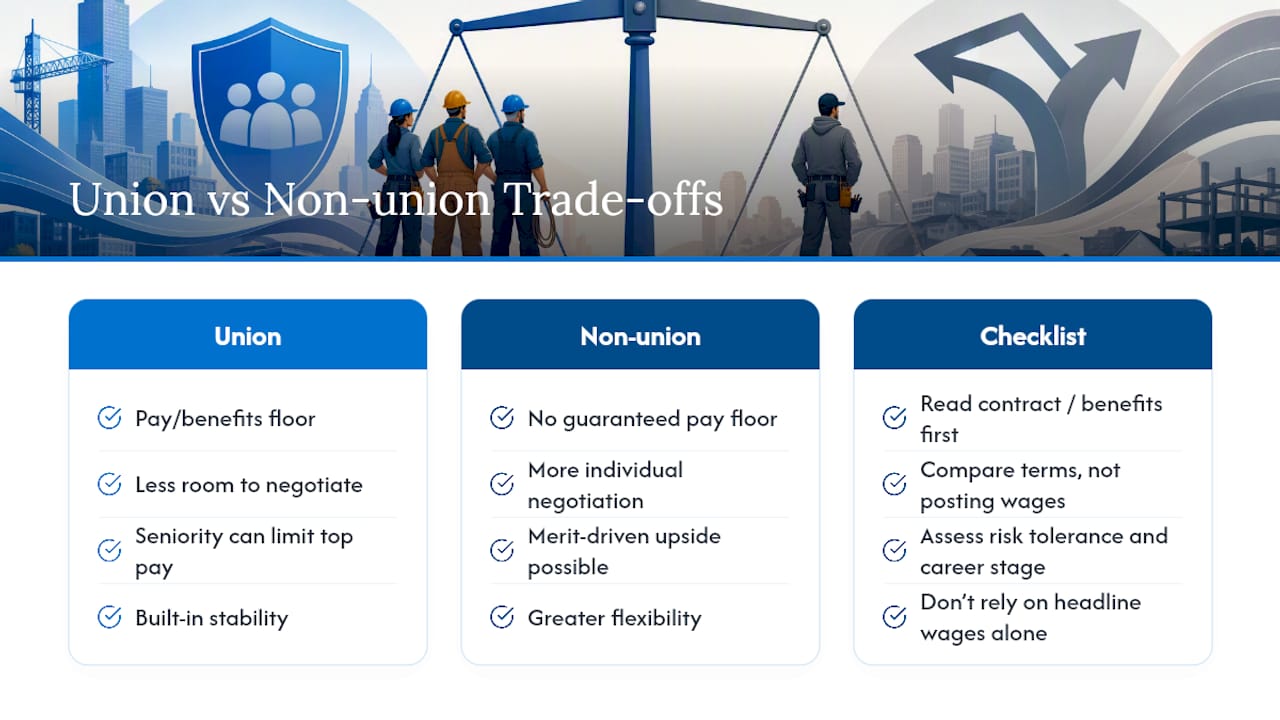
What should you prioritize first? Read the actual contract or benefits summary before you compare anything else. Wage numbers on a job posting tell you almost nothing about retirement contributions, discipline protections, or how fast you’ll actually advance. The workers who end up disappointed, in either direction, are usually the ones who compared headline numbers instead of terms.
Stability and flexibility aren’t opposites to rank. They’re variables to weigh against your own risk tolerance, industry, and stage of career.
— Max
Get Clear on Your Rights Before You Sign Anything
Whether you’re weighing a union offer, a non-union offer, or trying to understand what your current employer can and can’t do, the fastest path forward is knowing your actual legal footing, not what a recruiter tells you informally. An Employee Rights Explained guide offers a plain-language walkthrough of wage protections, discrimination law, and discipline rights that applies whether or not you belong to a union.
If your question is more urgent, say your employer just changed your schedule, pay structure, or job duties without warning, the Change in Working Conditions guide breaks down what employers are legally allowed to do and what counts as a red flag. Start with whichever guide matches your situation, and use the attorney directory if you need to talk to someone about your specific case.
This article is general information, not a substitute for advice from a qualified lawyer. Consult a qualified legal professional about your own circumstances before acting on anything here.
Sources
- Weekly earnings of nonunion workers were 85 percent of union members’ earnings in 2024 — BLS Economics Daily (2025)
- Employment at will doctrine — Cornell Law School Wex
- What is a union — U.S. Department of Labor
- Union vs nonunion trades — TradeColleges
FAQ
Is a union job always better than a non-union job?
No. Union jobs typically offer higher median pay and stronger benefits access, but non-union jobs often allow faster individual advancement and more flexibility, so the better choice depends on your priorities and industry.
How much more do union workers earn than non-union workers?
BLS data for 2024 shows nonunion workers earned a median of $1,138 per week versus $1,337 for union members, meaning nonunion pay was about 85% of union pay nationally.
What does “just cause” mean in a union contract?
Just cause means an employer must show a documented, legitimate reason before disciplining or firing a union member, unlike at-will employment where employers generally don’t need to state a reason.
Can I be fired without a reason in a non-union job?
In most states, yes. At-will employment lets employers terminate workers for almost any reason that isn’t illegal, and without the grievance and arbitration process a union contract provides.
Where can I find my rights if I’m not in a union?
An Employee Rights Explained guide covers legal protections that apply regardless of union status, including discrimination, wage, and discipline rights.