
If your employer fires you, cuts your hours or starts treating you differently after you complain about discrimination, unpaid wages or another legal violation, that may be illegal retaliation. Federal law protects workers who speak up, and the protection covers more than most employees expect. It also has limits, and strict filing deadlines, so the sooner you understand where you stand, the more options you keep. At Workplace Fairness, we publish free, plain-language guidance so that employees can act on their rights with confidence.
TL;DR
- Retaliation is a materially adverse action taken because you complained, took part in a complaint process or asserted a protected right.
- Informal complaints can be protected, and so can a good-faith complaint that turns out to be mistaken.
- Your employer can still discipline you for real misconduct or poor performance. The question is whether the complaint was the reason.
- To prove retaliation you generally show protected activity, an adverse action and a link between the two. Write everything down.
- Deadlines can be short: 180 or 300 days for an EEOC charge, and as little as 30 days under some whistleblower laws.
Table of Contents
- What retaliation means at work
- Which complaints are protected
- What retaliation looks like in practice
- Retaliation versus legitimate discipline
- How to prove retaliation
- Where to report and how long you have
- What you can recover
- If you are still employed
- Support free employee rights information
- FAQ
- Sources
What retaliation means at work
Retaliation happens when an employer takes a materially adverse action against you because you asserted rights the law protects. The U.S. Equal Employment Opportunity Commission (EEOC), the federal agency that enforces workplace anti-discrimination laws, defines it this way in its enforcement guidance. The protected assertion of rights is called “protected activity.”
Two things matter in that definition. First, the action must be because of your protected activity. Second, it must be materially adverse, meaning serious enough that it might discourage a reasonable person from speaking up. The EEOC says petty slights and minor annoyances do not meet that bar.
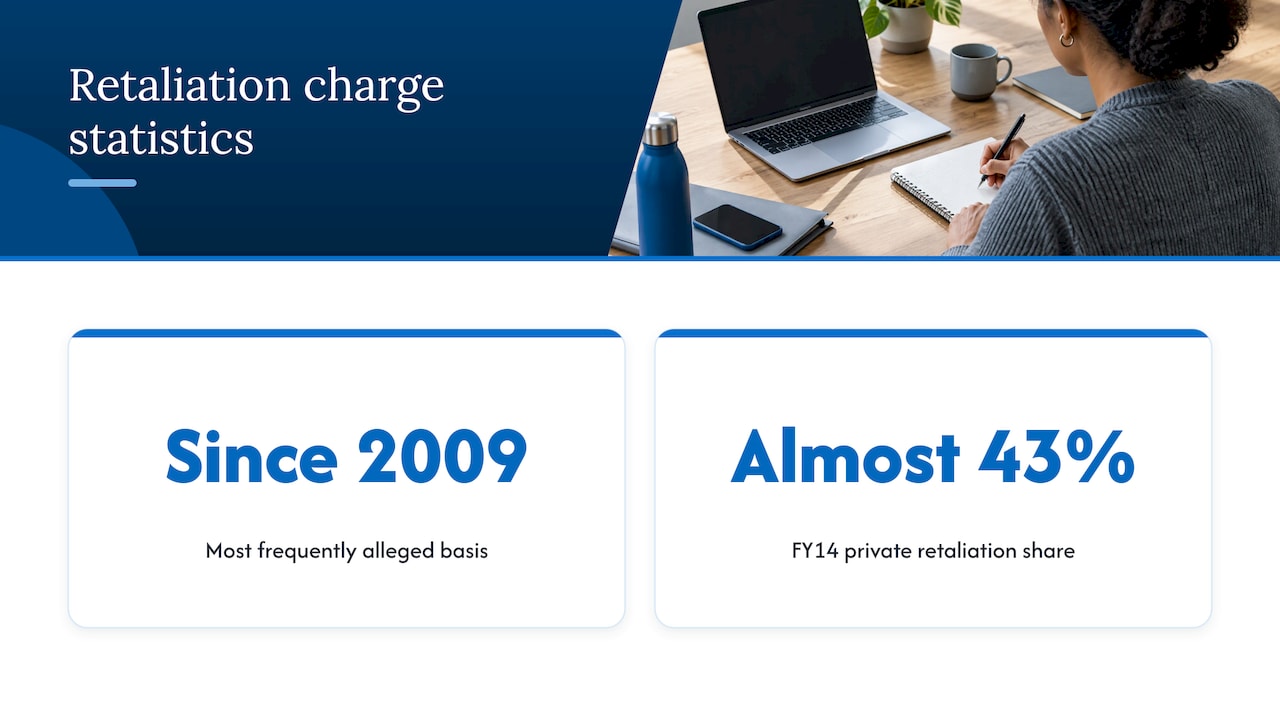
Retaliation is also common. The EEOC reported in written testimony that retaliation has been the most frequently alleged basis of private-sector discrimination charges since 2009, and that in fiscal year 2014 almost 43% of private-sector charges included a retaliation claim. If you are facing it, you are far from alone.
Which complaints are protected
Protected activity falls into two groups.
Opposition: speaking up inside the workplace
Opposition means resisting or complaining about conduct you reasonably believe is discriminatory. The EEOC’s guidance lists a wide range of examples:
- complaining or threatening to complain about discrimination against yourself or others
- giving information during an internal investigation
- refusing an order you reasonably believe is discriminatory
- resisting sexual advances
- requesting a reasonable accommodation for a disability or religious practice
- complaining about pay disparities connected to a protected characteristic
- gathering information with coworkers about possible discrimination
You do not need a formal written grievance. According to the EEOC’s retaliation brochure, informal complaints can be protected, and you need only a reasonable, good-faith belief that the law was violated. Telling a supervisor that a coworker’s comments about your religion are unacceptable can count.
Participation: using the complaint process
Participation means filing a charge, testifying or taking part in an investigation or lawsuit. The same brochure explains that participation is protected even if the original complaint was filed too late or found to lack merit. Using the process cannot be held against you, whatever its outcome.
Wage, leave and safety complaints
Protection extends beyond discrimination. The U.S. Department of Labor’s Wage and Hour Division says it is illegal to fire or take other adverse action against a worker for protected activity such as asking about pay or hours, asserting worker rights or filing a complaint. It lists issues including minimum wage and overtime, recordkeeping, family and medical leave and youth employment. The EEOC adds that the Fair Labor Standards Act (FLSA) retaliation protections apply regardless of immigration status.
One limit is worth knowing. The EEOC’s brochure notes that retaliation for conduct such as union activity or workers’ compensation claims is not covered by the laws the EEOC enforces, though other laws may protect you. For a broader map of your rights, see our guide to employee rights in the United States.
Family members are covered too
The protection can reach people close to the person who complained. The EEOC gives the example of a worker whose spouse filed a charge: if the employer acts against the worker to discourage the spouse’s complaint, both the worker and the spouse can claim retaliation.
What retaliation looks like in practice
Firing is the obvious form, but it is rarely the only one. The EEOC’s guidance counts any action that might deter a reasonable person from complaining. Its examples include:
- termination, demotion or suspension
- denial of a promotion or refusal to hire
- work-related threats or reprimands
- negative evaluations
- transfers to less desirable work
- unjustified closer scrutiny of attendance
- removal of supervisory duties
- threats of deportation
- action against a close family member
The Department of Labor’s guidance adds subtler examples: reduced hours or pay, shift changes, blacklisting and even exclusion from a regularly scheduled meeting. It also lists confiscating a passport or immigration documents. The Department’s whistleblower program names isolating or ostracizing an employee and reporting or threatening to report them to police or immigration authorities as further examples.
A pattern matters as much as a single event. A sudden run of write-ups after years of good reviews, a schedule that quietly shrinks, or a supervisor who stops speaking to you can each be part of the picture.
Retaliation versus legitimate discipline
Making a complaint does not make you untouchable. The EEOC states that neither participation nor opposition excuses neglecting your job duties or breaking workplace rules, and that employers may discipline or terminate for poor performance or misconduct. Whether an action is legitimate or retaliatory depends on the facts.
Worker.gov, the federal government’s worker-rights site, puts the line clearly: an employer may discipline or fire you for a nonretaliatory, nondiscriminatory reason, but may not do anything in response to your complaint that would discourage someone from speaking up.
The EEOC’s guidance defines discipline as punishment for violating a company rule, practice or policy, most commonly reprimands, warnings, suspensions and demotions. It is also clear that Title VII, the federal law against discrimination based on race, color, religion, sex and national origin, prohibits disciplining someone because they filed a charge, took part in an investigation or opposed discrimination.
Here is how the difference tends to show up:
| Question | Points toward legitimate discipline | Points toward retaliation |
|---|---|---|
| History | Documented problems existed before the complaint | Good reviews until the complaint, then sudden criticism |
| Consistency | Coworkers who broke the same rule were treated the same way | Coworkers who did the same thing faced no consequences |
| Timing | Action follows a specific, recorded incident | Action follows soon after the complaint, with no new incident |
| Stated reason | The reason is accurate and consistent | The reason shifts or is untrue |
| Process | The employer followed its usual steps | Steps were skipped or rushed |
No single row decides the question, but together they show whether your complaint, or your conduct, drove the decision.
How to prove retaliation
The EEOC’s brochure describes three elements: protected activity, an adverse action and a causal connection between them. California’s Civil Rights Department describes the same structure for state law: you engaged in protected activity, you suffered work-related harm, and the harm happened at least in part because of the protected activity.
The third element is usually the hardest, because employers rarely say “this is because you complained.” The EEOC points to several kinds of evidence:
- A direct statement. A manager who says or writes that the action is because of your complaint. Investigators call this a “smoking gun.”
- A false reason. An explanation that turns out to be untrue or keeps changing.
- Different treatment. Similar workers who did not complain were treated better.
- Timing. A decision made soon after your protected activity.
Build your record now
Because proof often rests on dates and details, start documenting as soon as you suspect a problem:
- Write down when and how you complained, to whom, and what you said.
- Save the employer’s responses, including emails, texts and chat messages, in a place you control.
- Keep copies of performance reviews, praise and attendance records from before the complaint.
- Note every change after the complaint: new rules, schedule changes, comments, exclusions, with dates and witnesses.
- Record what your employer says the reason is for each action.
Be careful with company property and confidential files. Keep to material you are already entitled to have, and ask an employment attorney before copying anything else.
Where to report and how long you have
Deadlines are the part of retaliation law that most often catches employees off guard.
Discrimination-based retaliation. The EEOC advises contacting it promptly because the deadline for filing a charge is 180 or 300 days, depending on where you live or work. You can file through the EEOC Public Portal, by phone at 1-800-669-4000, at a field office or by email. For retaliation, the brochure says the clock runs from when you learn of the negative job action. If you were fired after filing an earlier charge, the firing itself can be a new retaliation claim.
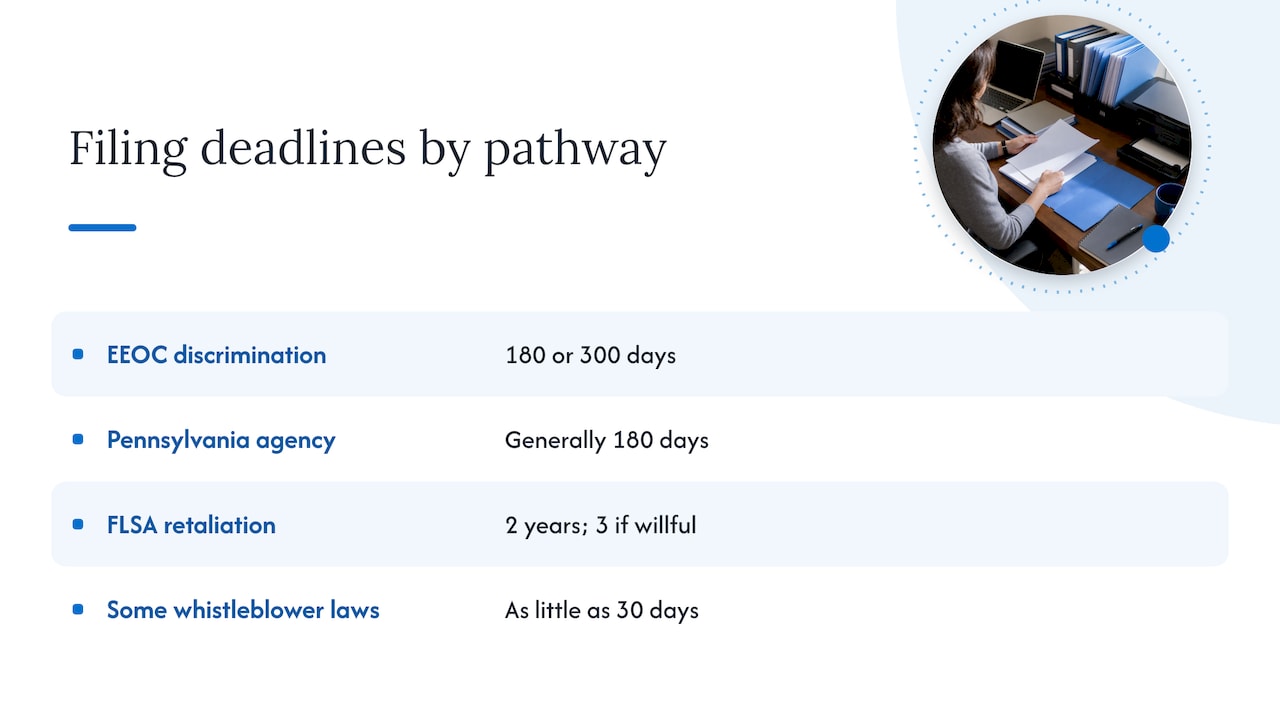
State agencies. Many states have their own agencies and laws. In Pennsylvania, for example, the Human Relations Commission says you generally have 180 days to file and that it will also file an employment complaint with the EEOC when federal law applies. Check your own state agency for its timeline.
Wage and hour retaliation. Under the FLSA you may file a retaliation complaint with the Department of Labor or bring a private lawsuit. The Department explains that remedies can include reinstatement, lost wages and an equal amount in liquidated damages, and that a two-year statute of limitations generally applies, or three years for willful violations. Our overview of labor standards enforcement explains how these agencies work.
Whistleblower laws. Some whistleblower statutes give you as little as 30 days. We list them in our guide to 30-day deadlines under U.S. whistleblower retaliation laws. If your complaint involved safety, fraud or another violation outside discrimination, read it before anything else.
If you are unsure which deadline applies, assume the shortest one and act quickly. A deadline missed cannot be recovered, while a complaint filed early can be supplemented later. Our guide to the workplace discrimination complaint process walks through filing step by step.
What you can recover
The EEOC says remedies for retaliation can include preliminary relief, which is a court order to stop retaliation while a charge is processed, compensatory and punitive damages (punitive damages only against private employers, not the government), and equitable relief such as back pay, front pay or reinstatement. Relief can also include policy changes, training for managers and reporting to the Commission.
Outcomes vary with the facts and the law that applies, and no one can promise a result. What the law does promise is that speaking up in good faith is protected.
If you are still employed
Most people who face retaliation are still at their jobs when it starts. A few practical habits help:
- Keep working to standard. Meet deadlines, follow policies and keep your attendance clean. It leaves the employer fewer legitimate reasons to cite.
- Communicate in writing. Follow up conversations with a short email summarizing what was said.
- Respond to criticism calmly and on the record. If a new write-up seems unfair, submit a written response and keep a copy.
- Do not wait for the final blow. A pattern of smaller actions can already be reportable.
- Know your baseline. In most states employment is “at will,” which means an employer can end it for almost any reason except an illegal one. Retaliation is one of those illegal reasons. Our explainer on at-will employment rights covers the other exceptions.
If you receive a termination notice, a demotion or a serious threat, consider speaking with an employment attorney about your situation. Our attorney directory is one way to find one.
Our perspective
We founded this organization in 1994 on a simple belief: employees are far stronger when they understand the law. Retaliation is where that belief is tested. A worker reports a problem, then waits to learn what it will cost, and many stay silent because they do not know that the law is on their side.
What we see in the law is encouraging. Protection reaches informal complaints, good-faith mistakes, family members and subtle actions as well as firing. Participation in a complaint process is protected regardless of outcome. These are real safeguards, and they exist so that no one has to choose between a paycheck and fairness.
Our work is to turn those safeguards into plain language you can use: what counts, what to write down, where to file and how fast. We build this free information with the knowledge of employment rights attorneys, and we are committed to keeping it free of legal jargon. Equitable workplaces are built one protected voice at a time, and yours counts.
Max
Support free employee rights information
Everything above is free to read because readers and supporters keep it that way. If this guide helped you, you can become a Workplace Fairness member from $25 per year through our membership page, which supports the plain-language resources we publish for employees and labor workers.

You can also explore the rest of the site from our home page, including guides on discrimination, wages and leave.
FAQ
Do people get fired after filing a retaliation complaint?
It happens, and it is itself illegal. The EEOC’s brochure says that if you file a charge and your employer fires you because the EEOC dismissed it, the employer has retaliated. You generally have 180 or 300 days from learning of the firing to file a new charge, depending on where you work.
What legally qualifies as retaliation?
A materially adverse action, one that might deter a reasonable person from complaining, taken because of protected activity. Firing, demotion, reduced hours, threats, negative evaluations and unfavorable transfers can all qualify. Petty slights and minor annoyances generally do not.
Can my employer still discipline me after I complain?
Yes, for real performance or conduct problems that would have led to discipline anyway. What the employer cannot do is punish you because of the complaint. Consistent treatment of coworkers, documented prior problems and an accurate stated reason all point toward legitimate discipline.
Is a complaint protected if it turns out to be wrong?
Often, yes. The EEOC says opposition needs only a reasonable, good-faith belief, and the Department of Labor explains that under many of its statutes you are protected even if your complaint rested on a mistaken belief that your rights were violated. Participation in an EEOC proceeding is protected even if the charge is found to lack merit.
Is it hard to win a retaliation case?
The hardest part is usually showing the link between your complaint and the action. Timing, inconsistent explanations, comparisons to coworkers and a clear written record all help. An employment attorney can assess how your facts fit the law that applies.
Sources
- EEOC: Questions and Answers, Enforcement Guidance on Retaliation and Related Issues
- EEOC: Retaliation/Reprisal brochure
- EEOC: Written Testimony of Raymond L. Peeler
- EEOC: Fact Sheet on Retaliation Based on Exercise of Workplace Rights
- EEOC: CM-612 Discharge/Discipline
- EEOC: Know Your Rights, Workplace Discrimination is Illegal
- U.S. Department of Labor: Retaliation
- U.S. Department of Labor: FAB 2022-2, Protecting Workers from Retaliation
- Whistleblower Protection Program: Retaliation
- Worker.gov: Protection against retaliation
- California Civil Rights Department: Workplace retaliation is against the law
- Pennsylvania Human Relations Commission: Filing a Complaint