Domestic violence leave is job-protected time off that survivors of domestic violence, sexual assault and stalking can use to get safe, and no single national law grants it to every worker. Your right depends mostly on your state and your employer’s size. In some states you can take up to 12 weeks. In others you get a set number of days, or “reasonable” leave. Federal law adds protections for some workers through the Family and Medical Leave Act and, for certain federal contractors, paid sick leave. This guide explains what the laws say, how they differ and what to do first.
TL;DR
- Safe leave is paid or unpaid, job-protected time off for court dates, medical care, counseling, relocation and victim services.
- Amounts vary widely: California allows up to 12 weeks, Illinois up to 12 workweeks, New Jersey 20 days, Massachusetts 15 days, while Oregon and Washington require “reasonable” leave.
- You usually must give notice, but emergencies are excused, and an employer’s request for proof is limited and confidential in many states.
- Employers cannot fire or punish you for using protected leave, and you are generally entitled to your job or an equivalent one afterward.
- Check your own state’s rules first, then the federal FMLA, which may also apply.
Table of Contents
- What domestic violence leave is
- What federal law covers
- State laws: where most of the protection lives
- Who is covered
- What you can use the leave for
- How much leave, and whether it is paid
- Notice and proof: what an employer can ask
- Protection from firing and retaliation
- Steps to take before you ask for leave
- Where Workplace Fairness fits
- Our perspective
- FAQ
- Sources
What domestic violence leave is
The U.S. Department of Labor describes safe leave as time off, paid or unpaid, that survivors of domestic violence, sexual assault and stalking can use for needs tied to the violence. Examples include preparing for legal proceedings, seeking medical or psychological treatment, relocating or receiving supportive services. The same page explains that this protection comes through paid sick and safe days laws or paid family and medical leave laws in several states and local governments.
The point of the law is practical. Survivors often have to be in several places during working hours: a courthouse, a clinic, a shelter, a new apartment. Without protected leave, each of those trips risks a missed shift, a warning or a lost job. Safe leave removes that risk so that safety planning does not cost a livelihood.
What federal law covers
There is no general federal statute that says “domestic violence leave.” Two federal rules matter, and both have limits.
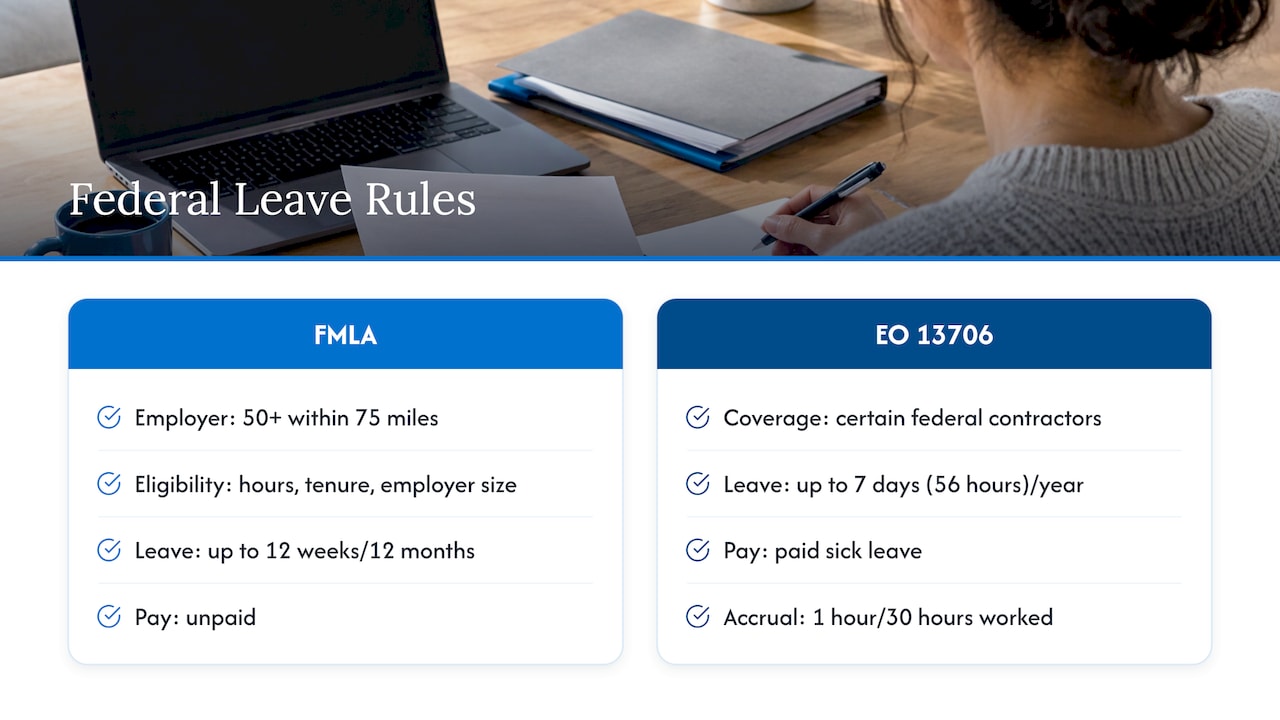
The Family and Medical Leave Act (FMLA). The FMLA requires employers with 50 or more employees within a 75-mile radius to provide up to 12 weeks of unpaid, job-guaranteed leave every 12 months to qualified employees. That includes leave to recover from your own serious health condition, which, as the Washington State Workers Rights Manual notes, can include conditions related to domestic violence. The New Jersey Department of Labor likewise says the federal FMLA includes conditions related to sexual and domestic violence. Eligibility turns on hours worked, tenure and employer size. Our guide to the four DOL tests that decide FMLA eligibility walks through each one.
Executive Order 13706. Certain federal contractors must provide up to seven days (56 hours) of paid sick leave a year, accruing at one hour for every 30 hours worked. Fact Sheet #84 from the Department of Labor says that leave can be used for absences resulting from domestic violence, sexual assault or stalking, including counseling, relocation, help from a victim services organization or related legal action. The order does not affect an employer’s FMLA obligations, and the paid sick leave can run at the same time as unpaid FMLA leave when the reason qualifies for both.
Federal contractors must also let employees use this leave in increments as small as one hour, with very limited exceptions. If you work for a company that holds a federal contract, ask your employer whether the order applies to your job.
State laws: where most of the protection lives
States fill the gap, and they do it differently. Here is how several of them compare, based on official state sources.
| State | Amount of leave | Paid or unpaid | Employer size or other limit |
|---|---|---|---|
| California | Up to 12 weeks if you experienced a qualifying act of violence; up to 10 days if a family member survived (CA Civil Rights Department) | See employer policy and other leave | Time off for court-related relief applies broadly; leave for health and safety activities applies at employers with 25 or more employees (CRD) |
| Illinois | Up to 12 workweeks (VESSA FAQ) | Unpaid, job-protected | Covers domestic, sexual and gender violence and other crimes of violence |
| Massachusetts | Up to 15 days in any 12-month period (Attorney General’s advisory) | Paid or unpaid, at the employer’s sole discretion | Employers with 50 or more employees |
| New Jersey | 20 days (NJ Department of Labor) | Unpaid, job-protected | Under the SAFE Act |
| Oregon | Reasonable leave (BOLI) | Not set by the page | Employers with 6 or more employees |
| Washington | Reasonable leave (L&I) | Depends on the leave used | Available to all employees and qualifying family members |
These are examples, not a full list, and laws change. Confirm the current rule on your state labor department’s website before you rely on a number. Some cities and counties add their own protections as well.
Who is covered
Coverage has two parts: which employees can take leave, and which relationships count.
Employees. Some states are generous about tenure and hours. Oregon’s labor bureau says any employee who is a victim of or at risk of domestic violence, sexual assault or stalking is covered, regardless of how long they have worked for the employer or how many hours they work each week. Other states tie coverage to employer size, as the table shows.
Family and household members. Many laws let you take leave when someone close to you is the survivor. California lists a child, parent, grandparent, grandchild, sibling, spouse, domestic partner or designated person, and a designated person can be someone related by blood or equivalent to a family member. Employers there may limit leave to one designated person in a 12-month period.
Illinois takes a wide view too. Its VESSA FAQ defines a family or household member to include a spouse or civil union partner, parent, grandparent, child, sibling, other people related by blood or by present or prior marriage or civil union, people who share a relationship through a child, anyone whose close association with the employee is the equivalent of a family relationship as determined by the employee, and people living in the same household.
A useful habit: write down who in your life might need support from you at some point, and check whether your state counts them. Chosen family is recognized in some states and not in others.
What you can use the leave for
The list of qualifying reasons is broadly similar across states. Oregon’s page says employers with six or more employees must allow reasonable leave to:
- seek legal or law enforcement assistance or remedies,
- seek medical treatment for or recover from injuries caused by domestic violence or sexual assault,
- obtain counseling from a licensed mental health professional,
- obtain services from a victim services provider, or
- relocate or secure an existing home to protect the health and safety of the employee or the employee’s minor child or dependent.
Washington’s statute, RCW 49.76, adds safety planning and other actions to increase safety. California’s notice goes further, naming time to prepare for or take part in civil, administrative or criminal proceedings, to seek childcare or care for a dependent adult, or to care for a family member recovering from injuries.
Massachusetts adds court-related details: appearing in court or before a grand jury, meeting with a district attorney or other law enforcement official, and attending child custody proceedings. The advisory also says that the employee must not be the perpetrator of the abusive behavior.
Safety accommodations beyond time off
Leave is not the only tool. Oregon’s BOLI lists examples of workplace safety accommodations, including a transfer, reassignment, modified schedule, changed work phone number, changed work station, installed lock or change in office policy. If the person who is harming you knows where you sit or when you arrive, these changes can matter as much as days off.
How much leave, and whether it is paid
Most state domestic violence leave is unpaid, but not all of it is, and “unpaid” does not mean you have no options.
- California allows up to 12 weeks for an employee who experiences a qualifying act of violence, and the same for an employee whose family member dies as a result. An employee whose family member survived is entitled to up to 10 days, with up to five of those days usable to help a family member relocate.
- Massachusetts employers must allow up to 15 days of paid or unpaid leave in any 12-month period. The employer decides whether the leave is paid, and the employee must first use available vacation, personal and sick leave unless the employer waives that requirement.
- Illinois provides up to 12 workweeks of unpaid but job-protected leave.
- New Jersey provides 20 days of unpaid, job-protected leave.
Because so much of this leave is unpaid, how you combine it with paid time off matters. Where your state or employer allows it, vacation, sick leave and paid family leave programs may bridge the gap. Our guide to paid family leave, FMLA and state benefits explains how those programs fit together and includes a six-step claim checklist.
Notice and proof: what an employer can ask
This is where survivors most often worry, and the rules are more protective than many people expect.
Notice. Washington requires advance notice of your intention to take leave. If an emergency or unforeseen circumstance prevents it, you or your designee must notify the employer no later than the end of the first day you take leave. Missouri’s statute asks for at least 48 hours’ notice unless that is not practicable. California asks for reasonable advance notice unless it is not possible.
Massachusetts is notable for imminent danger. In that case you need not give advance notice, but you must tell your employer within three workdays that the leave was taken under the law. The notice can come from you, a family member or your counselor, social worker, health care worker, clergy member, shelter worker, legal advocate or another professional. A person you trust can make that call when you cannot.
Proof. Washington lets employers require verification that you or your family member is a victim and that the leave was for a purpose the statute describes. Oregon says employers can ask for certification, and that any documents provided must be kept confidential and not released without your express permission.
The type of proof is often flexible. In Massachusetts, an employer cannot require evidence of an arrest, conviction or other law enforcement documentation. You can satisfy a request with any one of several documents, including a protective order, a police report, medical documentation or a sworn statement. California says an employer cannot discipline you for an unexcused absence if you provide certification within a reasonable time, and certification can include police reports, court records or other documentation. Missouri similarly bars action over an unscheduled absence if you provide certification within a reasonable period after the employer asks.
Confidentiality. Washington’s statute requires employers to keep the information you provide confidential. It may be disclosed only if you request or consent, a court or administrative agency orders it, or federal or state law requires it.
Protection from firing and retaliation
The core promise of these laws is that using them cannot cost you your job. California states that an employer cannot fire, discriminate against or retaliate against an employee because they, or their family member, are a victim of a qualifying act of violence. Massachusetts says an employer cannot discharge or discriminate against you for exercising your rights, and that on your return you are entitled to restoration to your original job or an equivalent position.
California also requires employers to inform each employee of their rights to time off because of a qualifying act of violence, a requirement highlighted in its July 2025 release on AB 2499. Look for a notice in your handbook or break room.
How it interacts with FMLA and other leave
Be careful about stacking. California’s FAQ says that if you are also eligible for FMLA or the California Family Rights Act, time off resulting from a qualifying act of violence runs at the same time. You are not entitled to back-to-back leave, and using FMLA or CFRA for these reasons may reduce your ability to use them for other reasons later. Know your total balance before you start.
If you are in a state without a domestic violence leave statute, or you are not covered by it, FMLA, paid sick leave and workplace accommodations may still help. Our overview of employee rights in the U.S. shows how those protections connect. If your employer has fired you or disciplined you and you are not sure how at-will rules apply, read about at-will employment rights.
Steps to take before you ask for leave
- Find your state’s law. Search your state labor department’s website for “domestic violence leave” or “safe leave.” Note the employer-size threshold, the number of days and whether notice or certification is required.
- Check your employer’s policy. Handbooks sometimes offer more than the law requires, including paid days.
- Gather documents safely. A protective order, police report, medical record, advocate letter or sworn statement can serve as proof. Keep copies somewhere your abuser cannot reach, such as a trusted person’s home or a secure account.
- Choose how to give notice. Put your request in writing if you can, and keep a copy. In an emergency, ask a trusted person or advocate to notify your employer for you where the law allows.
- Limit what you share. Give the employer what the law requires. Ask in writing how your information will be kept confidential.
- Record everything. Dates, requests, replies and any change in how you are treated. Our guide on documenting workplace harassment evidence shows what a useful record looks like.
- Get individual advice. If a request is denied or you face retaliation, speak with an employment attorney. If you are in immediate danger, call 911.
Where Workplace Fairness fits
Workplace Fairness publishes free, plain-language information on employee rights, employment law and discrimination, along with guides for pursuing claims and an attorney directory for finding an employment lawyer. If a leave request is denied or you are retaliated against, those guides and the directory are the next step.
Our work has been supported by individuals since 1994, when we were founded as the National Employee Rights Institute. A Membership, from $25 per year, helps us keep these resources free for the next worker who searches for them.
To learn more about who we are, visit About Workplace Fairness.
Our perspective
Every worker deserves to deal with violence without also fearing for a paycheck. That is the principle behind safe leave, and it is why we explain these laws in plain words rather than legal jargon.
The patchwork is a systemic barrier. A survivor in one state may have 12 weeks of protected leave, while one in another has a short list of days or a standard of “reasonable” time. Most people never read the statute until the worst moment of their lives. We think the answer is clear information, early and free, so that no one learns their rights after the job is already gone.
We also believe in collective responsibility. Employers can post the notice, train managers to respond with care and treat a request for leave as a safety matter. Coworkers can make it easier to ask. Advocates, attorneys and workers together have built the laws we have, and the same partnership will improve them.
If you are using leave now, know that asking for what the law gives you is not a favor. It is a right, and many people have used it to rebuild with a job still waiting.
Max
FAQ
Is domestic violence leave paid?
Usually it is unpaid, but it depends on the law and your employer. Illinois and New Jersey provide unpaid, job-protected leave. Massachusetts lets the employer decide whether leave is paid, and may require you to use vacation, personal and sick leave first. Certain federal contractors must provide up to seven days of paid sick leave a year that can be used for domestic violence-related absences.
Can my employer fire me for taking domestic violence leave?
Not when the leave is protected under the law that applies to you. California and Massachusetts both bar discrimination or retaliation for exercising these rights, and Massachusetts guarantees return to your original or an equivalent job. If you think you were punished for protected leave, keep records and consult an employment attorney, and use our attorney directory to find one.
Do I have to prove I am a victim?
Often an employer may ask for certification, but the options are broad and the information is confidential. In Massachusetts, a protective order, police report, medical documentation or sworn statement can be enough, and an employer cannot demand evidence of an arrest or conviction. Oregon says certification documents must stay confidential without your express permission.
Can I take leave to help a family member who is a victim?
In many states, yes. California allows up to 10 days for an employee whose family member survived a qualifying act of violence, and Illinois covers family or household members. Who counts as family differs by state, so check your state’s definition.
Does the FMLA cover domestic violence?
It can. FMLA gives eligible employees up to 12 weeks of unpaid, job-guaranteed leave each year, and that can include recovering from a serious health condition related to domestic violence. You must meet the employer size and eligibility tests, and the time can run at the same time as state leave.
Sources
- U.S. Department of Labor: 4 Types of Employment Laws That Can Help Domestic Violence Survivors at Work
- U.S. Department of Labor: Fact Sheet #84, Paid Sick Leave for Federal Contractors
- Washington State Workers Rights Manual (2022)
- New Jersey Department of Labor: Victims/Survivors of Domestic and Sexual Violence
- California Civil Rights Department: Survivors’ Right to Time Off FAQs (June 2025)
- California Civil Rights Department: Survivors’ Right to Time Off notice
- California Civil Rights Department: Violence Leave Protections release (July 2025)
- Illinois Department of Labor: VESSA FAQ
- Oregon BOLI: Domestic violence protections for workers
- Washington Department of Labor & Industries: Domestic Violence Leave
- Washington RCW 49.76.040
- Massachusetts Attorney General’s Advisory on Domestic Violence Leave