
Under federal law, an employer may require tipped workers to pool tips, but the employer, managers and supervisors can never take a share, and the employer can never keep tips for any purpose. Who else may join the pool depends on one question: does your employer take a tip credit against your wages? State and local laws can add stricter rules on top. This guide explains each piece so you can read your own pay stubs with confidence.
TL;DR
- Employers may never keep employees’ tips, and managers and supervisors may not receive money from a tip pool, whether or not a tip credit is taken.
- If your employer takes a tip credit, the pool may include only employees who customarily and regularly receive tips, such as servers, bartenders and bussers.
- If your employer pays the full minimum wage with no tip credit, the pool may also include cooks and dishwashers.
- Service charges are not tips, and pooled tips must be paid out by the regular payday.
- State law can be stricter than federal law, so check your state labor department as well as the U.S. Department of Labor.
Table of Contents
- What tip pooling and tip sharing mean
- The tip credit: why it changes everything
- Who can be in a tip pool
- Who can never take from the pool
- What happens to credit card tips and service charges
- State and local laws can go further
- Warning signs your tip pool may be unlawful
- Our perspective
- What to do if tips are taken or misallocated
- Worked example: one shift, two pay methods
- Common questions about who can sit on the pool
- Support the work
- FAQ
- Sources
What tip pooling and tip sharing mean
The two terms overlap, and employers use them loosely. In practice:
- Tip pooling means tips from several workers are collected into one fund and divided by a set formula. The employer often requires it.
- Tip sharing (sometimes called a tip-out) usually means one worker hands a set percentage of their tips directly to another, for example a server paying a share to the bartender and the bussers.
Both are governed by the same federal rules. The Fair Labor Standards Act (FLSA) treats tips as the property of the employee. An employer is prohibited from keeping any portion of employees’ tips for any purpose, regardless of whether a tip credit is taken. That single principle explains most of the rest of the law.
The tip credit: why it changes everything
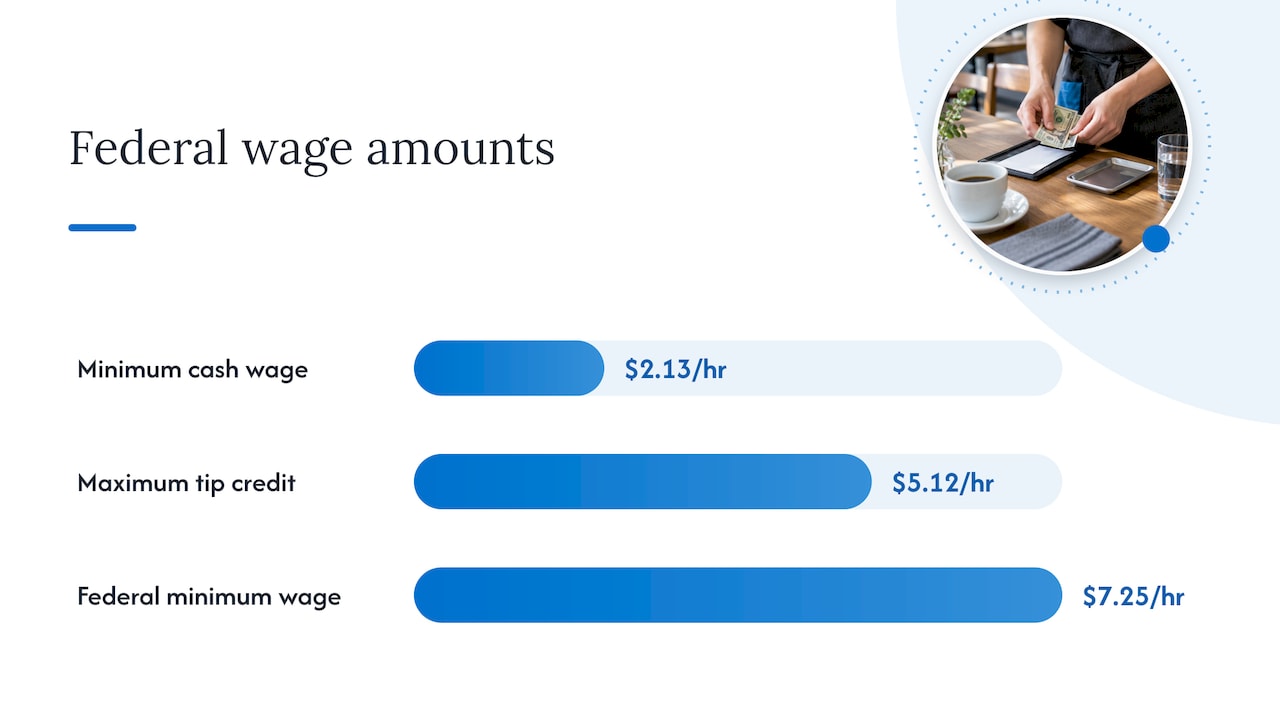
Most confusion about pooling comes from the tip credit. Under federal rules, an employer may pay a tipped employee a lower direct cash wage, then count a portion of the tips toward the federal minimum wage. The Department of Labor’s Fact Sheet #15 puts the federal minimum cash wage for tipped employees at $2.13 per hour, with a maximum tip credit of $5.12 per hour against the $7.25 federal minimum wage.
The arrangement carries conditions. The cash wage plus the tips you actually receive must equal at least the minimum wage. If tips fall short in a given workweek, the employer must make up the difference. When an employer takes the credit, it must also limit any mandatory pool to employees who customarily and regularly receive tips.
If an employer pays the full minimum wage in cash and takes no tip credit, the rules on who can be in the pool relax. That is the reason the same restaurant can have a very different pool depending on how it pays its servers.
Who can be in a tip pool
The Department of Labor describes two kinds of pools. Fact Sheet #15 separates them this way.
| Traditional pool | Nontraditional pool | |
|---|---|---|
| Tip credit taken? | Yes, allowed | No, only when no tip credit is taken |
| Who may be included | Employees who customarily and regularly receive tips: servers, bartenders, bussers | Those workers plus non-tipped workers such as dishwashers and cooks |
| Managers and supervisors | Never | Never |
| Employer | Never | Never |
Tipped employees
Servers, bartenders and bussers are the standard examples of workers who customarily and regularly receive tips. Their job involves enough direct customer interaction that the customer’s tip reasonably reflects their service.
Back-of-house workers
Cooks and dishwashers can share in a pool only when the employer takes no tip credit. Federal guidance looks at actual duties, not job titles. In a 2025 opinion letter, the Department explained that it considers service-related functions and sufficient customer interaction. A dishwasher with minimal dining-room presence and only occasional customer requests is not customarily and regularly tipped. If you work in the back of the house and your employer takes a tip credit from servers, a pool that includes you may be unlawful. That is worth documenting.
Employers that run tips through a point-of-sale system can use payroll and tip distribution tools to track who is eligible and keep a clear record of what each person received. Good records protect workers and employers alike, because they show whether the pool matches the legal categories.
Who can never take from the pool
The rule is the same whether or not a tip credit is involved. An employer, manager or supervisor may never keep employees’ tips. A manager or supervisor may keep only tips received personally from customers for services performed solely and directly by that person, according to WHD Opinion Letter FLSA2026-13.
Titles do not control. For this purpose, a manager or supervisor is defined by duties, specifically those that match the executive exemption criteria in 29 C.F.R. § 541.100, such as managing a department or having hiring and firing authority, as the same opinion letter explains. An assistant manager who schedules staff and has a say in hiring cannot be paid from the pool just because the title sounds junior. A lead server with no such authority is a different matter.
Two practical examples:
- A restaurant owner works a shift as a bartender and pockets part of the bar’s tip jar. This is unlawful if those are employees’ tips, because the employer may not keep them.
- A general manager seats a party, takes a to-go order, and receives a cash tip from a customer for the order he personally handled. Under the rule above, a manager may keep tips from services he performed solely and directly himself, but he may not draw a share of the servers’ pool.
What happens to credit card tips and service charges
Credit card tips
Tips left on a card belong to the employee just like cash. Distribution rules under 29 C.F.R. Part 531, Subpart D require pooled tips to be paid out by the regular payday. If your employer holds card tips for weeks, ask why in writing.
Service charges
A service charge is not a tip. The mandatory 18 percent added to a large party’s bill is one common example. The regulations and the Department’s 2026 opinion letter both treat service charges as distinct from tips. That means the employer may generally use them as part of its own revenue, including to pay wages, and they do not count as your tips. Whether you are entitled to any share of a service charge depends on your pay arrangement and, in some states, local law.
How big can the contribution be?
The FLSA does not set a maximum percentage for mandatory pool contributions, according to 29 C.F.R. § 531.54. When a tip credit is taken, though, the pool can only retain enough to be fair to those who customarily and regularly receive tips, and the employer must notify employees of required contributions. Notice is a real requirement, not a courtesy: ask for the policy in writing.
State and local laws can go further
Federal law is the floor. Many states require higher cash wages or limit the tip credit. The Department of Labor’s state tipped-wage page notes, for example, that in California employers must pay the full state minimum wage before tips. When state and federal rules differ, the rule more protective of the employee generally applies.
A few examples show how much the details vary:
- California: with the full minimum wage paid before tips, there is no tip credit to arrange pooling around, per the Department of Labor’s state summary.
- New York: the state’s Hospitality Wage Order permits tip sharing and tip pooling, and employers may set percentages among food service workers, according to the state labor department’s FAQ.
- Texas: the Texas Workforce Commission notes that a tip pool must include notice to employees and that the tip credit is limited to the actual amounts received by employees.
Some cities add their own rules. If you work in a major city, check the municipal labor office as well as your state agency. Because these details change, treat any chart or article, including this one, as a starting point and confirm on your state labor department’s own site.
Warning signs your tip pool may be unlawful
You do not need a law degree to spot most problems. Look for these:
- A manager or owner takes a cut, or “administrative” deductions come out of the pool.
- The pool includes cooks or dishwashers while servers are paid a reduced cash wage with a tip credit.
- You were never told, in writing or otherwise, how the pool works or what percentage you owe.
- Card tips are paid late or in a lump sum with no breakdown.
- Your cash wage plus tips falls below the minimum wage in some weeks and nobody makes up the difference.
- Service charges are described to customers as gratuities but never reach employees.
These often show up alongside other pay problems. Our guide to wage theft signs you should document shows what records to keep, and the labor worker rights and overtime guide covers how overtime applies to tipped workers.
Our perspective
Tip pooling is one of the clearest places where the law and everyday restaurant practice meet. When it works, a team that depends on one another shares fairly. When it fails, it is usually because workers never saw the rules written down.
We believe every tipped worker deserves to understand three things: who is in the pool, what the employer’s pay method is, and where the money goes. Those facts are not secrets, and they are not legal technicalities. They determine whether a paycheck is lawful.
That is why we publish free, plain-language information on employee rights, wage protections and employment law, and why we keep an attorney directory for people who need more than information. Fairness at work grows when workers and the professionals who serve them share knowledge. If our guides help you ask one better question of your employer, they have done their job.
Max
What to do if tips are taken or misallocated
The question of remedies is where workers most need a clear plan. Here is a sensible order of steps.
- Gather records. Keep pay stubs, schedules, tip reports, the written pool policy if there is one, and your own notes of dates, amounts and who said what. Photographs of posted policies help.
- Compare your pay with the rules above. Check whether a tip credit is taken, who is in the pool, and whether managers or owners participate.
- Raise it internally if you feel safe doing so. A short written request for the pool policy and a breakdown of your tips often resolves honest mistakes. Keep a copy.
- Contact the government. The U.S. Department of Labor’s Wage and Hour Division enforces the FLSA’s tip provisions; its tip regulations page explains the rules it enforces. Your state labor department may enforce a stricter state law, and it is worth filing there as well when your state’s rules are stronger.
- Talk to an employment attorney. If a significant amount of money is involved, or you fear retaliation, a lawyer can explain which claims apply and how much time you have to bring them. Deadlines for wage claims are limited, so do not wait.
Retaliation for asserting wage rights is itself prohibited under the FLSA. If you are fired or have your shifts cut after raising a tip complaint, document that too. Our employee rights overview explains the broader protections workers have.
Worked example: one shift, two pay methods
Imagine a restaurant where a server, a bartender, a busser and a dishwasher work a Friday night. The servers collect $900 in tips and the pool is split by hours worked.
Scenario A: tip credit taken. The servers and bartender receive a cash wage below the full minimum wage, and the employer counts tips toward the difference. Only the server, bartender and busser may be in the pool. The dishwasher cannot be, and the manager on duty cannot receive any of it. If a server’s cash wage and tips for the workweek fall below the minimum wage, the employer owes the difference.
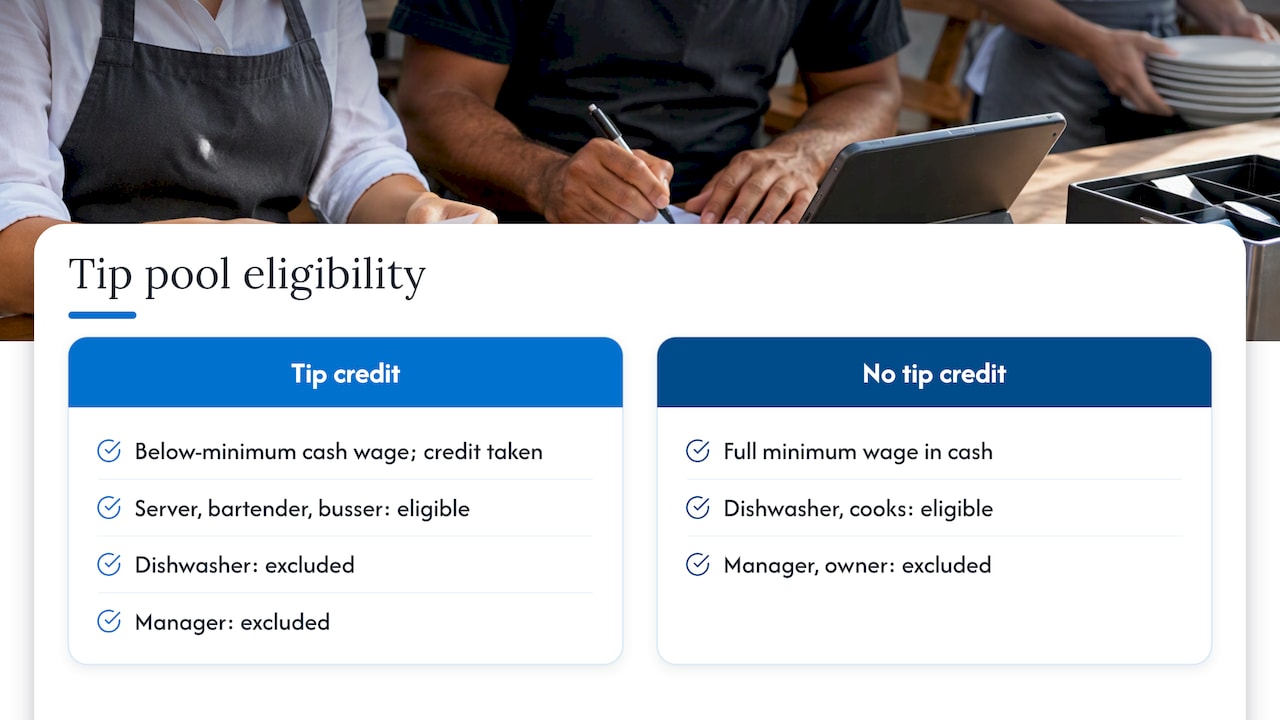
Scenario B: no tip credit. Everyone is paid at least the full minimum wage in cash. The employer may now include the dishwasher and cooks in a nontraditional pool. The manager still cannot take any of it, and neither can the owner.
In both scenarios, the pooled money must go to employees, be paid by the regular payday, and be tracked. The only variable is who is eligible to receive it.
Common questions about who can sit on the pool
Workers raise the same objections again and again, so here are the short answers.
“My employer says the pool is voluntary.” A voluntary tip-out between coworkers is different from a mandatory pool, but if your employer pressures you or sets the percentage, treat it as mandatory and apply the rules above.
“The owner works the floor sometimes.” An owner is an employer under the rule. If the owner shares in a pool made of employees’ tips, that is a red flag.
“Our shift lead has no hiring power.” Because the test turns on duties, not titles, a lead who lacks managerial authority is not automatically barred. The details matter, and so does your state’s law.
“We were told the percentage is capped.” Federal law sets no cap on mandatory contributions, so any cap would come from state law or company policy. Ask for it in writing.
Support the work
Workplace Fairness is a free resource funded by donations, and our members make it possible to keep guides like this one current. If you find the information useful, membership starts at $25 per year and helps us keep plain-language employment information open to every worker.

If you want to go further, explore the rest of the guides on common work issues or visit our home page to find an employment attorney in your state.
FAQ
Is tip pooling legal under federal law?
Yes. Employers may require tipped employees to pool tips, and employees may share tips voluntarily. The pool must follow FLSA rules: the employer cannot keep any of the tips, and managers and supervisors cannot receive any share. When a tip credit is taken, only employees who customarily and regularly receive tips may participate.
Can a manager or supervisor take part in a tip pool?
No. Managers and supervisors may not receive money from a mandatory tip pool. A manager may keep only tips that a customer gave for a service that the manager performed solely and directly. Whether someone counts as a manager depends on their actual duties, not their title.
Can cooks and dishwashers share in pooled tips?
Only when the employer takes no tip credit and pays the full minimum wage in cash. If a tip credit is taken, the pool is limited to workers who customarily and regularly receive tips, such as servers, bartenders and bussers. State law may restrict this further.
Are service charges the same as tips?
No. A service charge, such as an automatic fee added to a large party’s bill, is not a tip under the federal rules. Employers can generally treat it as revenue. Gratuities that customers leave voluntarily are tips and belong to employees.
What should I do if my employer breaks tip pooling rules?
Gather pay stubs, tip records and the pool policy, then file a complaint with the U.S. Department of Labor’s Wage and Hour Division and your state labor department. You may also speak with an employment attorney about recovering unpaid tips. Do not wait, because wage claims have time limits.
Sources
- Fact Sheet #15: Tipped Employees Under the Fair Labor Standards Act
- Tip Regulations under the Fair Labor Standards Act (FLSA)
- WHD Opinion Letter FLSA2026-13
- WHD Opinion Letter FLSA2025-03
- 29 CFR Part 531 Subpart D, Tipped Employees (eCFR)
- Minimum Wages for Tipped Employees (U.S. Department of Labor)
- Tips and Gratuities Frequently Asked Questions (New York State Department of Labor)
- Tip-Pooling / Tip-Sharing (Texas Workforce Commission)