
No federal law requires your employer to offer severance. If one does, the agreement is a contract, and you have real rights in it: time to review, protection for certain claims that can never be waived, and room to negotiate before you sign. This guide explains each of them in plain language so you can decide with a clear head, not under pressure.
TL;DR
- Severance is not guaranteed by federal law. It is owed only when a contract, policy or plan promises it, so read what you were actually promised.
- Signing usually means releasing your right to sue over past claims. You cannot waive future claims, workers’ compensation, unemployment benefits, or your right to file a charge with the EEOC.
- If you are 40 or older, federal law generally gives you 21 days to consider (45 in a group layoff) and 7 days to revoke after signing.
- Most offers can be negotiated. Ask for a few specific things, in writing, quickly and politely.
- Have an employment attorney read the agreement before you sign, especially if it includes a broad release, arbitration or a class action waiver.
Table of Contents
- Is your employer required to give you severance?
- How much severance do employers usually offer?
- What a release of claims actually does
- Review and revocation time if you are 40 or older
- Class action waivers and arbitration clauses
- Other terms to read closely
- How to negotiate your severance package
- Our perspective
- Keep learning, and support this work
- FAQ
- Sources
Is your employer required to give you severance?
In most cases, no. The U.S. Department of Labor states that the Fair Labor Standards Act does not require severance pay, and that it is a matter of agreement between an employer and an employee or the employee’s representative. The DOL’s own FLSA advisor says the same about vacation, holiday, severance and sick pay.
That does not mean severance is only a favor. An employer generally has to honor severance promised in an employment contract or company policy. So before you assume you are owed nothing, check:
- your offer letter or employment contract
- the employee handbook or a written severance policy
- any union or collective bargaining agreement
- any plan documents you received during a layoff
If you are asking whether everyone who is fired gets severance, the answer is no. Most U.S. workers are employed at will, which means employment can end for almost any lawful reason. Our guide to at-will employment rights explains where that principle stops, and our overview of wrongful termination laws shows why some filing deadlines can be as short as 30 days.
What the “70 rule” means
You may see a “rule of 70” mentioned alongside severance. It is not a federal rule that creates a right to pay. In company plans and contracts, it is typically a formula in which your age plus your years of service must reach 70 to qualify for something, such as retiree health coverage. If your paperwork mentions it, ask HR which benefit it controls and how your age and service are counted.
How much severance do employers usually offer?
There is no legal formula. The Department of Labor notes that severance is usually based on length of employment. A 2020 benchmark study of U.S. employers found that most used a standardized formula. More than half factored in years of service, position level or both, and 44% applied a flat number of weeks. The same study found that employers differed on whether they continued or shared the cost of medical coverage.
Two things follow for you:
- A standard formula is a starting point, not a ceiling. The offer you receive may be the employer’s default.
- The cash number is only part of the package. Health coverage, bonus treatment, equity and references can matter as much.
What a release of claims actually does
Almost every severance agreement contains a release. In exchange for pay or benefits, you promise not to sue your employer over what happened before you sign. Legal Aid at Work explains that a release may cover discrimination, harassment, retaliation, wrongful termination, leave, benefits, defamation and other state-law claims, including claims you know about and claims you do not yet know about.
That last point deserves attention. A general release is broad by design. If you suspect your layoff involved retaliation for a complaint, a leave request or a pay dispute, the time to raise it is before you sign, not after.
Rights you cannot waive
The law draws firm lines around what a release can reach. The EEOC explains that a severance agreement may release employment-related claims, including discrimination claims, but it cannot waive future rights or stop you from filing an EEOC charge or taking part in an agency investigation. The EEOC also says a waiver generally must be knowing and voluntary, supported by something of value beyond what you already deserve, and consistent with the law.
Legal Aid at Work adds that workers’ compensation claims generally cannot be waived, nor can your right to apply for unemployment benefits, and clearly owed minimum wage and overtime generally cannot be released. If an agreement pretends otherwise, that is a sign to have it reviewed. See how severance and jobless benefits interact in our guide to severance versus unemployment.
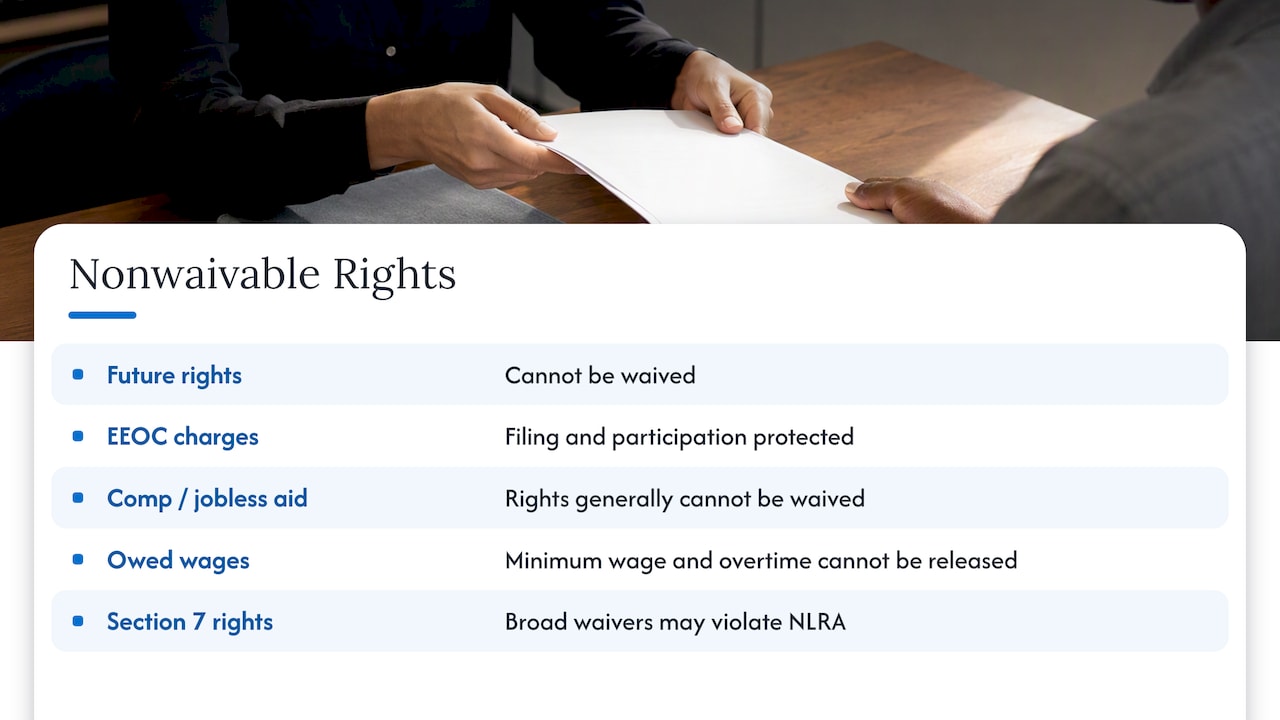
The National Labor Relations Board has also acted on this. In its McLaren Macomb decision, the Board ruled that an employer may violate the National Labor Relations Act simply by offering a severance agreement that broadly waives employees’ Section 7 rights, including through sweeping confidentiality or nondisparagement terms. The General Counsel’s guidance says confidentiality, nondisclosure and nondisparagement provisions can unlawfully interfere with protected activity or access to the Board, while narrower agreements may still be lawful. Enforcement priorities can shift between administrations, so treat this as a reason to question broad gag language, and ask an attorney how it applies to your situation.
Review and revocation time if you are 40 or older
If you are 40 or older and the release covers age discrimination claims, the Older Workers Benefit Protection Act sets specific rules. Under the federal regulation as published by the EEOC, the agreement must be written in plain language, refer expressly to the Age Discrimination in Employment Act, advise you in writing to consult an attorney, give you additional consideration, and not waive future claims. You generally must also receive:
| Situation | Time to consider | Time to revoke after signing |
|---|---|---|
| Individual separation | At least 21 days | At least 7 days |
| Group exit incentive or termination program | At least 45 days | At least 7 days |
The EEOC’s reproduction of 29 C.F.R. § 1625.22 states that the revocation period cannot be shortened. You may sign early if you choose, but nobody may pressure you into giving up the review time. If a manager says the offer expires tomorrow, that is a signal to slow down and ask for the agreement in writing.
Workers under 40 have no federal minimum review period, but state law or the agreement itself may provide one. Ask for a reasonable time to review it anyway.
Class action waivers and arbitration clauses
Some severance agreements, and some employment agreements you signed earlier, include a promise not to join a class or collective action. Legal Aid at Work notes that arbitration provisions often come with class action waivers that generally prevent you from bringing claims as part of a group lawsuit. For wage and hour problems that affect many coworkers, that can change how a claim can be brought, because individual claims are often too small to pursue alone.
There is one clear federal exception. According to Practical Law, the Ending Forced Arbitration of Sexual Assault and Sexual Harassment Act makes mandatory arbitration and joint-action waivers unenforceable for sexual assault and sexual harassment disputes, unless the person making the claim chooses to use them. Outside that, enforceability depends on the wording and on state law.
What to do about it:
- Look for the words “arbitration,” “class,” “collective,” “representative” and “jury trial.”
- Ask whether the clause replaces an agreement you already signed, or adds to it.
- Ask HR to remove it. It costs the employer little to agree when it has no live dispute with you.
- Have an attorney explain how it affects any wage, discrimination or retaliation claim you may have.
Other terms to read closely
Beyond the money and the release, check the clauses that shape your next job:
- Non-compete and non-solicitation. Ask for the scope, length and geography, and whether they were already in your contract.
- Nondisparagement and confidentiality. Make sure they do not bar you from speaking to government agencies or discussing working conditions. Our guide to negotiating non-disparagement clauses explains what you can still say.
- Cooperation clauses. These can require you to help with future legal matters. Ask who pays your time and expenses.
- Benefits end dates. Confirm when health coverage stops and what happens to bonuses, accrued paid time off and equity.
- References and the reason for departure. Get the agreed wording in writing.
- Payment structure. A lump sum and installments are not the same. Installments can stop if the employer claims you breached the agreement.
If the document is called a last chance agreement rather than a severance agreement, the stakes are different. Read what to know before waiving EEOC rights first.
How to negotiate your severance package
Many people sign the first offer because they fear it will be withdrawn. Most offers can be improved, though there are limits. A former HR leader interviewed by Business Insider said employees should focus on three or four priority terms with a clear reason for each, and that large standardized layoffs may leave less room for exceptions.
CNBC’s guidance lists the kinds of requests that tend to be reasonable: more pay if you are a high performer, in a senior role, or expecting a bonus, a lump sum versus installments, extended health coverage or other benefits, and a payout of unused paid time off. It also advises making a specific, concise request to HR and raising it in the first conversation or within a day or two.
A practical approach:
- Ask for the full agreement in writing and time to review it. Do not sign in the meeting.
- List what matters most. Extra weeks of pay, health coverage through a specific date, a narrower non-compete, mutual nondisparagement, a neutral reference.
- Tie each request to a fact. Tenure, performance reviews, a pending bonus, a project you led.
- Send a short written proposal. Keep it polite and specific. Do not threaten.
- Get every promise into the final document. A verbal assurance from a manager is not part of the contract.
- Have an employment attorney review it before you sign. Many offer a short initial consultation, and our attorney resources can help you start looking.
Senior employees negotiating bonuses, equity and clawback terms face a more complex picture. A guide to signing bonus and clawback negotiation covers how executives approach those specific terms.
Our perspective
We built Workplace Fairness on a simple idea: workers make better decisions when they understand the rules, and the rules are easier to understand when professionals and ordinary people explain them together. Severance is a clear example of why.
An employee who has just lost a job is often anxious, short on income and handed a dense legal document with a deadline. That imbalance is real. The employer has lawyers and a template. The employee has a few days and a mortgage. The law answers part of that imbalance with review periods, limits on waivers and protection for agency complaints, but those protections only help people who know they exist.
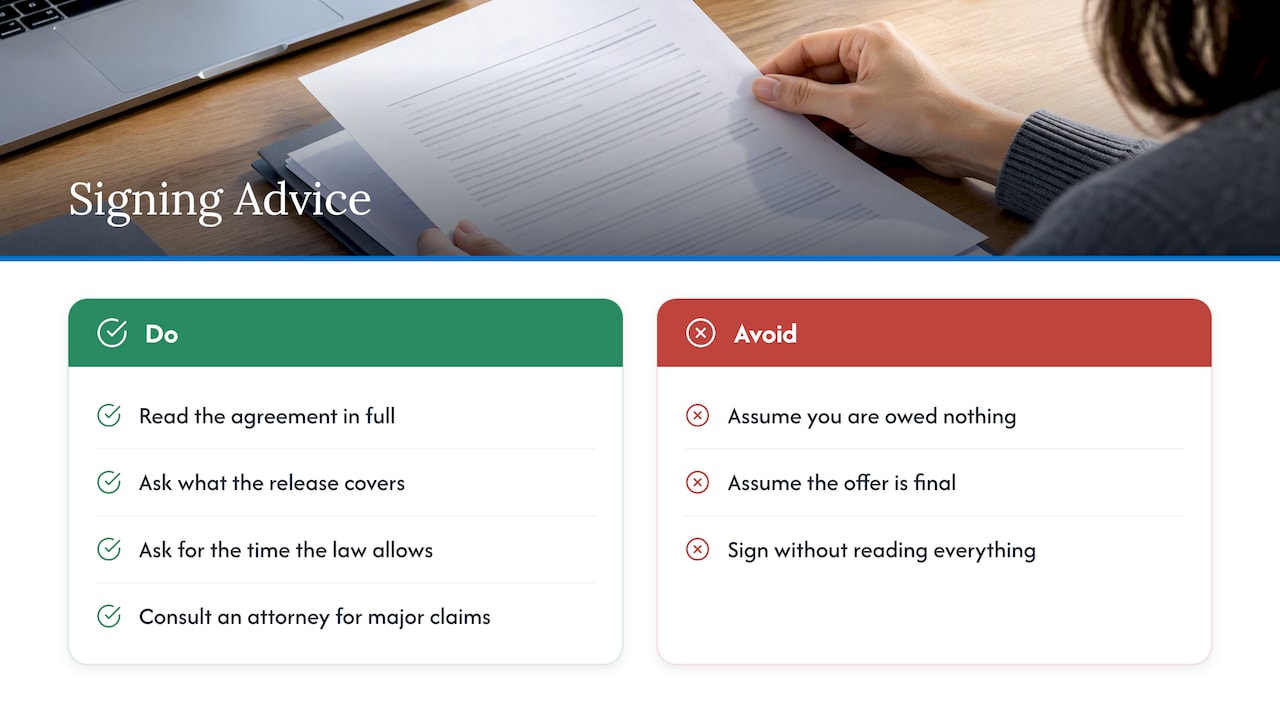
Our advice is steady and modest. Do not assume you are owed nothing, and do not assume the offer is final. Do not sign anything that you have not read in full. Ask what the release covers, and ask for the time the law gives you. When the stakes are large, such as a possible discrimination or retaliation claim, speak to an employment attorney before you sign, because you cannot undo a release afterward. Equitable workplaces are built one informed decision at a time, and this is one of those decisions.
— Max
Keep learning, and support this work
Workplace Fairness provides free, plain-language information about employee rights, and our resources depend on the people who value them. If this guide helped, consider a Workplace Fairness membership, which starts at $25 per year. You can also browse our employee rights guide or learn how to file an EEOC charge and meet its deadlines.
FAQ
Can I be fired and get no severance at all?
Yes, in most cases. Federal law does not require severance, so it depends on your contract, a company policy or plan, or a union agreement. Check those documents first, because an employer generally must honor severance that it promised.
Can I still file an EEOC charge after signing a severance agreement?
Yes. The EEOC states that an agreement cannot stop you from filing a charge or taking part in an investigation. What you may give up is the right to recover money or sue over the claims you released, so talk to an attorney before signing if you believe you were discriminated against.
How long do I have to decide whether to sign?
If you are 40 or older and the release covers age claims, you generally get at least 21 days to consider, or 45 days in a group termination program, plus at least 7 days to revoke after you sign. Younger workers may have less time under federal law, so ask for a reasonable period in writing.
Can I negotiate a severance package?
Often you can. Pay, health coverage, payout of unused time off, the scope of restrictive covenants and the wording of references are common requests. Large standardized layoffs leave less flexibility, so pick a few priorities and explain why each is fair.
Sources
- Severance Pay, U.S. Department of Labor
- FLSA Advisor, U.S. Department of Labor
- Key Considerations When Terminating an Employee, Venable
- Rule of 70 definition, Law Insider
- Severance & Separation Benefits benchmark study, 2020
- Severance Agreement and Release of Claims, Legal Aid at Work
- Understanding Waivers of Discrimination Claims in Employee Severance Agreements, EEOC
- Board Rules that Employers May Not Offer Severance Agreements Requiring Broad Waivers, NLRB
- NLRB General Counsel Memo on Severance Agreements
- Waivers and Claims under the ADEA, 29 C.F.R. § 1625.22, EEOC
- Employment Arbitration Toolkit, Practical Law
- What to negotiate in a layoff from your job, CNBC
- How and When to Negotiate Severance, Business Insider