
An adverse action notice is a legally required communication telling a consumer or job applicant that a credit, employment, or service decision went against them because of information in a consumer report. Creditors and users of consumer reports, including most employers, must send one under the Equal Credit Opportunity Act’s Regulation B and the Fair Credit Reporting Act. The Consumer Financial Protection Bureau, the Federal Trade Commission, and the Equal Employment Opportunity Commission all enforce different pieces of this requirement.
TL;DR:
- A creditor must send an adverse action notice within 30 days of receiving an application or taking action on an existing account.
- Employers must provide a pre-adverse notice with the consumer report and rights, allowing at least five business days for response before final decision.
- Notices must include specific details such as the action taken, the reporting agency’s contact info, and the reasons that influenced the decision, especially when a credit score is involved.
- Skipping the pre-adverse step or relying on vague, checklist-style reasons exposes employers and creditors to legal risks.
- Recipients should request their free report within 60 days, dispute inaccuracies, and report suspicious or discriminatory notices to authorities if needed.
Table of Contents
- What is an adverse action notice: legal definition and common use cases
- When must a notice be sent: timing rules for creditors and employers
- What must be included in an adverse action notice
- Pre-adverse action for employers: a step-by-step compliance checklist
- How to respond if you receive an adverse action notice
- Common compliance pitfalls that expose employers to risk
- A publisher’s perspective on clear notices and worker protection
- Getting help with an adverse action notice
- Primary sources: regulations and official guidance
- Sources
- FAQ
What is an adverse action notice: legal definition and common use cases
Adverse action, under the Equal Credit Opportunity Act’s Regulation B, describes a decision that denies, revokes, or changes the terms of credit. When that decision relies on a consumer report, the Fair Credit Reporting Act layers on its own notice duties, whether the report shaped a lending decision, a hiring choice, or an insurance quote. The two laws work together: Reg B defines the credit-specific obligation, and the FCRA governs any use of a third-party consumer report, regardless of the setting.
Recognizing adverse action starts with recognizing its everyday forms:
- A lender denies a loan or credit card application, or approves it on worse terms than requested.
- A landlord or insurer declines an application after pulling a background or credit file.
- An employer withdraws a job offer, denies a promotion, or ends employment based on a background check.
Anyone who requests and relies on a consumer report to make one of these calls, sometimes called a “user” of the report, inherits the notice obligation. A creditor is any business extending credit in the ordinary course, and an employer running background checks through a third-party consumer reporting agency counts as a user under the FCRA even when no credit is involved.
When must a notice be sent: timing rules for creditors and employers
Timing separates a compliant notice from a legal exposure, and the rules differ by context.
- Credit decisions. Under Regulation B, a creditor must notify an applicant of action taken within 30 days of receiving a completed application, or within 30 days of taking adverse action on an existing account.
- Employment decisions. The FCRA requires a two-step process: a pre-adverse action notice, including a copy of the consumer report and a Summary of Rights, must go out before any final decision, followed by a separate final adverse action notice afterward. Employers commonly allow a reasonable window, often at least five business days, for the applicant to respond before finalizing anything.
- Consumer response window. Once a notice arrives, the recipient can request a free copy of their report within 60 days and dispute anything inaccurate.
That 60-day window matters because it is often the only chance to catch an error before it resurfaces in a future application. Employers who skip the pre-adverse step, and simply send a final notice, are one of the most common sources of FCRA liability, since the law treats the pre-adverse notice as a mandatory pause, not a courtesy.
What must be included in an adverse action notice
A compliant notice is not a form letter with blanks filled in. It has to name specifics.
- A clear statement of the action taken (denial, termination, revocation, or a change in terms).
- The name, address, and contact information of the consumer reporting agency that supplied the report.
- A statement that the CRA did not make the decision and cannot explain the reasons for it.
- Notice of the right to a free copy of the report within 60 days and the right to dispute inaccurate information.
- The consumer’s credit score, when one was used, along with the key factors that affected it.
- For credit decisions, the ECOA notice identifying the enforcing federal agency, typically the CFPB.
The CFPB has warned creditors and employers that they cannot rely on generic, checklist-style reasons drawn from sample forms when those reasons do not reflect what actually drove the decision, a rule that applies with equal force to algorithm-based scoring models. That guidance, laid out in Consumer Financial Protection Circular 2023-03, closes a loophole some businesses used to avoid disclosing the real principal reasons behind a denial. Notices can be delivered in writing or electronically, and orally in narrow circumstances, and the CFPB’s Regulation B Appendix C sample forms remain a useful starting template, provided they are edited to match the actual reasons for the decision rather than copied wholesale.
Pre-adverse action for employers: a step-by-step compliance checklist
Employers using background checks to screen candidates follow a sequence the FCRA lays out in two distinct stages, and skipping either one creates legal risk.
- Send the pre-adverse action notice. Include a copy of the consumer report itself and a copy of the Summary of Rights, then give the candidate a reasonable opportunity to respond, typically at least five business days, before moving forward.
- Review any response. If the candidate disputes something or provides context, especially around a criminal record, document the review and complete an individualized assessment rather than relying on the report alone.
- Send the final adverse action notice. Once the decision is made, provide the CRA’s name and contact information, a statement that the CRA did not make the decision, and notice of the right to dispute and to request a free report within 60 days.
Pro Tip: Keep a written record of every candidate response and the reasoning behind the final decision. That file is often the deciding factor in whether a dispute stays a conversation or becomes a claim.
Employers weighing criminal history should treat the EEOC’s guidance on arrest and conviction records as a companion to FCRA process, not a separate concern, since both frameworks converge on the same point: a mechanical denial without individualized review invites legal exposure. Readers curious about how far employer screening can reach should see this guide on workplace privacy and background-check boundaries.
How to respond if you receive an adverse action notice
Getting one of these notices is unsettling, but the response window is short and the steps are concrete.
- Request your free report from the named consumer reporting agency within 60 days, and ask for the Summary of Your Rights if it was not included.
- File a dispute directly with the CRA, attaching any supporting documents, and follow up with the employer or creditor if the disputed information affected their decision.
- Watch for signs of a deeper problem: a vague or missing statement of reasons, no mention of your dispute rights, or a pattern that suggests your race, age, disability, or another protected trait factored into the outcome.
- If the notice looks incomplete or the reasoning feels discriminatory, contact the FTC, the CFPB, or the EEOC, or consult an employment attorney.
Readers who suspect their former employer’s account of events does not match reality may also want to review this guide on what a former employer says in references, since inaccurate references sometimes surface in the same background check that triggered the notice.
Common compliance pitfalls that expose employers to risk
Several recurring mistakes turn a routine screening decision into a legal problem.
- Relying on an algorithm or scoring model as an excuse for vague reasoning: the CFPB’s circular makes clear that automated decisions still require specific, accurate principal reasons.
- Copying a sample checklist reason without editing it to reflect what genuinely drove the decision, a shortcut regulators have flagged repeatedly.
- Treating an arrest record the same as a conviction: the EEOC’s guidance states that an arrest alone is not sufficient grounds for adverse action, and an individualized, job-related assessment is expected instead.
- Sending only a final notice and skipping the pre-adverse stage entirely, which removes the applicant’s chance to correct an error before the decision is locked in.
Pro Tip: Before finalizing any adverse decision tied to a background check, ask whether the stated reason would survive being read aloud to the candidate. If it would not, it is probably too vague to meet the legal standard.
A publisher’s perspective on clear notices and worker protection
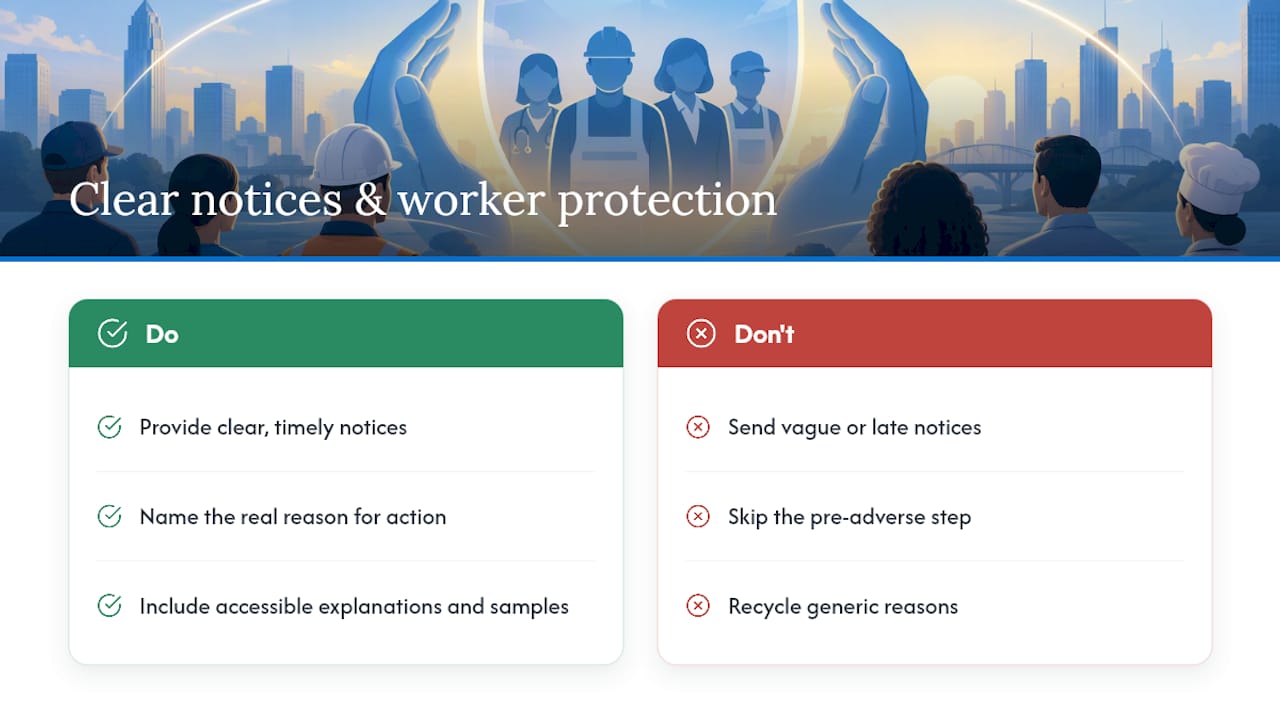
An organization was founded in 1994, originally as the National Employee Rights Institute, with a mission built on connecting the knowledge of employment rights attorneys to workers who need plain answers, not legal jargon. That mission shapes how we think about adverse action notices: a vague or late notice is not a technicality, it is a barrier that keeps someone from correcting an error that could follow them into their next job search or loan application.
Clear notices matter because they are often the only signal a worker gets that something in their record needs a second look. When an employer skips the pre-adverse step, or a creditor recycles a generic reason instead of naming the real one, the person on the other end loses the chance to fix a mistake before it does lasting damage. Accessible explanations, sample letters, and straightforward guides close that gap, and they are the reason resources like some organizations exist alongside the federal rules.
— Max
Getting help with an adverse action notice
Some organizations offer free guides and explanatory resources built specifically for readers navigating a confusing notice, whether it involves credit, employment, or a service denial. These libraries cover the practical side of these situations, including how references and background checks interact with hiring decisions, and what protections exist against unlawful discrimination.
If your situation calls for more than general information, our attorney directory connects you with employment lawyers who can review your specific notice. Readers who want to support this work directly, or access additional member resources, can explore Workplace Fairness membership starting at $25 per year.
- Review our guide on filing a discrimination complaint if your notice suggests bias played a role.
- Browse workplace rights every new employee should know for broader context beyond adverse action.
- Visit Workplace Fairness to start with our free resources.
Primary sources: regulations and official guidance
- Regulation B, 12 CFR 1002.9: the statutory notification standards and sample forms.
- CFPB Circular 2023-03: guidance on specificity and algorithmic decisions.
- FTC guidance on adverse action notices: creditor obligations explained plainly.
- EEOC background check guidance: the employer-facing two-step process.
This article is general information, not a substitute for advice from a qualified lawyer. Consult a qualified legal professional about your own circumstances before acting on anything here.
Sources
- Consumer Financial Protection Circular 2023-03: Adverse action notification requirements and the proper use of the CFPB’s sample forms provided in Regulation B
- Background checks: what employers need to know | EEOC
- Using consumer reports for credit decisions: what to know about adverse action and risk-based pricing notices | FTC
- Free credit reports | FTC consumer information
FAQ
Why am I getting an adverse action notice?
You are receiving one because a creditor, employer, or other business made a decision against you, such as a denial, termination, or unfavorable change in terms, based partly or entirely on a consumer report. The notice is required by law so you know why and can correct any errors involved.
What must be included in an adverse action notice under Regulation B?
A compliant notice names the specific action taken, identifies the consumer reporting agency, states that the agency did not make the decision, and explains the right to a free report and to dispute inaccuracies, all detailed in FTC guidance on consumer reports. When a credit score influenced the outcome, it must be disclosed along with the key contributing factors.
What federal law requires the notice of adverse action?
The Equal Credit Opportunity Act, through its implementing Regulation B, requires notice for credit-related adverse action, while the Fair Credit Reporting Act requires notice whenever a consumer report factors into any adverse decision, including employment. The CFPB and FTC share enforcement of these overlapping duties, with the EEOC handling the discrimination dimension in employment settings.