If you work in the private sector in the United States, federal law gives you the right to talk with coworkers about forming a union, to sign cards, to ask for a vote, and to do all of it without being fired, demoted, threatened or spied on. The National Labor Relations Act (NLRA) is the source of those protections, and the National Labor Relations Board (NLRB) enforces them. This guide explains what you may do, what your employer may and may not do, how a union actually gets formed, and what to do in the first days after something goes wrong.
TL;DR
- Most private-sector employees have the right to form, join or assist a union, and to act together with coworkers for mutual aid or protection, even without a union.
- Employers may share their views on unions, but they may not threaten, interrogate, spy on, or promise benefits to discourage organizing. Firing or disciplining someone for union activity is illegal.
- A union can be recognized voluntarily or through an NLRB election. An election requires a showing of interest from at least 30% of employees, and a win takes 50% plus one of the votes cast.
- Charges of unfair labor practices must be filed and served within six months of the event. Do not wait.
Table of Contents
- What the law actually guarantees
- What employers can and cannot do during a campaign
- How a union gets formed
- Your Weingarten rights in investigatory meetings
- When something goes wrong: filing a charge
- Our perspective
- Support the work behind this guide
- FAQ
- Sources
What the law actually guarantees
The heart of the law is Section 7 of the NLRA. It protects employees’ right to organize, to form, join or assist labor organizations, to bargain collectively through representatives of their own choosing, and to engage in other concerted activity for mutual aid or protection. The NLRB’s overview of Section 7 and Section 8(a)(1) also makes clear that the right includes the choice to refrain from union activity.
In practice, the NLRB says your rights include organizing a union to negotiate with your employer over terms and conditions of employment, and distributing union literature and wearing union insignia, subject to certain limits. You may also ask coworkers to sign authorization cards and discuss wages, hours and working conditions with each other. Those are the activities most often cut off by employers, and most often found unlawful when they are.
Who is covered
The NLRA covers most private-sector employees. Some groups fall under different rules, including federal employees, many state and local government workers, and supervisors. If you are unsure which law applies to you, start with the Department of Labor’s plain-language pages on what a union is and forming a union at a non-union workplace.
Protected concerted activity: you do not need a union to be protected
Many workers assume the law only helps once a union exists. It does not. Activity is “concerted” when it is done with or on the authority of other employees, and “protected” when it concerns your interests as employees. Two coworkers who raise a safety concern together, or a group that signs a letter asking for a schedule change, can be protected. We explain how this connects to remedies such as back pay in our guide to protected concerted activity rights, and how employer-imposed changes can matter in change in working conditions.
Because most U.S. employment is at will, many people believe they can be dismissed for any reason. That is not true when the reason is protected activity. Our page on at-will employment rights lays out the exceptions.
What employers can and cannot do during a campaign
Employers have rights too, and knowing where the line sits helps you recognize a violation. An employer may tell employees what it thinks about unions, as long as it does not threaten them or promise rewards. The NLRB’s guidance lists what is off limits: employers cannot spy on, coercively question, photograph, or bribe employees regarding union activity.
| Employer conduct | Generally lawful | Generally unlawful |
|---|---|---|
| Speech | Sharing opinions about unions without threats or promises | Threatening to close the workplace if employees organize |
| Pay and benefits | Continuing planned changes as scheduled | Withholding promised wage changes because of the union drive |
| Conversations | Enforcing consistent rules about work-time talk | Banning talk about the union while allowing other non-work discussions |
| Observation | Seeing what is openly visible at work | Spying on, photographing, or coercively questioning employees about union activity |
| Discipline | Discipline for legitimate, consistently enforced reasons | Firing, demoting or penalizing someone for union activity |
The examples in the middle column come from general NLRA principles; the examples in the right-hand column are drawn from the NLRB’s guidance on interference with employee rights. The NLRB’s page on discrimination because of union activities covers firing and other discipline in more detail.
Is union busting illegal?
The term “union busting” is not a legal category, but much of what it describes is unlawful. Threats, surveillance, interrogations, promises of benefits, and retaliation against organizers are unfair labor practices. Some tactics are legal even when they feel hostile, such as an employer holding meetings to argue against the union. The test is whether the conduct interferes with, restrains or coerces employees in exercising their rights. If the answer might be yes, document it and talk to the NLRB.
There is also a related issue many organizers overlook: employers sometimes use outside consultants or messaging campaigns to shape the debate. Our piece on shilling on the corporate dollar looks at that dynamic. Technology matters too, since monitoring can chill organizing. See our overview of workplace surveillance rights.
How a union gets formed
There are two main routes, and the Department of Labor’s worker.gov page on forming a union describes both.
- Voluntary recognition. If a majority of employees sign authorization cards, the employer may choose to recognize the union without an election.
- An NLRB election. If the employer does not recognize the union, employees can petition the NLRB. That requires showing support from at least 30% of the employees in the proposed group, through cards or a petition. The NLRB then conducts a secret-ballot vote.
If the union wins at least 50% plus one of the votes cast, the employer is required by law to bargain in good faith. Note the phrase “votes cast”: the count is of those who vote, not of everyone eligible.
A practical path for starting a union
The law sets the minimum. Organizers who have done this work stress that a bare majority is rarely enough on its own. According to guidance from workerorganizing.org, successful campaigns rely on deep one-on-one conversations and an organizing committee that reflects the diversity of the workplace, so the effort can withstand the anti-union pressure that tends to follow. In plain steps:
- Start with a few trusted coworkers. Talk about shared problems, such as pay, scheduling, safety or favoritism, before you talk about a union.
- Build a committee that looks like the workplace. Include different shifts, departments, roles and backgrounds. A committee that mirrors the workforce is harder to dismiss as a small faction.
- Talk off the clock and away from work systems. Do your organizing in non-work time and in non-work areas, and avoid employer email or devices for sensitive conversations.
- Choose a union or an organizing support partner. Many workers contact an established union. You can also consult the DOL’s resources for workers.
- Collect authorization cards. Aim well above the minimum, because some support will fade under pressure.
- Decide on recognition or an election. Your union representative and the NLRB regional office can explain the process for your situation.
- Prepare for the response. Know the lines in the table above, and keep notes of anything that crosses them.
What about “right to work” states?
Right-to-work laws do not stop you from organizing, and they do not change your NLRA rights. They affect whether a union and employer can require workers to pay union fees as a condition of employment. More than two dozen states have such laws. Our guide to what right to work means walks through how it works in practice, and our comparison of union and non-union pay helps you weigh what to check before you sign a card.
Your Weingarten rights in investigatory meetings
Once a union represents workers, a different protection applies. Under the NLRB’s Weingarten rights guidance, a represented employee can ask for a representative during an investigatory interview that the employee reasonably believes could lead to discipline. The representative may be a steward, a union agent, or sometimes a fellow employee, and is more than a silent observer. They can ask the employer to clarify questions, advise you, and add information after questioning. They cannot tell you to lie or obstruct a legitimate investigation.
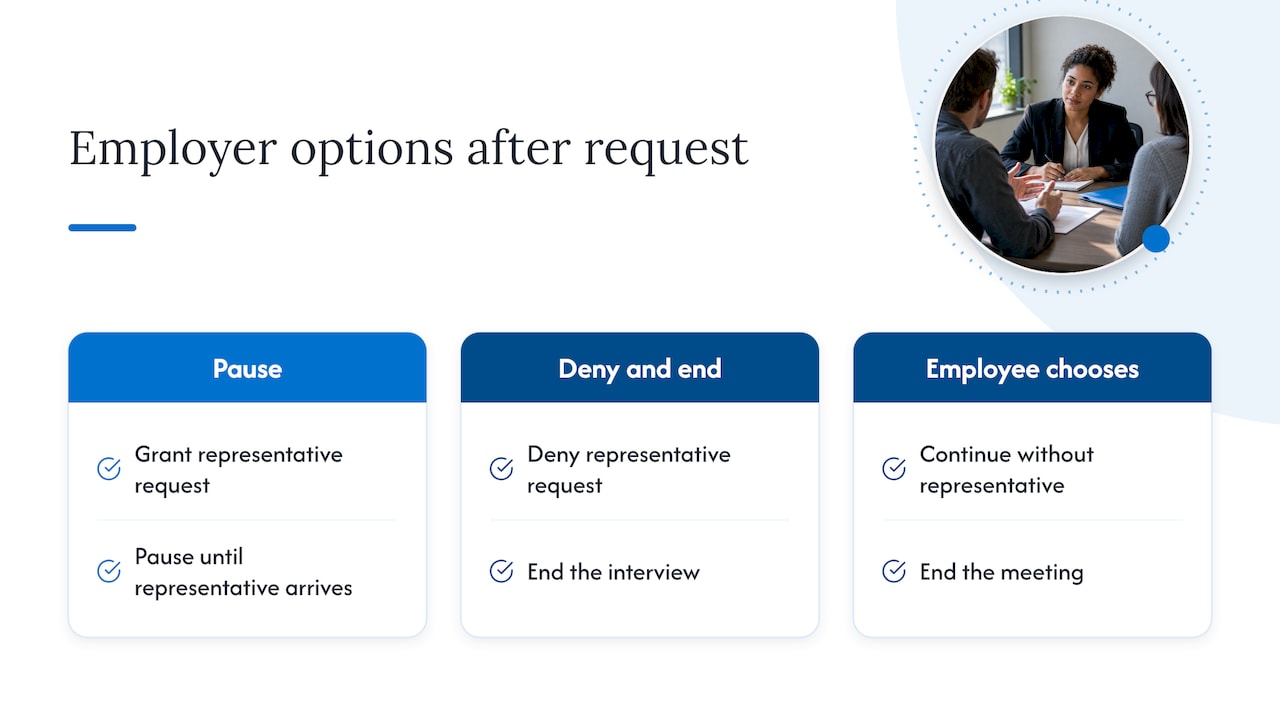
When you make the request, the employer has three lawful options: grant it and pause until the representative arrives, deny it and end the interview, or give you the choice between going on without a representative and ending the meeting. Continuing to question you after a clear request is the costly mistake that produces unfair labor practice charges.
A point that surprises many people: these rights currently apply to union-represented employees. Whether they should extend to non-union workplaces remains an active legal debate, so do not assume you have them before a union is certified.
When something goes wrong: filing a charge
If you believe your employer has crossed a line, you can file an unfair labor practice charge with the NLRB. Our page on what a labor board charge is explains the basics. A few rules matter most.
- Six months is the limit. The NLRB can only issue a complaint on charges that are filed and served within six months of the event. Missing the window by even a day bars the agency from processing the charge.
- Call a regional office first. The NLRB advises people to work with an Information Officer, who can answer questions about the form or draft the charge for you. That helps avoid mistakes that lead to dismissal or delay, like giving too much evidence or naming the wrong worksite.
- File where the event happened. A charge that an employer unlawfully discharged someone is usually filed with the Regional office with jurisdiction over the worksite.
- Keep records. Write down dates, times, names, witnesses and exact words as soon as possible. Save texts, schedules and notices.
If an election has already been held, the NLRB may set aside the result when a party commits objectionable conduct that may have affected the outcome. That is a separate path from an individual charge, and a union representative or the regional office can explain which applies.
Our perspective
We have spent three decades connecting the knowledge of employment rights attorneys with the people who most need it. Founded in 1994 as the National Employee Rights Institute, we changed our name in 2001 to reflect that broader mission: linking legal knowledge with workers and organizations who care about fairness on the job.
What we see in the questions workers bring is a gap between legal rights and lived experience. The law says you may organize. It is harder to feel that when a manager calls you into an office. Rights on paper are only a foundation. They become real when workers know them, talk to one another, and act within the deadlines.
We also believe the choice belongs to you. Some workers will conclude after reading the facts that a union is right for them. Others will weigh the costs and decide differently. Either way, you deserve accurate, jargon-free information, and no one should face retaliation for asking the question.
Our advice is simple. Learn the rules before the conversation starts. Document as you go. Contact the NLRB early, and consult an employment or labor attorney if you are facing discipline. Equitable workplaces are built by people who know their protections and use them together.
— Max
Support the work behind this guide
This guide is free, and we want it to stay that way. If it helped, you can support our plain-language resources through a Workplace Fairness membership, which starts at $25 per year. You can also browse more guides on our homepage, including our overview of common work issues.
FAQ
Can a company fire you for organizing a union?
No. The NLRA makes it unlawful for an employer to fire, demote or otherwise penalize employees for exercising their right to organize. If it happens, you can file a charge with the NLRB, and you must do so within six months of the event. Contact a regional office or an employment attorney quickly.
Do I need a union to be protected when I act with coworkers?
No. Section 7 protects concerted activity for mutual aid or protection, even where no union exists. The activity generally has to involve or be on behalf of other employees and concern your work conditions. A purely personal complaint may not qualify.
What can an employer say during a union campaign?
An employer may share its views about unions as long as it does not threaten employees or make promises tied to the vote. It cannot spy on you, coercively question you, photograph you for union activity, or bribe you. When in doubt, write down what was said and by whom.
Do Weingarten rights apply if my workplace is not unionized?
Currently, Weingarten rights apply to union-represented employees. Whether they should extend to non-union workplaces is still debated. If you are called into a meeting that could lead to discipline, stay calm, ask questions about its purpose, and seek advice afterward.
How many employees must support a union before an election?
The NLRB process requires a showing of interest from at least 30% of employees in the proposed unit. To win, the union needs at least 50% plus one of the votes cast. Organizers usually collect far more than 30% before filing.
Sources
- Your Rights during Union Organizing, NLRB
- Interfering with employee rights (Section 7 & 8(a)(1)), NLRB
- Discriminating against employees because of their union activities, NLRB
- Weingarten Rights, NLRB
- Election-related content, NLRB
- Charge filing information, NLRB
- Charge cover information, NLRB
- Form a union, U.S. Department of Labor, worker.gov
- What is a union, U.S. Department of Labor
- Forming a union at a non-union workplace, U.S. Department of Labor
- How to start a union at work, workerorganizing.org